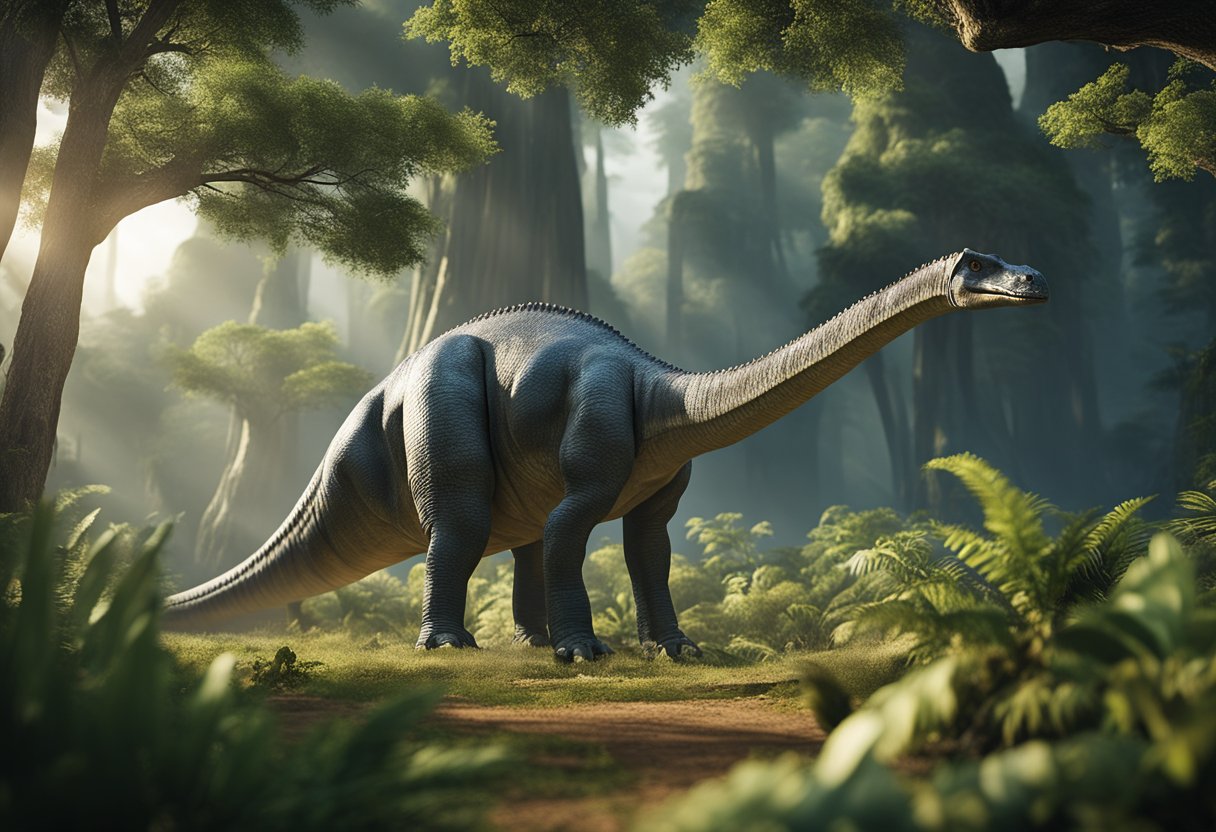
Alamosaurus is the only known genus of titanosaurian sauropod that lived in North America during the Late Cretaceous period, approximately 70 to 66 million years ago. Reaching estimated lengths of up to 30 meters and weighing over 70 metric tons, it stands as one of the largest land animals to ever inhabit the continent, representing the final lineage of long-necked giants before the K-Pg extinction.
Taxonomy and Discovery History
The discovery of Alamosaurus sanjuanensis remains a pivotal chapter in North American paleontology. Unlike many of its famous sauropod relatives like Diplodocus or Brontosaurus, which dominated the Jurassic landscape, Alamosaurus appeared much later. For a long time, scientists believed sauropods had gone extinct in North America during the Early Cretaceous, creating what was known as the "sauropod hiatus." The discovery of Alamosaurus proved that these giants returned or persisted in the southern reaches of the continent until the very end of the Age of Dinosaurs.
The Ojo Alamo Formation
The genus was first described by paleontologist Charles W. Gilmore in 1922. A common misconception is that the dinosaur was named after the famous Alamo Mission in San Antonio, Texas. In reality, the name is derived from the Ojo Alamo Formation in San Juan County, New Mexico, where the first specimens—a scapula and an ischium—were unearthed. The species name, sanjuanensis, also pays homage to its discovery site in San Juan County.
Classification and Evolution
Alamosaurus is classified within the Titanosauria, a diverse group of sauropods that flourished globally during the Cretaceous. Specifically, it is often placed within the family Saltasauridae or the more inclusive clade Lithostrotia. Its presence in North America during the Maastrichtian stage suggests a faunal interchange. Most researchers believe its ancestors migrated from South America, where titanosaurs were the dominant herbivores, across a temporary land bridge or island chain into what is now the Southwestern United States.
Physical Characteristics and Morphology
To understand the sheer scale of Alamosaurus, one must look at the biomechanical requirements of an animal of its size. As a titanosaur, it possessed a body plan optimized for weight distribution and high-efficiency browsing.
Skeletal Structure
The skeleton of Alamosaurus was a marvel of biological engineering. Like other titanosaurs, its vertebrae were "pneumatized," meaning they contained numerous air-filled pockets. This evolutionary trait significantly reduced the weight of the massive neck and spine without compromising structural integrity. Its limbs were pillar-like, with the humerus and femur showing extreme thickness to support dozens of tons of mass.
The Question of Dermal Armor
One of the defining features of many titanosaurids, such as Saltasaurus, was the presence of osteoderms—bony plates embedded in the skin that acted as armor. While direct evidence of osteoderms has not been conclusively found in direct association with Alamosaurus skeletons as of 2026, many paleontologists hypothesize that it may have possessed them, following the phylogenetic pattern of its closest relatives. This armor would have provided a secondary defense against the apex predators of its era.
Limb Proportions
Analysis of the limb bones suggests that Alamosaurus had a slightly more upright posture than earlier sauropods. Its front legs were relatively long compared to its hind legs, giving it a somewhat level or slightly upward-sloping back. This posture would have been advantageous for reaching high into the canopy of Cretaceous conifers and flowering trees.
Size Estimates: How Big Was Alamosaurus?
Determining the exact size of Alamosaurus has been a challenge because a complete, articulated skeleton has never been found. Instead, paleontologists rely on scaling fragments—such as massive individual vertebrae and limb bones—against more complete titanosaur relatives from South America.
Weight and Mass
Early estimates placed Alamosaurus in the range of 30 to 50 tons. However, more recent discoveries, including a massive cervical (neck) vertebra found in the Javelina Formation of Texas, have forced a radical upward revision. Contemporary research suggests that the largest individuals could have reached 60 to 80 metric tons. This puts Alamosaurus in the same weight class as the legendary Argentinosaurus and Patagotitan, potentially making it the heaviest dinosaur ever found in North America.
Length and Height
In terms of length, mature specimens are estimated to have reached 28 to 30 meters (92 to 98 feet). When standing in a neutral position, its head would have reached the height of a four-story building. These dimensions were not just for show; they allowed the animal to access food sources that were completely unreachable by other herbivores like Edmontosaurus or Torosaurus.
| Feature | Estimated Measurement |
|---|---|
| Maximum Length | 30 meters (98 feet) |
| Maximum Weight | 73,000 - 80,000 kg (80+ tons) |
| Shoulder Height | 6 - 7 meters (20 - 23 feet) |
| Time Period | 70 to 66 Million Years Ago (Maastrichtian) |
| Primary Location | Southwest USA (NM, TX, UT) |
| Diet | Herbivore (Browsing) |
Paleoecology: Life in the Late Cretaceous
The world Alamosaurus inhabited was vastly different from the lush, swampy environments often depicted in older dinosaur media. The southwestern part of North America during the Late Cretaceous consisted of semi-arid floodplains, coastal plains, and inland basins.
Geographic Range
Fossils of Alamosaurus have been recovered from several key geological formations:
- Ojo Alamo Formation (New Mexico): The type locality.
- Javelina Formation (Texas): Yielded some of the largest known specimens.
- North Horn Formation (Utah): Provides evidence of the northernmost extent of its range.
- Black Peaks Formation (Texas): Indicates its presence right up until the end of the Cretaceous.
Predator-Prey Dynamics
One of the most fascinating aspects of Alamosaurus ecology is its coexistence with Tyrannosaurus rex. In the Javelina and Ojo Alamo formations, the remains of these two titans are found in the same strata. This presents a dramatic picture of the Late Cretaceous: the largest terrestrial carnivore of all time living alongside one of the largest terrestrial herbivores.
While a fully grown Alamosaurus was likely immune to predation due to its sheer size, juveniles and sub-adults would have been primary targets for T. rex or packs of smaller dromaeosaurs. An adult Alamosaurus could have defended itself using its massive, whip-like tail or by simply using its bulk to crush an attacker.
Diet and Feeding Mechanics
As a high-level browser, Alamosaurus utilized its long neck to sweep across large areas of vegetation without moving its heavy body, a strategy that conserved vital energy. Its teeth were peg-like or shovel-shaped, designed for stripping leaves and needles rather than grinding. Like other sauropods, it likely swallowed its food whole, relying on a massive gut and potentially gastroliths (stomach stones) to break down tough plant matter through fermentation and mechanical processing.
Significant Fossil Finds and Specimens
The history of Alamosaurus research is a story of gradual discovery, with each new find adding a layer of complexity to our understanding of this giant.
The Perot Museum Specimen
One of the most significant finds in recent decades is the specimen housed at the Perot Museum of Nature and Science in Dallas, Texas. Discovered in the Big Bend National Park, this find included a series of articulated neck vertebrae. This specimen has been crucial for digital reconstruction, allowing researchers to model the range of motion in the neck and better estimate the animal's total mass.
The Big Bend Giants
Texas has proven to be the most fertile ground for Alamosaurus research. The fossils found in Big Bend National Park include some of the largest titanosaur bones ever discovered in the northern hemisphere. In 2011, a massive humerus (upper arm bone) was reported that dwarfed previous finds, suggesting that Alamosaurus continued to grow throughout its long life, reaching sizes that rivaled the South American giants.
The "Sauropod Hiatus" and Migration Theory
A major point of discussion in paleontology is why Alamosaurus is the only sauropod in North America at a time when the rest of the continent was dominated by duck-billed dinosaurs and horned dinosaurs.
- The Extinction: Sauropods largely disappeared from North American fossil records around 100 million years ago.
- The Gap: For nearly 30 million years, the continent lacked these long-necked giants.
- The Reintroduction: Alamosaurus appears suddenly in the fossil record around 70 million years ago.
- The Source: Biological similarities strongly suggest it originated from South American lineages that moved north when sea levels dropped or volcanic activity created a land bridge.
This migration theory is supported by the fact that Alamosaurus fossils are predominantly found in the southern parts of North America. They do not appear in the well-studied Northern formations like the Hell Creek Formation in Montana, suggesting they were restricted by climate or competition to the warmer, southern latitudes.
Frequently Asked Questions
Was Alamosaurus the biggest dinosaur?
While Alamosaurus was the largest dinosaur in North America during its time, it is generally considered slightly smaller than the absolute record-holders like Argentinosaurus or Maraapunisaurus. However, the largest Alamosaurus specimens found in Texas suggest it was a close contender, easily ranking within the top ten largest dinosaurs ever discovered.
Did Alamosaurus live at the same time as T. rex?
Yes. Alamosaurus and Tyrannosaurus rex coexisted in the southwestern United States during the Maastrichtian stage of the Late Cretaceous. They would have encountered each other in regions like modern-day Texas and New Mexico.
Why is it called "Alamo" saurus if it's not named after the fort?
The name comes from the Ojo Alamo Formation in New Mexico. "Ojo Alamo" means "Poplar Spring" in Spanish. The formation itself was named long before the dinosaur was discovered, and the dinosaur simply adopted the name of the rock layer where it was found.
What did Alamosaurus eat?
It was a strict herbivore. Its diet likely consisted of conifers, cycads, and early flowering plants (angiosperms). Its height allowed it to reach the tops of trees that other herbivores could not, reducing competition for food.
Could Alamosaurus breathe like a bird?
Current evidence suggests that titanosaurs like Alamosaurus had a respiratory system similar to modern birds, featuring a complex system of air sacs. This allowed for a highly efficient "one-way" breathing cycle, which was necessary to move oxygen through such a long neck and to help cool the animal's massive body.
Next Steps for Enthusiasts
For those looking to see Alamosaurus in person, a visit to the Perot Museum of Nature and Science in Dallas or the Smithsonian National Museum of Natural History in Washington, D.C., is highly recommended. These institutions house significant specimens and offer deep insights into the ongoing research regarding titanosaur biomechanics. As paleontology moves further into the 2020s, new CT scanning technologies and biomechanical modeling are expected to provide even more precise data on how these North American titans lived, moved, and eventually succumbed to the K-Pg mass extinction.