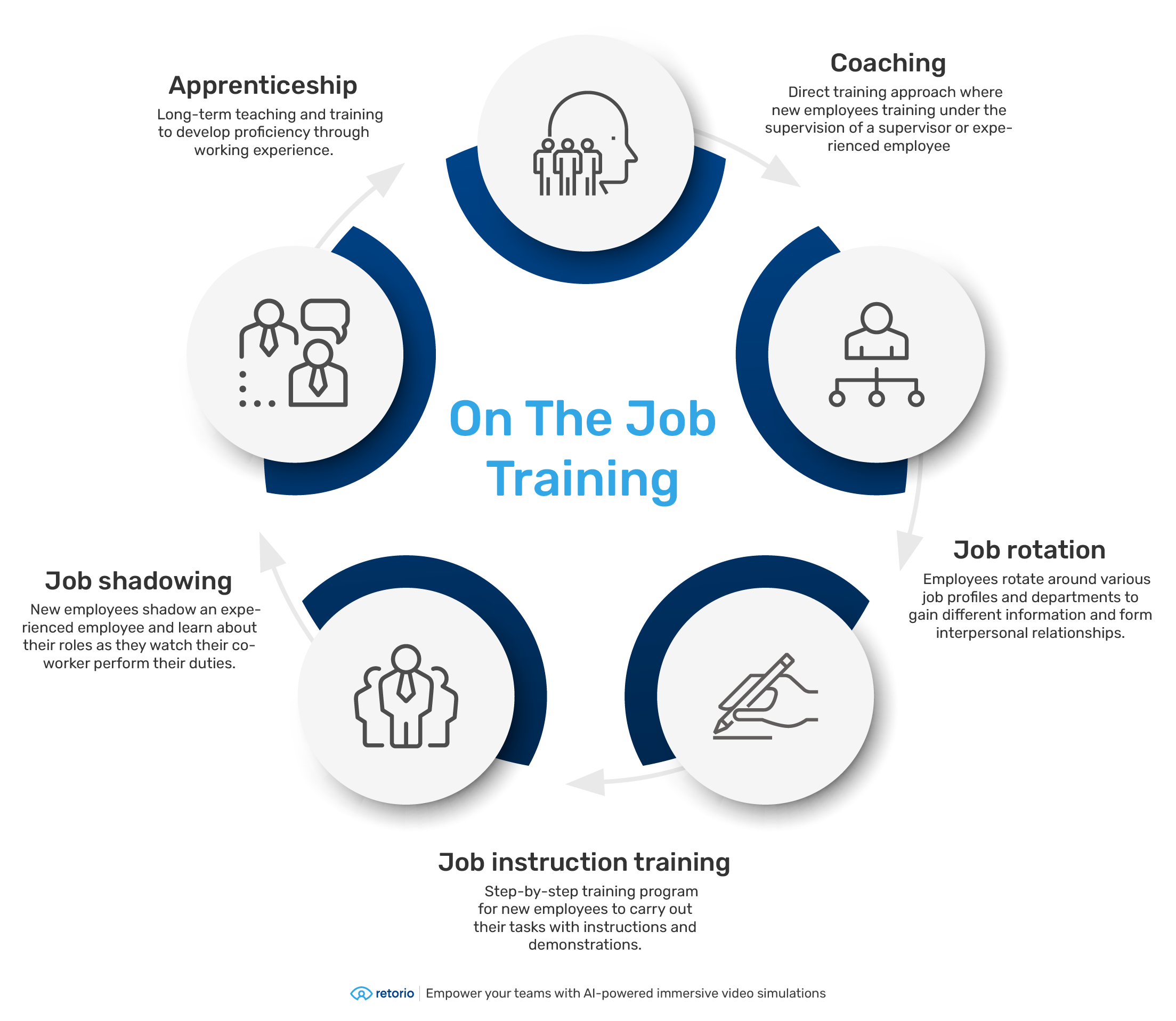
On-the-job training delivers practical, hands-on learning within the actual work environment, allowing employees to acquire role-specific skills while actively producing measurable output. It minimizes external instruction costs, accelerates time-to-productivity, improves knowledge retention through immediate contextual application, and fosters close alignment with proprietary company workflows, team dynamics, and organizational culture.
Understanding On-the-Job Training in Modern Operations
On-the-job training (OJT) is an operational learning method where workers acquire technical competencies, procedural knowledge, and operational habits while performing their actual job duties at the workplace. Rather than isolating learners in lecture halls, simulated environments, or disconnected digital learning modules, OJT grounds development in everyday workflows using genuine production tools, internal software, and actual client-facing scenarios.
Workplace learning research frequently emphasizes the 70-20-10 framework, developed by the Center for Creative Leadership. This evidence-based model posits that approximately 70 percent of professional development occurs through experiential, on-the-job tasks, 20 percent through developmental relationships and coaching, and only 10 percent through formal educational seminars or courses. OJT bridges the dominant 70 percent experiential band with the 20 percent social coaching band.
Historically viewed primarily as trade apprenticeships or industrial floor shadowing, OJT has evolved into a vital talent strategy across software engineering, healthcare administration, customer success, and technical consulting. To understand its value, organizations distinguish between two functional forms:
- Unstructured OJT: Informal job shadowing where a new hire observes a senior peer without a codified syllabus, performance checklist, or measurable milestones. While low in administrative friction, it frequently leads to inconsistent habits and gaps in compliance knowledge.
- Structured OJT (S-OJT): A planned, systematic process led by an experienced mentor using standardized training checklists, objective competency assessments, clear safety protocols, and defined evaluation rubrics.
When businesses invest in structured OJT, they unlock distinct advantages that benefit organizational bottom lines and individual career trajectories.
Primary Advantages of On-the-Job Training for Employers
Strategic workforce planning requires training methodologies that generate measurable returns on investment. For leadership teams and human resource directors, OJT offers major financial and operational advantages over traditional instructional methods.
1. Significant Cost Efficiency
Traditional corporate training programs carry substantial direct and indirect overhead expenses:
- External seminar enrollments and commercial course licenses.
- Third-party instructor retainers and travel fees.
- Off-site facility rentals, catering, and event logistics.
- Extended non-productive employee hours spent away from active operations.
OJT circumvents these expenses by transforming the operational workplace into the learning environment. The organization leverages existing physical infrastructure, active software subscriptions, and internal subject-matter experts. Because trainees perform operational tasks as they learn, the net cost of onboarding is partially offset by the output generated during the training window.
2. Immediate Operational Output and Faster Time-to-Productivity
Classroom instruction inherently creates a lag phase: employees spend days or weeks consuming theoretical concepts before executing a single practical task. When they finally transition to production, they often encounter a distinct gap between classroom simulations and daily operational realities.
OJT eliminates this transition delay. From early onboarding sessions, trainees execute basic tasks—such as processing standard support tickets, configuring basic development environments, or running standard diagnostic checks. Under mentor supervision, work completed by the trainee contributes directly to operational throughput. This hands-on immersion accelerates the timeline required for an employee to achieve full, autonomous productivity.
3. Precision Alignment with Proprietary Systems and Culture
Generic external courses teach industry broad-strokes, but they cannot teach an organization’s proprietary software architectures, specific standard operating procedures (SOPs), or internal communication norms. For instance, an off-the-shelf course on project management teaches general agile theory, but it cannot show an associate how your company manages cross-functional risk handoffs in enterprise enterprise-resource-planning (ERP) tools.
OJT ensures that every learned skill maps directly to the company's established tech stack, quality-assurance guidelines, regulatory controls, and customer expectations. Trainees internalize the exact methods, naming conventions, and escalation pathways required to succeed within that specific company.
4. Knowledge Retention and Institutional Memory Preservation
When veteran personnel retire or transition to other roles without systematic knowledge transfer, organizations suffer institutional amnesia. S-OJT creates an active pipeline where senior staff systematically transfer tacit knowledge—the unwritten, experience-based insights on how to handle edge cases, navigate legacy systems, and resolve production blockers—to rising staff.
This pairing also serves as leadership development for mentors. Supervising an OJT track strengthens the mentor’s delegation, diagnostic, and communication capabilities, preparing them for formal supervisory roles.
5. Increased Employee Retention and Lower Attrition
High early-stage turnover often stems from poor onboarding, ambiguous job expectations, and feelings of isolation. When organizations provide a structured mentor-mentee pairing on day one, trainees establish strong social bonds and receive clear, contextual guidance.
Employees who receive deliberate, practical investments in their professional capabilities are statistically more engaged and less likely to leave within their first 12 to 18 months. Transparent progression checkpoints give trainees a tangible sense of mastery, reducing the anxiety that typically accompanies new responsibilities.
Direct Advantages of On-the-Job Training for Employees
Employees, apprentices, and career changers gain clear professional advantages when training occurs within the actual workflow rather than an academic silo.
1. Higher Knowledge Retention Through Contextual Practice
Cognitive science demonstrates that passive auditory or text-based instruction results in steep forgetting curves unless immediately reinforced through practice. When individuals read a manual or watch a lecture, theoretical retention decays rapidly within 48 hours.
OJT applies the principle of contextual learning: trainees absorb an instruction, immediately execute it using actual tools, receive real-time corrective feedback, and repeat the task under varying conditions. This immediate synthesis converts short-term working memory into long-term procedural muscle memory, substantially boosting retention rates.
2. Earning While Learning Without Student Debt
Off-the-job certifications, vocational school modules, and specialized bootcamps often demand high tuition fees alongside unpaid study hours. OJT allows employees to earn their standard wages while simultaneously acquiring valuable technical skills.
This structure lowers the barrier to entry for candidates from varied socioeconomic backgrounds. It creates clear career pathways in technical trades, IT administration, clinical operations, and financial services, providing upward economic mobility without the burden of educational debt.
3. Real-Time Feedback and Low-Risk Iteration
In typical academic or off-site testing setups, learners only receive feedback days or weeks after submitting an assignment or taking an exam. If they misinterpret a core concept, they may reinforce improper techniques for weeks before an instructor notices.
Under structured OJT, a mentor observes execution in real time. If a trainee mistypes a code syntax, misaligns a component on an assembly jig, or handles an intake call awkwardly, the mentor intervenes immediately to explain the error, model the correct approach, and have the trainee re-attempt the task correctly. This immediate feedback loop prevents bad habits from solidifying.
4. Organic Team Integration and Cultural Fluency
Onboarding extends beyond task mechanics; it involves navigating team politics, cross-department dependencies, and unwritten cultural standards. Trainees working alongside peers naturally absorb:
- How cross-functional handoffs operate in practice.
- Who to contact for swift escalation of specific technical hurdles.
- The team’s specific communication cadence, humor, and mutual-support habits.
By the end of a structured OJT cycle, the trainee is fully integrated into the team's operational fabric, eliminating the awkward re-entry friction often experienced after returning from extended off-site seminars.
Comparing On-the-Job Training with Off-the-Job Training
To build a balanced corporate learning strategy, operational leaders must evaluate how OJT compares directly to off-the-job training modalities (such as university courses, off-site workshops, and asynchronous e-learning modules).
| Parameter | Structured On-the-Job Training (OJT) | Off-the-Job Training (Classroom / External) | | :--- | :--- | :--- |\n| Primary Location | Actual workplace, active production floor, or internal digital workspace. | Off-site seminar rooms, external campuses, or remote digital portals. | | Primary Instructor | Senior peers, team leads, or dedicated internal coaches. | Professional third-party trainers, academic lecturers, or automated software. | | Direct Costs | Low to moderate (internal resource allocation, mentor hours). | High (tuition, travel, platform licensing, facility hire). | | Immediate Productivity | High; trainee work contributes to live company output. | Zero; trainee time is dedicated exclusively to study. | | Content Specificity | Highly customized to internal tools, SOPs, and company culture. | Broad industry standards; lacks company-specific context. | | Retention Rates | Exceptionally high due to hands-on application and repetition. | Variable; prone to rapid decay without immediate application. | | Workplace Disruption | Potential minor slowdowns in mentor production speed. | Extended employee absence from day-to-day duties. | | Safety / Error Risk | Moderate to high if unstructured; mitigated by close supervision. | Negligible; exercises occur in simulated or theoretical sandboxes. | | Scalability | Lower; limited by the ratio of experienced mentors to trainees. | High; hundreds can attend identical webinars or e-learning tracks. |
Essential Prerequisites for a High-Performance OJT Program
Implementing an OJT program without structured preparation usually results in unstructured shadowing, where trainees simply inherit the shortcuts, bad habits, and cognitive blind spots of their mentors. To capture the full advantages of OJT, organizations must establish these functional prerequisites.
1. Rigorous Competency Mapping and Task Decomposition
Leadership must deconstruct the target role into discrete, measurable competencies. Rather than setting an ambiguous goal like "learn customer account management," the operational training plan must outline specific, verifiable tasks:
- Navigating the internal CRM to update billing records without escalation errors.
- Executing an end-of-month reconciliation using dual-verification compliance checklists.
- Triaging an angry enterprise account using the five-step conflict-resolution protocol.
Each competency must have clear success criteria, detailing what constitutes passing execution, acceptable time thresholds, and zero-tolerance safety or regulatory compliance points.
2. "Train-the-Trainer" Enablement for Senior Staff
Possessing exceptional subject-matter expertise does not automatically make an employee an effective teacher. In fact, seasoned professionals often suffer from the "curse of knowledge," forgetting how challenging basic procedures are for novices.
Organizations must train their mentors in core adult-learning fundamentals:
- How to break complex procedures into manageable chunks.
- Techniques for offering constructive, non-punitive corrective feedback.
- The EDAC Method (Explain, Demonstrate, Apply, Check):
- Explain: The mentor describes the operational step, why it matters, and common risks.
- Demonstrate: The mentor performs the task at standard production speed, then again slowly, explaining each motion.
- Apply: The trainee performs the task under full mentor observation.
- Check: The mentor evaluates the work, corrects variations, and validates proficiency.
3. Mentor Workload Adjustment
A common point of failure in corporate OJT is expecting senior employees to train newcomers while holding them to 100 percent of their standard production quotas. This creates friction, prompting mentors to view trainees as burdens rather than assets.
Organizations must adjust operational targets for mentors during active training periods. If training consumes 25 percent of a senior specialist's daily capacity, their individual production expectations must be reduced accordingly to maintain high training quality and prevent mentor burnout.
Structured OJT Competency Cycle:
- Task Breakdown
- Mentor Demonstrates (EDAC)
- Supervised Execution
- Rubric Assessment
- Independent Production
Overcoming Common Disadvantages and Risks of OJT
While the benefits are significant, OJT introduces operational risks that managers must proactively identify and mitigate.
Risk 1: Inconsistent Instruction and Bad Habit Transfer
When training is decentralized, different mentors emphasize different priorities. Trainee A might learn proper safety or data-entry protocols, while Trainee B learns unapproved shortcuts that bypass compliance checks.
- Mitigation: Require every mentor and trainee to use standardized, signed competency checklists. Independent quality assurance leads or departmental managers must conduct spot audits on trainee outputs before certifying them for autonomous work.
Risk 2: Production Errors in Live Environments
Because learning takes place in real environments, a trainee's mistake can impact actual clients, damage equipment, corrupt live databases, or cause production downtime.
- Mitigation: Create a stepped-access hierarchy. For software fields, use isolated staging environments that mirror production data without risking live integrity. For physical operations, require a strict observation and co-signing phase before letting trainees interact independently with mission-critical machinery or customer transactions.
Risk 3: Safety and Compliance Liabilities
In regulated spaces—such as construction, chemical manufacturing, and healthcare—inadequately supervised OJT can lead to safety violations, bodily injury, or legal liability.
- Mitigation: Mandatory safety and compliance modules must be successfully completed off-the-job before any hands-on operational training begins. Trainees should never touch hazardous equipment or sensitive private records without verified baseline certifications.
Frequently Asked Questions
How does on-the-job training directly impact employee retention?
Structured OJT reduces early turnover by eliminating onboarding ambiguity and building immediate social bonds between new hires and experienced mentors. When employees receive hands-on guidance and regular feedback from day one, they achieve task mastery faster and experience less imposter syndrome and operational anxiety. This sense of competence and internal support significantly increases their intent to stay with the company long term.
What industries gain the highest return from on-the-job training?
Industries with proprietary workflows, complex physical operations, or continuous technology updates yield the highest return from OJT. Prominent examples include manufacturing, construction, logistics, healthcare operations, IT system administration, and hospitality. In these environments, broad classroom theory cannot replicate the situational awareness, sensory feedback, and real-time troubleshooting needed for day-to-day excellence.
How can a business calculate the ROI of an on-the-job training program?
To measure OJT return on investment, calculate the total program investment (mentor time allocation, trainee wages during onboarding, material waste, and development of training checklists) against measurable performance gains. Track metrics like reduced time-to-full-productivity, drops in error rates, decreased reliance on external trainers, and lower 90-day turnover rates. Dividing net cost savings and added productivity value by total program costs yields the program's ROI.
What is the functional difference between structured and unstructured OJT?
Unstructured OJT is informal, opportunistic shadowing where an employee simply follows a colleague and observes whatever tasks occur that day, without a standardized syllabus or objective grading criteria. Structured OJT follows a deliberate, documented training curriculum with explicit competencies, verified step-by-step methodologies (such as the EDAC model), formal progress milestones, and rigorous competency assessments before a trainee is signed off for independent work.
Can on-the-job training completely replace classroom learning?
No. OJT is most effective when paired with foundational, off-the-job instructional training—an approach known as blended learning. Core theoretical principles, regulatory compliance rules, conceptual foundations, and mandatory safety basics are often taught most efficiently in controlled, low-stress classroom or e-learning environments. Once these theoretical foundations are secured, OJT is the ideal method for applying, contextualizing, and mastering those concepts in real-world workflows.
Action Plan: Establishing a Resilient OJT Framework
To capture the advantages of on-the-job training while protecting production quality, take these practical implementation steps:
- Select a Single Target Role: Avoid overhauling every operational role at once. Choose a single high-turnover or high-volume position with clear, measurable tasks (such as Tier-1 Support Specialist or Junior Assembly Technician).
- Audit and Codify Standard Operating Procedures: Document the exact step-by-step instructions for the target role's core daily responsibilities. Eliminate conflicting approaches among senior staff to ensure a unified standard.
- Draft a Milestone-Driven Competency Checklist: Build a 30-60-90 day progression matrix that outlines exactly what tasks a trainee must demonstrate independently to achieve sign-off.
- Formally Train and Incentivize Mentors: Select top performers who demonstrate high patience and strong communication—not just technical speed. Train them on the EDAC delivery method, and adjust their individual production quotas to give them dedicated space to teach.
- Institute Gatekeeper Reviews: Ensure that departmental managers, not just assigned mentors, conduct milestone evaluations to independently verify quality and prevent the normalization of bad habits.