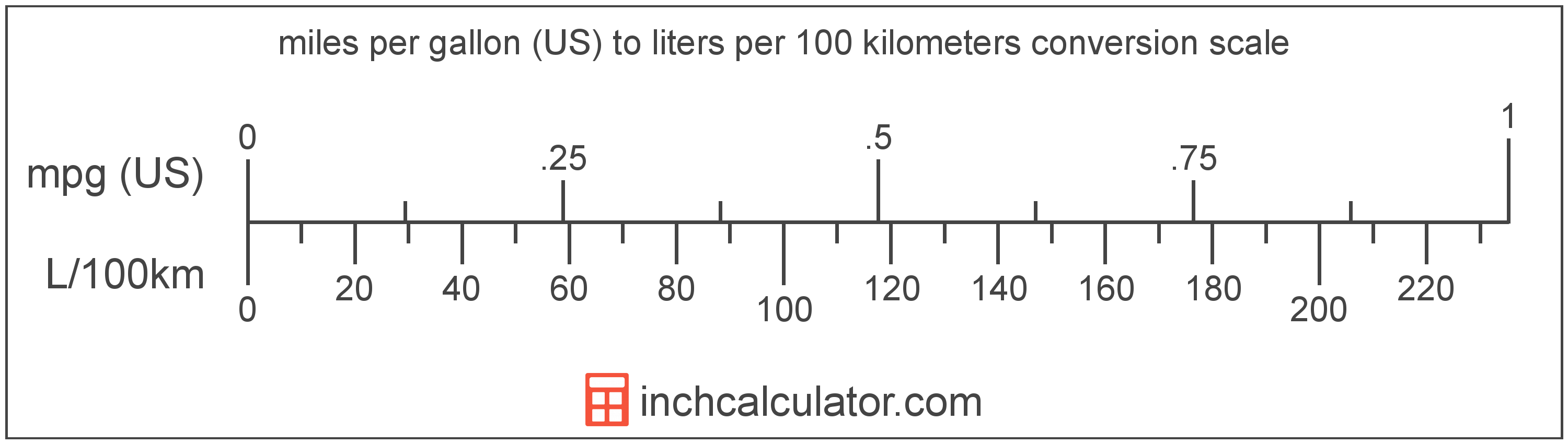
Converting 9.5 liters per 100 kilometers (L/100 km) results in approximately 24.76 miles per gallon (MPG) when using the United States liquid gallon. For those in the United Kingdom or countries using the Imperial system, 9.5 L/100 km is equivalent to approximately 29.73 MPG.
Fuel efficiency remains a critical metric for vehicle owners in 2026, serving as a primary indicator of both operational costs and environmental impact. While the global automotive market continues its transition toward electrification, millions of internal combustion engine (ICE) and hybrid vehicles remain on the road, making the understanding of consumption units like L/100 km and MPG essential. This guide provides the mathematical foundations for these conversions, the historical context of the units, and an analysis of what 9.5 L/100 km means for a vehicle's performance in the current technological landscape.
Understanding the Math: Consumption vs. Efficiency
To convert between L/100 km and MPG, one must first recognize that these two units measure different concepts. Liters per 100 kilometers (L/100 km) is a measure of fuel consumption. It tells you how much fuel is required to cover a specific, fixed distance. In this system, a lower number is better because it indicates less fuel is being "consumed" to reach the 100 km mark.
Conversely, miles per gallon (MPG) is a measure of fuel efficiency. It tells you how far the vehicle can travel on a fixed amount of fuel. In this system, a higher number is better because it indicates the vehicle can go "further" on a single gallon. This inverse relationship is why the conversion involves division rather than simple multiplication.
The Mathematical Constants
Because these units exist on different scales (metric vs. imperial) and measure different directions (consumption vs. efficiency), specific mathematical constants are used to bridge the gap.
- US Conversion Constant: 235.215
- UK (Imperial) Conversion Constant: 282.481
These constants are derived from the number of liters in a gallon and the number of kilometers in a mile. Since a US gallon is smaller than a UK gallon, the constants differ significantly.
How to Convert 9.5 L/100 km to US MPG
The United States uses the "liquid gallon," which is defined as exactly 231 cubic inches or approximately 3.785 liters. To convert 9.5 L/100 km to US MPG, you divide the US constant (235.215) by the consumption value.
The Formula:
235.215 / L/100 km = US MPG
The Calculation for 9.5 L/100 km:
235.215 / 9.5 = 24.75947...
When rounded to two decimal places, 9.5 L/100 km equals 24.76 US MPG.
In the 2026 automotive market, 24.76 MPG is often associated with mid-sized SUVs, light-duty pickup trucks, or older sedan models. For a modern non-hybrid internal combustion vehicle, this figure represents average performance. However, compared to the high-efficiency hybrids and plug-in hybrids (PHEVs) common in 2026, this number would be considered relatively high consumption.
How to Convert 9.5 L/100 km to UK (Imperial) MPG
The United Kingdom and several Commonwealth nations historically used the Imperial gallon. An Imperial gallon is larger than a US gallon, measuring approximately 4.546 liters. Because the gallon is larger, the vehicle can travel further on that single unit of fuel, resulting in a higher MPG figure for the same physical fuel consumption.
The Formula:
282.481 / L/100 km = UK MPG
The Calculation for 9.5 L/100 km:
282.481 / 9.5 = 29.73484...
When rounded to two decimal places, 9.5 L/100 km equals 29.73 UK MPG.
It is vital for international travelers and car buyers to distinguish between these two units. A vehicle advertised at "30 MPG" in a UK-based publication might seem more efficient than a "25 MPG" vehicle in a US-based report, even if their actual fuel consumption (9.5 L/100 km) is identical.
Comparison Table: L/100 km to MPG Context
To better understand where 9.5 L/100 km sits in the spectrum of fuel economy, it is helpful to view it alongside other common consumption ratings.
| Fuel Consumption (L/100 km) | US MPG (Approx.) | UK MPG (Approx.) | Typical Vehicle Class (2026) |
|---|---|---|---|
| 5.0 | 47.04 | 56.50 | Modern Hybrid Sedans / Compacts |
| 6.5 | 36.19 | 43.46 | Efficient Turbocharged Compact SUVs |
| 8.0 | 29.40 | 35.31 | Standard Mid-size Crossovers |
| 9.5 | 24.76 | 29.73 | Full-size Sedans / Mid-size SUVs |
| 11.0 | 21.38 | 25.68 | Full-size SUVs / Performance Vehicles |
| 13.0 | 18.09 | 21.73 | Heavy-duty Trucks / High-HP Sports Cars |
Is 9.5 L/100 km Good Fuel Economy in 2026?
As of 2026, fuel efficiency standards have tightened globally. In the United States, the Environmental Protection Agency (EPA) and the Corporate Average Fuel Economy (CAFE) standards have pushed manufacturers toward higher efficiency. Similarly, in Europe, the European Environment Agency (EEA) monitors strict CO2 emission targets that favor vehicles consuming much less than 9.5 L/100 km.
For Mid-Size SUVs and Crossovers
For a standard internal combustion engine (ICE) mid-size SUV, 9.5 L/100 km is a "middle-of-the-road" figure. It is not exceptionally efficient, but it is typical for vehicles that do not utilize full hybrid systems. If you are driving a vehicle of this size, achieving 24.76 US MPG in mixed city and highway driving is considered acceptable, though many 2026 hybrid models in this same class now achieve closer to 6.0 or 7.0 L/100 km (33–39 MPG).
For Compact Cars
If a compact car or a small sedan is returning 9.5 L/100 km, this is generally considered poor efficiency by 2026 standards. Small, lightweight vehicles are expected to perform much better, usually staying well under 7.0 L/100 km. High consumption in a small vehicle often points to aggressive driving habits, mechanical issues, or an outdated engine design.
For Performance and Heavy Vehicles
In the context of high-performance sports cars or full-size pickup trucks, 9.5 L/100 km is actually quite impressive. Many older trucks in these categories struggle to stay below 12 or 13 L/100 km. Modern engineering, including cylinder deactivation, 10-speed transmissions, and mild-hybrid systems, has made it possible for larger vehicles to hover around the 9.5 L/100 km mark.
Factors Affecting Real-World Fuel Consumption
The figure of 9.5 L/100 km is often a "combined" rating provided by manufacturers. However, real-world results can vary significantly based on several technical and behavioral factors.
Driving Conditions and Environment
- City vs. Highway: Frequent stop-and-go traffic significantly increases fuel consumption because the engine must work harder to overcome inertia every time the vehicle moves from a standstill. On the highway, steady speeds allow the engine to operate in its most efficient power band.
- Ambient Temperature: Cold weather negatively impacts fuel economy. Engines take longer to reach their optimal operating temperature, and cold air is denser, increasing aerodynamic drag. Additionally, winter-blend fuels often have slightly lower energy content.
- Terrain: Driving in mountainous or hilly regions requires more energy to overcome gravity during climbs. While some energy is recovered during descents (especially in hybrids via regenerative braking), the net result is usually higher consumption.
Vehicle Maintenance
- Tire Pressure: Under-inflated tires increase rolling resistance, forcing the engine to burn more fuel to maintain speed. According to the U.S. Department of Energy, properly inflated tires can improve fuel mileage by up to 3%.
- Aerodynamics: Roof racks, cargo carriers, or even driving with windows open at high speeds increase drag. At highway speeds, overcoming air resistance is the primary task of the engine.
- Engine Health: Worn spark plugs, clogged air filters, or malfunctioning oxygen sensors can cause the engine to run "rich" (using too much fuel), quickly pushing a vehicle from 8.0 L/100 km up to 9.5 or higher.
Calculating Your Own Consumption Manually
While modern 2026 vehicles have sophisticated trip computers that display L/100 km in real-time, manual verification is the only way to ensure the sensors are accurate.
- Fill the Tank: Fill your fuel tank completely and reset your trip odometer to zero.
- Drive Normally: Use the vehicle until you are ready for your next fill-up (ideally when the tank is at least half empty).
- Refill and Record: Fill the tank again and record exactly how many liters of fuel you added. Record the distance on the trip odometer.
- The Calculation: Divide the liters used by the distance traveled, then multiply by 100.
Example:
- You added 45 liters of fuel.
- Your trip odometer shows 474 kilometers.
- Calculation:
(45 / 474) * 100 = 9.493... - Result: Your real-world consumption is 9.5 L/100 km.
The Environmental Impact of 9.5 L/100 km
In 2026, the conversation around fuel economy is inseparable from carbon emissions. Fuel consumption is directly proportional to the amount of CO2 a vehicle emits. For a standard gasoline engine, every liter of fuel burned produces approximately 2.3 kilograms of CO2.
At a rate of 9.5 L/100 km, a vehicle emits roughly 218.5 grams of CO2 per kilometer. For context, many regions now have targets to bring fleet averages below 95 grams of CO2 per kilometer. A vehicle consuming 9.5 L/100 km is contributing more than double that target, which explains the increasing shift toward hybridization and electrification to lower these numbers.
For drivers looking to reduce their footprint without switching vehicles, "ecodriving" techniques—such as gradual acceleration and maintaining a steady speed—can often reduce consumption from 9.5 L/100 km to 8.5 L/100 km, a nearly 10% improvement in efficiency.
FAQ: Frequently Asked Questions
Which is better: a higher or lower L/100 km number?
A lower L/100 km number is always better. It means your car requires less fuel to travel the same distance. For example, 7.0 L/100 km is much more efficient than 9.5 L/100 km.
Why does the US use a different MPG than the UK?
The difference stems from historical definitions of the "gallon." The US gallon is based on the 18th-century English "wine gallon," while the UK Imperial gallon was standardized in 1824 based on the volume of 10 pounds of distilled water. This makes the UK gallon about 20% larger than the US gallon.
How does 9.5 L/100 km compare to electric vehicles?
Electric vehicles (EVs) use different units, such as kWh/100 km. However, the International Energy Agency (IEA) often uses "MPGe" (miles per gallon equivalent) for comparison. A typical EV in 2026 might achieve over 100 MPGe, making a 24.76 MPG (9.5 L/100 km) gasoline vehicle significantly less efficient in terms of energy per mile.
Can I improve my 9.5 L/100 km rating without buying a new car?
Yes. Aside from mechanical maintenance, the most effective way to improve this number is to reduce high-speed driving. Aerodynamic drag increases exponentially with speed; driving at 100 km/h (62 mph) instead of 120 km/h (75 mph) can often lower your consumption from 9.5 L/100 km to under 8.5 L/100 km.
Is 9.5 L/100 km the same for diesel and gasoline?
The conversion to MPG remains the same regardless of fuel type because you are measuring volume. However, diesel fuel contains more energy per liter than gasoline. Therefore, a diesel engine consuming 9.5 L/100 km is technically using more "energy" but providing the same volume-based efficiency as a gasoline engine at 9.5 L/100 km.
Practical Recommendation
If your vehicle is currently returning 9.5 L/100 km, you are operating at a standard efficiency level for a non-hybrid mid-size vehicle in 2026. To verify if this is "normal" for your specific car, compare your results against the manufacturer’s window sticker or official data from resources like FuelEconomy.gov. If your vehicle is rated for 7.0 L/100 km but you are seeing 9.5, check your tire pressure and consider a diagnostic check for your oxygen sensors or fuel injectors. For those looking to lower fuel costs, transitioning to a vehicle that achieves 6.0 L/100 km or lower would provide a significant reduction in monthly expenses and carbon output.