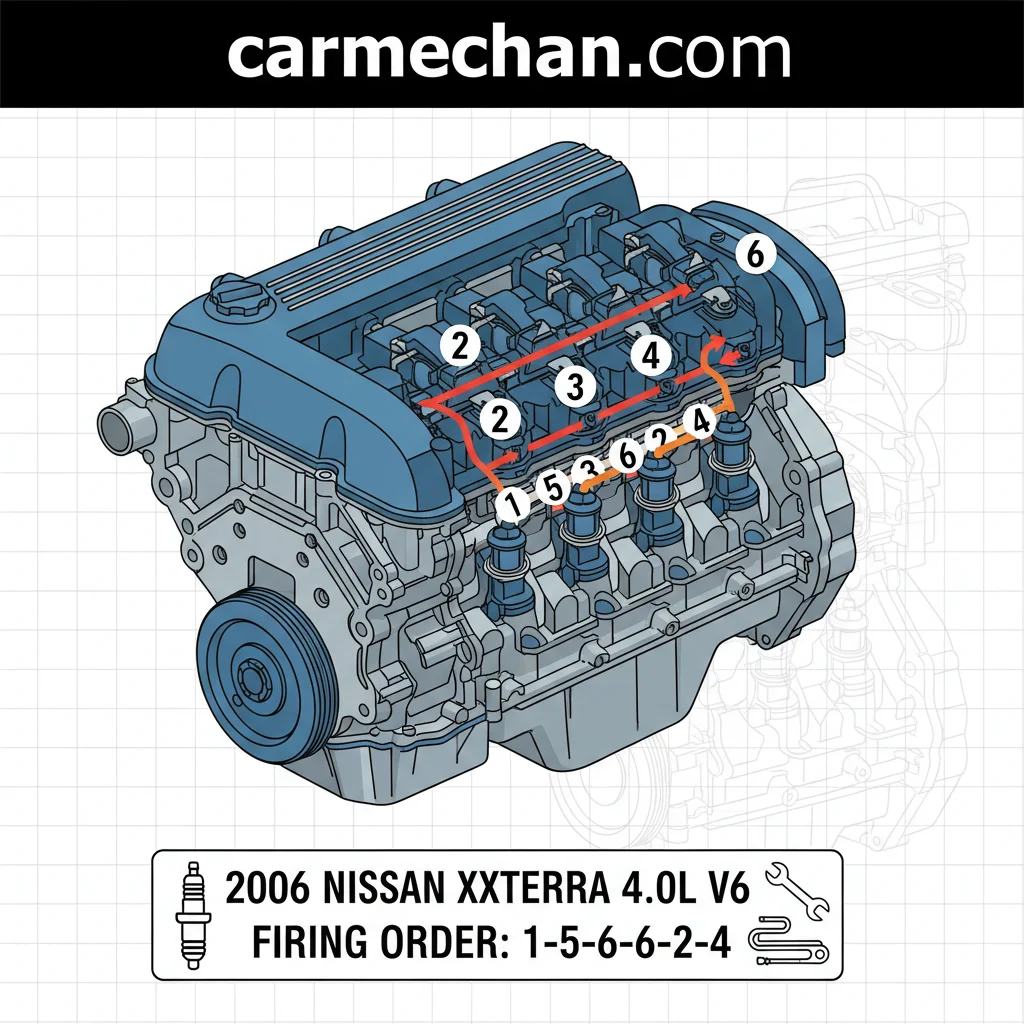
The firing order for the most common Toyota 3.0L V6 engines, including the 1MZ-FE and 3VZ-FE, is 1-2-3-4-5-6. For Toyota’s famous 3.0L Inline-6 engines, such as the 2JZ-GE, the firing order is 1-5-3-6-2-4. In both cases, cylinder numbering begins at the front of the engine, closest to the timing belt or chain.
Understanding the firing order of a Toyota 3.0L engine is essential for diagnosing ignition misfires, performing tune-ups, or replacing ignition coils and spark plug wires. Whether you are working on a classic 1990s 4Runner or a 2000s-era Camry, the sequence in which the cylinders ignite dictates the engine's balance, smoothness, and power delivery. As of 2026, many of these engines remain on the road due to their legendary durability, making accurate technical knowledge vital for ongoing maintenance.
The Importance of Firing Order in Toyota Engineering
The firing order is the sequence in which the spark plugs ignite the air-fuel mixture in each cylinder. Toyota engineers design this sequence to minimize vibration and distribute the mechanical load evenly across the crankshaft. By spreading the power strokes across the engine block, the manufacturer ensures that the internal forces do not concentrate in one area, which would otherwise lead to premature bearing wear or excessive harmonic resonance.
In the context of Toyota’s 3.0L powerplants, the firing order is deeply integrated with the engine's physical layout. Toyota has produced two primary types of 3.0L engines that enthusiasts and mechanics frequently encounter: the V6 (V-shaped) and the Inline-6 (straight-six). Because these layouts differ fundamentally in their geometry, their firing orders and cylinder numbering systems are distinct.
Toyota 3.0L V6 Firing Order (1MZ-FE and 3VZ-FE/E)
The V6 family is perhaps the most ubiquitous 3.0L configuration Toyota has ever produced. The 3VZ-E (SOHC) and 3VZ-FE (DOHC) were staples of the late 80s and early 90s, while the 1MZ-FE powered millions of vehicles from 1994 through the mid-2000s.
Cylinder Numbering and Identification
Before applying the 1-2-3-4-5-6 firing order, you must correctly identify the cylinders. Toyota V6 engines use a "Bank" system.
- Bank 1: This is the "Right" bank if you are looking at the engine from the front (the side with the timing belt). In a transverse-mounted engine (front-wheel drive like the Camry), Bank 1 is the rear bank, located closest to the firewall. It contains cylinders 1, 3, and 5.
- Bank 2: This is the "Left" bank. In a transverse engine, this is the front bank, located closest to the radiator. It contains cylinders 2, 4, and 6.
The 1-2-3-4-5-6 Sequence
The firing order 1-2-3-4-5-6 means that the ignition alternates between the banks. Cylinder 1 fires first on Bank 1, followed immediately by Cylinder 2 on Bank 2, then back to Bank 1 for Cylinder 3, and so on. This "see-saw" effect is what gives the Toyota V6 its characteristic smooth idle.
Ignition System Variations
How this firing order is executed depends on the year of the engine.
- Distributor Systems (3VZ-E): Found in older 4Runners and Pickups, a mechanical distributor sends spark through six individual wires. The wires must be plugged into the distributor cap in the exact 1-2-3-4-5-6 sequence (following the rotation of the rotor) to match the engine's internal cycle.
- Waste-Spark Systems (Early 1MZ-FE): These use three ignition coils mounted on one bank (usually the front bank, 2-4-6), with spark plug wires leading to the opposite bank. In this setup, two cylinders fire simultaneously—one on the compression stroke and one on the exhaust stroke (the "waste" spark).
- Coil-on-Plug (COP) Systems (Late 1MZ-FE): By the early 2000s, Toyota moved to individual coils for each cylinder. The Engine Control Module (ECM) triggers each coil independently according to the 1-2-3-4-5-6 sequence.
Toyota 3.0L Inline-6 Firing Order (2JZ and 7M Series)
While the V6 is common in sedans and SUVs, Toyota’s 3.0L Inline-6 engines—specifically the 7M-GE/GTE and the legendary 2JZ-GE/GTE—are found in performance vehicles like the Supra and Lexus IS300.
Cylinder Numbering and Identification
The Inline-6 layout is much simpler to map. Since all cylinders are in a single row, they are numbered 1 through 6 starting from the front (timing belt side) and moving toward the rear (transmission side).
The 1-5-3-6-2-4 Sequence
Unlike the V6, the Inline-6 uses the firing order 1-5-3-6-2-4. This specific sequence is a hallmark of "perfect primary and secondary balance." In a straight-six, cylinders 1 and 6 move in unison, as do 2 and 5, and 3 and 4. By firing in the 1-5-3-6-2-4 order, the engine cancels out end-to-end rocking motions, resulting in the vibration-free operation for which the Supra and Lexus GS300 are famous.
Technical Comparison of Toyota 3.0L Engines
To help differentiate between these engines during repair, the following table summarizes the key specifications related to ignition and layout.
| Engine Code | Configuration | Typical Firing Order | Cylinder 1 Location | Common Applications |
|---|---|---|---|---|
| 3VZ-E | 3.0L V6 (SOHC) | 1-2-3-4-5-6 | Front Right (Passenger Side) | 1988–1995 4Runner, Pickup |
| 3VZ-FE | 3.0L V6 (DOHC) | 1-2-3-4-5-6 | Bank 1 (Rear/Firewall Side) | 1992–1993 Camry, Lexus ES300 |
| 1MZ-FE | 3.0L V6 (DOHC) | 1-2-3-4-5-6 | Bank 1 (Rear/Firewall Side) | 1994–2006 Camry, Avalon, Sienna |
| 7M-GE | 3.0L I6 (DOHC) | 1-5-3-6-2-4 | Front (Near Timing Belt) | 1986–1992 Supra, Cressida |
| 2JZ-GE | 3.0L I6 (DOHC) | 1-5-3-6-2-4 | Front (Near Timing Belt) | 1993–2005 Supra, IS300, GS300 |
Practical Application: Diagnosing Misfires
If your Toyota 3.0L engine is running roughly or the "Check Engine" light is flashing, the firing order and cylinder numbering are your primary tools for repair. Modern OBD-II scanners will provide "P030X" codes, where "X" represents the cylinder number.
- P0301 (Cylinder 1 Misfire): On a 1MZ-FE V6, this is the cylinder on the passenger side, back by the firewall. It is often the hardest to reach.
- P0304 (Cylinder 4 Misfire): On the same V6, this is the middle cylinder in the front bank, right behind the radiator.
- Cross-Firing: If you have replaced spark plug wires on a 3VZ-E or an early 1MZ-FE and the engine won't start or pops loudly, you have likely swapped two wires. Use the firing order to trace each wire from the distributor or coil to the correct spark plug.
The "Waste-Spark" Troubleshooting Tip
On many 1MZ-FE engines, if you have a misfire on both Cylinder 1 and Cylinder 4 simultaneously, the problem is likely not the spark plugs. Because these two cylinders share a single coil in the waste-spark system, a failure of the Coil at Cylinder 4 will often cause a "companion" misfire at Cylinder 1 via the connecting wire.
Step-by-Step Guide to Replacing Ignition Components
When working on these engines in 2026, age-related brittleness is a major factor. Follow these steps to ensure the firing order remains intact:
- Label Everything: Before removing any wires or coils, use masking tape to label the cylinder number on the wire and the corresponding port on the distributor or coil pack.
- Inspect the "Rear" Bank (V6): On transverse 3.0L engines, the rear bank (1-3-5) is difficult to access. Many mechanics replace all three rear coils and plugs at once to avoid having to remove the intake plenum again later.
- Verify Rotor Rotation: For 3VZ-E engines with distributors, remember that the rotor spins in a specific direction (clockwise). The firing order 1-2-3-4-5-6 must follow that clockwise path around the cap.
- Check for Oil in Spark Plug Wells: A common issue with the 1MZ-FE and 2JZ-GE as they age is valve cover gasket failure. Oil can leak into the spark plug wells, shorting out the spark. Even if your firing order is correct, the spark won't reach the combustion chamber if the boot is soaked in oil.
Common Mistakes to Avoid
- Assuming Sequential Numbering: Do not assume cylinders are numbered 1-2-3 on one side and 4-5-6 on the other for the V6. Toyota uses the staggered 1-3-5 and 2-4-6 method. Getting this wrong will lead to incorrect part replacement.
- Mixing up the I6 and V6: While both are 3.0L, a 2JZ (I6) will never use a V6 firing order. Ensure you have identified the engine layout correctly before consulting diagrams.
- Incorrect Coil Seating: On COP systems, the coil must click firmly onto the spark plug. If it is loose, the firing sequence will be interrupted, triggering a P0300 (Random/Multiple Misfire) code.
Frequently Asked Questions
Is the firing order different for the Toyota 3.0L Diesel (1KZ-TE)?
Yes. The 1KZ-TE is a 4-cylinder engine. The firing order for most Toyota 4-cylinder engines, including the 3.0L diesel, is 1-3-4-2. This is entirely different from the V6 and I6 gasoline engines discussed here.
Where can I find the firing order marked on my engine?
In many cases, Toyota stamps the cylinder numbers (1 through 6) on the intake manifold casting or near the spark plug wells. On older models with distributors, the "1" position is often marked on the distributor cap itself.
Can a wrong firing order damage my Toyota engine?
Yes. If the spark plugs fire at the wrong time (e.g., when the intake valve is open), it can cause a backfire through the intake manifold, potentially damaging the Air Flow Meter (AFM) or plastic intake components. Long-term running with a swapped wire can also lead to unburned fuel entering the catalytic converter, causing it to overheat and melt.
Why did Toyota use 1-2-3-4-5-6 for the V6 instead of something more complex?
This sequence is actually quite elegant for a 60-degree V6. It allows for a simple, repeating "Left-Right" pattern that balances the primary forces of the pistons. It also simplifies the wiring harness design, as the wires don't need to crisscross excessively.
Does the 1MZ-FE VVT-i change the firing order?
No. While Variable Valve Timing (VVT-i) changed how the valves operate and improved efficiency, the fundamental crankshaft geometry and firing order remained 1-2-3-4-5-6.
Final Recommendation for Owners
When performing ignition work on any Toyota 3.0L engine, the most reliable resource is the Vehicle Emission Control Information (VECI) label, usually located on the underside of the hood. This label often includes a basic diagram of the cylinder layout. If the label is missing, always refer to the specific engine code (e.g., 1MZ-FE vs. 2JZ-GE) rather than just the displacement, as the firing orders are not interchangeable between V6 and Inline-6 configurations. For 2026 maintenance, prioritize replacing the spark plug tube seals along with your plugs, as these are the most frequent cause of "false" misfires on these aging but reliable powerplants.