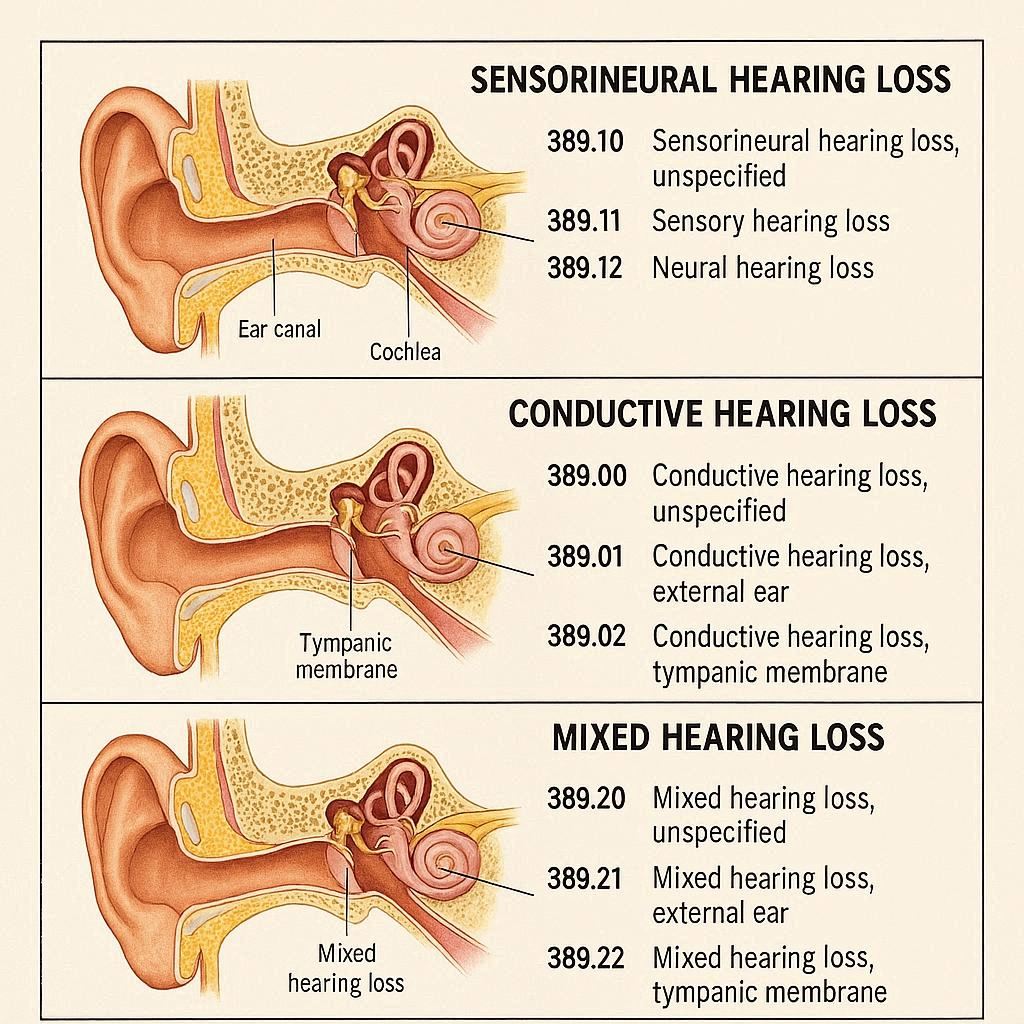
When a patient receives a diagnosis of unspecified hearing loss, bilateral (ICD-10 code H91.93), it indicates that hearing impairment has been identified in both ears, but the underlying etiology or specific nature of the loss remains undetermined at the time of the encounter. This diagnostic code serves as a placeholder in the International Classification of Diseases, 10th Revision, allowing clinicians to document the presence of a bilateral impairment while ongoing diagnostic testing or clinical observation is conducted to refine the specific diagnosis.
Defining ICD-10 Code H91.93
The ICD-10-CM (Clinical Modification) system is the standard used by healthcare providers, hospitals, and insurance companies to classify and code all diagnoses, symptoms, and procedures. Code H91.93 falls under the broader category of "Other hearing loss" (H91). Within this hierarchy, the fifth character "9" signifies "unspecified," and the sixth character "3" specifies "bilateral."
In the medical record, "unspecified" does not necessarily imply a lack of effort to determine the cause; rather, it reflects that the documentation provided by the clinician has not yet identified a specific pathology such as sensorineural, conductive, or mixed hearing loss. It is a critical functional diagnostic tool used for billing, medical necessity verification, and longitudinal tracking of a patient’s auditory health.
The Clinical Significance of "Bilateral" and "Unspecified"
The term "bilateral" is significant in clinical practice because it indicates that both the left and right auditory systems are affected. This often triggers a broader diagnostic workup than a unilateral (single-sided) presentation. When a provider labels this loss as "unspecified," they are essentially indicating that the clinical picture—which may include patient self-reporting, basic physical examinations, or initial audiometric screenings—has confirmed the symptom but not the specific diagnostic classification.
Common Diagnostic Pathways
When this code is utilized, it is frequently a temporary state in a patient’s health record. Physicians typically follow up with objective assessments, including:
- Pure-Tone Audiometry: To measure the softest sounds a patient can hear across different frequencies.
- Tympanometry: To assess the condition of the middle ear and the mobility of the eardrum.
- Speech Audiometry: To determine the patient’s ability to recognize speech at various volumes.
- Otoacoustic Emissions (OAEs): To test the function of the outer hair cells in the cochlea.
Once these tests are completed, the physician should ideally update the medical record with a more specific ICD-10 code, such as those denoting sensorineural or conductive hearing loss, to provide a more accurate depiction of the patient's condition.
Insurance and Documentation Requirements
For insurance purposes, H91.93 is a valid diagnosis code, but it carries limitations regarding medical necessity. Many private and government insurance programs, including Medicare, require documentation that supports the level of care provided. If a patient is seeking hearing aids or advanced otological interventions, an "unspecified" code may be viewed as insufficient justification for long-term treatment.
Payers look for "medical necessity" to approve coverage for auditory devices or surgical procedures. Using an unspecified code repeatedly without progression to a more descriptive diagnosis can lead to:
- Claim Denials: Automated billing systems may flag unspecified codes for additional review.
- Requests for Records: Insurance carriers may request clinical notes to verify that a thorough examination was performed.
- Delayed Authorization: The absence of a specific etiology can stall the approval process for specialized interventions.
Comparison of Hearing Loss Coding Categories
To understand where H91.93 fits within the broader spectrum of auditory diagnostics, it is helpful to compare it against other common coding structures in the H90 and H91 series.
| Diagnostic Category | Common ICD-10 Root | Description |
|---|---|---|
| Conductive | H90.0–H90.2 | Issues with the ear canal, eardrum, or middle ear bones. |
| Sensorineural | H90.3–H90.5 | Issues with the inner ear or the auditory nerve. |
| Mixed | H90.6–H90.8 | A combination of conductive and sensorineural loss. |
| Unspecified | H91.93 | Bilateral loss where the cause is currently unknown. |
The Role of the Audiologist and ENT
The transition from an "unspecified" diagnosis to a definitive one usually involves a collaboration between primary care physicians, Otolaryngologists (ENTs), and Audiologists. The ENT is responsible for ruling out structural abnormalities or disease processes that require medical or surgical management. The Audiologist provides the functional data required to classify the severity (mild, moderate, severe, profound) and the type of loss.
When a patient is coded with H91.93, they are often in the phase of "triage," where the immediate priority is to rule out "red flag" conditions—such as acoustic neuromas, sudden sensorineural hearing loss, or chronic middle ear infections—that require immediate intervention. Once these high-risk conditions are excluded, the clinician can focus on the long-term management of the hearing impairment.
Practical Implications for Patients
If you have been told your diagnosis is "unspecified hearing loss," it is important to understand that this is not a final prognosis. It is an administrative bridge. Patients should take the following steps:
- Request a Detailed Audiogram: Ensure you receive a copy of your test results. This document contains the objective data that turns an "unspecified" label into a clear clinical profile.
- Ask About the Specific Type: Ask your provider, "Based on my test, is this a problem with sound conduction or is it nerve-related?" The answer to this determines your treatment options.
- Discuss Persistence: If your hearing loss persists, ensure the diagnostic code in your file is updated during subsequent visits to reflect the ongoing nature of the condition rather than relying on an initial, generic code.
- Verify Coverage: If you are seeking hearing aids, confirm with your insurance provider whether they require a specific diagnosis code rather than an unspecified one to release benefits.
Limitations and Challenges
A significant challenge with the H91.93 code is the potential for clinical inertia. Because it is a valid code, it can be easy for a busy practice to continue using it across multiple visits rather than documenting the nuance of the patient's condition. For the patient, this can be frustrating if they are seeking clarity on why their hearing is declining. Furthermore, "unspecified" coding can mask trends in a patient population. Researchers and public health officials rely on specific coding to identify the prevalence of sensorineural versus conductive issues; using "unspecified" for too long dilutes the quality of medical data.
Frequently Asked Questions
Is H91.93 a permanent diagnosis? No, H91.93 is intended to be a temporary or provisional code. It should be replaced with a more specific diagnosis once testing confirms the origin and type of hearing loss.
Can I get hearing aids with an "unspecified" code? Some insurance plans may approve hearing aids with this code if the clinical notes indicate that a comprehensive exam was performed and the hearing loss is permanent. However, many plans prefer more specific diagnostic information.
Why did my doctor use this code instead of naming the disease? Your doctor likely used this code because they had confirmed the symptom (you cannot hear well in both ears) but had not yet finalized the cause (e.g., genetic, noise-induced, or age-related).
Does this code indicate the severity of my hearing loss? No. The code only specifies that the loss is bilateral and unspecified. It does not provide information regarding whether the loss is mild, moderate, or profound.
What should I do if my insurance denies a claim using this code? Contact your healthcare provider's billing office. They can review your clinical notes to see if a more specific, billable diagnosis code is supported by your test results, which could then be submitted to the insurer.
Next Actions for Patients and Providers
For providers, the recommendation is to use H91.93 only during the initial evaluation phase. Subsequent encounters should utilize more descriptive coding as testing concludes. For patients, the priority is to move from the "unspecified" diagnostic stage to a specific one by completing the recommended diagnostic testing. Understanding the terminology in your medical file allows for more productive communication with your healthcare team and ensures you receive the most appropriate path of treatment for your auditory health.