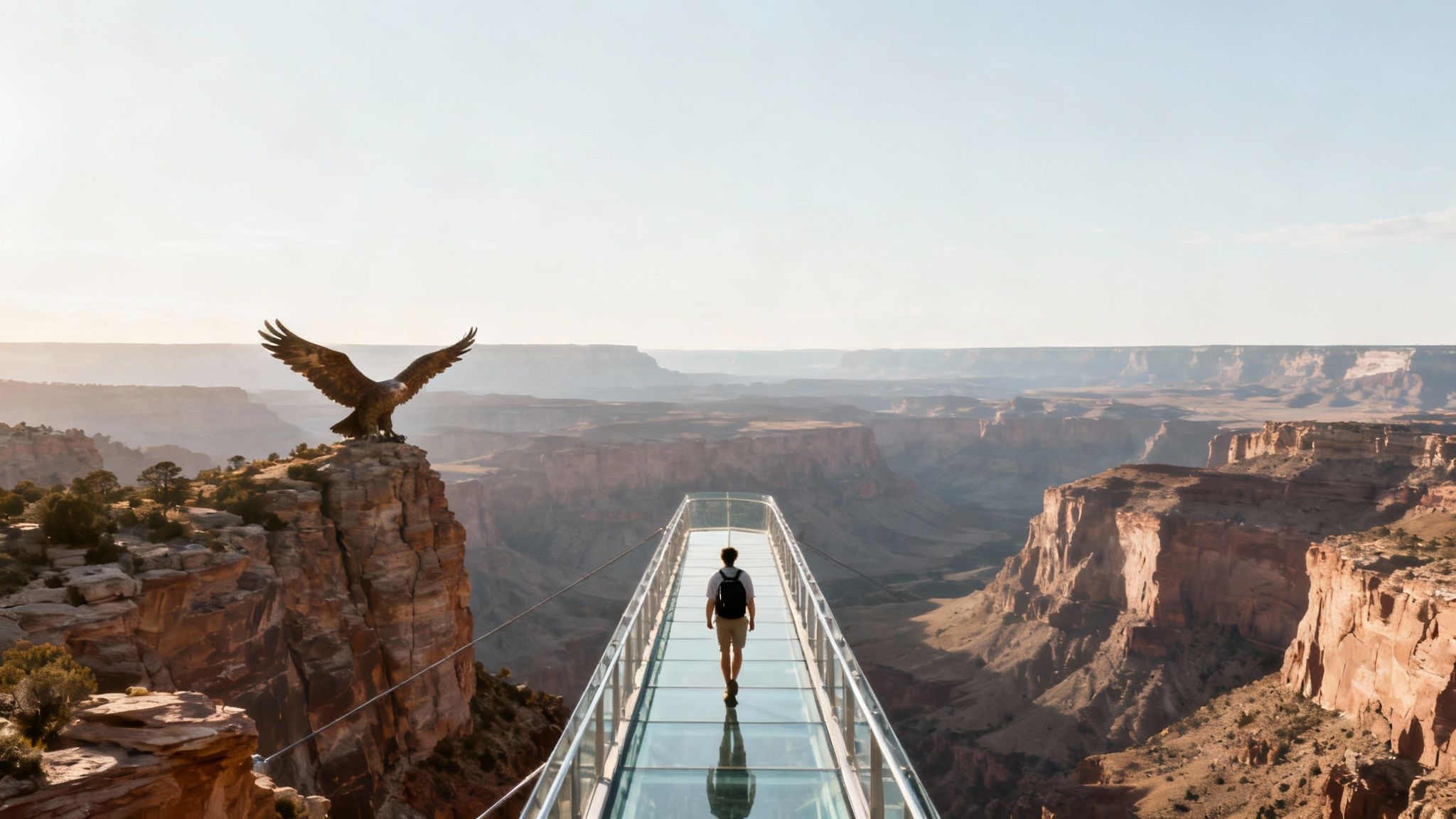
Walking across the Grand Canyon refers to two distinct achievements: the historic 2013 high-wire crossing by Nik Wallenda and the physically demanding "Rim-to-Rim" (R2R) hike. While the high-wire event was a singular televised spectacle over the Little Colorado River Gorge, the R2R hike is a 21-to-24-mile journey through the canyon’s core that requires extensive physical preparation and permits.
The Historical Spectacle: Nik Wallenda’s High-Wire Crossing
When people search for "a man walking across the Grand Canyon," they are often recalling the global media event of June 23, 2013. Nik Wallenda, a member of the famous "Flying Wallendas" acrobat family, became the first person to cross a gorge in the Grand Canyon area on a tightrope. This event, titled "Skywire Live," was broadcast to millions and remains a benchmark for extreme aerial feats.
The Technical Specifications of the Walk
The crossing did not take place within the boundaries of Grand Canyon National Park, but rather on Navajo Nation land at the Little Colorado River Gorge. This distinction is vital because the National Park Service (NPS) generally prohibits such stunts. Wallenda walked on a 2-inch-thick steel cable suspended 1,500 feet above the river—a height greater than the Empire State Building.
The cable spanned 1,400 feet. Wallenda performed the walk without a safety harness or a net, relying solely on his balance and a 43-pound, 30-foot-long balancing pole. During the 22-minute crossing, he faced wind gusts exceeding 30 miles per hour and the "pendulum effect" of the wire, which required him to crouch twice to stabilize the cable's rhythm.
The Significance of the Feat
Wallenda’s walk was as much a psychological battle as a physical one. The visual depth of the canyon can cause "spatial disorientation," where the lack of a close visual horizon makes it difficult for the inner ear to maintain balance. His success solidified his legacy and brought massive international attention to the geological grandeur of the region, though it also sparked debates regarding the commercialization of sacred tribal lands.
The Pedestrian Achievement: Walking Rim-to-Rim (R2R)
For most people in 2026, "walking across the canyon" means completing the Rim-to-Rim (R2R) trek. This is a journey from one side of the Grand Canyon to the other on foot, traversing the "Inner Canyon." It is considered one of the premier backpacking and endurance challenges in the United States.
Defining the Routes
A man walking across the canyon floor typically chooses between three primary "corridor" trails. The North Rim and South Rim are separated by approximately 10 miles "as the crow flies," but the walking distance is significantly longer due to the descent to the Colorado River and the subsequent ascent.
- North Kaibab Trail: The only maintained trail from the North Rim into the inner canyon. It is longer and more rugged than the South Rim trails.
- Bright Angel Trail: The most popular trail on the South Rim, known for having more shade and seasonal water stations.
- South Kaibab Trail: A shorter, steeper ridge-line trail on the South Rim that offers panoramic views but lacks shade and water.
A standard "Rim-to-Rim" walk usually starts at the North Rim (higher elevation) and ends at the South Rim, or vice-versa. Crossing from the North Rim to the South Rim via the North Kaibab and Bright Angel trails totals roughly 23.5 miles.
Planning and Logistics for 2026
By 2026, the logistics of walking across the canyon have become more regulated to protect the fragile desert ecosystem and ensure hiker safety. The National Park Service has implemented refined reservation systems for both overnight stays and transportation.
The Trans-Canyon Waterline Project
Hikers in 2026 must account for the Trans-Canyon Waterline (TCW) project. This massive multi-year infrastructure effort, which began in earnest years ago, involves replacing the aging pipeline that provides water to the South Rim. This project often results in temporary trail closures or detours, particularly around the Phantom Ranch area and the North Kaibab Trail. Before starting a walk, it is mandatory to check the NPS Grand Canyon Current Conditions for specific 2026 construction updates.
Backcountry Permits
If the "walk" involves staying overnight at the bottom of the canyon—which is highly recommended for safety—a Backcountry Permit is required. In 2026, these are issued through a lottery system on Recreation.gov. Demand far exceeds supply, especially for the Bright Angel and Cottonwood campgrounds.
Seasonal Limitations
The "walking window" is narrow. The North Rim is generally open from mid-May to mid-October. Outside of these months, the North Rim road (Highway 67) is closed due to snow, making a true across-the-canyon walk nearly impossible without extreme winter expedition gear. The most popular times for a crossing are May, June, September, and October.
Physical Demands and Technical Preparation
Walking across the Grand Canyon is a feat of endurance that should not be underestimated. The elevation change alone is enough to exhaust fit athletes.
Elevation and Grade
The South Rim sits at approximately 6,800 feet, while the North Rim is significantly higher at roughly 8,200 feet. The Colorado River at the bottom sits at approximately 2,400 feet. A man walking from the North Rim to the South Rim will descend nearly 6,000 feet and then climb approximately 4,500 feet.
This "inverted mountain" dynamic is what makes the walk so dangerous; the easiest part (the descent) comes first, while the most grueling part (the ascent) occurs when the hiker is already fatigued and potentially dehydrated.
Thermal Management and "The Heat"
The temperature gradient in the Grand Canyon is extreme. It is common for the temperature at the rim to be 30°F to 40°F cooler than at the bottom. In the "Box"—a narrow section of the North Kaibab trail near the river—summer temperatures frequently exceed 110°F (43°C). Radiant heat from the black Vishnu Schist rock walls can push the perceived temperature even higher.
Essential Gear for a 2026 Crossing
- Footwear: Broken-in trail runners or lightweight hiking boots with aggressive tread.
- Hydration: A minimum 3-liter capacity. In 2026, hikers should carry a lightweight water filter as a backup, as pipeline construction may cause intermittent outages at official water stations.
- Electrolytes: Water alone is insufficient. Hyponatremia (low blood sodium) is a major risk for canyon walkers.
- Trekking Poles: Highly recommended to reduce the impact on knees during the 6,000-foot descent.
Comparing the Primary Walking Routes
| Feature | North Kaibab Trail | Bright Angel Trail | South Kaibab Trail |
|---|---|---|---|
| Length to River | 14 miles | 9.5 miles | 7 miles |
| Elevation Change | 5,800 feet | 4,380 feet | 4,700 feet |
| Water Availability | Seasonal (Supai/Cottonwood) | Multiple Rest Houses | None |
| Best For | Entering from North Rim | Ascent (due to shade/water) | Views (Descent only) |
| Difficulty | Extreme | Strenuous | Strenuous |
Safety Protocols and Risk Mitigation
Every year, the Grand Canyon’s Search and Rescue (PSAR) team assists hundreds of hikers. Walking across the canyon requires a "self-rescue" mindset.
The "Golden Rule" of Canyon Walking
The most critical rule is: Do not attempt to walk from rim to rim in a single day during the summer. While "Day Hikers" do attempt this, the NPS strongly advises against it between June and August. The combination of heat, elevation, and distance is frequently lethal for those who are not elite-level endurance athletes.
Recognizing Hyponatremia vs. Dehydration
Many walkers make the mistake of drinking too much plain water without replacing salt. Symptoms of hyponatremia include nausea, vomiting, and confusion. If a hiker is "sloshing" (feeling water in their stomach) but still feels ill, they likely need salt, not more water. Carrying salty snacks like pretzels or electrolyte tabs is a technical requirement for this journey.
Wildlife Encounters
The canyon is home to rattlesnakes, scorpions, and rock squirrels. Interestingly, rock squirrels cause more injuries to hikers than any other animal, usually by biting people who try to feed them or by chewing through expensive backpacks to reach food. Walkers are advised to use "Mighty Mo" or similar protective mesh bags for food storage at campgrounds.
The Significance of the "Inner Canyon" Geology
To truly appreciate the walk, one must understand the layers being traversed. Walking across the canyon is a walk through time. At the rim, you stand on Kaibab Limestone, roughly 270 million years old. By the time you reach the river, you are touching Vishnu Basement Rock, which is approximately 1.7 to 1.8 billion years old. This "Great Unconformity"—a gap in the geological record where nearly a billion years of rock is missing—is one of the most famous geological features in the world and is visible along the Bright Angel and South Kaibab trails.
Frequently Asked Questions
Has anyone ever walked across the Grand Canyon on a tightrope?
Yes, Nik Wallenda successfully walked across the Little Colorado River Gorge on a high wire on June 23, 2013. He crossed a 1,400-foot span without a harness or net. He is the only person to have officially performed this feat, though other tightrope walkers have crossed smaller gorges in the surrounding areas.
How long does it take to walk across the Grand Canyon on foot?
For a fit hiker, a Rim-to-Rim (R2R) walk typically takes 12 to 15 hours if done in a single day, or 2 to 3 days if backpacking. Most experts recommend a multi-day trip to allow for recovery and to avoid hiking during the "danger hours" of 10:00 AM to 4:00 PM when heat is at its peak.
Can you walk across the Grand Canyon for free?
There is no "walking fee," but you must pay the National Park entrance fee (currently $35 per vehicle or $20 per person for 2026). If you plan to camp overnight at the bottom, you must pay for a backcountry permit. Additionally, many hikers pay for a shuttle service (Trans-Canyon Shuttle) to get back to their starting rim, which costs approximately $120-$150 per person.
What is the best month to walk across the canyon?
May and October are widely considered the best months. In May, the wildflowers are blooming and the North Rim has just opened. In October, the temperatures at the bottom are much more manageable, and the fall colors on the North Rim (aspens and maples) are spectacular.
Is there a bridge at the bottom of the Grand Canyon?
Yes, there are two main suspension bridges for pedestrians and mules: the Silver Bridge and the Black Bridge. The Black Bridge is used by mules and hikers on the South Kaibab Trail, while the Silver Bridge carries the Trans-Canyon Waterline and connects the Bright Angel Trail to Phantom Ranch.
Final Recommendation for 2026 Hikers
If you intend to walk across the Grand Canyon in 2026, begin your physical training at least six months in advance, focusing on eccentric leg strength (downhill hiking) and cardiovascular endurance. Secure your backcountry permits exactly four months in advance through the lottery. Always carry a secondary method of water purification and respect the "no hiking 10 AM to 4 PM" advisory during the summer months.