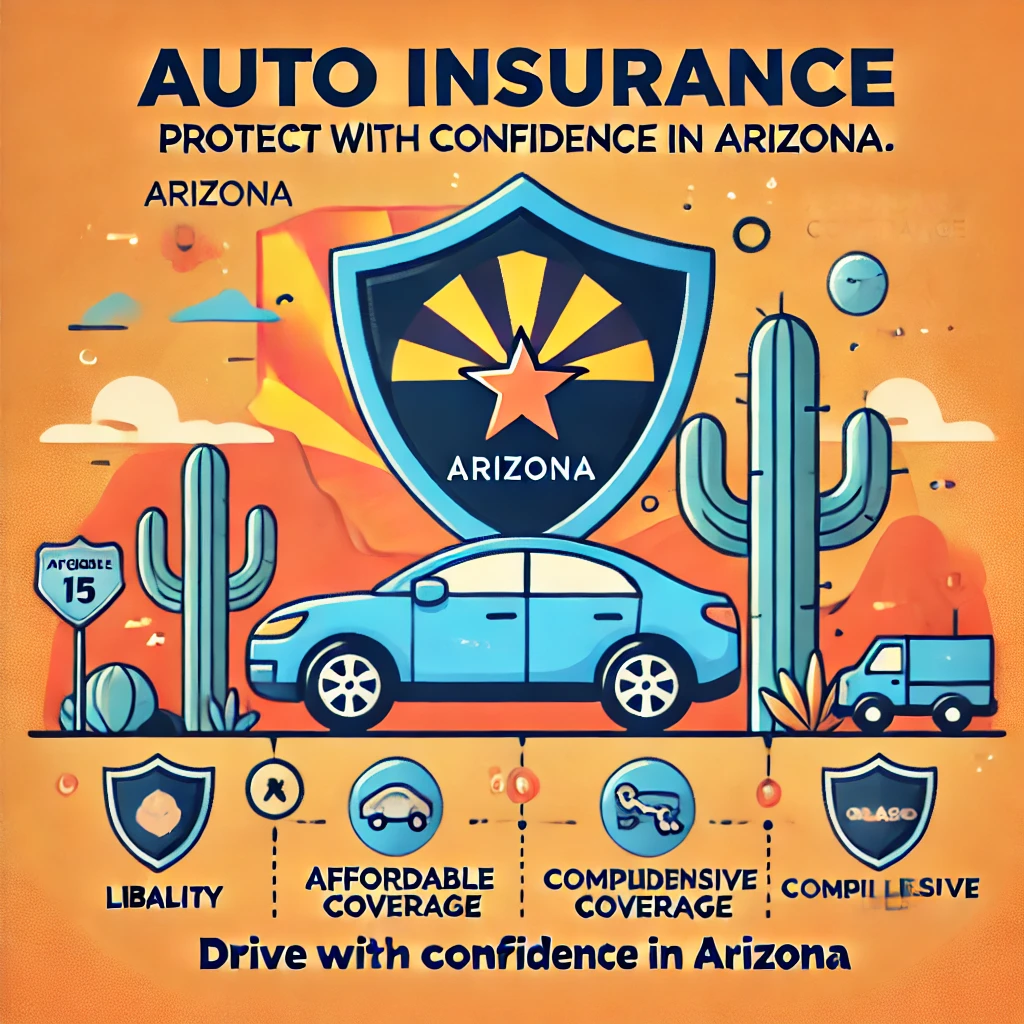
To legally operate a motor vehicle in Arizona in 2026, drivers must carry liability insurance with minimum limits of $25,000 for bodily injury per person, $50,000 for bodily injury per accident, and $15,000 for property damage. This "25/50/15" coverage is mandatory and serves as the baseline for financial responsibility.
Arizona law operates under a "tort" or "at-fault" system. This means that the driver determined to be responsible for a collision is also responsible for the resulting damages, whether they are medical expenses, lost wages, or vehicle repairs. Because the financial stakes of a car accident can easily reach six figures, the state mandates a minimum level of insurance to ensure that victims receive at least some compensation. However, while these minimums satisfy the legal requirement to register a vehicle and maintain a driver’s license, they often fall short of covering the total costs of a moderate to severe accident.
The Three Pillars of Arizona’s Minimum Liability Coverage
Arizona’s legal minimum auto insurance is strictly liability-based. It does not cover the policyholder’s own vehicle or injuries; rather, it pays for the damages the policyholder causes to others. The coverage is broken down into three specific categories, often expressed by insurers as 25/50/15.
Bodily Injury Liability (Per Person)
The first figure, $25,000, represents the maximum amount the insurance company will pay for the medical expenses, funeral costs, or legal fees of a single person injured in an accident where you are at fault. In 2026, medical costs have continued to rise, and a single emergency room visit followed by diagnostic imaging can quickly exhaust this limit. If the injured party’s bills exceed $25,000, they may pursue the driver’s personal assets to cover the remainder.
Bodily Injury Liability (Per Accident)
The second figure, $50,000, is the total cap for all bodily injuries sustained by all people in a single accident. For example, if you collide with a vehicle containing four passengers and all four are injured, your insurance will provide a total of $50,000 to be split among them, with no more than $25,000 going to any one individual. In a multi-passenger accident, this total limit is frequently insufficient, leaving the at-fault driver vulnerable to multiple lawsuits.
Property Damage Liability
The third figure, $15,000, covers the damage you cause to someone else's property. While this usually applies to the other driver's vehicle, it also covers damage to buildings, fences, light poles, or any other physical property. Considering that the average price of a new vehicle in 2026 often exceeds $50,000, a $15,000 limit is remarkably low. If a driver totals a modern SUV or a luxury sedan, they could be held personally liable for the tens of thousands of dollars in remaining vehicle value.
The Arizona Financial Responsibility Law
Arizona Revised Statutes (A.R.S.) § 28-4009 and § 28-4135 dictate the rules for financial responsibility. Every motor vehicle operated on Arizona roadways must be covered by an Arizona-authorized insurance company. The state utilizes a sophisticated electronic verification system that links insurance companies directly with the Arizona Department of Transportation (ADOT) Motor Vehicle Division (MVD).
When a policy is cancelled or lapses, the insurance provider is legally required to notify the MVD immediately. If the MVD does not receive notice of a replacement policy, they will send an inquiry to the vehicle owner. Failure to provide proof of insurance within the specified timeframe results in the suspension of the vehicle’s registration and, potentially, the owner’s driver’s license.
Proof of Insurance Requirements
Drivers in Arizona must be able to provide proof of insurance at the request of law enforcement or if involved in an accident. In 2026, Arizona continues to accept both physical insurance cards and electronic versions displayed on smartphones or tablets. This proof must include:
- The name of the insurance company.
- The policy number.
- The effective and expiration dates of the policy.
- The vehicle identification number (VIN), year, and make of the covered vehicle.
Penalties for Non-Compliance in 2026
The state of Arizona takes insurance requirements seriously, and the penalties for driving without the legal minimum are strictly enforced. Penalties escalate based on whether it is a first, second, or subsequent offense within a 36-month period.
| Offense Number | Estimated Fine | Registration/License Suspension | SR-22 Requirement |
|---|---|---|---|
| First Offense | $500 | 3 Months | Yes (for 3 years) |
| Second Offense | $750 | 6 Months | Yes (for 3 years) |
| Third Offense+ | $1,000 | 1 Year | Yes (for 3 years) |
Beyond the flat fines, there are additional "civil penalties" and fees required to reinstate a license and registration. Furthermore, those convicted of driving without insurance are typically required to file an SR-22 certificate. An SR-22 is not insurance itself; it is a document filed by an insurance company with the MVD certifying that the driver has the required minimum liability coverage. Maintaining an SR-22 usually results in significantly higher insurance premiums and must be kept on file for three consecutive years.
The "At-Fault" System and Liability Gap
Arizona’s "At-Fault" or "Tort" system means that there is no limit on the amount for which a driver can be sued following an accident. If you carry only the legal minimums and cause an accident resulting in $100,000 of medical debt for the other party, your insurance will pay $25,000, and you are legally responsible for the remaining $75,000.
This creates a "liability gap." For many Arizona residents, the cost of increasing coverage limits is relatively low compared to the financial protection it offers. Many insurance professionals recommend limits of at least 100/300/50 to protect personal assets like homes, savings accounts, and future wages from being garnished in a civil judgment.
Uninsured and Underinsured Motorist Coverage
While Arizona law requires liability insurance to protect others, it does not strictly require you to purchase protection for yourself against other drivers who may be uninsured. However, under A.R.S. § 20-259.01, insurance companies are required to offer Uninsured Motorist (UM) and Underinsured Motorist (UIM) coverage in writing.
- Uninsured Motorist (UM): This covers your medical expenses if you are hit by a driver who has no insurance at all or if you are the victim of a hit-and-run.
- Underinsured Motorist (UIM): This kicks in when the at-fault driver has insurance (such as the 25/50/15 minimum), but their limits are not high enough to cover all your medical bills.
Because Arizona consistently ranks among the states with a high percentage of uninsured drivers, these "optional" coverages are considered essential by safety experts, even though they are not part of the legal minimum required to register a car.
Common Misconceptions About Minimum Insurance
A common point of confusion for Arizona drivers is the difference between "legal minimum" and "full coverage." The state-mandated insurance includes zero protection for your own vehicle.
- Collision Coverage: This pays for repairs to your vehicle after an accident, regardless of who is at fault. It is not legally required by the state, but if you have a loan or lease on your vehicle, the lender will likely require it.
- Comprehensive Coverage: This covers non-collision events, such as theft, vandalism, fire, or damage from Arizona’s notorious monsoon storms and hailstones. Like collision, it is not a state requirement.
- Glass Coverage: Arizona has a specific statute regarding safety glass. While insurers must offer a $0 deductible for glass repair/replacement as an option, it is not a part of the basic 25/50/15 requirement.
Factors Influencing the Cost of Minimum Insurance in Arizona
In 2026, several factors influence how much an Arizona driver pays for a minimum liability policy. While the limits are the same for everyone, the risk profile of the driver determines the premium.
- Location (ZIP Code): Drivers in high-traffic areas like Phoenix, Mesa, or Tucson typically pay higher rates than those in rural areas like Cochise County due to the higher frequency of accidents and claims.
- Credit History: Arizona allows insurance companies to use credit-based insurance scores to help determine premiums. Drivers with higher credit scores generally pay less for the same minimum coverage.
- Driving Record: Speeding tickets, at-fault accidents, and DUIs significantly increase the cost of insurance. A single DUI in Arizona can cause premiums to triple, even for minimum coverage.
- Vehicle Usage: Those who commute long distances on I-10 or I-17 every day are statistically more likely to be involved in an accident, leading to higher rates compared to "pleasure use" drivers.
How to Obtain and Verify Coverage
To ensure you are meeting the legal requirements, you should only purchase insurance from companies licensed to operate in the state of Arizona. You can verify a company’s status through the Arizona Department of Insurance and Financial Institutions.
When purchasing a policy:
- Request an "Arizona State Minimum Liability" quote.
- Ensure the policy is effective immediately before driving a newly purchased vehicle.
- Confirm that the insurance company will electronically notify the MVD of your coverage.
- Download the insurer's mobile app or print a copy of your ID card to keep in the vehicle.
If you are moving to Arizona from another state, you must obtain an Arizona-specific policy. Out-of-state insurance is generally not accepted for vehicle registration purposes, even if the limits meet or exceed Arizona’s 25/50/15 requirements.
Frequently Asked Questions
What happens if I cause an accident that exceeds my $15,000 property damage limit?
If the damage to the other party's vehicle or property exceeds $15,000, the insurance company will pay out the maximum $15,000 and then issue a release of claims. However, the injured party is not required to sign this if they intend to sue you for the remaining balance. You would be responsible for paying the difference out of your own pocket, which could lead to the seizure of assets or wage garnishment.
Does Arizona's minimum insurance cover my own car?
No. Arizona's legal minimum insurance is strictly liability insurance. It only pays for the injuries and property damage you cause to others. To cover your own vehicle, you must add "Physical Damage" coverages, known as Collision and Comprehensive insurance.
Do I need insurance if my car is in storage and not being driven?
If the vehicle is registered with the MVD, it must be insured. However, Arizona offers a "Planned Non-Operational" or "De-Indiv" status for vehicles that are not being driven. If you intend to store a car, you must notify the MVD to avoid registration suspension for lack of insurance. Alternatively, some insurers offer "Storage Coverage," but you must ensure this is reported correctly to the state.
Can I use a digital insurance card in Arizona?
Yes. Under Arizona law, law enforcement officers and the MVD must accept electronic proof of insurance. This can be a PDF on your phone, an image, or a display within your insurance company’s official mobile application. It is recommended to have a backup physical copy in case your phone battery dies or you are in an area with no cellular service.
Is Arizona a "No-Fault" state?
No, Arizona is an "At-Fault" state. This means the person who caused the accident is responsible for all damages. In "No-Fault" states, each driver's own insurance pays for their medical bills regardless of who caused the crash. In Arizona, the at-fault driver's liability insurance is the primary source of compensation for the victim.
Final Recommendation for Arizona Drivers
While carrying the legal minimum insurance of 25/50/15 satisfies the requirements of the Arizona Motor Vehicle Division and keeps you "legal" on the road, it is rarely the most financially sound decision. Given the high cost of modern medical care and vehicle technology in 2026, these limits can be exhausted in seconds during a moderate collision.
Drivers should evaluate their total net worth and consider increasing their liability limits to at least 100/300/100. For most drivers, the difference in monthly premiums between the bare minimum and significantly higher protection is often less than the cost of a single meal out. Always ensure that any policy you purchase is registered with the Arizona MVD to avoid unnecessary registration suspensions and costly reinstatement fees.