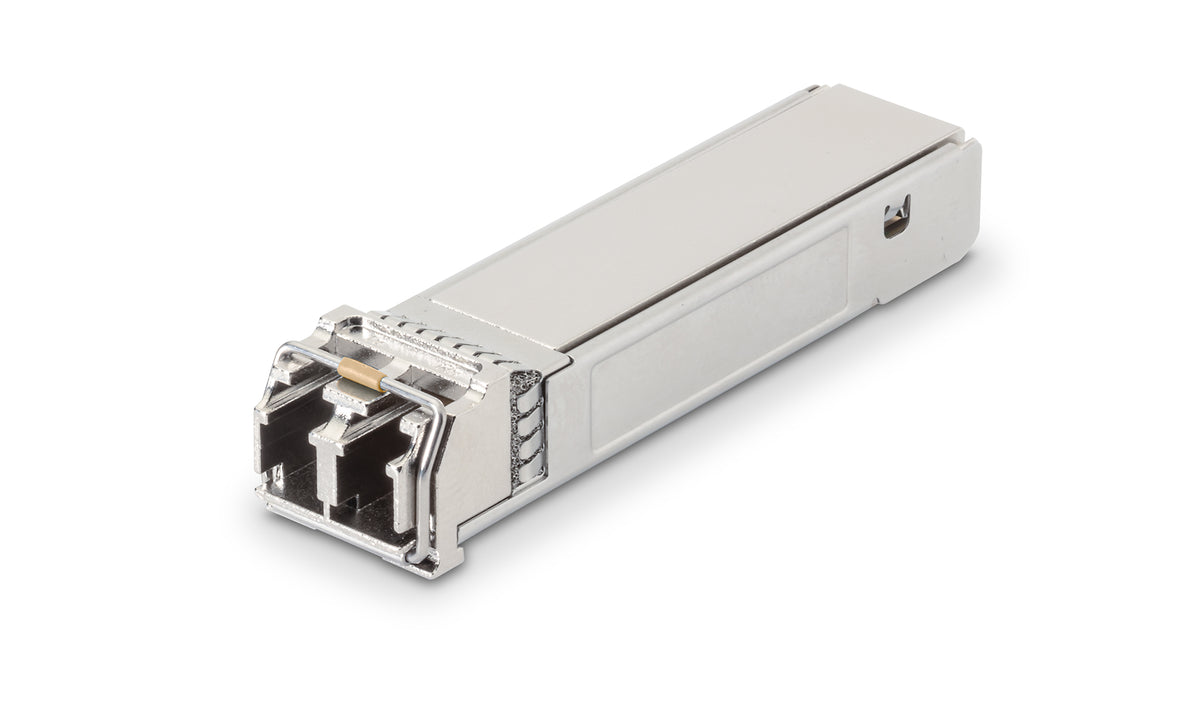
The Arista SFP-10G-SR is a hot-swappable SFP+ transceiver designed for 10 Gigabit Ethernet (10GbE) deployments, providing a maximum reach of 300 meters over OM3-grade multimode fiber. Operating at a 850nm wavelength, this module is the industry standard for short-range, high-bandwidth connectivity between switches, servers, and storage arrays in high-density data center environments.
Understanding the Arista 10GBASE-SR Specification
The "SR" in 10GBASE-SR stands for Short Range. In the context of Arista’s networking portfolio, the SFP-10G-SR module represents the most common optical interface used for high-speed local area network (LAN) connections. While single-mode fiber (SMF) is preferred for long-haul telecommunications, multimode fiber (MMF) remains the dominant choice for indoor data center cabling due to its lower total cost of ownership, easier termination, and the lower cost of the transceivers themselves.
As of 2026, the 10GbE standard remains a foundational technology. While the industry has moved toward 100G, 400G, and even 800G for core and spine-leaf uplinks, 10GbE continues to be the primary choice for management networks, legacy server attachments, and various edge-computing applications where 25G or higher is not yet a cost-effective requirement.
The Arista SFP-10G-SR operates on the 850nm wavelength, utilizing a Vertical-Cavity Surface-Emitting Laser (VCSEL). This laser type is highly efficient and significantly less expensive to manufacture than the edge-emitting lasers required for long-range single-mode optics. The module supports a nominal data rate of 10.3 Gbps, adhering strictly to the IEEE 802.3ae standard.
Fiber Types and Distance Limitations
The ability of an Arista SFP-10G-SR to reach its maximum 300-meter rating is entirely dependent on the quality and grade of the multimode fiber (MMF) being used. Multimode fiber is categorized by its "OM" (Optical Multimode) rating, which defines its modal bandwidth.
Modal Dispersion and the 10G Challenge
In multimode fiber, light travels down the core in multiple paths or "modes." Because these paths have slightly different lengths, different parts of the light signal arrive at the receiver at slightly different times. This phenomenon is known as modal dispersion. At higher speeds, such as 10Gbps, the pulses of light are very close together. If they spread out too much (disperse), they overlap, and the receiver can no longer distinguish between the 1s and 0s.
To reach 300 meters, the fiber must have a high enough modal bandwidth to minimize this spreading.
Distance Comparisons by Fiber Grade
- OM1 (62.5/125 µm): This legacy fiber (usually orange-jacketed) has a very low modal bandwidth. At 10Gbps, the Arista SFP-10G-SR is limited to approximately 33 meters.
- OM2 (50/125 µm): Also considered legacy, OM2 improves the reach to roughly 82 meters.
- OM3 (50/125 µm, Laser-Optimized): This is the minimum requirement to achieve the 300-meter link distance stated in the product specifications. OM3 fiber (aqua-jacketed) is designed specifically for use with 850nm VCSELs.
- OM4/OM5 (50/125 µm): These higher grades of fiber allow the Arista SFP-10G-SR to exceed its standard rating, often reaching up to 400 meters or more, depending on the quality of the patches and total link loss.
Technical Specifications and Power Budgets
For a network engineer in 2026, understanding the physical layer specs is critical for link budget planning. If a link exceeds 300 meters or has too many patch points, the "light budget" may be exceeded, leading to bit errors or total link failure.
| Feature | Specification |
|---|---|
| Media Type | Multimode Fiber (MMF) |
| Connector Type | Dual LC |
| Wavelength | 850 nm |
| Max Distance (OM3) | 300 Meters |
| Max Distance (OM4) | 400 Meters |
| Transmit Power (Min) | -7.3 dBm |
| Transmit Power (Max) | -1.0 dBm |
| Receive Sensitivity (Max) | -9.9 dBm |
| Power Consumption | < 1.0 Watt |
| Operating Temp Range | 0°C to 70°C (Commercial) |
Digital Optical Monitoring (DOM)
One of the most valuable features of the Arista SFP-10G-SR is Digital Optical Monitoring, often referred to as DOM or DDM (Digital Diagnostics Monitoring). This technology allows the Arista EOS (Extensible Operating System) to report real-time parameters of the transceiver. Engineers can monitor:
- Optical Transmit Power: To ensure the laser is functioning within spec.
- Optical Receive Power: To detect if there is too much attenuation in the fiber run.
- Temperature: To prevent overheating in high-density chassis.
- Laser Bias Current: To predict potential laser failure before it happens.
- Supply Voltage: To ensure the switch is providing clean power to the module.
Deployment Scenarios in Modern Data Centers
While 10G might seem "slow" compared to 400G backplanes, the SFP-10G-SR remains a staple in the Arista ecosystem for several specific roles.
Top of Rack (ToR) to End of Row (EoR)
In larger data center rows, a ToR switch might need to connect to an aggregation or EoR switch. If the row is long or the cabling must travel through overhead trays to a central patch panel, the distance often exceeds the 7-meter or 10-meter limit of Direct Attach Copper (DAC) cables. The SFP-10G-SR provides a reliable 100-300 meter buffer that covers almost any internal data center floor plan.
Campus Backbone Connectivity
For smaller organizations or satellite offices, 10GbE is frequently used as the "backbone" connecting different floors or buildings. Since many older buildings are pre-wired with OM3 fiber, the SFP-10G-SR is the most efficient way to upgrade from 1GbE to 10GbE without the massive expense of re-pulling single-mode fiber.
High-Fidelity Storage Networking
Storage Area Networks (SANs) using iSCSI or FCoE (Fiber Channel over Ethernet) require stable, low-latency connections. The Arista SFP-10G-SR offers lower latency than 10GBASE-T (copper RJ45) because it avoids the complex signal processing required to push 10Gbps over twisted-pair copper.
Arista EOS Compatibility and Software Considerations
Arista switches run EOS (Extensible Operating System), which is known for its open, programmable nature. However, the switch must recognize the transceiver to initialize the link correctly.
Genuine Arista vs. Third-Party Optics
Arista typically codes their transceivers with specific EEPROM data. When you plug an Arista SFP-10G-SR into an Arista 7050 or 7280 series switch, the switch identifies it immediately.
If a network administrator uses a non-Arista branded optic, the switch may mark the port as "unsupported." While Arista has historically been more flexible than competitors like Cisco or HP, certain versions of EOS may require a specific command to enable the use of third-party transceivers:
switch(config)# service unsupported-transceiver
Note: In 2026, the use of genuine Arista optics is still highly recommended for mission-critical paths to ensure full support from Arista TAC (Technical Assistance Center) during outages.
Checking Link Status via CLI
To verify that your Arista SFP-10G-SR is performing correctly and hitting its 300-meter potential, you can use several EOS commands:
show inventory: Confirms the module is recognized and provides the serial number.show interfaces ethernet transceiver: Provides the DOM data (TX/RX power).show interfaces ethernet: Look for CRC errors or Input errors. If you see these on a 300m link, it usually indicates dirty fiber or a link that is slightly too long for the power budget.
Installation and Maintenance Best Practices
To ensure a link actually reaches 300 meters without issues, physical layer maintenance is paramount.
The "Cleanliness First" Rule
The most common cause of failure in 10GBASE-SR links is contamination. A single speck of dust on the 850nm laser aperture or the LC connector can cause significant signal attenuation or reflection.
- Always use a click-cleaner or lint-free wipes with 99% isopropyl alcohol before mating connectors.
- Never touch the end-face of the fiber or the optic with your bare fingers.
Understanding Bend Radius
Multimode fiber is sensitive to "macro-bending." If the fiber is bent too sharply (usually a radius less than 1 inch or 25mm), light leaks out of the core into the cladding. This increases attenuation. In a 300-meter run, several sharp bends can add up, causing the receive power to drop below the -9.9 dBm sensitivity threshold of the Arista SFP-10G-SR.
Cable Management
In high-density Arista 7000-series switches, cable strain can physically pull the SFP+ module out of its seat or put pressure on the internal alignment of the LC duplex connector. Use "J-hooks" or Velcro ties (never zip-ties) to support the weight of the 300m fiber bundles.
Troubleshooting Common Link Issues
If you have installed an Arista SFP-10G-SR and the link is down or performing poorly, follow this structured troubleshooting path:
- Verify Physical Link: Ensure the "Link" LED on the Arista switch is green. If it is dark, the optic may not be seated, or there is a total break in the fiber.
- Check Transmit/Receive Power: Use the
show interfaces transceivercommand. If the RX power is "Low Alarm" or "Low Warning," you have too much loss in the fiber. If the TX power is low, the optic itself may be failing. - Swap the Optic: Move the SFP-10G-SR to a known-good port. If the problem follows the optic, replace the module.
- Test the Fiber: Use a VFL (Visual Fault Locator) or "red light" tool to check for breaks. For 300-meter links that are failing, an OTDR (Optical Time-Domain Reflectometer) can pinpoint the exact meter-mark where a break or a bad splice is located.
- Polarity Check: Multimode fiber uses a "Transmit" and "Receive" strand. If the link won't come up, try a "crossover" at one end to ensure TX is hitting RX.
Alternatives to 10GBASE-SR
While the SFP-10G-SR is versatile, it isn't always the best tool for the job.
- DAC (Direct Attach Copper): For distances under 7 meters (like within a single rack), DAC is cheaper, uses less power, and has lower latency.
- AOC (Active Optical Cable): These are SFP+ ends permanently attached to a fiber cable. They are great for "Top of Row" distances (up to 30m) where you don't want to deal with cleaning individual connectors.
- 10GBASE-LR: If you need to go beyond 300-400 meters, you must switch to Single-Mode Fiber and use the Arista SFP-10G-LR, which supports distances up to 10km.
- 10GBASE-ER: For campus-wide links, the "Extended Range" (ER) optics can reach up to 40km on single-mode fiber.
Comparison: Arista 10G SFP+ Options
| Optic Model | Media | Max Distance | Best Use Case |
|---|---|---|---|
| SFP-10G-SR | MMF (OM3) | 300m | Standard Data Center Link |
| SFP-10G-LR | SMF | 10km | Campus/Building to Building |
| SFP-10G-ER | SMF | 40km | Long-haul Metro |
| SFP-10G-T | Cat6a/7 | 30m | Legacy Copper Infrastructure |
| SFP-10G-CR | Copper (DAC) | 7m | Intra-rack connection |
FAQ
Does Arista SFP-10G-SR support 1GbE speeds?
Many Arista SFP-10G-SR modules are "dual-rate," meaning they can operate at both 1Gbps and 10Gbps. However, this depends on the specific hardware generation of the switch port. You may need to manually configure the speed using the speed forced 1000full command in EOS.
Can I use OM1 fiber with an Arista 10G SR module?
Yes, but you will be severely limited in distance. You should not expect a stable link beyond 33 meters. If you must use 10G over long runs of legacy OM1 fiber, you may need "Mode Conditioning" patch cables, though these are typically used for LX/LH optics rather than SR.
What is the difference between SFP-10G-SR and SFP-10G-SRL?
In Arista's catalog, the SRL stands for "SR-Lite." These are often lower-cost versions with slightly reduced specifications or shorter validated distances. Always check the specific datasheet, as SRL optics might not reach the full 300m on OM3.
Is the Arista SFP-10G-SR compatible with other brands?
The 10GBASE-SR standard is universal. An Arista SFP-10G-SR on one end of a fiber can talk to a Cisco, Juniper, or Dell 10GBASE-SR optic on the other end without issue, provided the fiber type and wavelength match.
Can I plug a 10G SR optic into a 25G or 40G port?
Arista QSFP ports (40G/100G) can often accept SFP+ optics using a QSA (QSFP-to-SFP Adapter). Additionally, 25G SFP28 ports are generally backwards compatible with 10G SFP+ optics like the SFP-10G-SR.
Final Recommendation
When deploying Arista SFP-10G-SR transceivers in 2026, the key to success lies in the infrastructure. If your goal is to hit the 300-meter limit, ensure your facility is wired with OM3 or OM4 laser-optimized fiber. For any new installations, opting for OM4 is a wise choice to provide a buffer for signal degradation and potential future upgrades to 25G or 40G over the same glass. Always prioritize port cleanliness and use EOS's built-in DOM features to monitor your links proactively.