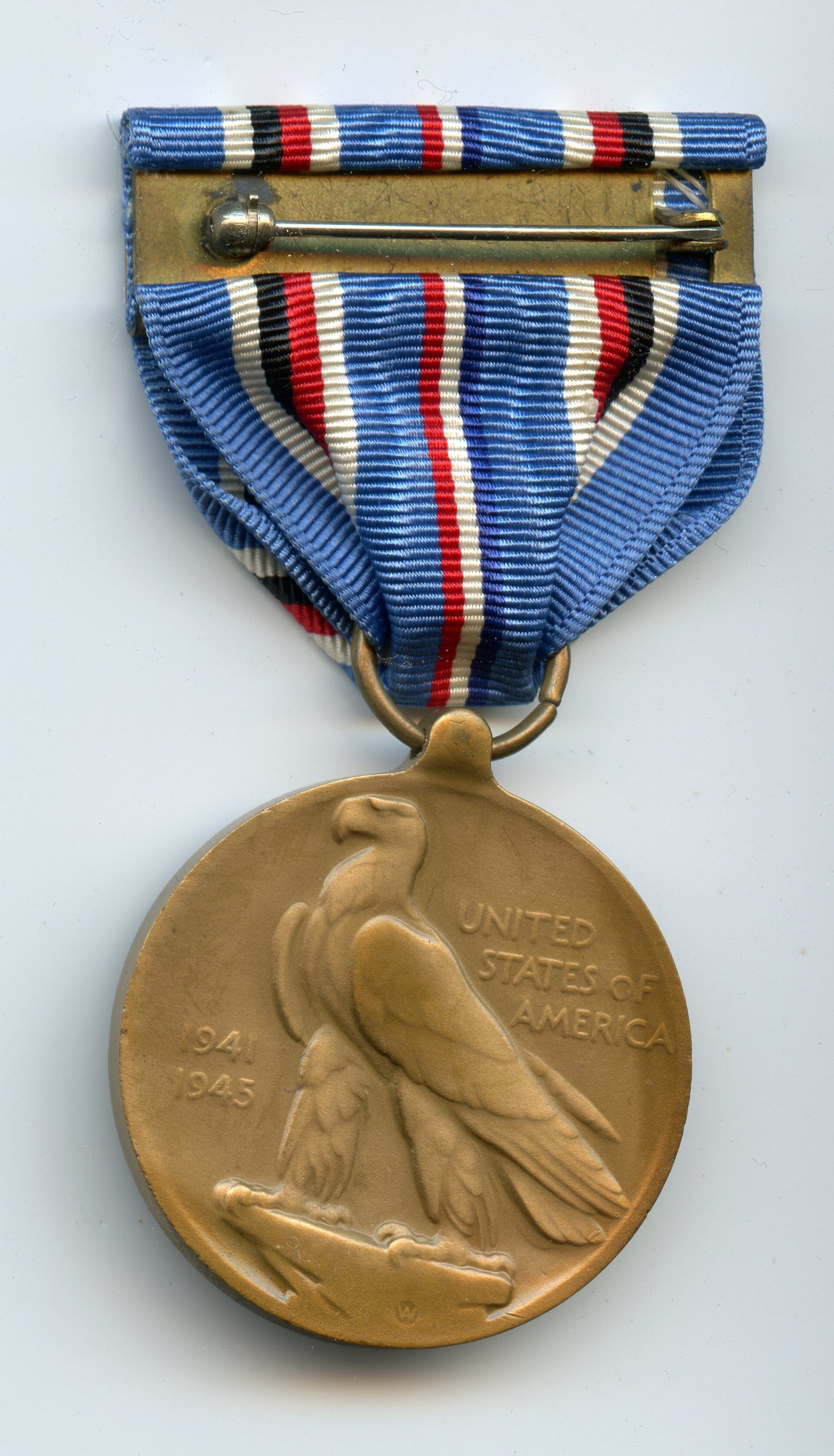
The American Campaign Medal is a United States military award established in 1942 to recognize service members who performed duty within the American Theater of Operations during World War II. To qualify, personnel generally had to serve for an aggregate of one year within the continental limits of the United States or 30 consecutive days (or 60 non-consecutive days) outside those limits but within the designated theater between December 7, 1941, and March 2, 1946.
The Historical Origins of the American Campaign Medal
The American Campaign Medal was created during the height of World War II as part of a broader effort to recognize the global nature of the conflict. On November 6, 1942, President Franklin D. Roosevelt signed Executive Order 9265, which established three distinct theater campaign medals: the American Campaign Medal, the European-African-Middle Eastern (EAME) Campaign Medal, and the Asiatic-Pacific Campaign Medal.
Initially, these awards were issued only as ribbon bars. The physical bronze medals were not authorized or produced until after the war ended, with the final design for the American Campaign Medal being approved in 1947. This delay was primarily due to the scarcity of metal during the war years and the administrative priority of managing active combat operations.
The medal serves as a testament to those who defended the "Home Front" and the surrounding maritime boundaries. While often overshadowed by the combat-heavy narratives of the European and Pacific theaters, the American Theater was a site of significant activity, including anti-submarine warfare, coastal defense, and the massive logistical efforts required to sustain a two-front war.
Defining the American Theater of Operations
To understand eligibility, one must first understand the geographical scope of the American Theater as defined by the Department of Defense. This theater was expansive, covering a significant portion of the Western Hemisphere. The boundaries included:
- Eastern Boundary: From the North Pole, south along the 75th meridian west longitude to the 77th parallel north latitude, then southeast through Davis Strait to the intersection of the 40th parallel north latitude and the 35th meridian west longitude, then south to the 10th parallel north latitude, then southeast to the intersection of the Equator and the 20th meridian west longitude, and finally south along the 20th meridian west longitude to the South Pole.
- Western Boundary: From the North Pole, south along the 141st meridian west longitude to the east boundary of Alaska, then south and southeast along the Alaska-Canada boundary to the Pacific Ocean, then south along the 130th meridian west longitude to the 30th parallel north latitude, then southeast to the intersection of the Equator and the 100th meridian west longitude, and finally south along the 100th meridian west longitude to the South Pole.
Essentially, this included all of the continental United States, Alaska, the Aleutian Islands, Hawaii, parts of the Caribbean, and vast stretches of the Atlantic and Pacific Oceans.
Eligibility Criteria and Service Requirements
Eligibility for the American Campaign Medal is governed by specific regulations that differ slightly depending on whether the service was performed within the Continental United States (CONUS) or outside of it.
Service Outside the Continental United States
For those stationed outside the continental limits of the U.S. but within the American Theater (such as in Alaska, Hawaii, or the Caribbean), the requirements are:
- Permanent Assignment: Any length of time if the individual was permanently assigned to a unit outside CONUS.
- Temporary Duty: 30 consecutive days or 60 non-consecutive days of service.
- Combat Participation: Direct participation in combat against the enemy, provided the individual was awarded a combat decoration or furnished a certificate by a corps commander (or higher) stating they actually participated in combat.
Service Within the Continental United States
For personnel whose service was restricted to the 48 states (at the time), the requirements were more stringent to ensure the medal remained a mark of significant contribution:
- Duration: Service for an aggregate period of one year between December 7, 1941, and March 2, 1946.
- Continuous Service: This year of service did not necessarily have to be continuous, but it had to occur within the specified eligibility window.
Naval and Maritime Service
Personnel serving on vessels operating within the American Theater qualified if they were assigned to the vessel for a period of 30 consecutive days or 60 non-consecutive days. This specifically included those engaged in the critical Battle of the Atlantic and anti-submarine patrols along the East and West coasts.
Design and Symbolism of the Medal
The American Campaign Medal is rich in symbolic detail, reflecting the diverse responsibilities of the Armed Forces during the era. The medal was designed by Thomas Hudson Jones and the obverse (front) was sculpted by Anthony de Francisci.
The Obverse (Front)
The front of the bronze medal depicts a central scene of modern warfare. It features a Navy cruiser steaming through the ocean, with a B-24 Liberator bomber flying overhead. In the foreground, a sinking enemy submarine is visible, representing the intense anti-submarine warfare that took place in American waters. In the background, a small cityscape suggests the "Home Front" that these forces were protecting. The words "AMERICAN CAMPAIGN" are embossed across the top.
The Reverse (Back)
The reverse side is consistent across all three theater medals (American, EAME, and Asiatic-Pacific). it features a powerful American bald eagle perched upon a rock. The eagle is flanked by the dates "1941-1945" and the words "UNITED STATES OF AMERICA." This design emphasizes the unity and strength of the nation throughout the duration of the global conflict.
The Ribbon Specifications
The ribbon is primarily orient blue, representing the Americas. In the center, there are three stripes of white, black, and red (representing Germany) and white, black, and red (representing Japan), symbolizing the enemies the U.S. was fighting on both sides. Near the edges, there are stripes of white, red, and white, mirroring the colors of the United States.
Authorized Devices and Campaign Stars
While the medal itself recognizes general service, specific achievements or participation in recognized campaigns are noted through the use of service stars.
- Bronze Service Stars: These are authorized for wear on the ribbon for those who participated in specific designated campaigns. For the American Theater, these campaigns were primarily maritime and aerial.
- Recognized Campaigns:
- Antisubmarine Campaign: This applied to personnel who served in units specifically designated as participating in anti-submarine operations between December 7, 1941, and September 2, 1945.
- Ground Combat: While rare in the American Theater, specific instances like the Aleutian Islands Campaign (before it was moved to the Asiatic-Pacific designation for certain periods) or specific coastal defense actions could qualify.
If an individual was awarded the medal for service within the continental U.S. without participating in a specific campaign, the ribbon is worn "plain," without any stars.
Comparison of WWII Theater Campaign Medals
To provide context on where the American Campaign Medal fits within the hierarchy of WWII service awards, the following table compares the three primary theater medals.
| Medal Name | Established | Primary Theater Focus | Key Eligibility Window | Primary Ribbon Color |
|---|---|---|---|---|
| American Campaign Medal | Nov 6, 1942 | North/South America, Atlantic/Pacific coastal zones | Dec 7, 1941 – Mar 2, 1946 | Blue |
| Asiatic-Pacific Campaign Medal | Nov 6, 1942 | Pacific Ocean, Asia, Oceania | Dec 7, 1941 – Mar 2, 1946 | Orange |
| European-African-Middle Eastern Campaign Medal | Nov 6, 1942 | Europe, North Africa, Middle East | Dec 7, 1941 – Nov 8, 1945 | Brown |
How to Verify Eligibility and Request a Medal in 2026
As we move further from the events of World War II, many families seek to verify the service of their ancestors and obtain the medals they earned. In 2026, the process remains standardized through federal channels.
1. Review the DD Form 214
The DD Form 214 (Report of Separation) is the primary document used to verify military service and awards. For WWII-era veterans, this form—or its predecessor, the WD AGO form—will list "Campaign Medals" or "Service Awards." If "American Campaign Medal" or "American Theater Ribbon" is listed, the veteran is officially credited.
2. Requesting Records from NARA
If the records are lost, the next-of-kin can request a copy of the veteran's Official Military Personnel File (OMPF) from the National Personnel Records Center (NPRC), which is part of the National Archives. Requests can be submitted online through the eVetRecs portal or via Standard Form 180.
3. Applying for Replacement Medals
The U.S. government provides one set of replacement medals to the veteran or their primary next-of-kin at no cost. In 2026, these requests should be directed to the specific branch of service's awards center:
- Army: U.S. Army Human Resources Command (Fort Knox).
- Navy/Marine Corps/Coast Guard: Navy Personnel Command or the National Personnel Records Center.
- Air Force: (Note: Air Force personnel during WWII were part of the Army Air Forces; requests go through the Army or NPRC).
Proper Wear and Display
For active-duty personnel (though rare as of 2026, this applies primarily to ceremonial or historical wear) and veterans in civilian attire, the American Campaign Medal follows strict protocols.
- Order of Precedence: The medal is worn after the Women's Army Corps Service Medal and before the Asiatic-Pacific Campaign Medal.
- Civilian Display: Many families choose to display the medal in a shadow box alongside the veteran’s photograph, discharge papers, and other decorations. It is recommended to use acid-free mounting materials to preserve the silk ribbon and the bronze finish of the medal.
- Cleaning: The medal is made of bronze. It should generally not be cleaned with harsh chemicals. A light dusting with a soft cloth is usually sufficient. If the ribbon is frayed, authentic replacement ribbons can be purchased from authorized military insignia dealers.
Frequently Asked Questions
Can a veteran receive both the American Campaign Medal and the World War II Victory Medal?
Yes. The American Campaign Medal recognizes service within a specific geographic theater, while the World War II Victory Medal is a general service medal awarded to all members of the Armed Forces who served at any time between December 7, 1941, and December 31, 1946. Most veterans who earned the American Campaign Medal also qualified for the Victory Medal.
Why did some veterans only receive the ribbon and not the medal?
During the war, the bronze medals were not yet manufactured. Veterans were issued "ribbon bars" to wear on their uniforms. While the government authorized the medals later, many veterans had already transitioned back to civilian life and never formally applied for the physical bronze medal.
Is the American Campaign Medal considered a "combat" medal?
It is classified as a "service medal," not a "valor medal" like the Silver Star. However, it can be awarded for combat participation if the recipient was involved in active engagements with the enemy within the American Theater (such as naval battles with U-boats). In these cases, the recipient is often entitled to a Bronze Service Star on the ribbon.
What is the difference between the "American Defense Service Medal" and the "American Campaign Medal"?
The American Defense Service Medal was awarded for service before the U.S. entered the war (September 8, 1939, to December 7, 1941). The American Campaign Medal is specifically for service after the attack on Pearl Harbor through the end of the war.
Are merchant marines eligible for this medal?
Merchant Marines served under different regulations. While they performed similar duties, they were often awarded the Merchant Marine American Theater Medal, which has a different design but recognizes similar service during the same timeframe.
Next Steps for Researchers and Families
If you believe a family member was entitled to the American Campaign Medal but never received it, your first step should be to secure their discharge papers. If those papers show at least one year of service within the U.S. during the qualifying dates, or any service outside CONUS within the American Theater, you are likely eligible to request the medal from the National Archives. Verifying these records not only honors the individual's service but also preserves a vital piece of family and national history.