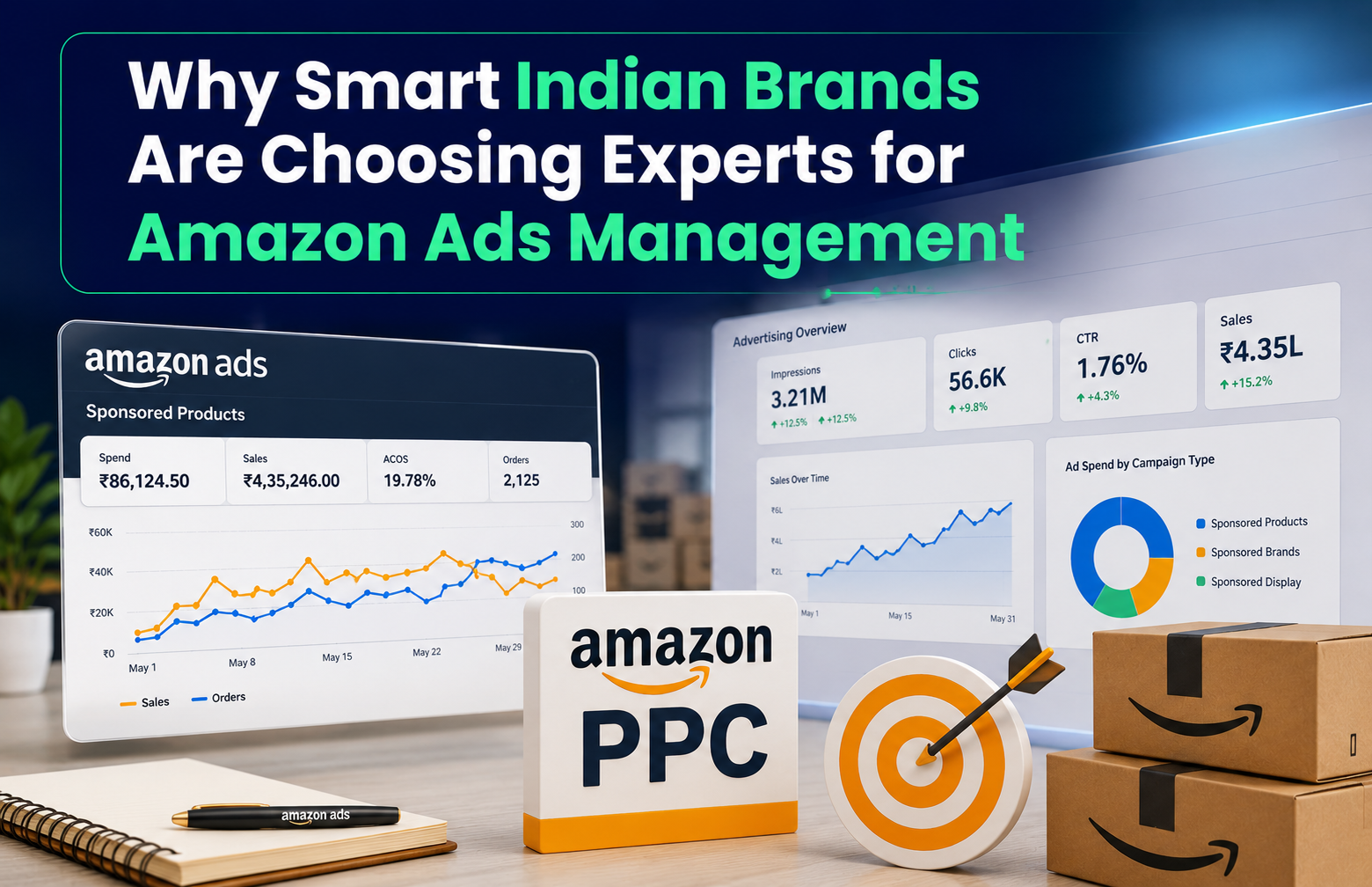
Amazon Ads India is the integrated advertising suite provided by Amazon.in to help sellers, vendors, and agencies reach millions of shoppers across the Indian subcontinent. By 2026, the platform has evolved into a sophisticated ecosystem utilizing AI-driven placements and diverse media formats to drive product discoverability and brand loyalty in one of the world's fastest-growing e-commerce markets.
The Indian e-commerce landscape in 2026 is characterized by a mobile-first population, a massive surge in Tier-2 and Tier-3 city shoppers, and a highly competitive "Great Indian Festival" seasonal cycle. For any business selling on Amazon.in, advertising is no longer just a luxury for growth—it is a functional necessity to maintain organic visibility and defend market share against aggressive domestic and international competitors.
The Evolution of the Amazon Ads Ecosystem in India
In the early 2020s, advertising on Amazon was primarily about keyword bidding for search results. Fast forward to 2026, and the platform has integrated deep learning models that predict consumer intent with high precision. Amazon Ads India now encompasses everything from basic search ads to high-production video content on Amazon miniTV and programmatic buying via the Amazon DSP (Demand Side Platform).
The primary objective for advertisers in the Indian market is balancing ACOS (Advertising Cost of Sales) with ROAS (Return on Ad Spend) while navigating a price-sensitive consumer base. Indian shoppers are known for extensive research, price comparisons, and a heavy reliance on "Social Proof" (reviews and ratings). Consequently, your advertising strategy must align with these behavioral patterns to be successful.
Core Prerequisites for Advertising on Amazon.in
Before launching your first campaign, several foundational requirements must be met. The Indian regulatory environment and Amazon’s internal policies necessitate specific documentation and account setups.
- Active Seller or Vendor Account: You must have a professional seller account on Amazon.in. This requires a GST (Goods and Services Tax) registration, which is mandatory for selling taxable goods in India.
- Amazon Brand Registry: While not strictly mandatory for Sponsored Products, Brand Registry is a prerequisite for Sponsored Brands, Sponsored Display, and creating an Amazon Storefront. In India, this requires a valid trademark registered with the Controller General of Patents, Designs and Trademarks.
- Account Health and Buy Box: Ads will only serve if your product is the "Featured Offer" (formerly known as the Buy Box). High shipping times or poor seller ratings can disqualify your ads from appearing.
- Compliance with Local Laws: Advertisements must adhere to the Advertising Standards Council of India (ASCI) guidelines, particularly concerning claims about health, finance, and product superiority.
Primary Ad Formats and Their Strategic Applications
Understanding the nuances of each ad format is critical for budget allocation. Each format serves a different stage of the marketing funnel, from awareness to conversion.
Sponsored Products
This is the "bread and butter" of Amazon advertising in India. These ads appear directly in search results and on product detail pages. They are highly effective because they are "native"—they look like organic listings except for the "Sponsored" tag.
- Best For: Driving immediate sales, launching new products, and boosting organic ranking through increased sales velocity.
- Targeting: You can target specific keywords (Manual) or let Amazon’s algorithm find relevant queries (Automatic).
Sponsored Brands
These ads allow you to showcase your brand logo, a custom headline, and multiple products. In 2026, the video component of Sponsored Brands has become the highest-converting sub-format in India, as shoppers prefer visual demonstrations over static images.
- Best For: Building brand awareness, promoting a product portfolio, and capturing top-of-the-funnel traffic.
- New Feature: "Storefront" integration allows you to drive traffic to a customized multi-page brand landing page within Amazon.
Sponsored Display
Sponsored Display uses machine learning to reach audiences both on and off Amazon. This is particularly powerful in India for retargeting shoppers who viewed your product but didn't buy, or for targeting customers browsing complementary categories (e.g., showing a laptop bag ad to someone looking at laptops).
- Best For: Defensive strategies (on your own product pages) and offensive strategies (targeting competitor pages).
Amazon miniTV and Video Ads
A unique aspect of the Indian market is the popularity of Amazon miniTV, a free, ad-supported video service within the Amazon shopping app. By 2026, advertisers can run non-skippable video ads here, reaching a massive audience that consumes "snackable" content between shopping sessions.
Comparison of Amazon Ads India Formats (2026 Data)
| Ad Format | Primary Goal | Targeting Options | Placement | Cost Model |
|---|---|---|---|---|
| Sponsored Products | Conversion | Keywords, Products | Search Results, Detail Pages | CPC (Cost Per Click) |
| Sponsored Brands | Brand Loyalty | Keywords, Products | Top of Search, Video | CPC / vCPM |
| Sponsored Display | Retargeting | Audiences, Interests | On/Off Amazon, Third-party apps | CPC / vCPM |
| Amazon DSP | Awareness/Scale | Behavioral, Demographics | Across the Web, IMDb, miniTV | CPM (Cost Per Mille) |
| Sponsored Brands Video | Engagement | Keywords, Categories | Middle of Search Results | CPC |
Strategic Optimization for the Indian Market
To succeed with Amazon Ads India, a generic global strategy will rarely suffice. The Indian market demands localization and a deep understanding of regional cycles.
1. Leveraging Regional Languages
By 2026, Amazon.in supports multiple regional languages including Hindi, Tamil, Telugu, Kannada, Malayalam, Bengali, and Marathi. Smart advertisers are now optimizing their backend keywords and ad copy to reflect how people search in their native tongues. For instance, a shopper in rural Maharashtra might search for a "water heater" using local terminology.
2. The "Sales Festival" Strategy
The Indian calendar is dominated by major shopping events:
- The Great Indian Festival (Diwali): The largest event of the year. CPCs typically triple, and advertisers must plan their budgets 2-3 months in advance.
- Prime Day: Usually held in July, focusing on Prime members who have a higher lifetime value.
- Republic Day & Independence Day Sales: Significant spikes in consumer electronics and fashion.
During these periods, the strategy shifts from ACOS-efficiency to Top-of-Search dominance. If you aren't visible in the first three slots during Diwali, your sales velocity will drop significantly compared to competitors who are bidding aggressively.
3. Bidding and Budget Management
Amazon uses a "second-price auction" model. However, in 2026, Dynamic Bidding (Up and Down) has become the standard. This allows Amazon to increase your bid by up to 100% if it feels a conversion is highly likely. For the price-sensitive Indian market, setting "Bid Caps" is essential to prevent runaway costs during high-traffic windows like 8:00 PM to 11:00 PM IST, when most Indian consumers are active on their mobile devices.
Advanced Metrics: Moving Beyond ACOS
While ACOS remains the most discussed metric, advanced sellers in India now focus on Total Advertising Cost of Sales (TACOS) and New-to-Brand (NTB) metrics.
- TACOS: This measures your total ad spend against your total revenue (organic + paid). A healthy TACOS in the Indian consumer electronics category is typically between 8% and 12%.
- NTB Metrics: This tells you how many customers are buying from your brand for the first time. In a growing market like India, acquiring a new customer is often worth a temporary hit to ROAS, as the lifetime value (LTV) of that customer can be harvested through email marketing and retargeting later.
Common Mistakes to Avoid in Amazon Ads India
- Ignoring Negative Keywords: Many Indian sellers lose money by appearing for irrelevant "Broad" match queries. For example, if you sell "Gold Jewelry," you must add "Artificial" and "Imitation" as negative keywords to avoid wasting budget on low-intent clicks.
- Poor Mobile Optimization: Over 80% of Amazon.in traffic is mobile. If your Sponsored Brand video or A+ content isn't legible on a small screen, your conversion rate will crater, regardless of how much you spend on ads.
- Inconsistent Stock Levels: Running ads for out-of-stock products is a cardinal sin. Amazon's algorithm penalizes listings that drive traffic but cannot fulfill orders, leading to a drop in organic ranking that can take weeks to recover.
- Static Creative: In the 2026 landscape, consumers have "ad blindness." Refreshing your Sponsored Display imagery and Sponsored Brand headlines every 30-45 days is necessary to maintain a high Click-Through Rate (CTR).
The Role of AI and Automation in 2026
The Amazon Advertising console now provides "AI-generated image and video" tools specifically for the Indian marketplace. These tools can take a standard product photo and place it in a culturally relevant lifestyle setting (e.g., a kitchen during a festival or a traditional Indian living room). Utilizing these tools reduces the cost of creative production, which was previously a barrier for smaller D2C brands in India.
Furthermore, Marketing Stream, a real-time data API, allows advertisers to see hourly performance. Since Indian shopping habits peak sharply in the evening, using automation to "daypart" your bids—increasing them during peak hours and lowering them during the late-night lull—can improve efficiency by 15-20%.
FAQ about Amazon Ads India
1. What is a good ACOS for a seller on Amazon.in? A "good" ACOS is relative to your product margins and goals. Generally, for a mature product in India, an ACOS between 15% and 25% is considered healthy. For new product launches, an ACOS of 50% or higher is common as you prioritize visibility and reviews over immediate profit.
2. Can I run ads if I don't have a GST number? No. To sell and advertise on Amazon.in, a GST registration is a legal requirement for most categories. Even if your turnover is below the standard threshold, Amazon requires GST details to create a seller account.
3. How much does it cost to start advertising on Amazon India? There is no minimum spend. You can start with as little as ₹50 per day for Sponsored Products. However, to see meaningful data and results in a competitive category, a daily budget of at least ₹500 to ₹1,000 is recommended.
4. What is the difference between Amazon Ads and Amazon DSP in India? Amazon Ads (Sponsored Products/Brands) is a self-service console for keyword-based search advertising. Amazon DSP (Demand Side Platform) is a programmatic platform that allows you to buy display, video, and audio ads across the internet (including sites like Times of India or NDTV) using Amazon’s first-party shopper data.
5. How do I improve my ad ranking without increasing my bid? Focus on your Click-Through Rate (CTR) and Conversion Rate (CR). Amazon’s auction rewards "Relevancy." If your ad converts better than a competitor’s, Amazon may give you a higher placement even if your bid is lower, because they make more money from the eventual sale.
Recommended Next Steps for Sellers
To maximize your impact with Amazon Ads India, start by auditing your current product listings. Ensure that your titles are localized and your images are high-quality. Once the foundation is solid, launch an Automatic Targeting campaign for 14 days to gather data on what Indian consumers are actually typing into the search bar. Use the "Search Term Report" from this campaign to graduate into Manual Targeting, where you can bid more aggressively on high-performing keywords.
Monitor your TACOS weekly and adjust your strategy based on the upcoming Indian festival calendar. In 2026, the brands that win are those that treat Amazon not just as a retail shelf, but as a dynamic media channel that requires constant optimization and cultural alignment.