In organic chemistry, the terms alpha carbon and beta carbon identify the relative positions of carbon atoms in a molecule based on their proximity to a specific functional group. The alpha carbon is the first carbon atom attached directly to the functional group, while the beta carbon is the second carbon atom in the chain, bonded to the alpha carbon.
Understanding the distinction between these two positions is a fundamental requirement for mastering organic reaction mechanisms. Whether you are studying the acidity of protons in a carbonyl compound or predicting the outcome of an elimination reaction in an alkyl halide, the location of the carbon atom dictates the chemical environment and the potential pathways for transformation. As of 2026, these structural definitions remains the cornerstone of IUPAC nomenclature and mechanistic organic chemistry, providing a universal language for researchers and students alike.
The Greek Lettering System in Organic Nomenclature
Organic molecules can be incredibly complex, often containing long chains of carbon atoms. While IUPAC numbering (1, 2, 3...) provides a systematic way to name molecules for identification, the Greek lettering system ($\alpha, \beta, \gamma, \delta, \epsilon$) is used specifically to describe the relative distance of atoms from a "group of interest," usually a functional group like a carbonyl ($C=O$), a hydroxyl ($-OH$), or a halogen ($-X$).
The alpha ($\alpha$) position is always the one immediately adjacent to the functional group. Moving further away along the carbon skeleton, the next carbon is the beta ($\beta$) position, followed by the gamma ($\gamma$), delta ($\delta$), and epsilon ($\epsilon$) positions. This system is particularly useful because the reactivity of a carbon atom (and the hydrogens attached to it) changes significantly as you move further away from the electronegative or pi-bond-containing functional group.
The Alpha Carbon: Definition and Unique Reactivity
The alpha carbon is arguably the most strategically important site in many organic molecules, particularly in carbonyl-containing compounds like aldehydes, ketones, esters, and carboxylic acids. Because it is directly bonded to the functional group, it experiences the strongest inductive and resonance effects.
The Acidity of Alpha Protons
One of the most critical concepts in organic chemistry is the acidity of the hydrogens attached to the alpha carbon, known as alpha hydrogens. In a standard alkane, the $pKa$ of a hydrogen is approximately 50, making it essentially non-acidic. However, when a hydrogen is located on an alpha carbon adjacent to a carbonyl group, its $pKa$ drops significantly, often to the range of 19–20.
This dramatic increase in acidity occurs because the resulting conjugate base, called an enolate, is stabilized by resonance. The negative charge on the alpha carbon can be delocalized onto the electronegative oxygen atom of the carbonyl group. This resonance stabilization makes the formation of the enolate intermediate energetically favorable under basic conditions, allowing the alpha carbon to act as a nucleophile in reactions like the Aldol condensation or the Claisen rearrangement.
Stereochemistry at the Alpha Position
In the context of biochemistry, the alpha carbon is central to the structure of amino acids. In an alpha-amino acid, both the amino group ($-NH_2$) and the carboxyl group ($-COOH$) are attached to the same central carbon—the alpha carbon. Except for glycine, this alpha carbon is a chiral center (stereocenter), meaning it is bonded to four different groups. The spatial arrangement at this specific alpha carbon determines whether the amino acid is an L-isomer or a D-isomer, which is vital for the folding and function of proteins in living organisms.
The Beta Carbon: Structure and Role in Elimination
The beta carbon is the second carbon atom in the sequence, bonded directly to the alpha carbon but not to the functional group itself. While it may seem "further from the action," the beta carbon plays a decisive role in many reaction types, most notably in elimination reactions.
Beta-Elimination (1,2-Elimination)
In the study of alkyl halides and alcohols, the beta carbon is the site where "beta-elimination" occurs. In an E1 or E2 mechanism, a base abstracts a proton from the beta carbon, and a leaving group departs from the alpha carbon. This simultaneous or sequential process results in the formation of a double bond (pi bond) between the alpha and beta carbons, creating an alkene.
The presence and number of beta hydrogens are crucial. If a molecule lacks beta hydrogens (for example, neopentyl bromide), it cannot undergo E2 elimination. Furthermore, if there are multiple different beta carbons in a molecule, the reaction may produce a mixture of alkene isomers. Chemists use Zaitsev’s Rule to predict that the more substituted alkene (the one where the double bond is connected to more carbon groups) will generally be the major product, as it is more thermodynamically stable.
The Inductive Effect at the Beta Position
Unlike the alpha carbon, the beta carbon does not typically participate in resonance stabilization with the functional group. The electronic influence of the functional group on the beta carbon is primarily inductive. Because inductive effects weaken rapidly with distance, the beta hydrogens are significantly less acidic than alpha hydrogens. However, they are still more reactive than hydrogens in a standard hydrocarbon chain due to the electron-withdrawing nature of nearby electronegative atoms or groups.
Comparative Analysis: Alpha vs. Beta Carbon
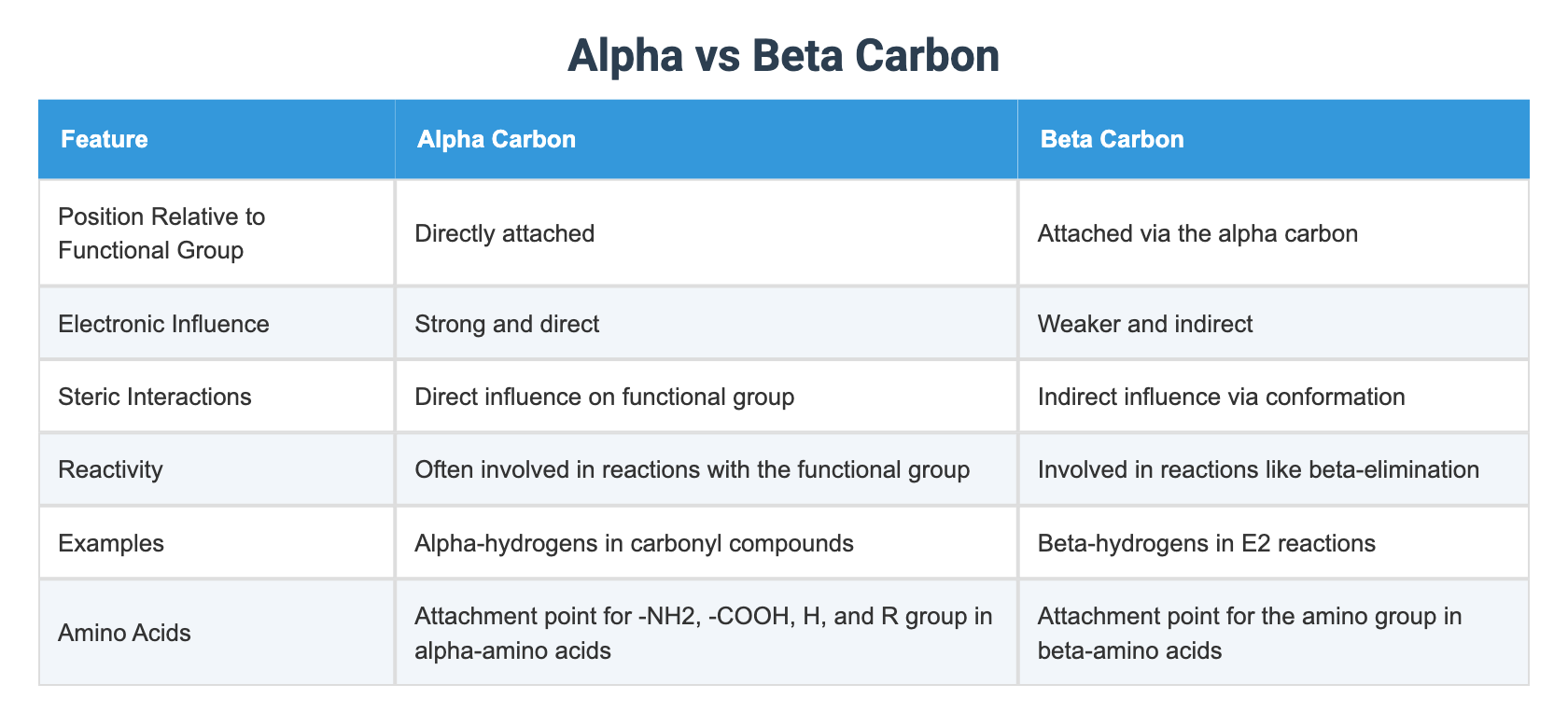
To better understand how these two positions differ in practice, it is helpful to compare their physical and chemical properties side-by-side.
| Feature | Alpha Carbon ($\alpha$) | Beta Carbon ($\beta$) |
|---|---|---|
| Distance | Directly bonded to the functional group. | Second carbon; bonded to the alpha carbon. |
| Proton Acidity | High (especially in carbonyls) due to resonance. | Low; primarily influenced by induction. |
| Primary Reaction Role | Nucleophile (via enolate) or site of substitution. | Site of proton abstraction in elimination. |
| Common Intermediate | Enol or Enolate. | Carbocation (in E1) or transition state (E2). |
| Hybridization | Usually $sp^3$, but becomes $sp^2$ in enols. | Usually $sp^3$, becomes $sp^2$ in the product alkene. |
| Biochemical Context | Central atom in amino acids. | Involved in $\beta$-oxidation of fatty acids. |
Chemical Reactions Involving Alpha and Beta Positions
The distinction between these carbons is not merely academic; it governs the outcome of numerous synthetic pathways used in pharmaceuticals and materials science.
1. Alpha-Substitution Reactions
In alpha-substitution, a hydrogen on the alpha carbon is replaced by an electrophile. This typically proceeds through an enol or enolate intermediate. Common examples include:
- Halogenation: Replacing an alpha hydrogen with a halogen (e.g., Bromine).
- Alkylation: Using a strong base (like LDA) to form an enolate, which then attacks an alkyl halide to extend the carbon chain.
2. The Aldol Reaction
The Aldol reaction is a classic example of alpha carbon utility. One carbonyl molecule forms an enolate at its alpha carbon, which then acts as a nucleophile to attack the carbonyl carbon of another molecule. This creates a new carbon-carbon bond between the alpha carbon of one molecule and the former carbonyl carbon of the second.
3. Dehydration of Beta-Hydroxy Carbonyls
Following an Aldol reaction, the resulting molecule is often a beta-hydroxy aldehyde or ketone (meaning an $-OH$ group is on the beta carbon). Under heat or acidic conditions, the molecule can undergo dehydration. A hydrogen is lost from the alpha carbon and the hydroxyl group is lost from the beta carbon, forming an alpha,beta-unsaturated carbonyl compound. This conjugated system is exceptionally stable and is a common structural motif in natural products.
4. Michael Addition (Conjugate Addition)
In alpha,beta-unsaturated systems, the beta carbon becomes an electrophilic site. Because of the conjugation with the carbonyl group, a nucleophile can attack the beta carbon rather than the carbonyl carbon itself. This is known as a 1,4-addition or Michael addition. It demonstrates that under certain structural conditions, the beta carbon can become a primary site of reactivity.
Practical Identification in Complex Molecules
Identifying alpha and beta carbons in simple chains is straightforward, but it can become challenging in cyclic or branched structures. To identify them correctly, follow these steps:
- Locate the Functional Group: Find the carbonyl, hydroxyl, halogen, or nitrile group.
- Identify the "Zero" Point: The carbon atom that is part of the functional group (like the carbonyl carbon) or the atom to which the group is attached is your starting point.
- Label the Alpha Carbon: Look at every carbon atom directly bonded to that starting point. If a ketone is unsymmetrical, it will have two different alpha carbons (one on the left, one on the right).
- Label the Beta Carbon: Follow the chain one step further. Any carbon bonded to an alpha carbon (that is not the original functional group carbon) is a beta carbon.
In a molecule like cyclohexanone, the two carbons adjacent to the $C=O$ group are both alpha carbons. The next carbons in the ring are the beta carbons. Because the molecule is symmetric, the two alpha positions are equivalent, but in substituted rings, they may behave differently due to steric hindrance.
Biological Significance: The Beta-Oxidation Pathway
The alpha/beta distinction is also vital in metabolism. Beta-oxidation is the process by which fatty acids are broken down in the mitochondria to generate energy. During this cycle, the fatty acid chain is oxidized specifically at the beta carbon.
The process involves a sequence of four reactions (dehydrogenation, hydration, oxidation, and thiolysis). By oxidizing the beta carbon into a carbonyl group, the bond between the alpha and beta carbons becomes weakened. This allows the enzyme thiolase to cleave the two-carbon fragment (acetyl-CoA) from the chain. This elegant biochemical pathway relies entirely on the specific chemical environment of the beta position relative to the thioester functional group.
Common Pitfalls and Misconceptions
Students often confuse the carbonyl carbon with the alpha carbon. In an aldehyde ($R-CHO$), the carbon of the $CHO$ group is the carbonyl carbon; the carbon atom in the $R$ group attached to it is the alpha carbon. A common mistake is attempting to deprotonate the hydrogen directly attached to the carbonyl carbon (the aldehydic hydrogen), which is not acidic. Only the hydrogens on the adjacent alpha carbon are acidic enough for enolate chemistry.
Another confusion arises in naming. In IUPAC numbering, the carbonyl carbon of a carboxylic acid is $C1$, making the alpha carbon $C2$. It is essential to remain consistent: if you are using Greek letters, $\alpha$ is the neighbor. If you are using IUPAC numbers, $C1$ is the functional group carbon itself.
Summary and Next Steps
The distinction between alpha and beta carbons is more than a labeling convention; it is a map of molecular reactivity. The alpha carbon is defined by its proximity to the functional group, offering a site for nucleophilic attacks and resonance-stabilized intermediates. The beta carbon serves as the foundation for elimination reactions and conjugate additions in unsaturated systems.
To further your understanding of these concepts, practitioners should focus on:
- Practicing Mechanism Drawing: Draw the movement of electrons in E2 eliminations to see how beta hydrogens are removed.
- Studying pKa Tables: Compare the acidity of protons at different positions to predict which site a base will attack first.
- Exploring Enolate Chemistry: Look into Regioselectivity, specifically how a chemist can choose to form a "kinetic" enolate vs. a "thermodynamic" enolate by targeting specific alpha carbons.
By mastering the relationship between these positions, you gain the ability to predict the behavior of complex organic molecules in both synthetic and biological environments.
Frequently Asked Questions
Can a molecule have more than one alpha carbon?
Yes. If a functional group is located in the middle of a carbon chain, such as in a ketone (e.g., 3-pentanone), there are two alpha carbons—one on either side of the carbonyl group. Depending on the symmetry of the molecule, these alpha carbons may be identical or different in their reactivity.
Why are beta hydrogens important in the E2 reaction?
In an E2 (Elimination Bimolecular) reaction, a base must remove a proton at the same time the leaving group departs. For the orbital overlap to occur correctly to form a new pi bond, the proton must be taken from the beta carbon. Without a beta hydrogen, the E2 mechanism cannot proceed.
Is the alpha carbon always $sp^3$ hybridized?
Initially, in many saturated molecules, the alpha carbon is $sp^3$ hybridized. However, during reactions like enolization, the alpha carbon changes its hybridization to $sp^2$ to accommodate the double bond in the enol or enolate form. This change is crucial for the planar geometry required for resonance.
What is an alpha-beta unsaturated compound?
This is a molecule where a double bond exists specifically between the alpha and beta carbons, conjugated with a carbonyl group. These compounds are uniquely stable and reactive, serving as the primary substrates for Michael addition reactions.
How does a gamma carbon differ from alpha and beta?
The gamma ($\gamma$) carbon is the third carbon atom from the functional group. Because it is further away, the inductive effect of the functional group is very weak, and there is no direct resonance path. Gamma carbons and their hydrogens typically behave like those in standard alkanes unless the molecule has a special cyclic or conjugated structure.