Ray Bradbury’s “All Summer in a Day” is a seminal science fiction short story that explores themes of isolation, jealousy, and the psychological impact of environment. Set on a perpetually rainy Venus, the narrative follows Margot, a young girl whose memories of the sun lead to her victimization by classmates who have never experienced it.
First published in 1954, "All Summer in a Day" remains a staple of middle-school and high-school curricula in 2026 due to its profound emotional resonance and mastery of descriptive language. The story serves as a cautionary tale about groupthink and the human tendency to fear or resent those who possess experiences different from our own. While the scientific understanding of Venus has evolved significantly since the 1950s, Bradbury’s "World of Rain" remains one of the most evocative settings in American literature.
The Narrative Framework: Plot and Setting on Venus
The story is set in a future where humans have established colonies on the planet Venus. In Bradbury’s fictionalized version of the solar system, Venus is a world of endless, torrential downpours. The rain has lasted for seven years, creating an environment of thick jungles and subterranean living quarters. The colonists live underground to escape the relentless pressure of the storms.
The plot centers on a specific day: the one day every seven years when the rain stops and the sun emerges for a single hour. This event is the focal point of the children’s lives, yet most of them are too young to remember the last time it happened. They are nine years old, meaning they were only two during the previous occurrence. Margot, however, moved to Venus from Earth five years ago. She is the only one who truly remembers what the sun looks like, feels like, and represents.
The Conflict of Memory and Jealousy
The primary conflict arises from Margot’s distinctness. Because she remembers the sun, she is pale, withdrawn, and physically frail. She finds the constant rain unbearable and refuses to participate in the games or songs of the other children unless they involve the sun. This "otherness" breeds deep resentment among her peers.
The children’s jealousy is fueled by the possibility that Margot’s parents may take her back to Earth. The thought that she might return to a world of permanent sunlight while they remain trapped in the rain creates a toxic social dynamic. This culminates in a cruel act of bullying just moments before the sun is scheduled to appear.
Character Analysis: Margot vs. The Group
Understanding the characters is essential to decoding the "All Summer in a Day" PDF text. The story is less about individual personalities and more about the interaction between a sensitive individual and a homogenous group.
Margot: The Burden of Earthly Memory
Margot is the story's protagonist, though she is largely passive. She is described as "an old photograph dusted from an album," highlighting her lack of vitality in the Venusian environment. To Margot, the sun is not just a weather event; it is a vital necessity for her soul. Her refusal to shower or play games underscores her total rejection of the rainy world. Her memory of the sun—"like a lemon," "like a penny," or "like a fire in the stove"—is her only treasure, and it is precisely this treasure that her classmates seek to devalue.
William and the Classmates: The Power of the Mob
William acts as the primary antagonist and the catalyst for the group's cruelty. He represents the voice of skepticism and malice. When he tells Margot, "You’re lying, you don’t remember!" he is trying to erase her advantage. The other children follow his lead, not necessarily because they are inherently evil, but because they are caught in a collective frenzy of anticipation and spite. The mob mentality allows them to commit an act of great cruelty—locking Margot in a windowless closet—without immediate guilt.
Themes and Symbolism in "All Summer in a Day"
Bradbury uses vivid imagery and symbolism to elevate a simple story of schoolyard bullying into a universal commentary on the human condition.
The Sun as a Symbol of Life and Truth
In the story, the sun represents more than heat or light; it represents truth and emotional warmth. When the sun finally emerges, the transformation of the children is instantaneous. They become "wild animals escaped from their caves," experiencing a vitality they never knew existed. The sun validates Margot’s "lies" and exposes the children’s ignorance.
The Closet: Isolation and Stolen Opportunity
The closet where Margot is trapped is the ultimate symbol of her isolation. It represents the dark, oppressive nature of the Venusian environment, but it is also a prison created by human hands. By locking her away, the children literally and figuratively "shut out" the truth that Margot represents. The tragedy of the story is that Margot, the one person who truly needed the sun, is the only one who misses it.
The Rain: Relentless Monotony
The rain symbolizes the crushing weight of conformity and the erosion of the individual. Bradbury describes the sound as "the sweet crystal fall of showers and the concussion of storms so heavy they were like tidal waves come over the islands." The rain has washed away Margot’s color and the children’s empathy.
Literary Analysis: Similes, Metaphors, and Imagery
One reason "All Summer in a Day" is frequently studied via PDF and digital modules is its rich use of figurative language. Educators use the text to teach students how to identify and interpret literary devices.
| Literary Device | Example from Text | Significance |
|---|---|---|
| Simile | "The children pressed to each other like so many roses, so many weeds, intermixed, peering out for that hidden sun." | Contrasts the beauty of the children with the choking nature of their group behavior. |
| Metaphor | "She was an old photograph dusted from an album." | Emphasizes Margot's fragility and her belonging to a different time and place (Earth). |
| Hyperbole | "A thousand forests had been crushed under the rain and grown up a thousand times to be crushed again." | Illustrates the ancient, cyclical, and violent nature of the Venusian ecosystem. |
| Onomatopoeia | "The drum and gush of water," "the tatting drum." | Mimics the sensory experience of the never-ending storm, creating a feeling of claustrophobia. |
Scientific Context: Bradbury’s Fictional Venus
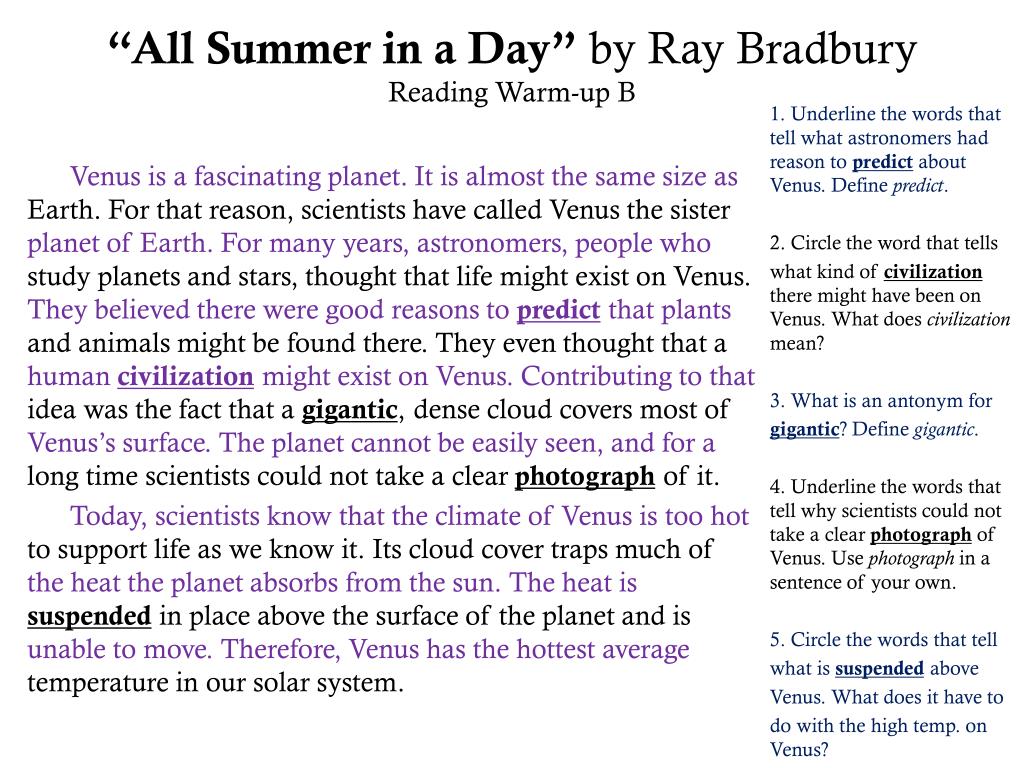
When reading "All Summer in a Day" in 2026, it is important to distinguish between Bradbury’s literary Venus and the actual planet. In the 1950s, the surface of Venus was obscured by thick clouds, leading some scientists and many science fiction writers to speculate that it might be a swampy, rainy world.
We now know that Venus is a hellscape with surface temperatures hot enough to melt lead, an atmosphere of carbon dioxide, and clouds of sulfuric acid. There is no liquid water on the surface. However, Bradbury’s choice to ignore the harsh scientific reality in favor of a "rain forest" setting allows him to explore the psychological effects of weather on the human psyche. The "scientific" inaccuracy does not detract from the story’s emotional truth.
Why Readers Search for "All Summer in a Day" PDF
The search for a PDF version of this story is often driven by educational needs. Teachers and students look for digital copies for several reasons:
- Annotation and Close Reading: Digital PDF versions allow students to use highlighting tools and comment features to track themes and literary devices directly on the text.
- Accessibility: PDFs can be read by screen readers, making the story accessible to students with visual impairments or learning disabilities.
- Classroom Distribution: Since the story is short (usually around 4–6 pages), it is easily shared within Learning Management Systems (LMS) for homework assignments.
- Vocabulary Building: Many educational PDFs include a glossary of terms like "slackening," "concussion," and "tumultuously" to help students navigate Bradbury’s sophisticated prose.
Legal and Ethical Access to the Text
"All Summer in a Day" is still under copyright. While many school districts have licensed digital versions, readers should look for legitimate sources such as:
- Literary Databases: Sites like JSTOR or ProQuest often hold analyzed versions of the text.
- Educational Platforms: Services like CommonLit or Newsela frequently offer the story with accompanying pedagogical tools.
- Anthologies: The story is a centerpiece of Bradbury’s collection The Medicine for Melancholy and R is for Rocket.
The Ending Explained: Guilt and the Return of the Rain
The conclusion of the story is famous for its "quiet" horror. After the sun disappears and the rain returns—"cold and beads of rice"—the children remember Margot. The realization of what they have done hits them with physical force. They cannot look at each other; their faces are "solemn and pale."
The ending is unresolved. We see the children walk toward the closet and unlock the door, but we never see Margot come out, nor do we hear her speak. This ambiguity forces the reader to imagine Margot’s state of mind. Has she been broken by the experience? Will the children ever be able to apologize? By ending the story at the moment the door opens, Bradbury emphasizes the weight of the consequence rather than the resolution of the conflict.
Frequently Asked Questions
Why do the children hate Margot so much?
The children hate Margot because she is different and because she has memories they envy. She represents a world (Earth) that they have never seen and may never see. Her "paleness" and her refusal to join their culture are interpreted as a claim of superiority, which triggers their desire to humble her.
What is the significance of the "seven years" cycle?
The seven-year cycle heightens the stakes of the story. If the sun came out every day, the children would have no reason to be jealous or cruel. The rarity of the event makes the sun a scarce resource, and as with many scarce resources in human history, it becomes a source of conflict and gatekeeping.
Is Margot’s family really going back to Earth?
The story suggests that her parents are considering it because Margot is struggling so much on Venus, even though it would cost them "thousands of dollars." This potential escape is a major factor in the children's resentment; they feel she doesn't "belong" on Venus if she isn't willing to suffer the rain like they do.
What does the sun feel like to the children?
Bradbury describes the sun as a "gold large penny" and the heat as "the sun in their arms." To the children, the experience is almost spiritual. It is a moment of pure, unadulterated joy where they feel "the sun on their cheeks like a warm iron." This sensory explosion makes their subsequent realization of Margot's loss even more painful.
How does the setting influence the mood?
The setting is the most important element of the mood. The "slackening" of the rain creates a sense of breathless anticipation, while the "concussion" of the storm creates a sense of dread. The contrast between the vibrant, brief colors of the sunny hour and the "gray ashen" world of the rain mirrors the emotional journey of the characters.
Practical Recommendations for Students and Educators
If you are analyzing "All Summer in a Day" for a class or personal study in 2026, consider these steps to deepen your understanding:
- Compare Media: Watch the 1982 short film adaptation. While it makes some changes to the ending, it provides a visual representation of the "rain world" that can help clarify Bradbury’s imagery.
- Focus on the Senses: Create a T-chart listing the sensory details Bradbury uses for the rain versus those he uses for the sun. This will reveal how he uses language to manipulate the reader’s emotions.
- Write the "Missing" Scene: As a creative exercise, write the dialogue that occurs after the closet door opens. This helps in exploring the themes of atonement and permanent psychological damage.
- Analyze the Group Dynamics: Look for moments where individual children show hesitation. Does anyone try to stop William? Understanding why the group acts as a single unit is key to the story's message.
"All Summer in a Day" remains a masterpiece because it captures a fundamental truth about human nature: that the most beautiful experiences can be tainted by the ugliness of our treatment of one another. Whether read in a physical book or a PDF, the story continues to challenge readers to examine their own capacity for empathy.