Finding affordable commercial auto insurance in Midwest City, OK, requires balancing Oklahoma state liability minimums, fleet requirements, and localized risk factors such as I-40 traffic and local weather patterns. Business owners can secure competitive rates by optimizing deductibles, maintaining clean driving records, and bundling policies through independent local agencies or established national carriers licensed with the Oklahoma Insurance Department.
Operating a business that relies on vehicles—whether it is a single delivery van, a fleet of contractors' trucks, or executive transport—brings significant financial exposure. For business owners in Midwest City, Oklahoma, finding a policy that protects company assets without crippling daily operating budgets is a high-priority task. Commercial auto insurance is not merely a legal requirement; it is a vital shield against catastrophic losses resulting from accidents, property damage, and liability claims.
Navigating the insurance market in Oklahoma can feel complex due to varying state minimum limits, municipal traffic densities, and specialized coverage endorsements required for different industries. Securing affordable coverage involves more than simply picking the lowest premium on a comparison website. It requires a strategic understanding of how insurers calculate risk, what mandatory minimums apply in Oklahoma, and how to leverage discounts, telematics, and proper vehicle classifications to reduce out-of-pocket costs.
Understanding Commercial Auto Insurance Requirements in Oklahoma
Before shopping for policy quotes, business owners must understand the legal and regulatory framework governing commercial vehicles in Oklahoma. Unlike personal auto insurance, commercial policies are engineered to cover higher liability limits, heavier vehicles, and business-specific equipment or cargo.
State Minimum Liability Limits
The State of Oklahoma mandates that any vehicle operated on public roadways must carry minimum liability coverage. For commercial vehicles, these limits mirror or exceed personal requirements depending on the gross vehicle weight rating (GVWR) and the nature of the cargo. The statutory minimums in Oklahoma are commonly referred to as 25/50/25 coverage:
- $25,000 for bodily injury or death of one person in an accident.
- $50,000 for total bodily injury or death liability per accident when multiple people are injured.
- $25,000 for property damage liability per accident.
Relying solely on these state minimums leaves most businesses dangerously exposed. If a company vehicle causes a multi-car pileup on Interstate 40 or Tinker Diagonal, property damage and medical expenses can easily exceed these statutory caps. Most risk management professionals recommend carrying a combined single limit (CSL) of at least $500,000 or $1,000,000, or supplementing a primary commercial auto policy with a commercial umbrella policy.
Personal Auto vs. Commercial Auto Insurance
A common pitfall for small business owners in Midwest City is using personal auto insurance for vehicles used in daily business operations. Standard personal policies routinely contain exclusions for commercial use, meaning that if an employee gets into an accident while transporting tools, delivering goods, or visiting job sites, the claim can be entirely denied.
Commercial auto insurance covers a broader range of vehicle types, including pickup trucks, box trucks, service utility vans, and passenger cars driven by employees. It also accounts for business-specific exposures, such as loading and unloading liability and non-owned or hired auto liability if employees drive their personal vehicles for company errands.
Key Cost Factors Impacting Midwest City Business Owners
Insurance underwriters evaluate several distinct risk variables when determining premium costs for businesses located in Midwest City and the greater Oklahoma City metropolitan area. Understanding these factors helps business owners identify where they can make operational adjustments to lower their rates.
Location and Municipal Risk Profiles
Midwest City sits within Oklahoma County, an area with higher traffic density and congestion compared to rural parts of the state. Proximity to major transportation corridors like Interstate 40, Interstate 240, and busy thoroughfares such as SE 15th Street and Reno Avenue increases the statistical probability of commuter accidents, fender-benders, and multi-vehicle collisions. Insurers factor regional claims history, local litigation trends, and municipal traffic citation statistics directly into base rate calculations.
Vehicle Classification and Usage
The type of vehicles in your fleet and how they are used dictate a substantial portion of your premium. Insurers divide commercial vehicles into distinct classifications:
- Service Use: Vehicles used by plumbers, electricians, and contractors who transport tools and equipment to job sites.
- Retail Use: Vehicles used to deliver goods directly to retail consumers.
- Commercial Use: Heavy hauling, long-haul trucking, or commercial transport that operates outside a standard local radius.
Local service vehicles operating strictly within a 50-mile radius of Midwest City typically enjoy lower rates than long-haul commercial trucks traversing state lines, as the exposure window is significantly smaller.
Driver MVRs and Safety Programs
Your human capital represents your greatest liability or your strongest discount asset. Underwriters pull Motor Vehicle Records (MVRs) for every driver authorized to operate company vehicles. Drivers with speeding tickets, driving under the influence (DUI) citations, or at-fault accidents within the past three to five years will drive premiums up sharply. Establishing a formal corporate driver safety program and instituting strict hiring filters can dramatically reduce these surcharges over time.
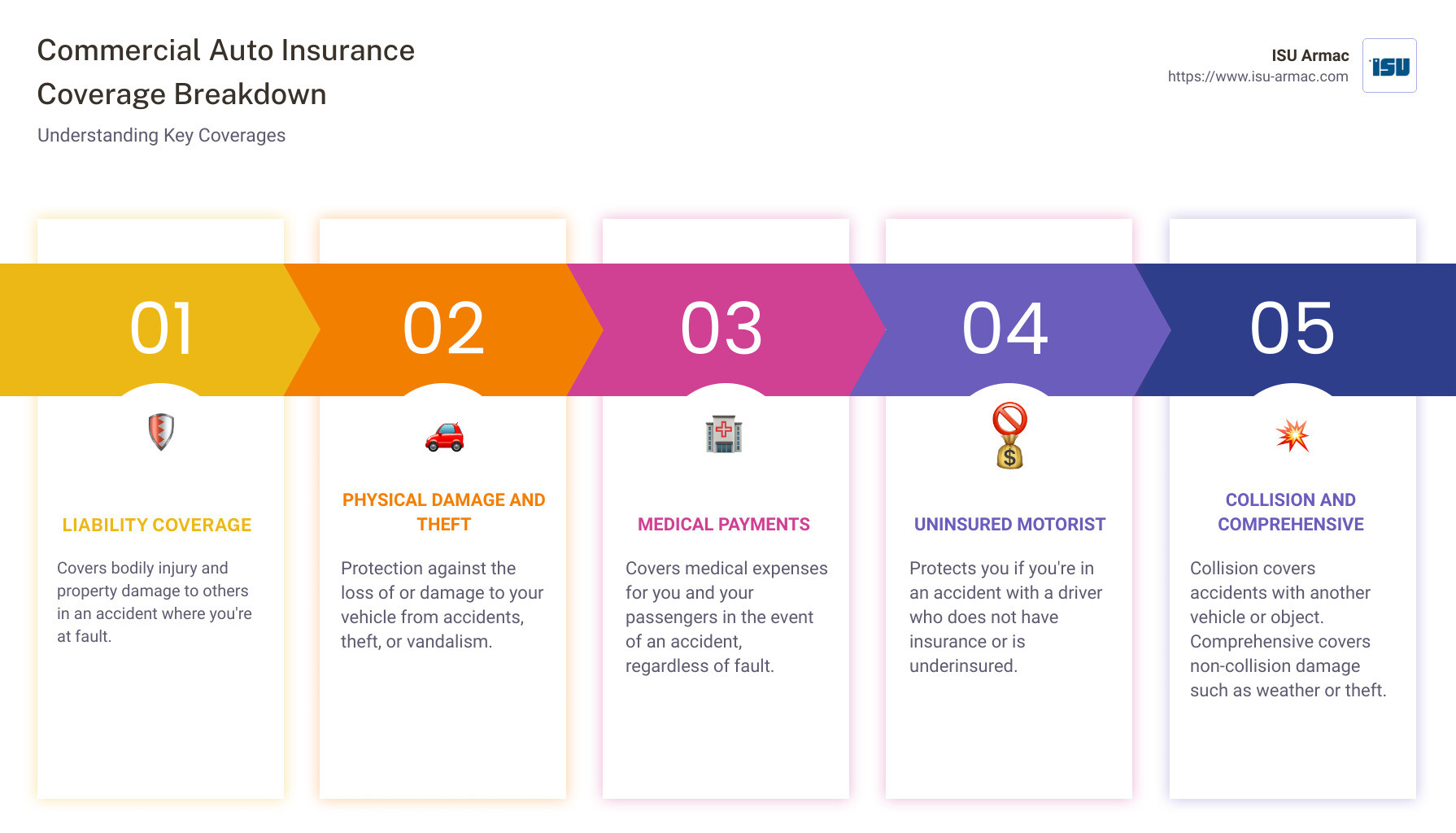
Comparison of Commercial Auto Coverage Types
Selecting the right balance of coverage ensures your business remains protected without paying for unnecessary extras. The table below outlines the primary coverage components available in standard commercial auto policies.
| Coverage Type | What It Protects | Recommended For |
|---|---|---|
| Bodily Injury Liability | Medical bills, legal fees, and judgments if your driver injures someone in an accident. | All businesses (consider limits above state minimums). |
| Property Damage Liability | Repairs or replacement costs for other vehicles or property damaged by your driver. | All businesses operating motor vehicles. |
| Collision Coverage | Damage to your own company vehicle resulting from a collision with another car or object. | Newer vehicles, financed/leased trucks, or high-value fleets. |
| Comprehensive Coverage | Non-collision events such as hail damage, theft, vandalism, fire, or animal strikes. | All businesses, especially given Oklahoma's severe weather risks. |
| Uninsured/Underinsured Motorist | Medical expenses and vehicle repairs if you are hit by a driver with little or no insurance. | Essential in Oklahoma due to state uninsured motorist statistics. |
| Hired and Non-Owned Auto | Liability protection when employees use personal cars or rented vehicles for business tasks. | Businesses where staff run errands or rent cars for travel. |
Strategies to Lower Commercial Auto Insurance Premiums
Finding truly affordable commercial auto insurance in Midwest City does not mean sacrificing vital protection. Savvy business owners utilize specific tactical adjustments to negotiate better rates with carriers.
Adjusting Deductibles and Policy Limits
Raising your collision and comprehensive deductibles from $500 to $1,000 or $2,500 can yield immediate premium savings of 15% to 30%. Before making this adjustment, ensure your business maintains a cash reserve capable of absorbing that higher deductible in the event of an unexpected claim.
Bundling Business Insurance Products
Insurance companies reward customer loyalty. If you purchase your general liability, workers' compensation, commercial property, and commercial auto insurance through a single carrier, you qualify for multi-policy bundling discounts. This consolidation also simplifies administrative overhead and billing cycles.
Utilizing Telematics and Dashcams
Many modern commercial insurers offer telematics programs—either via mobile apps or hardwired vehicle plug-in devices—that monitor driving habits such as speed, harsh braking, rapid acceleration, and cornering distance. Safe-driving fleets can earn substantial discounts. Additionally, installing commercial-grade dashcams provides undeniable evidence in liability disputes, often preventing costly payouts and subsequent rate hikes.
Step-by-Step Guide to Purchasing a Commercial Auto Policy
Securing a policy efficiently requires preparation and a methodical approach to gathering quotes and evaluating proposals.
- Gather Necessary Documentation: Compile a comprehensive list of all company vehicles, including Vehicle Identification Numbers (VINs), exact mileage, and primary storage locations. Collect full driver's license numbers and employment history for all authorized drivers.
- Determine Operational Radius: Calculate the typical travel distance for your vehicles. Insurers differentiate between local (under 50 miles), intermediate (50 to 200 miles), and long-distance operations.
- Request Multiple Quotes: Contact independent insurance brokers who can compare rates across multiple top-tier carriers licensed by the Oklahoma Insurance Department. Independent agents have access to regional and national markets that captive agents cannot offer.
- Review Policy Exclusions: Carefully examine policy drafts for radius restrictions, driver exclusions, and cargo limitations before signing. Ensure that any specialized equipment, toolboxes, or custom bed modifications are explicitly scheduled on the policy.
- Finalize and Verify Proof of Insurance: Once bound, obtain your commercial auto identification cards (proof of insurance) for every vehicle, and keep digital or physical copies stored safely in each glove compartment to comply with Oklahoma traffic statutes.
Common Mistakes to Avoid When Buying Commercial Coverage
Avoiding common missteps can save your business from uncovered losses and unexpected financial penalties.
- Undisclosed Drivers: Allowing family members, seasonal workers, or newly hired employees to drive company vehicles without adding them to the policy can result in denied claims if an accident occurs.
- Failing to Report Fleet Changes: Forgetting to remove sold vehicles or add newly acquired trucks immediately leaves gaps in coverage or results in paying for insurance on assets you no longer own.
- Chasing the Lowest Price Alone: Selecting a bare-bones policy from an unrated or poorly reviewed carrier can leave your business stranded when a major claim is filed. Always verify the financial stability rating of the insurance provider through rating agencies such as A.M. Best.
Frequently Asked Questions
Is commercial auto insurance required for a single-owner LLC in Midwest City?
Yes. If the vehicle is titled in the name of the LLC or used to conduct business operations—even if you are the sole driver—a commercial auto policy is required. Personal auto policies frequently deny coverage for corporate-owned vehicles.
How does Oklahoma's weather impact commercial auto insurance rates?
Oklahoma is prone to severe thunderstorms, damaging hail, high winds, and occasional tornadoes. Comprehensive coverage protects your vehicles against these acts of nature, making comprehensive policies essential for Midwest City businesses, even if premium costs reflect regional storm risk.
Can I get commercial auto insurance with bad driving history?
Yes, but you may be classified as a high-risk driver, resulting in higher premiums. Specialized non-standard commercial carriers write these policies, and maintaining a clean record for 36 consecutive months will allow you to transition back to standard, lower-cost markets.
Are trailers towed behind work trucks covered automatically?
Not always. While liability coverage often extends to towed trailers, physical damage coverage for the trailer itself usually requires a specific endorsement or separate scheduled listing on the policy. Always verify trailer coverage limits with your broker.
How often should I review my commercial auto insurance policy?
You should review your commercial auto policy annually before renewal, or immediately whenever your business expands its fleet, changes operational locations, hires new drivers, or alters the primary use of its vehicles.
Disclaimer: Insurance regulations, statutory liability limits, and underwriting guidelines change periodically. Business owners should consult with a licensed insurance professional or broker authorized in the State of Oklahoma to obtain personalized policy recommendations tailored to their specific commercial operations.