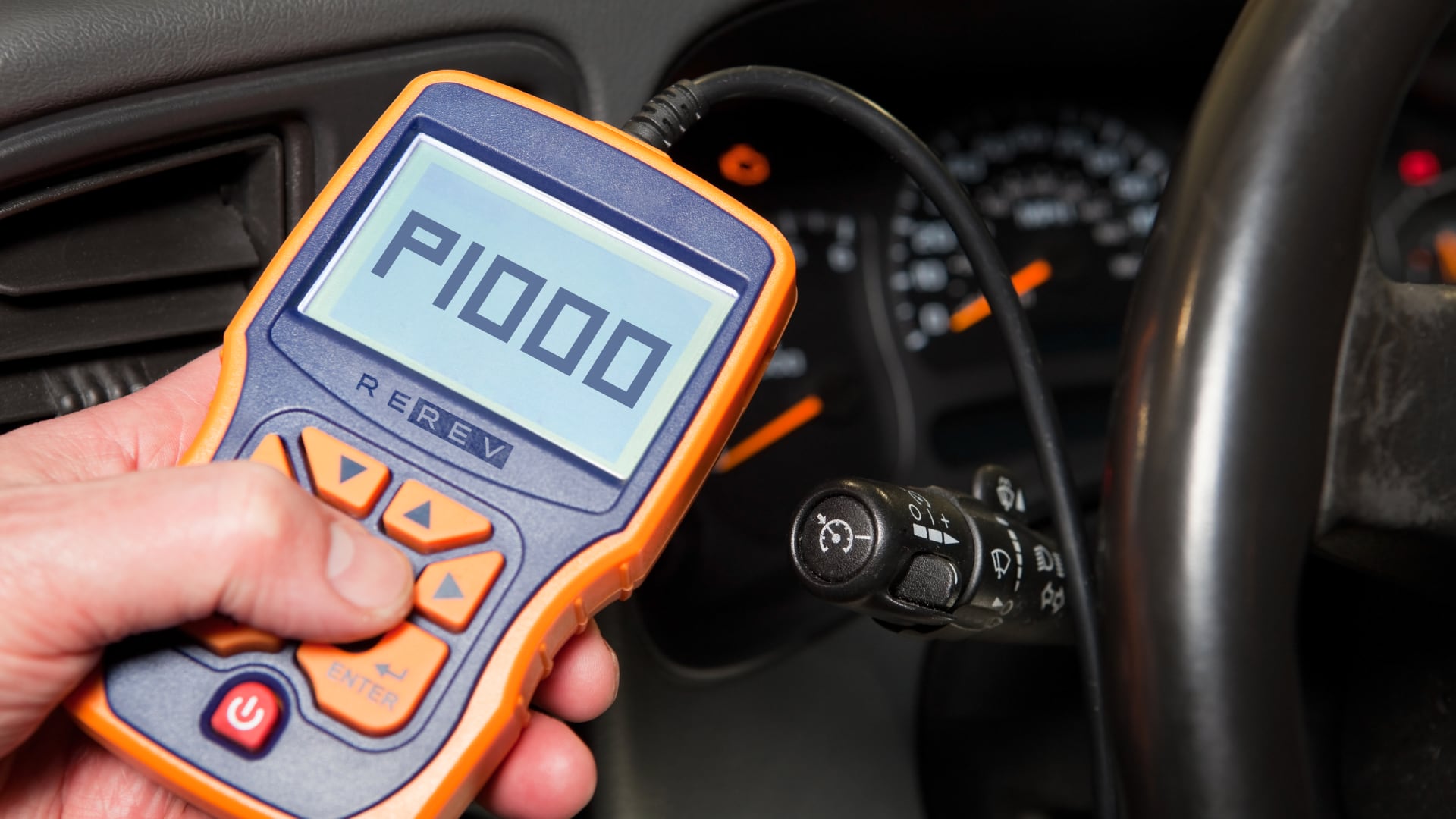
The P1000 code on a 7.3L Powerstroke diesel engine indicates that the On-Board Diagnostics (OBD-II) system readiness monitors are incomplete. It is not a mechanical failure but a status notification showing the Powertrain Control Module (PCM) has not finished its internal self-testing sequence following a memory reset.
Understanding the P1000 Diagnostic Trouble Code
In the context of the Ford 7.3L Powerstroke, produced between 1994.5 and 2003, the P1000 code serves as a placeholder. Formally defined as "OBD-II Monitor Testing Incomplete," this code appears whenever the engine’s computer has its "Keep Alive Memory" (KAM) cleared. Unlike a P0401 (EGR flow) or a P1211 (ICP pressure), the P1000 does not illuminate the Check Engine Light (CEL) or Malfunction Indicator Lamp (MIL) on its own in most configurations. Instead, it remains stored in the background until the vehicle successfully completes a specific series of driving maneuvers known as a "Drive Cycle."
For 7.3 Powerstroke owners, this code is most significant during emissions testing. In many jurisdictions as of 2026, a vehicle cannot pass a smog inspection if a P1000 code is present, as it indicates the vehicle’s emissions systems have not been fully evaluated by the PCM. This prevents people from simply clearing a "real" trouble code right before an inspection to hide a mechanical fault.
Primary Causes of the P1000 Code on a 7.3 Powerstroke
Several routine actions can trigger the P1000 code on the 7.3L platform. Because these engines are now aging classics, many owners perform their own maintenance, which often involves the following:
- Battery Disconnection: If you have recently replaced your batteries or disconnected them to perform electrical work (such as replacing a starter or glow plug relay), the PCM loses its constant power supply. This wipes the stored monitor data.
- Clearing Codes with a Scanner: If you had a previous code (like a P0472 for the Exhaust Back Pressure sensor) and used an OBD-II scanner to clear it, the PCM resets all readiness monitors to "Incomplete," triggering the P1000.
- PCM Replacement or Reflash: Installing a new PCM or updating the software (flashing) will always result in a P1000 until the truck is driven sufficiently.
- Performance Tuners: Many 7.3 Powerstroke owners use chips (like TS6 or Hydra) or flash tuners. Switching tunes or installing a new calibration often resets the KAM, resulting in the P1000 code.
- Intermittent Power Loss: A faulty PCM relay or a corroded fuse box connection can cause the computer to lose power momentarily while the engine is off, essentially "resetting" the monitors overnight.
The Role of OBD-II Readiness Monitors
To understand why the P1000 persists, one must understand what the PCM is looking for. The 7.3L Powerstroke uses several "monitors"—internal software routines that check the health of specific systems. While modern 2026 diesel engines have a dozen or more monitors, the 7.3L is simpler. Depending on the year and the GVWR (Gross Vehicle Weight Rating), your truck likely tracks:
- Misfire Monitor: Ensures all eight cylinders are contributing equally.
- Fuel System Monitor: Monitors the high-pressure oil pump (HPOP) and injector performance.
- Comprehensive Component Monitor (CCM): Checks sensors like the MAP, EBP, and IAT for circuit integrity.
- EGR Monitor: (Primarily on California-spec or later models) Ensures the Exhaust Gas Recirculation system is functioning.
- Glow Plug Monitor: Tracks the resistance and function of the glow plug system (common on 1999-2003 models).
The P1000 code will not disappear until every one of these monitors switches from "Not Ready" to "Ready" or "Complete."
The Ford 7.3 Powerstroke Drive Cycle
To clear the P1000 code, you must perform a drive cycle that allows the PCM to see the specific parameters required to test each system. Simply driving on the highway for an hour may not be enough, as some tests require idling or deceleration.
Before attempting the drive cycle, ensure your fuel tank is between 15% and 85% full. Many OBD-II monitors will not run if the tank is near empty or completely full. Also, ensure the Engine Oil Temperature (EOT) reaches at least 170°F, as the 7.3L PCM relies heavily on oil temperature for its diagnostic logic.
Step-by-Step Drive Cycle Procedure
- Cold Start: Start the engine from a "cold" state (EOT below 100°F). Let the truck idle for at least three minutes. This allows the Glow Plug Monitor to run (the PCM checks the current draw or the GPCM feedback).
- City Driving: Drive the truck at steady speeds between 25 and 45 mph for 10 minutes. This provides the PCM with data for the Comprehensive Component Monitor.
- Highway Cruise: Merge onto a highway and accelerate to 55-65 mph. Maintain this speed using a steady throttle (avoid cruise control if possible) for approximately 10 to 15 minutes. This allows the Fuel System Monitor to evaluate the HPOP and injector pulse widths under load.
- Coast Down: While on the highway, take your foot off the accelerator and allow the truck to coast down to 30 mph without touching the brakes. This "deceleration fuel cut-off" period is critical for certain internal PCM calibrations.
- Stop and Idle: Bring the vehicle to a complete stop and let it idle in gear (if automatic) or neutral (if manual) for two minutes.
If all conditions are met and no other faults are detected, the P1000 should clear. On many Ford vehicles, the P1000 will be replaced by a P1111 code, which is the Ford-specific code for "System Pass."
P1000 vs. P1111: The Ford Logic
It is a common point of confusion for 7.3 owners when they see a P1111 code after trying to clear a P1000. In Ford’s diagnostic language:
- P1000: Tests are incomplete. You are not ready for emissions testing.
- P1111: All tests are complete. The system has passed. You are ready for emissions testing.
If your scanner shows P1111, you have successfully resolved the P1000 status. You do not need to "fix" a P1111; it is a clean bill of health for the OBD-II system.
Troubleshooting a Persistent P1000 Code
If you have driven hundreds of miles and performed multiple drive cycles but the P1000 remains, there is an underlying issue preventing a specific monitor from completing. The PCM cannot "Ready" a monitor if it detects a marginal sensor reading, even if that reading isn't bad enough to trigger a different specific error code.
Common Barriers to Monitor Completion
| Problem Area | Effect on P1000 | Solution |
|---|---|---|
| Thermostat Issues | If the engine never reaches 170°F-180°F, the PCM stays in "warm-up mode" and won't run monitors. | Replace the thermostat with a high-quality 192°F or 203°F unit. |
| Weak Batteries | Voltage drops below 10.5V during cranking can reset the KAM, causing the P1000 to reappear every time you start the truck. | Test batteries and check the starter draw. |
| EBP Sensor/Tube | A clogged Exhaust Back Pressure tube provides "frozen" data, preventing the Comprehensive Component Monitor from finishing. | Clean the EBP tube and sensor orifice. |
| Aftermarket Tuning | Some "extreme" tunes disable certain monitors entirely. The PCM will never see them as "Ready." | Switch the truck back to a "Stock" setting for the drive cycle. |
| BARO/MAP Delta | If the Barometric Pressure and Manifold Absolute Pressure sensors don't agree at key-on, monitors may hang. | Inspect vacuum lines to the MAP sensor. |
Emissions Testing and the P1000
In 2026, emissions standards for older diesel engines remain strict in many regions. If you take your 7.3 Powerstroke to a testing station with a P1000 code, you will likely receive a "Not Ready" result. This is not a "Fail," but a "Re-test Required."
Most states allow for one or two monitors to be "Not Ready" on older vehicles (pre-2004), but this varies significantly. For example, a 2002 7.3 Powerstroke might be allowed to have the "EGR Monitor" incomplete but must have the "Comprehensive Component" and "Fuel System" monitors ready. Always check your local Department of Motor Vehicles (DMV) or environmental agency guidelines before testing.
Summary of Readiness Status
| Monitor Name | Requirement for 7.3L | Typical Completion Action |
|---|---|---|
| Misfire | Mandatory | Continuous during all driving phases. |
| Fuel System | Mandatory | Steady-state cruising (55 mph) for 5+ miles. |
| Comprehensive Component | Mandatory | Mixed city/highway driving with varied RPM. |
| EGR | Year/State Dependent | Stop-and-go driving with EOT above 170°F. |
| Glow Plug | Mandatory (99-03) | Cold start followed by 3-minute idle. |
FAQ: Frequently Asked Questions
Can I drive my truck with a P1000 code?
Yes. The P1000 code does not affect engine performance, fuel economy, or longevity. It is strictly a software status indicator for the OBD-II system. You can drive the truck across the country with a P1000 without any mechanical risk, provided there are no other active trouble codes.
How many miles does it take to clear a P1000?
There is no set mileage. While some owners clear it in 20 miles, others may drive 200 miles without it clearing if the specific "Drive Cycle" parameters (like coasting or idling) aren't met. On a 7.3 Powerstroke, the focus should be on the type of driving rather than the distance.
Will P1000 cause a limp mode?
No. Limp mode is typically triggered by high oil temperature, overboost, or a failure in the electronic throttle assembly. A P1000 is a "non-MIL" code, meaning it does not request the computer to alter engine output or fuel mapping.
Why did my P1000 come back after I fixed it?
The P1000 will reappear every time the PCM loses power. If it returns unexpectedly, check for a loose battery terminal, a blown "Cigar Lighter" fuse (which often powers the OBD-II port/PCM memory on F-series trucks), or a failing ignition switch that is cutting power to the PCM.
Does the 7.3 Powerstroke have a catalytic converter monitor?
Most 7.3 Powerstroke engines (especially Federal models) do not have a catalytic converter, and even those that do (some 1994.5-1997 models) do not have a downstream O2 sensor to monitor it. Therefore, you will not see a "Catalyst Monitor" on a 7.3 diagnostic report.
Practical Recommendation for 7.3 Owners
If you are facing an upcoming emissions test and have a P1000 code, the most effective strategy is to use a smartphone app (like FORScan or Torque Pro) paired with an OBD-II adapter. These tools allow you to view the "Readiness Monitors" in real-time. Instead of guessing, you can see exactly which monitor is "Incomplete."
If the Glow Plug Monitor is the only one left, focus on cold starts. If the Fuel System Monitor is the holdout, find a long stretch of flat highway for a steady-state cruise. Using data-driven diagnostics will save you hours of unnecessary driving and fuel costs. If the code persists for more than a week of varied driving, prioritize checking your Engine Oil Temperature (EOT) sensor accuracy, as a "cold" reading is the most common reason the PCM refuses to initiate its self-tests.