The 14 cloud security principles represent a comprehensive framework developed by the UK’s National Cyber Security Centre (NCSC) to help organizations evaluate the security of cloud services. These principles guide decision-makers in assessing whether a cloud provider can protect sensitive data, maintain service availability, and defend against evolving cyber threats in a multi-tenant environment.
Understanding these principles is no longer optional for IT leadership; it is a fundamental requirement for risk management. As we navigate the complex landscape of 2026, where artificial intelligence and quantum-ready encryption are at the forefront of defense strategies, these 14 principles provide the structured lens necessary to separate robust service providers from those with underlying vulnerabilities.
1. Data in Transit Protection
Data in transit remains one of the most significant attack vectors. This principle dictates that user data must be protected against interception and manipulation while moving between the user’s device and the cloud service, or between different components of the service itself.
By 2026, the standard for this protection has evolved beyond simple TLS (Transport Layer Security) implementations. High-assurance providers now utilize TLS 1.3 as a baseline, ensuring that older, vulnerable versions are deprecated. Organizations must verify that the provider uses strong, modern cryptographic suites. Furthermore, with the rise of quantum computing concerns, forward-thinking providers are beginning to implement "hybrid" post-quantum cryptographic (PQC) algorithms to ensure that data captured today cannot be decrypted by future quantum machines.
2. Asset Protection and Resilience
This principle focuses on the physical and logical protection of the infrastructure that hosts your data. It covers everything from the physical security of data centers to the resilience of the hardware and the processes for data sanitization.
Cloud consumers must ensure that their data is not only protected from theft but also from accidental loss or destruction. Resilience involves geographical redundancy—ensuring that a localized disaster (like a power grid failure or a natural event) does not result in permanent data loss. Additionally, when a user deletes data or leaves a service, the provider must have verified procedures for "sanitization," ensuring that the physical storage media is wiped so that subsequent tenants cannot recover the previous user’s information.
3. Separation Between Users
In a cloud environment, "multi-tenancy" is the norm. This means your data likely resides on the same physical server as a competitor or a malicious actor. Principle 3 requires that the provider maintains robust separation between different tenants.
The failure of separation is often referred to as a "side-channel attack" or "guest-to-host" escape. Security architects must examine how the provider achieves this isolation. Does it rely on hardware-level virtualization, containerization, or software-defined networking? In 2026, the use of confidential computing—utilizing Trusted Execution Environments (TEEs) at the processor level—has become a key differentiator for high-security workloads, providing an extra layer of hardware-enforced isolation.
4. Governance Framework
Security is not just a technical challenge; it is a management one. The governance framework principle requires the provider to have a clear organizational structure and a set of security policies that are actively managed and audited.
A provider should be able to demonstrate compliance with international standards such as ISO/IEC 27001 or SOC2 Type II. However, governance in 2026 also involves clear accountability for AI-driven security operations. Organizations should ask: Who is responsible for security decisions? How are risks identified and mitigated? Is there a board-level commitment to security, or is it treated as a purely operational expense?
5. Operational Security
Operational security (OpSec) involves the day-to-day practices that keep a cloud service running safely. This includes configuration management, vulnerability management, incident management, and protective monitoring.
One of the most critical aspects of OpSec is patch management. A provider must be able to deploy security updates rapidly across their entire fleet without disrupting service. Furthermore, protective monitoring is essential; the provider must be looking for signs of unauthorized access or anomalous behavior. In the current year, this often involves sophisticated machine learning models that can identify "zero-day" patterns that traditional signature-based systems would miss.
6. Personnel Security
The "insider threat" remains a potent risk. Principle 6 requires that cloud provider staff are subject to rigorous background checks and that their access to customer data is strictly limited and audited.
Providers should implement the principle of least privilege (PoLP) for their employees. This means that even a senior system administrator should not have access to customer data unless there is a specific, logged, and time-limited reason to do so. Organizations should inquire about the provider's vetting processes and how they handle the offboarding of employees to ensure that access is revoked immediately upon resignation or termination.
7. Secure Development
The software that powers the cloud service must be built with security in mind from the very first line of code. This principle focuses on the Secure Development Lifecycle (SDL).
Secure development involves rigorous testing, including static and dynamic analysis (SAST/DAST), and regular third-party penetration testing. In 2026, "Security as Code" is the standard, where security checks are integrated directly into the CI/CD (Continuous Integration/Continuous Deployment) pipeline. If a provider cannot explain their secure development practices, they are likely accumulating technical debt that will eventually manifest as a security breach.
8. Supply Chain Security
Cloud providers do not operate in a vacuum; they rely on a vast network of third-party vendors for hardware, software, and services. Principle 8 demands that the provider manages the risks associated with its own supply chain.
Recent years have shown how devastating supply chain attacks (like those targeting popular open-source libraries or hardware firmware) can be. Providers must now maintain a Software Bill of Materials (SBOM) for their services, allowing them to quickly identify if a newly discovered vulnerability affects their stack. They must also audit their own vendors with the same rigor that their customers audit them.
9. Secure User Management
The provider must give the customer the tools necessary to manage their own users securely. This includes the ability to create, modify, and delete accounts, and to assign specific roles and permissions.
A secure user management system should support granular access controls. For example, an organization should be able to grant a developer access to "staging" environments without giving them access to "production" data. The system must also be designed to prevent "privilege escalation," where a user with low-level access finds a way to gain administrative rights.
10. Identity and Authentication
Weak passwords are the bane of cybersecurity. This principle requires that all access to the service—both by the customer and by the provider’s staff—is protected by strong authentication.
By 2026, multi-factor authentication (MFA) is no longer a "recommendation" but a mandatory requirement. Specifically, organizations should look for providers that support FIDO2/WebAuthn standards (such as passkeys or hardware security keys), which are resistant to phishing. The provider’s internal interfaces for managing the service should be even more strictly controlled, often requiring "break-glass" procedures for high-risk actions.
11. External Interface Protection
Every point where the cloud service connects to the outside world—API endpoints, web portals, or command-line interfaces—is a potential entry point for an attacker. These interfaces must be identified and defended.
Protection mechanisms include Web Application Firewalls (WAFs), Rate Limiting (to prevent brute-force and DDoS attacks), and rigorous input validation to prevent injection attacks (like SQLi or XSS). As more enterprises move toward "API-first" architectures, the security of these programmatic interfaces becomes paramount. They must be authenticated, encrypted, and monitored with the same intensity as the main user portal.
12. Secure Service Administration
The tools and systems the provider uses to manage the cloud service itself are high-value targets for attackers. If an administrator’s workstation is compromised, the entire cloud could be at risk.
Secure service administration involves using dedicated, hardened devices for administrative tasks, often referred to as Privileged Access Workstations (PAWs). These devices should not be used for general web browsing or email. Furthermore, all administrative actions should be performed over secure, encrypted channels that are separate from the public internet (out-of-band management).
13. Audit Information for Users
You cannot defend what you cannot see. Principle 13 requires the provider to provide the customer with the logs and audit information necessary to monitor access to their data and service.
This audit information is crucial for incident response. If a breach occurs, the logs should tell you who accessed what, when, and from where. In 2026, these logs must be provided in formats that are easily ingestible by modern Security Information and Event Management (SIEM) systems. The provider should also guarantee the integrity of these logs, ensuring they cannot be altered or deleted by an attacker attempting to cover their tracks.
14. Secure Use of the Service
The final principle shifts the focus back to the customer. Even the most secure cloud provider cannot protect a customer who misconfigures their environment or uses the service recklessly.
The provider is responsible for educating the customer on how to use the service securely. This includes providing clear documentation, security best practices, and "secure by default" configurations. For example, when a customer creates a new storage bucket, it should be private by default rather than public. The customer, in turn, must accept their part of the "shared responsibility model."
Comparison of Responsibilities Across the 14 Principles
| Principle Group | Primary Focus | Primary Responsibility |
|---|---|---|
| Infrastructure & Physical | Principles 2, 3 | Cloud Provider |
| Product Security | Principles 1, 7, 11 | Cloud Provider |
| Operational & Staff | Principles 5, 6, 12 | Cloud Provider |
| Supply Chain & Governance | Principles 4, 8 | Cloud Provider |
| Access & Identity | Principles 9, 10 | Shared (Provider tools / Customer config) |
| Visibility & Usage | Principles 13, 14 | Shared (Provider logs / Customer monitoring) |
The Shared Responsibility Model in 2026
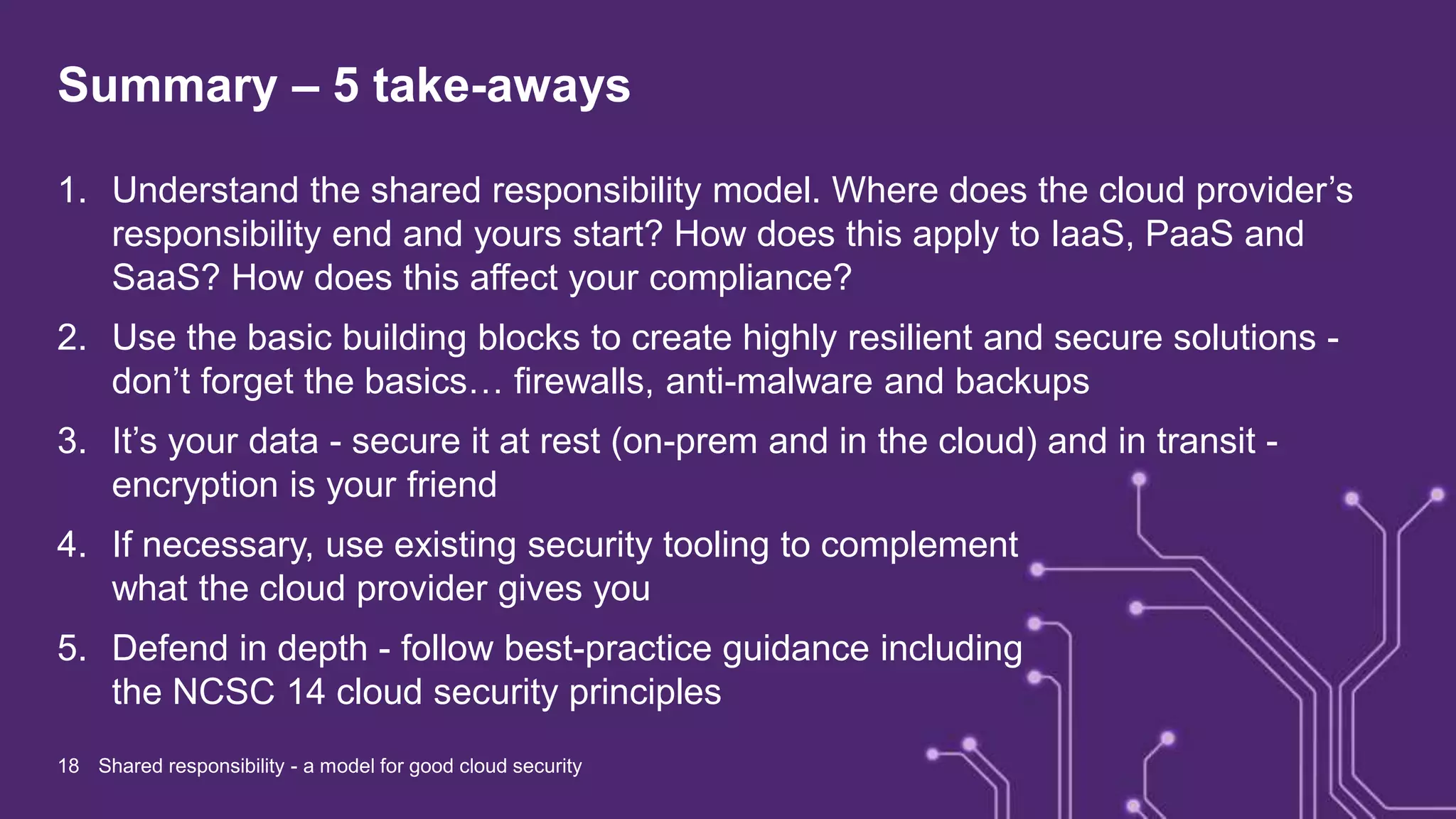
It is a common misconception that moving to the cloud means "outsourcing" security. In reality, security is a shared responsibility. While the provider is responsible for the "security of the cloud" (the physical buildings, the hypervisors, the core networking), the customer is responsible for "security in the cloud" (the data, the application code, the identity management).
In 2026, the boundaries of this model have become more nuanced with the rise of Serverless and Platform-as-a-Service (PaaS) offerings. In these models, the provider takes on more responsibility for patching and runtime security, but the customer remains responsible for the logic of their code and the permissions they grant to users. Failure to understand where the provider's responsibility ends and yours begins is one of the leading causes of cloud data breaches.
Common Pitfalls in Applying the Principles
- Over-reliance on Certifications: While ISO 27001 is valuable, it is a point-in-time assessment. It does not guarantee security against a new threat tomorrow. Organizations must look for continuous assurance.
- Ignoring Principle 14: Many organizations assume that because they are on a "major" cloud provider, they are automatically secure. They neglect their own configuration duties, leading to exposed databases and leaked API keys.
- Lack of Exit Strategy: Principle 2 (Asset Protection) and Principle 13 (Audit) are vital when leaving a provider. If you cannot get your data out securely or verify its deletion, you have a significant compliance risk.
- Siloed Security Teams: Security should not be the sole responsibility of the "Security Team." Developers and Ops teams must understand these 14 principles to build and maintain secure cloud-native applications.
Frequently Asked Questions
Are the 14 cloud security principles legally binding?
No, the 14 principles are a set of guidelines and best practices rather than a legal statute. However, they are heavily used by the UK government and public sector organizations to assess suppliers. For private enterprises, they serve as an excellent framework for due diligence and can help meet regulatory requirements like GDPR or NIS2 by providing a structured approach to risk assessment.
How often should an organization audit a provider against these principles?
An initial deep-dive audit should be conducted during the procurement phase. Following that, a high-level review should occur annually, or whenever the provider introduces major changes to their architecture. Many modern providers now offer "Compliance Centers" where customers can view real-time or near-real-time status of various security controls, reducing the need for manual annual audits.
Do these principles apply to small cloud providers as well as hyperscalers like AWS or Azure?
Yes, the principles are "provider-agnostic." Whether you are using a global giant or a niche local provider, the risks remain the same. While smaller providers might not have the massive security budgets of hyperscalers, they must still be able to demonstrate how they meet each of the 14 principles, perhaps through different but equally effective technical means.
Can a provider "fail" a principle and still be safe to use?
It depends on your risk appetite and the nature of your data. For example, a provider might not have the most robust "Personnel Security" vetting (Principle 6) compared to a government-grade service, but if you are only hosting non-sensitive public marketing data, that might be an acceptable risk. Security is always a balance between cost, usability, and risk.
How has AI changed the application of these 14 principles in 2026?
AI has primarily impacted Operational Security (Principle 5) and External Interface Protection (Principle 11). Providers now use AI to detect subtle patterns of attack that human analysts would miss. Conversely, attackers use AI to find vulnerabilities. This "AI arms race" means that providers must be more transparent about how they use AI to defend their infrastructure and ensure that the AI models themselves are secure from "adversarial machine learning" attacks.
Practical Next Action
To implement these principles effectively, start by performing a Gap Analysis. Map your current cloud service provider's features and your own internal processes against the 14 principles. Identify where the provider falls short and where your own internal configurations are lacking. Use this analysis to create a prioritized roadmap for remediation, focusing first on the highest-impact areas like Identity (Principle 10) and Data in Transit (Principle 1).