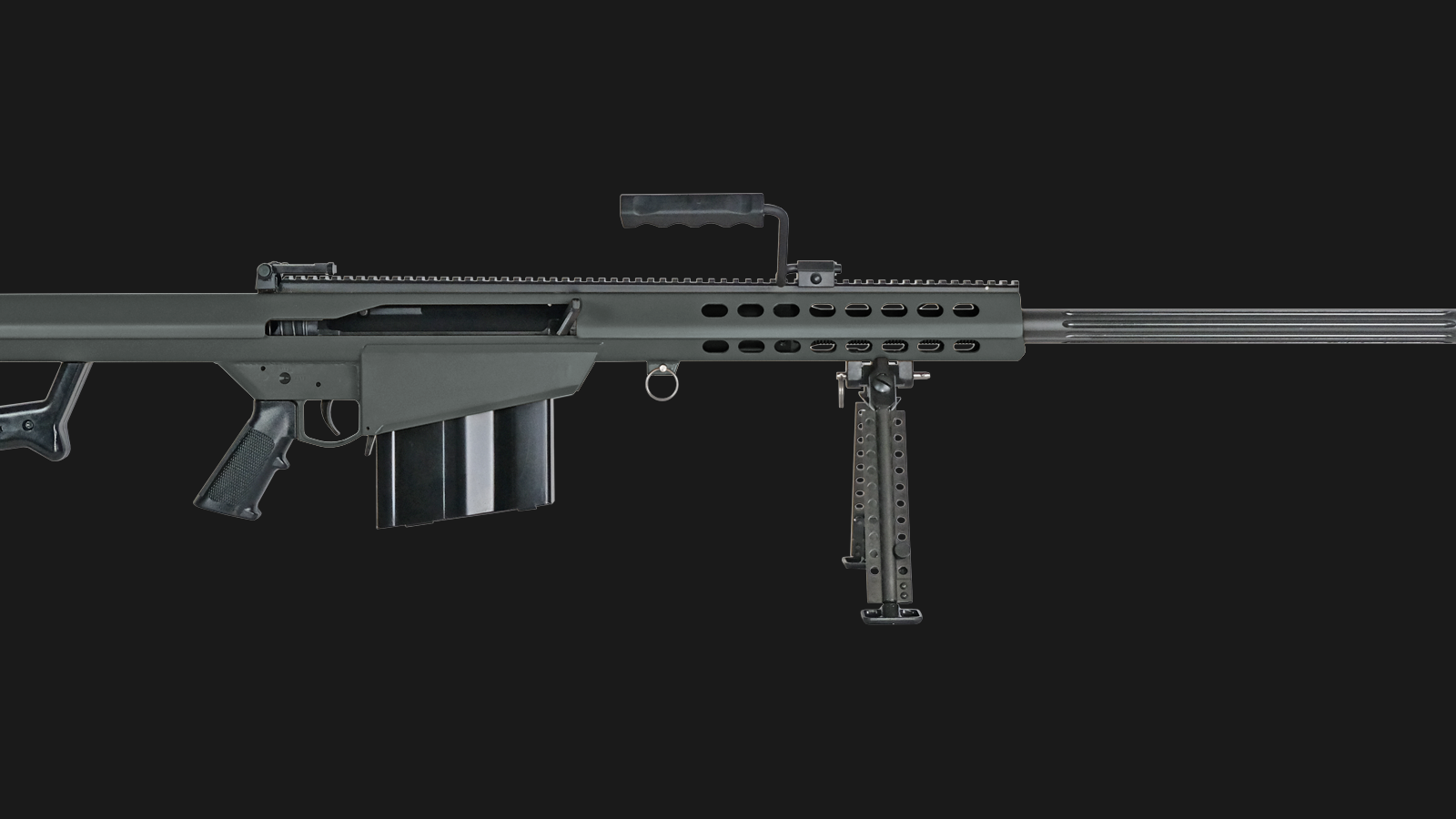
The debate surrounding the Barrett .50 caliber rifle centers on the tension between its utility as a precision long-range tool for military and law enforcement applications and concerns regarding its availability to private citizens. Proponents highlight its role in anti-materiel operations, while critics emphasize the potential risks associated with high-energy firearms in civilian environments.
The Barrett .50 caliber platform—most notably the M82A1 and its successors—represents a landmark in firearms engineering. Developed by Ronnie Barrett in the early 1980s, the semi-automatic .50 BMG (Browning Machine Gun) rifle was designed to fill a specific tactical void: the ability to disable equipment, communication arrays, and radar stations from extreme distances. Over the past four decades, the rifle has been adopted by over 60 allied nations and various specialized units, solidifying its reputation as a standard for long-range interdiction. However, this high-performance pedigree has placed the platform at the center of legislative and social discourse regarding civilian ownership of military-grade hardware.
Technical Foundations of the Barrett Platform
To understand the debate, one must first understand the machine itself. The Barrett M82A1 is a recoil-operated, semi-automatic firearm chambered in .50 BMG (12.7×99mm NATO). Unlike traditional bolt-action rifles, the M82A1 utilizes a short-recoil system that helps mitigate the immense force generated by the cartridge.
The .50 BMG cartridge was originally engineered in the late 1910s for anti-aircraft and anti-vehicle use. When fired from a barrel of standard length, the muzzle energy routinely exceeds 13,000 foot-pounds. This energy, combined with the ballistic coefficient of heavy-grain projectiles, allows for effective engagement of targets well beyond the 1,500-meter mark. For tactical units, this provides the capability to neutralize hardened targets without requiring close-proximity exposure.
Critics often point to this power as a primary reason for concern, arguing that the terminal ballistics of a .50 caliber round far exceed any legitimate recreational or self-defense need. Proponents counter that the rifle is essentially a target shooting and collection piece, noting that the weight, cost, and specialized nature of the ammunition make it inherently unsuited for criminal activity.
The Legislative Landscape
The "Barrett .50 caliber debate" is largely a manifestation of broader legislative efforts to regulate high-energy firearms. Various jurisdictions have attempted to restrict or outright ban .50 BMG rifles through legislation that categorizes them under "assault weapon" or "destructive device" definitions.
- California Legislation: California has long been at the forefront of this debate. In 2004, the state enacted the .50 Caliber BMG Regulation Act, which effectively banned the sale and transfer of .50 BMG rifles. Owners were required to register existing firearms with the Department of Justice. This set a precedent for other states attempting to use legislative classification to limit access.
- Federal Classification: At the federal level, the Bureau of Alcohol, Tobacco, Firearms and Explosives (ATF) classifies these rifles as standard Title I firearms, provided they are semi-automatic and do not utilize explosive projectiles. They are not considered "destructive devices" under the National Firearms Act (NFA) unless the barrel bore exceeds 0.50 inches or the firearm is designed to fire explosive payloads.
- The "Sporting Purpose" Argument: Throughout these debates, the industry defense has relied on the "sporting purpose" test. Because these rifles are widely used in long-range competitive shooting (such as the F-Class or ELR—Extreme Long Range—disciplines), owners argue that they fulfill a legitimate, lawful use that should be protected under constitutional or statutory frameworks.
Comparing Operational Realities
When evaluating the impact of the Barrett rifle in a civilian context, it is helpful to contrast it with smaller-caliber platforms. The table below highlights the technical differences that fuel the ongoing policy arguments.
| Feature | Barrett .50 BMG | Standard .308 Win | Civilian Context |
|---|---|---|---|
| Muzzle Energy | ~13,000+ ft-lbs | ~2,600 ft-lbs | Barrett is ~5x more powerful |
| Weight | 30+ lbs | 7–10 lbs | High burden for carry |
| Effective Range | 1,500+ meters | 800 meters | Barrett is for specialized long-range |
| Ammo Cost | High ($4–$8 per round) | Moderate ($1–$2 per round) | Prohibitive for casual use |
| Primary Use | Anti-materiel / ELR | Hunting / Target / Tactical | Barrett is niche/specialized |
Societal and Safety Concerns
The primary concern cited by advocates of tighter regulation is the potential for these rifles to penetrate body armor or fortified structures. In the hands of a bad actor, a .50 caliber rifle poses a threat profile that exceeds that of standard patrol rifles used by law enforcement.
Conversely, supporters of ownership argue that "fear of capabilities" is a poor metric for legislation. They point out that in the four decades since the introduction of the M82A1, there has been a statistically negligible number of crimes involving these firearms. The barrier to entry—the cost of the firearm, the specialized optics required, the logistics of transporting a 30-pound rifle, and the sheer expense of the ammunition—acts as a natural deterrent to misuse.
The debate also touches upon the concept of "escalation." Opponents suggest that allowing high-energy military technology into civilian hands creates an arms race, where law enforcement must then procure increasingly heavy armor and equipment to compensate. Proponents argue this is a fundamental misunderstanding of the Second Amendment and the role of the civilian in maintaining readiness, regardless of technological advancement.
The Role of Long-Range Sport Shooting
It would be inaccurate to characterize the Barrett .50 caliber debate without acknowledging the thriving community of long-range enthusiasts. Extreme Long Range (ELR) shooting has grown significantly in the 2020s, with matches held throughout the United States and internationally. For these shooters, the Barrett rifle is a precision instrument, not a weapon of war.
The discipline requires significant mathematical calculations involving windage, elevation, Coriolis effect, and ballistic drift. The skill required to place a projectile on a target at a mile distance is akin to high-level engineering. Collectors and enthusiasts often view attempts to ban these rifles as an infringement on a specialized, disciplined form of marksmanship that requires immense patience, training, and financial investment.
Institutional Perspectives
Law enforcement agencies generally view the .50 caliber platform as a niche asset rather than a primary tool. While some tactical teams utilize them for "bunker busting" or disabling vehicles, the platform is rarely used in urban patrol scenarios. Because the rounds have such high penetration power, the risk of "over-penetration"—where a round passes through the target and continues for several miles—makes the rifle practically useless for urban defensive applications.
Policy analysts often suggest that the intensity of the debate stems more from the "look" and "military provenance" of the weapon than its actual utility in crime. In legislative hearings, the rifle is frequently presented as a symbol of military power, which creates a visceral reaction in the public that may not align with the reality of its usage rates.
Practical Considerations for Owners
For those considering the acquisition of a .50 caliber rifle in 2026, the prerequisites involve more than just financial capability. Owners must navigate a complex patchwork of state and local laws.
- Transport Logistics: Because of the length and weight of these rifles, specialized cases and secure storage are required. They cannot be stored in standard residential gun safes without modification.
- Range Access: Many public shooting ranges explicitly prohibit .50 BMG cartridges. This is due to the concussion, the debris kicked up by the muzzle brake, and the potential for damage to backstops. Finding a location to legally and safely fire the rifle is often the most significant hurdle for new owners.
- Maintenance: The cleaning and maintenance of a .50 caliber system require specialized tools. The barrel and muzzle brake, in particular, are subject to extreme heat and pressure, necessitating strict adherence to the manufacturer’s maintenance schedule to ensure safety.
Frequently Asked Questions
Are Barrett .50 caliber rifles illegal in the United States? No, they are not illegal at the federal level. They are treated as standard Title I firearms. However, individual states such as California, New York, and others have enacted specific bans or strict registration requirements for these firearms.
Why are .50 caliber rifles so controversial? The controversy stems from their military design, extreme range, and high muzzle energy. Critics fear the destructive potential of the caliber, while proponents argue it is a legitimate tool for specialized long-range precision shooting.
Can a .50 caliber rifle be used for hunting? While technically possible, it is widely considered inappropriate. The .50 BMG cartridge is designed for anti-materiel use and is excessive for ethical hunting of any game animal in North America. Its weight and recoil also make it impractical for field use.
What is the "sporting purpose" of a .50 caliber rifle? The primary sporting purpose is Extreme Long Range (ELR) competitive shooting. This involves engaging steel targets at distances ranging from 1,000 to over 2,000 yards, requiring highly technical skills in ballistics and environmental calculation.
Do these rifles require a special license? Under federal law, no special license is required beyond the standard background check (NICS) performed when purchasing any rifle from a licensed dealer. State laws, however, may impose registration or permitting requirements.
Final Recommendation
If you are interested in the Barrett .50 caliber platform, your first step should be to research the specific statutes in your jurisdiction. The legal landscape regarding high-energy rifles can shift rapidly. Furthermore, do not purchase the platform until you have identified a local, certified range that allows .50 BMG fire. Investing in training with experienced long-range instructors is essential to understanding the ballistics and safety requirements inherent to this caliber. Treat the platform as a specialized precision tool, and always prioritize range safety protocols and local legal compliance.