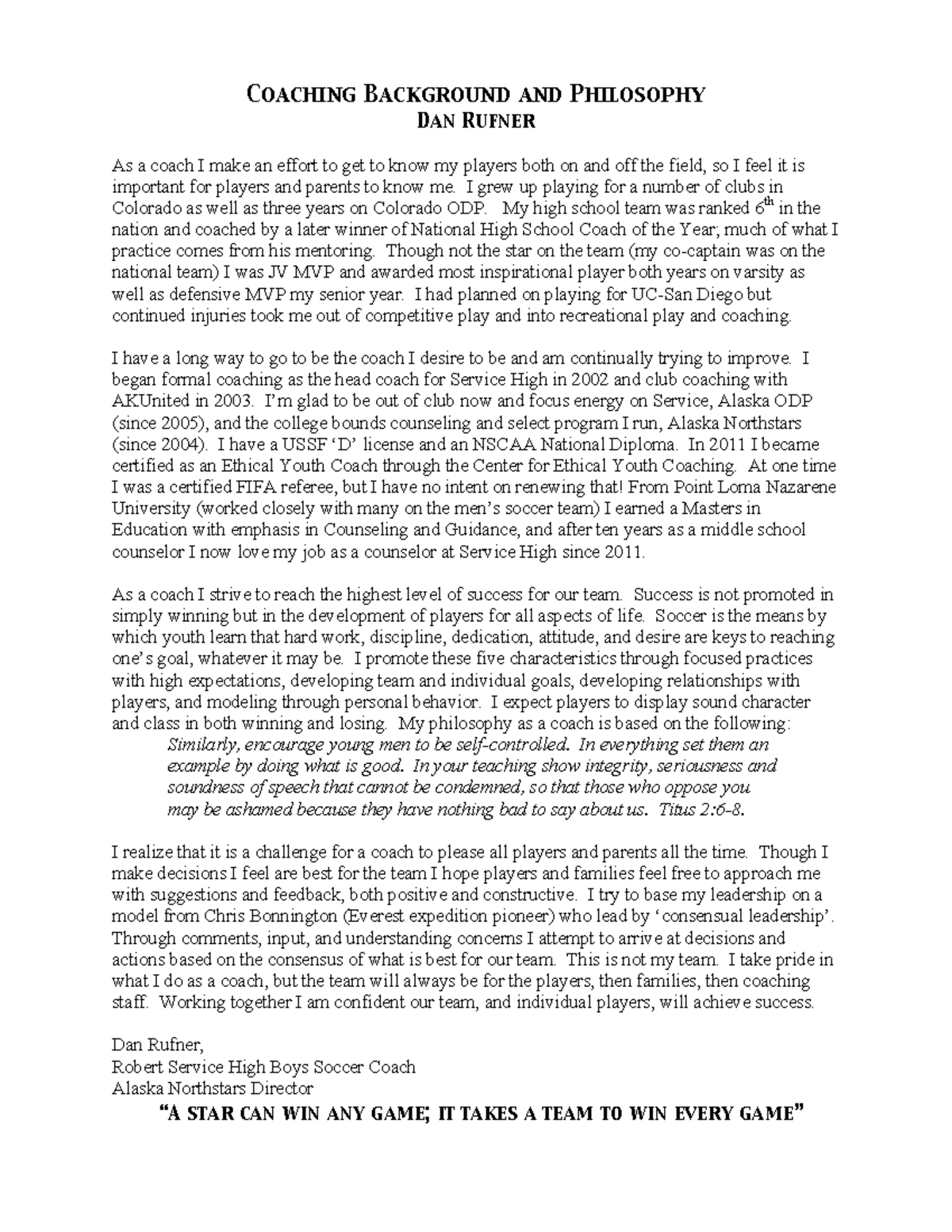
A one-page coaching philosophy is a concise, formal document that outlines your core beliefs, values, and methodologies as a leader. It serves as a professional manifesto, defining how you interact with clients or athletes, your definition of success, and the specific frameworks you use to facilitate growth and achieve measurable results.
Creating a coaching philosophy in one page is a foundational exercise for any professional practitioner, whether in sports, executive leadership, or personal development. By 2026, the coaching industry has moved toward extreme clarity and transparency. Clients and organizations no longer have the patience for multi-page dossiers; they require a high-impact summary that proves competence and cultural fit within minutes. This document is not merely a marketing tool; it is your internal "North Star" that ensures consistency across your practice.
The Strategic Purpose of a One-Page Philosophy
The primary reason to distill your entire approach into a single page is to force a level of clarity that is often lost in longer descriptions. A one-page limit requires you to prioritize your most effective strategies and your most deeply held convictions. This brevity is essential for several reasons:
- Instant Alignment: When a prospective client or employer reads your philosophy, they should immediately understand if your style aligns with their needs. If you are a high-accountability coach and they are seeking gentle exploration, the philosophy acts as a filter, saving both parties time.
- Professional Credibility: In the 2026 landscape, standardized certifications from bodies like the International Coaching Federation (ICF) or the European Mentoring and Coaching Council (EMCC) are expected. A well-articulated philosophy demonstrates that you have internalized these competencies into a unique, personal system.
- Consistent Decision-Making: When faced with a difficult ethical dilemma or a plateau in a client's progress, your written philosophy provides a framework for how to respond. It keeps your coaching "on-brand" and prevents you from drifting into methods that don't suit your strengths.
Core Components of the Document
To be effective, a one-page coaching philosophy must cover four distinct quadrants: your "Why" (Purpose), your "How" (Methodology), your "Who" (Target Audience), and your "What" (Results).
1. Vision and Mission Statement
Begin with a powerful opening statement. This is not a generic "I want to help people" sentence. Instead, it should define the specific transformation you facilitate. For example: "I empower mid-career executives to transition from operational management to visionary leadership through radical candor and emotional intelligence frameworks." This sets the stage and establishes the high-level goal of your engagement.
2. Foundational Values and Beliefs
Identify three to five core values that govern your behavior. In 2026, values such as psychological safety, sustainable growth, and evidence-based practice are highly regarded. Do not just list the words; provide a one-sentence explanation of how that value manifests in a coaching session. For instance, if you value "Autonomy," you might state: "I believe the client is the expert in their own life; my role is to facilitate discovery, not to provide answers."
3. The Coaching Framework or Methodology
This is the technical heart of your philosophy. You must name the models you use—such as the GROW model (Goal, Reality, Options, Will), Appreciative Inquiry, or Cognitive Behavioral Coaching. Explain how these tools are applied. This section proves that your coaching is grounded in established theory rather than just "friendly advice."
4. Definition of Success and Accountability
How do you know the coaching is working? Define your metrics for success. This might include qualitative data like improved confidence or quantitative data like 360-degree feedback scores or specific KPI achievements. Clearly state what you expect from the client (commitment, honesty, action) and what they can expect from you (confidentiality, preparation, challenge).
The Step-by-Step Writing Process
Writing a one-page document is often more difficult than writing a ten-page one. It requires rigorous editing and a focus on high-utility language.
Step 1: The Reflection Phase
Before writing, look at your past successes. What themes emerge? Do you tend to be more directive or non-directive? Do you focus on the future or solve current roadblocks? Spend time identifying the specific "hooks" that make your coaching unique. Use the current 2026 standards of your specific niche—whether that is the updated ICF Core Competencies or modern athletic training principles—to ensure your language is contemporary.
Step 2: Drafting the "Hook"
Your first paragraph must grab the reader. It should state your unique value proposition (UVP). Avoid industry jargon that doesn't add value. Instead, use active verbs. "I bridge the gap between..." or "I catalyze transformation in..." are strong starting points. This section should be approximately 75 to 100 words.
Step 3: Outlining the Methodology
Dedicate the middle 200 words to your process. This is where you explain your "secret sauce." If you use a specific psychological framework, explain why it is the most effective choice for your target demographic. For example, an executive coach might explain how they use systems thinking to help leaders understand the ripple effects of their decisions across a global organization.
Step 4: Refining for Brevity
Once you have a draft, perform a "word audit." Remove phrases like "I believe that" or "It is my opinion that." The reader knows it is your philosophy. State your beliefs as facts within your practice. For example, instead of "I believe that every client has the potential to lead," write "Every client possesses latent leadership potential that my process systematically unlocks."
Formatting for Maximum Impact
In 2026, the visual presentation of a professional document is as important as the content. A wall of text will likely be ignored. Use a modular layout that allows for quick scanning.
| Component | Recommended Format | Purpose |
|---|---|---|
| Header | Name, Credentials, Title | Immediate identity and authority verification. |
| Mission Statement | Bolded, 14pt-16pt font | The primary takeaway for the reader. |
| Core Values | Bulleted list with sub-text | Easy-to-digest principles of engagement. |
| Methodology | Narrative paragraph or diagram | Technical proof of your professional approach. |
| Success Metrics | Short list or "If/Then" statements | Clarifies expectations and measurable outcomes. |
| Contact/CTA | Footer | Next steps for engagement or consultation. |
Adapting the Philosophy for Different Niches
While the structure remains the same, the tone and emphasis must shift depending on whether you are coaching in a corporate, athletic, or life-coaching context.
Corporate and Executive Coaching
In the business world of 2026, the emphasis is on ROI and Strategic Alignment. Your philosophy should highlight how coaching supports organizational goals. Use terms like "stakeholder management," "inclusive leadership," and "agility." The tone should be professional, objective, and data-driven.
Athletic and Sports Coaching
For coaches in the sports arena, the focus shifts toward Long-Term Athlete Development (LTAD) and Character Building. Your philosophy might center on "Process over Outcome" or "The Pursuit of Mastery." It is vital here to mention your stance on ethics, sportsmanship, and the psychological well-being of the athlete, which has become a primary focus in modern sports science.
Life and Personal Coaching
Life coaching philosophies often lean into Holistic Development and Purpose. The tone is typically more empathetic and visionary. Key terms include "alignment," "authenticity," and "self-actualization." However, even here, maintaining a professional structure prevents the document from feeling overly sentimental or ungrounded.
Common Pitfalls to Avoid
Even experienced coaches fall into traps that can weaken their one-page philosophy. By 2026, the market is saturated, and errors in positioning can be costly.
- Being Too Generic: If any other coach could put their name on your document and it would still be true, it is not specific enough. You must include details that are unique to your experience and personality.
- Neglecting the Audience: Many coaches write their philosophy for themselves. It should be written for the client. Instead of saying "I like to use active listening," say "You will be heard and understood through a process of deep, active listening that identifies your unspoken barriers."
- Lacking Technical Depth: A philosophy that is all "heart" and no "science" lacks credibility in a professional setting. Ensure you mention the evidence-based models that inform your work.
- Failing to Update: A philosophy written in 2022 is likely obsolete by 2026. As the coaching world integrates more AI tools and neuroscientific research, your philosophy must reflect your current understanding of human behavior and performance.
Integrating 2026 Standards of Coaching Excellence
Current standards in 2026 emphasize the "Co-Active" and "Systemic" nature of coaching. This means acknowledging that a client does not exist in a vacuum. Your one-page philosophy should briefly touch upon how you handle the client's environment. Are you looking at their corporate culture? Their family dynamics? Their biological health?
Furthermore, ethical transparency is at an all-time high. A small section or sentence regarding your adherence to a specific code of ethics (like the ICF Code of Ethics) is non-negotiable for professional status. This builds immediate trust and sets a standard for the professional relationship.
Frequently Asked Questions
How long should a one-page coaching philosophy actually be?
A standard one-page philosophy should range between 300 and 500 words. This provides enough depth to be meaningful while leaving sufficient white space to ensure the document remains readable and aesthetically pleasing. If you find yourself going over 600 words, you are likely including too much "narrative" and not enough "essence."
Should I include my personal history or biography?
No. A coaching philosophy is a statement of principles and methods, not a resume or a biography. While your background informs your philosophy, the document should focus on the client’s experience and your professional approach. You can include a link to your full bio in the footer, but keep the one-page philosophy focused on the "how" and "why" of your coaching.
How often should I revise my coaching philosophy?
You should review your philosophy annually. However, significant changes should only occur if you have undergone new training, adopted a new primary methodology, or shifted your target niche. Minor tweaks to the language to reflect current industry standards—such as the 2026 focus on mental health integration in performance coaching—are appropriate.
Is it better to use "I" or "We" in the document?
If you are an individual practitioner, use "I." It creates a personal connection and establishes individual accountability. If you are representing a coaching firm or a collective, use "We." Consistency is key; do not switch between the two throughout the document.
Should I include pricing or package details on this page?
No. The coaching philosophy is a high-level document about your approach and values. Including pricing can detract from the perceived value of your expertise and make the document feel like a sales flyer rather than a professional manifesto. Keep logistical details for your "Services" or "Onboarding" documents.
Can I use a visual or infographic format?
Yes, provided it remains professional. In 2026, many coaches use a "Modular" design where different sections are in stylized boxes. This can make the document more engaging. However, ensure that the text remains the priority and that the design does not obscure the core message of your philosophy.
Practical Recommendation for Next Actions
To begin, set aside two hours of uninterrupted time. Start by brainstorming your "non-negotiables"—the three things you will always do in a coaching session and the three things you will never do. These will form the skeleton of your values and methodology sections.
Once you have a rough draft, share it with a trusted colleague or a mentor for a "clarity check." Ask them to describe your coaching style based only on that document. If their description matches your intent, you have successfully captured your philosophy. Finally, ensure the document is saved as a high-quality PDF and integrated into your website, LinkedIn profile, and onboarding materials. A clear philosophy is the most effective way to attract the right clients and build a sustainable, high-impact coaching practice in 2026.