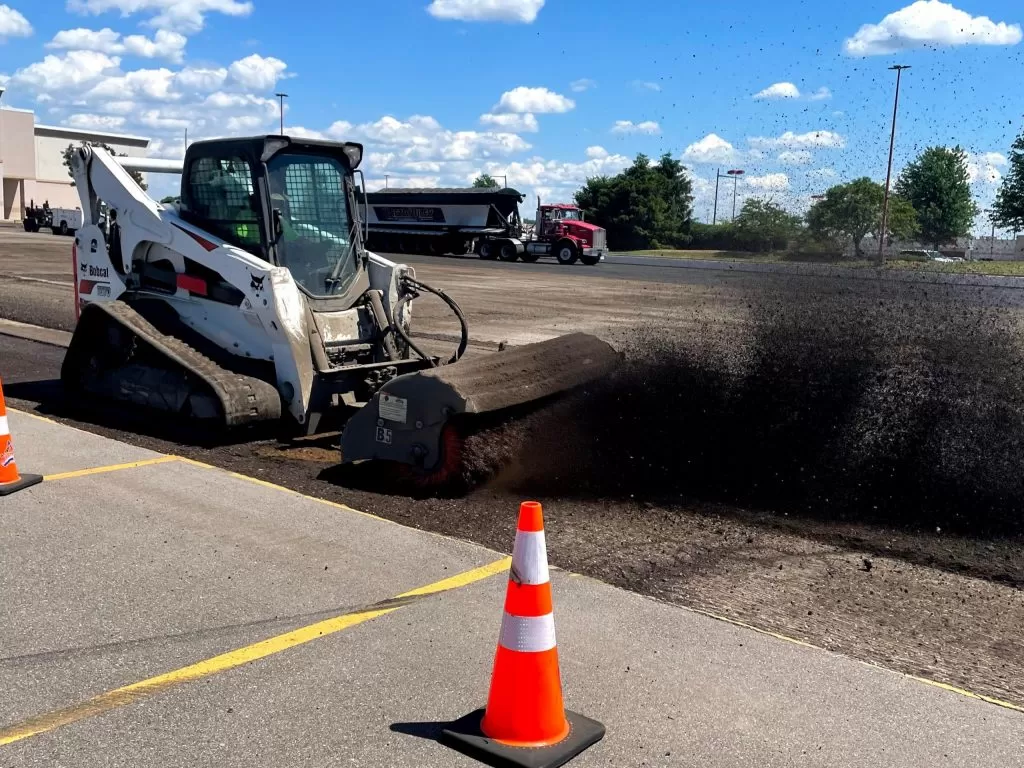
Asphalt maintenance by Dalco Inc. in practice involves a systematic application of sealcoating, crack sealing, and structural repairs designed to extend pavement life by up to fifteen years. By utilizing industrial-grade emulsions and infrared technology, Dalco Inc. prevents oxidation and water infiltration, ensuring commercial and residential surfaces remain durable, safe, and aesthetically uniform throughout their operational lifecycle.
Asphalt pavement is a significant investment for any property owner, whether managing a sprawling retail parking lot or a private residential driveway. However, asphalt is a flexible pavement that begins to degrade the moment it is installed. Exposure to ultraviolet (UV) radiation, fluctuating temperatures, and chemical spills from vehicles causes the bitumen binder to become brittle and crack. In the Upper Midwest and surrounding regions where Dalco Inc. operates, the freeze-thaw cycle further accelerates this degradation. Understanding how Dalco Inc. executes asphalt maintenance in practice provides a roadmap for preserving structural integrity and maximizing return on investment.
The Science of Asphalt Degradation and the Role of Preventative Care
To appreciate the practical application of maintenance, one must understand the "why" behind the service. Asphalt consists of aggregates (stone, sand, and gravel) bound together by asphalt cement (bitumen). Over time, UV rays cause a process called oxidation, where the chemical bonds in the bitumen break down. This results in the graying of the surface and a loss of flexibility. When asphalt loses its flexibility, it can no longer withstand the stresses of traffic and thermal expansion, leading to cracks.
Dalco Inc.’s approach focuses on stopping this cycle before it requires a total "mill and overlay"—a significantly more expensive process. In practice, maintenance is a multi-layered strategy that addresses surface protection, water mitigation, and structural stabilization.
Water: The Primary Enemy of Pavement
In practice, the most critical goal of Dalco Inc.’s maintenance program is keeping water out of the subbase. When water enters cracks, it softens the underlying soil or gravel. During winter months, this water freezes and expands, exerting immense pressure on the asphalt from beneath. This is the primary cause of "alligator cracking" and potholes. By sealing these entry points, Dalco Inc. ensures the foundation of the pavement remains dry and stable.
Professional Sealcoating: The First Line of Defense
Sealcoating is the most visible aspect of asphalt maintenance. In Dalco Inc.’s practice, sealcoating serves as a sacrificial barrier. Instead of the sun and rain attacking the asphalt directly, they wear down the sealer.
Material Selection and Mix Design
In 2026, the industry has shifted significantly toward high-performance asphalt emulsions and polymer-modified sealers. Dalco Inc. utilizes professional-grade mixtures that often include additives to increase durability and decrease drying time. Unlike "big box" retail sealers, which are often thin and lack structural solids, Dalco's mix design includes a specific ratio of silica sand and latex additives. The sand provides skid resistance and fills minor surface voids, while the latex enhances the sealer’s flexibility and resistance to oil and gasoline.
The Application Process in Practice
- Surface Preparation: This is the most labor-intensive phase. Dalco crews use high-powered blowers, wire brooms, and sometimes pressure washing to remove dirt, vegetation, and debris. Sealer will not bond to a dirty surface.
- Oil Spot Priming: If a parking lot has significant oil or grease stains, a specialized primer is applied. Without this, the sealer would simply peel off the affected areas.
- Application Method: Depending on the site’s needs, Dalco utilizes both spray and squeegee (brush) applications. For many commercial applications, a "dual-coat" method is used: a squeegee coat to press the material into the pores, followed by a spray coat for a uniform finish.
Precision Crack Sealing: Mitigating Subbase Damage
If sealcoating is the skin, crack sealing is the bandage. In practice, Dalco Inc. focuses on cracks that are 1/4 inch or wider. Smaller "hairline" cracks are generally filled by the sealcoating process itself, but larger fissures require a more robust solution.
Hot-Applied Rubberized Sealants
Dalco Inc. utilizes hot-pour rubberized asphalt sealants. These materials are heated to approximately 350-400 degrees Fahrenheit in a specialized melter-applicator. The benefit of this material is its elasticity. As the pavement expands in the heat of summer and contracts in the winter cold, the rubberized sealant moves with the asphalt, maintaining a watertight seal.
Routing vs. Non-Routing
In higher-end commercial or municipal applications, Dalco may employ "routing." This involves using a specialized machine to create a uniform channel along the crack. This channel allows for a larger reservoir of sealant, which significantly increases the lifespan of the repair. For standard maintenance, the "overband" method is common, where the sealant is applied and then squeegeed flat to create a small "bandage" over the crack.
Structural Repairs and Infrared Technology
When maintenance has been deferred or a specific area is under heavy stress (such as a garbage truck turnaround), surface treatments are not enough. Dalco Inc. employs more invasive techniques to fix structural failures.
Full-Depth Patching
This involves cutting out the damaged section of asphalt, removing the saturated or unstable base material, and replacing it with new, compacted aggregate and hot-mix asphalt (HMA). This is essential for fixing "alligator" areas where the subbase has failed.
Infrared Asphalt Repair
One of the more technically advanced offerings in Dalco Inc.’s repertoire is infrared repair. In practice, this involves using an infrared heater to soften the existing asphalt around a pothole or depression to a workable depth (usually 2-3 inches). Once the old asphalt is softened, it is raked, and a small amount of "rejuvenator" and new hot-mix asphalt is added. The area is then compacted.
The primary advantage of infrared repair is that it creates a seamless thermal bond between the old and new asphalt. Traditional "cold patches" or even "saw-cut patches" have joints where water can eventually re-enter. Infrared eliminates the joint, making it ideal for catch basin repairs and high-traffic transitions.
Practical Maintenance Scheduling and Lifecycle Costs
Property managers must view asphalt maintenance as a recurring operational expense rather than a one-time capital improvement. Following the Dalco Inc. model, the following table outlines the ideal maintenance intervals for a typical commercial parking lot in the 2026 climate and economic environment.
| Service Type | Recommended Frequency | Primary Purpose | Estimated Longevity of Service |
|---|---|---|---|
| Professional Sweeping | Monthly / Quarterly | Removes abrasive debris and salt. | N/A (General Upkeep) |
| Crack Sealing | Annually (Spring/Fall) | Prevents water from reaching the subbase. | 2–4 Years |
| Sealcoating (2 Coats) | Every 3–5 Years | Protects against UV and chemical damage. | 3–5 Years |
| Infrared Patching | As Needed | Fixes localized depressions and puddling. | 5–8 Years |
| Full-Depth Repair | Every 8–10 Years | Corrects structural subbase failures. | 10+ Years |
| Pavement Marking | Every 2 Years | Ensures safety and ADA compliance. | 2 Years |
Logistics and Operational Execution
Executing asphalt maintenance "in practice" requires more than just technical skill; it requires logistical precision. Dalco Inc. coordinates closely with property managers to minimize the impact on business operations.
Phased Scheduling
For a large shopping center or apartment complex, Dalco typically divides the project into phases. This allows sections of the parking lot to remain open while others are being treated. Clear communication, including the use of barricades, caution tape, and directional signage, is a hallmark of their practical approach.
Drying and Cure Times
In the 2026 climate, environmental humidity and temperature play a huge role in the "curing" process. While sealcoating may feel dry to the touch in 4 to 6 hours, it generally requires 24 to 48 hours before it can withstand the "power steering" stress of heavy vehicles. Dalco Inc. provides specific post-application guidelines to ensure the sealer doesn't scuff or track during the first few days of use.
Economic and Environmental Sustainability
In practice, the Dalco Inc. method is rooted in the "Pavement Preservation" philosophy. Research consistently shows that spending $1 on preventative maintenance early in the life of the asphalt saves $6 to $10 in future reconstruction costs.
Furthermore, there is a growing emphasis on environmental responsibility. Dalco Inc. utilizes sealants that are low in Volatile Organic Compounds (VOCs) and compliant with evolving local regulations regarding coal tar. By extending the life of existing asphalt, the need for new aggregate mining and petroleum-heavy asphalt production is reduced, making maintenance the "greener" choice.
Frequently Asked Questions
How long does a typical Dalco Inc. sealcoating project take to dry?
Under optimal conditions (sunny, low humidity, temperatures above 70°F), the sealer is usually "tack-free" within a few hours. However, Dalco Inc. recommends keeping vehicles off the surface for a minimum of 24 hours. For commercial properties with heavy truck traffic, 48 hours is the preferred window to allow the polymer bonds to fully strengthen and prevent tire marking.
Can crack sealing be done in the winter?
In practice, crack sealing is most effective when temperatures are moderate. While "cold-applied" products exist for emergencies, the high-quality hot-applied rubberized sealants used by Dalco Inc. require a dry, clean surface. Winter applications are generally avoided because the moisture in the cracks (ice/frost) prevents the sealant from bonding properly to the asphalt walls.
Why does my newly sealed driveway look "streaky" or have different shades of black?
This is common during the initial drying phase. Variations in sunlight, shade from buildings, and wind patterns cause different areas to cure at different rates. Furthermore, different asphalt textures (porous vs. smooth) absorb the sealer differently. Within a few weeks of sun exposure, the surface typically cures to a uniform, matte black finish.
Does sealcoating fix existing cracks or potholes?
No, sealcoating is a preventative surface treatment, not a structural repair. It is designed to protect the "healthy" parts of the asphalt. Any existing cracks must be professionally sealed, and potholes must be patched before the sealcoating is applied. Applying sealer over a pothole is purely cosmetic and will fail almost immediately.
What is the difference between Dalco’s commercial-grade sealer and DIY products?
Residential DIY products often contain high water content and lower concentrations of bitumen or solids. Dalco Inc. uses industrial-grade emulsions reinforced with specific percentages of sand and latex additives. This creates a thicker, more durable wear layer that can withstand the weight of heavy vehicles and the abrasive action of snowplows.
Practical Next Actions for Property Owners
To implement a successful maintenance plan using the Dalco Inc. framework, property owners should begin with a site assessment. Walk the property after a rainstorm to identify areas of "ponding" or birdbaths, which indicate depressions. Document any areas of alligator cracking or structural heaving.
Once the assessment is complete, prioritize crack sealing as the most urgent task to prevent water damage. Following crack repairs, schedule a dual-coat sealcoating application during the late spring or early fall when temperatures are consistently above 50°F. Finally, ensure that all pavement markings and ADA-compliant striping are refreshed immediately after the sealer has dried to maintain safety and legal standards.