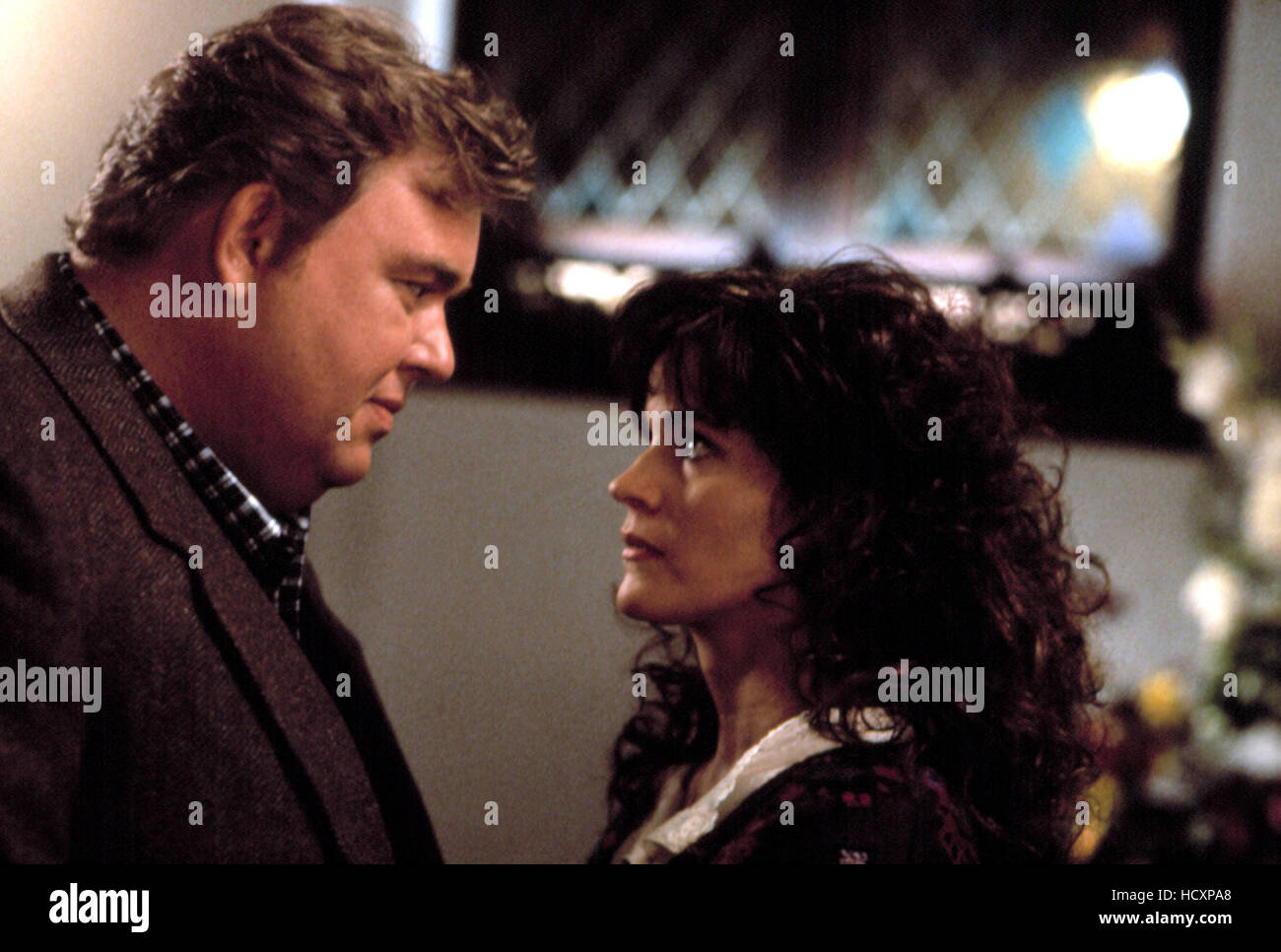
Ally Sheedy delivers a nuanced performance as Theresa Luna in the 1991 romantic comedy-drama Only the Lonely, a film written and directed by Chris Columbus. Starring alongside John Candy and Maureen O’Hara, Sheedy portrays a shy, unassuming funeral home employee who becomes the romantic interest of a Chicago police officer, helping to ground a story focused on the tension between familial obligation and personal independence.
The film Only the Lonely occupies a distinct space in the filmography of the early 1990s, blending the comedic sensibilities of John Candy with a sentimental, character-driven narrative. For viewers exploring the career of Ally Sheedy, this role serves as a bridge between her iconic status as a member of the 1980s "Brat Pack" and her transition into more mature, grounded adult roles in the following decade. Understanding her contribution to this film requires an examination of the character's narrative purpose, the chemistry of the ensemble cast, and the film’s reflection of suburban Chicago social dynamics.
The Role of Theresa Luna
Theresa Luna is introduced to the audience as a person living on the fringes of her own life. Working in the back office of her father’s funeral home, she is characterized by her extreme introversion and a lack of self-confidence that has been exacerbated by an overbearing family environment. When she meets Danny Muldoon (John Candy), an Irish-American police officer struggling to find his own identity while caring for his domineering mother, the two characters find a common ground in their shared struggle for autonomy.
In terms of acting technique, Sheedy adopts a physical and vocal posture that emphasizes Theresa’s hesitance. Unlike the more assertive characters she portrayed in The Breakfast Club or St. Elmo’s Fire, Theresa is defined by what she does not say. Sheedy uses small, hesitant gestures and a soft-spoken delivery to convey the character's internal repression. As the narrative progresses and Danny helps her gain confidence, Sheedy shifts her performance, showing a gradual, earned sense of agency. This character arc is essential to the film's thematic core: the idea that individuals can find the courage to define their own lives even when tethered to suffocating domestic expectations.
Ensemble Dynamics and Narrative Chemistry
Only the Lonely is fundamentally an ensemble piece, and Sheedy’s performance acts as the fulcrum for the conflict between Danny and his mother, Rose (Maureen O’Hara). The friction in the film is driven by Rose’s jealousy and refusal to let go of her son, and Theresa becomes the catalyst that forces the mother-son dynamic to break.
Key Cast Contributions
- John Candy (Danny Muldoon): Provides the comedic, vulnerable center of the film. His performance is marked by a gentle, "everyman" quality that balances the heavier dramatic beats of the screenplay.
- Ally Sheedy (Theresa Luna): Acts as the stabilizing force for Danny. Her character’s lack of baggage—save for her own family troubles—offers an escape for Danny, allowing him to visualize a life outside his mother’s home.
- Maureen O’Hara (Rose Muldoon): Represents the traditionalist obstacle. Her performance is sharp and often intentionally grating, which makes the quiet patience of Sheedy’s character all the more effective as a foil.
The chemistry between Sheedy and Candy is understated. They do not rely on high-octane romantic sparks; instead, their connection is built on quiet dates and shared moments of vulnerability. This choice of tone by Chris Columbus keeps the film firmly within the realm of grounded "dramedy" rather than traditional rom-com farce.
Production and Historical Context
Released in May 1991, Only the Lonely was produced by John Hughes, a figure whose influence on the career of Ally Sheedy cannot be overstated. Hughes, having written and directed seminal works that defined Sheedy’s early career, brought a sense of mid-western sensibility to this project. The film is famously set in Chicago, a city that serves as a character in itself, mirroring the rigid, traditional, and often stifling atmosphere that the protagonists are trying to navigate.
The film’s production style reflects the late 1980s and early 1990s aesthetic of American suburban cinema. It relies heavily on location shooting and naturalistic lighting, prioritizing dialogue and character interaction over complex camera movements. For researchers and film historians, Only the Lonely provides a snapshot of the transition period in Hollywood, where the "high-concept" blockbuster era was occasionally punctuated by small-scale, character-based films that focused on middle-class, blue-collar struggles.
Comparison of Character Archetypes
To better understand the specific niche Sheedy occupied in Only the Lonely, it is helpful to compare the role of Theresa Luna against her other notable portrayals of the era.
| Film Title | Character Archetype | Character Personality |
|---|---|---|
| The Breakfast Club | The Outcast / Basket Case | Eccentric, defensive, and artsy |
| St. Elmo’s Fire | The Idealist / The Journalist | Ambitious, slightly lost, and intense |
| Only the Lonely | The Wallflower / Romantic Lead | Quiet, repressed, and growth-oriented |
| Short Circuit | The Animal Activist | Principled, spirited, and proactive |
As the table illustrates, Theresa Luna represents a departure from the more eccentric roles that marked Sheedy’s early fame. The role requires a "less is more" approach that underscores a transition into adult dramatic territory, moving away from the "teen angst" branding that dominated her early public perception.
Critical Reception and Cultural Impact
Upon its release, Only the Lonely received generally positive reviews, with particular praise aimed at the performances of the lead cast. While it was not a massive blockbuster in the style of John Hughes’s teen films, it found a steady audience in the home video market throughout the 1990s.
Critics often pointed to the film’s "heart" as its defining quality. The film avoided the more cynical tropes of late-80s comedy and instead opted for a sincerity that mirrored the personality of its star, John Candy. For Ally Sheedy, the film demonstrated her ability to hold her own against legendary actors like Maureen O’Hara. The film continues to be discussed in the context of John Candy’s legacy, as it represents one of his most successful attempts at balancing his comedic timing with genuine, heavy-hearted dramatic pathos.
Challenges in Character Representation
The film is not without its critics, particularly regarding the depiction of the mother-son dynamic. Some viewers and scholars argue that the film leans heavily on the "meddling mother" trope, which at times borders on the caricature of Irish-Catholic suburban life in Chicago. Theresa Luna’s role as the "savior" who rescues the protagonist from his mother is a classic trope, and modern audiences might find the resolution of her character’s arc to be somewhat passive. Sheedy navigates these script limitations by injecting Theresa with enough quiet dignity to ensure she never feels like merely a plot device, but rather a fully realized person navigating her own insecurities.
FAQ: Frequently Asked Questions
1. Is Ally Sheedy’s role in Only the Lonely considered a comedy or a drama? The film is classified as a romantic comedy-drama (dramedy). While it contains humorous moments derived from the odd-couple dynamic between the characters, the central plot concerns family dysfunction and personal growth, giving it a dramatic foundation that distinguishes it from pure comedy.
2. How did John Hughes influence this film? John Hughes produced Only the Lonely and served as a mentor to director Chris Columbus. His influence is evident in the film's Chicago setting, the focus on the struggle of the "everyman," and the sensitive handling of the relationship between the younger leads and the older generation.
3. Was Only the Lonely a major box office success? The film performed modestly at the box office. While it was not a massive commercial phenomenon, it has maintained a consistent reputation over the years as a "comfort" movie and a vital entry in the filmographies of both John Candy and Ally Sheedy.
4. Does the character Theresa Luna have a significant backstory? The film provides minimal backstory, focusing instead on her present reality: working in her father’s funeral home and living a life defined by quiet reserve. Her history is implied through her demeanor and her instant recognition of Danny’s need for an escape from his own domestic situation.
5. Why is this film often associated with the "Brat Pack" era? It is associated with that era primarily because of Ally Sheedy’s involvement. However, the film actually marks the post-Brat Pack period, where many of the actors associated with that label began to take on more diverse roles in adult-focused cinema.
Recommendation for Viewers
For those interested in the craft of acting and the evolution of character-driven cinema, Only the Lonely is a worthwhile watch. To gain the most from the film, approach it as an exercise in ensemble dynamics rather than looking for rapid-fire comedic payoffs. Pay attention to the subtle, non-verbal cues Sheedy provides in scenes with Maureen O’Hara; these interactions serve as the primary engine for the film’s tension. The movie offers a poignant, if slightly traditional, look at the difficulty of setting boundaries with one's family, anchored by performances that elevate the material beyond the typical romantic comedy standard.