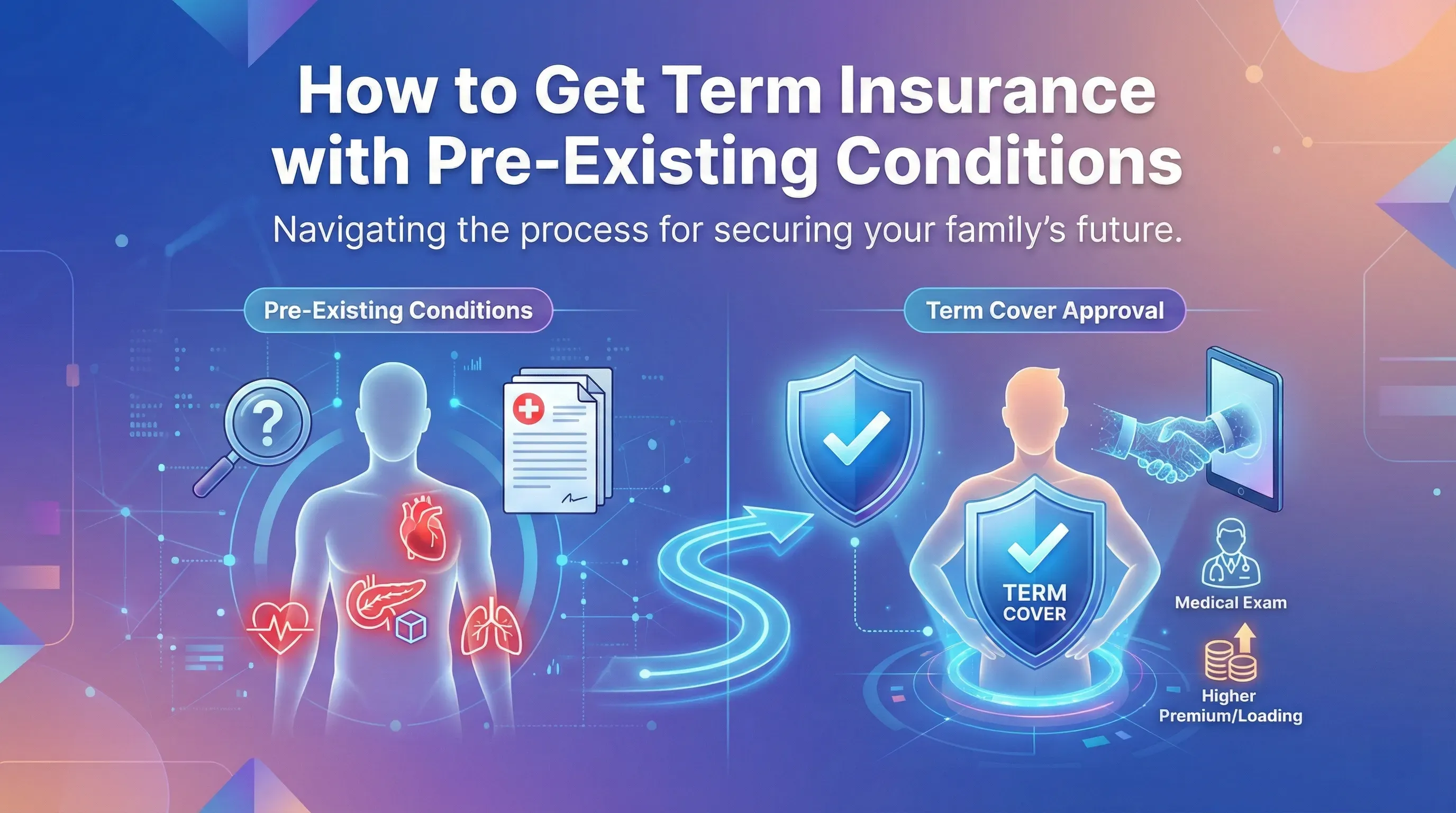
Securing life insurance with a pre-existing condition involves navigating specialized policy types such as guaranteed issue, simplified issue, and group life insurance. While traditional term or whole life policies remain accessible for many through "impaired risk" underwriting, those with more severe chronic illnesses typically rely on no-exam products that prioritize accessibility over low premiums.
Finding the right life insurance policy when you have a medical history can feel like an uphill battle. In 2026, the insurance landscape has evolved significantly, with carriers utilizing more sophisticated data to assess risk. However, the core challenge remains: how do you balance the need for financial protection for your family with the reality of higher premiums or potential denials?
A "pre-existing condition" is a broad term used by insurers to describe any health issue you had before applying for coverage. This ranges from manageable conditions like well-controlled Type 2 diabetes to more acute concerns like recent cancer treatment or cardiovascular disease. The strategy for 2026 is no longer just about finding any company that will take you; it is about finding the specific underwriting niche that favors your particular diagnosis.
1. Guaranteed Issue Life Insurance: The No-Questions-Asked Solution
Guaranteed issue life insurance is often considered the final safety net for individuals whose medical history makes them uninsurable through traditional channels. As the name suggests, acceptance is guaranteed regardless of your health status, provided you meet the age requirements (typically between 50 and 80).
How Guaranteed Issue Works
In 2026, guaranteed issue policies remain a staple for those with terminal illnesses, recent major surgeries, or multiple chronic comorbidities. These policies do not require a medical exam, and perhaps more importantly, they do not require you to answer any health questions or grant access to your medical records.
The trade-off for this guaranteed acceptance is twofold: cost and the "graded death benefit." Because the insurer is taking on a high level of unknown risk, the premiums per dollar of coverage are significantly higher than any other policy type. Furthermore, most guaranteed issue policies feature a two-year waiting period. If the insured passes away from natural causes within the first 24 months of the policy, the beneficiaries do not receive the full death benefit. Instead, they typically receive a refund of all premiums paid plus a small amount of interest (often 10%). After the two-year mark, the full face value is payable for any cause of death.
When to Choose This Option
This option is best suited for individuals who have been repeatedly declined for other types of coverage. If you are currently in treatment for a life-threatening illness or have a condition that is considered "uninsurable" by standard carriers, guaranteed issue provides a way to cover final expenses, such as funeral costs and small outstanding debts.
2. Simplified Issue Life Insurance: The Fast-Track Middle Ground
Simplified issue life insurance offers a middle path between the rigors of a full medical exam and the high costs of guaranteed issue policies. This product is designed for individuals with moderate health issues who want a quicker approval process and higher coverage amounts than guaranteed issue can provide.
The Underwriting Process
Unlike guaranteed issue, simplified issue policies do involve health questions. You will be asked a series of "Yes/No" questions regarding your medical history, recent hospitalizations, and prescription drug use. In 2026, many carriers supplement these questions with a "real-time" check of your Medical Information Bureau (MIB) report and prescription databases.
If you can answer "No" to the knockout questions—which usually cover terminal illness, HIV/AIDS, and current confinement to a nursing home—you are likely to be approved. The benefit of this approach is that you can often secure coverage within 24 to 48 hours without a needle ever touching your arm.
Coverage and Costs
Simplified issue policies generally offer higher face values than guaranteed issue, often ranging from $25,000 to $500,000 depending on the carrier and your age. While more expensive than a fully underwritten policy, they are considerably more affordable than guaranteed issue. They are ideal for those with conditions like well-controlled hypertension, sleep apnea, or those who have been "clean" from a major health event for at least two to three years.
3. Group Life Insurance: The Workplace Advantage
For many individuals with pre-existing conditions, the most cost-effective way to obtain coverage is through an employer-sponsored group life insurance plan. Because these plans spread risk across a large pool of employees, insurers often waive individual medical underwriting for "basic" coverage amounts.
Guaranteed Issue Increments
Most corporate benefit packages include a basic life insurance policy (often one to two times your annual salary) that is provided automatically. In 2026, many employers also offer "supplemental" or "voluntary" life insurance where you can purchase additional coverage. Often, there is a "Guaranteed Issue Amount"—for example, $150,000—that you can buy during your initial eligibility period without answering a single health question.
Limitations of Group Coverage
The primary drawback of group life insurance is its lack of portability. If you leave your job, you often lose the coverage or are forced to convert it to an individual policy at significantly higher "attained age" rates. Furthermore, if you need more than the guaranteed issue amount, you will likely have to fill out a Evidence of Insurability (EOI) form, which brings your pre-existing condition back into the spotlight and may lead to a denial for the extra coverage.
4. Impaired Risk Traditional Life Insurance: Using Specialized Underwriting
If you need a large amount of coverage (over $500,000) to protect a mortgage or provide for young children, do not immediately assume you are stuck with "no-exam" products. Many traditional life insurance companies specialize in "impaired risk" or "clinical underwriting."
The Power of Niche Carriers
Insurance companies are not monolithic in how they view diseases. For example, Carrier A might be very strict with Type 1 Diabetics, while Carrier B has a specialized underwriting department that focuses on diabetic risks, offering much better "table ratings" (the extra premium added for health risks).
In 2026, specialized brokers use advanced software to run "informal inquiries." Instead of submitting a formal application that could result in a "decline" on your permanent record, the broker sends your anonymized medical data to several "impaired risk" carriers to see which one offers the best tentative rate.
Why This Matters
If your condition is well-managed, documented by regular doctor visits, and shows a positive trajectory (e.g., your A1C levels are stable or your cardiac ejection fraction is within a certain range), you may qualify for a "Substandard" or "Table Rated" policy. While more expensive than a "Standard" rate, a Table 2 or Table 4 term policy is still significantly cheaper and offers much higher death benefits than a guaranteed issue policy.
5. Final Expense Insurance: Specialized Whole Life
Final expense insurance, often marketed as "burial insurance," is a specialized form of whole life insurance tailored for seniors with health issues. These policies are designed to cover the specific costs associated with end-of-life expenses, typically ranging from $5,000 to $50,000.
Graded vs. Level Benefits
Final expense policies are unique because they often offer "level," "graded," or "modified" benefits within the same product line based on your answers to a health questionnaire.
- Level Benefit: If your condition is minor, you get full coverage from day one.
- Graded Benefit: If your condition is more serious (e.g., a heart attack 18 months ago), the policy might pay 30% in year one, 70% in year two, and 100% thereafter.
- Modified Benefit: Similar to graded, but usually with a more restrictive payout structure for the first two years.
The Value of Permanent Coverage
Unlike term insurance, which expires after a set period, final expense insurance is permanent. As long as you pay the premiums, the policy will be there when you pass away. For those with chronic conditions that may worsen over time, locking in a permanent rate in 2026 provides peace of mind that the coverage won't disappear just when it's needed most.
Comparison of Life Insurance Options for Pre-Existing Conditions
| Policy Type | Medical Exam? | Health Questions? | Max Coverage (Typical) | Waiting Period? | Best For... |
|---|---|---|---|---|---|
| Guaranteed Issue | No | No | $25,000 | Yes (2 Years) | Terminal illness or serious recent events. |
| Simplified Issue | No | Yes (Limited) | $500,000 | Usually No | Managed chronic conditions needing fast approval. |
| Group Life | No | No (up to limit) | $150k - $250k | No | Employees with access to workplace benefits. |
| Impaired Risk Term | Yes | Yes (Full) | $1M+ | No | Large coverage needs with stable health history. |
| Final Expense | No | Yes (Basic) | $50,000 | Varies | Seniors looking to cover funeral costs specifically. |
Strategic Steps to Applying with a Pre-Existing Condition
Navigating the application process in 2026 requires more than just filling out a form. To get the best possible rate, follow these strategic steps:
1. Gather Comprehensive Medical Records
Insurers value stability. Before applying, ensure you have a clear record of your diagnosis, treatment plan, and medications. If you have a condition like asthma or diabetes, having a recent "Attending Physician Statement" (APS) that notes your compliance with treatment can drastically improve your underwriting outcome.
2. Work with an Independent Agent
Captive agents (who work for only one company) are limited by that company’s specific underwriting guides. An independent agent has access to dozens of carriers and can "shop" your case to find the one that is most lenient toward your specific condition.
3. Be 100% Transparent
In the age of digital health data, "hiding" a condition is almost impossible. Discrepancies between your application and your MIB report or prescription history are a leading cause of denials. It is always better to disclose a condition and explain its management than to have the insurer discover it during the background check.
4. Consider "Wait and See" for Recent Events
If you have recently suffered a major health event, such as a heart attack or a cancer diagnosis, most traditional insurers will want to see a "post-event" period of stability (often 6 to 24 months) before they will offer coverage. In 2026, applying too early can lead to a flat decline, which makes future applications more difficult.
Impact of Common Pre-Existing Conditions on Premiums
Not all conditions are treated equally in the eyes of an actuary. Understanding how your specific diagnosis is categorized can help you set realistic expectations for your premiums.
- Cardiovascular Issues: Insurers look at the date of the last event, the number of vessels involved, and current lifestyle (e.g., smoking). If you have had a stent or bypass but have been stable for three years, you may qualify for standard or low-substandard rates.
- Diabetes: Type 2 is treated much more favorably than Type 1. Underwriters focus on your A1C levels. In 2026, some carriers offer "credits" for using continuous glucose monitors (CGMs) that show consistent control.
- Cancer: The type, stage, and "time since last treatment" are the critical factors. Non-melanoma skin cancers are often ignored, while internal cancers typically require a 2-to-5-year waiting period for traditional coverage.
- Mental Health: Anxiety and depression are common and, if well-managed with therapy or low-dose medication, often result in standard rates. More severe diagnoses like bipolar disorder or schizophrenia typically move a policy into the simplified or guaranteed issue categories.
Frequently Asked Questions
Can I be denied life insurance because of a pre-existing condition?
Yes, you can be denied for traditional term or whole life insurance if your health risk is deemed too high for the carrier’s guidelines. However, you cannot be denied for Guaranteed Issue life insurance, as it does not involve health underwriting.
Is life insurance with a pre-existing condition more expensive?
Generally, yes. Insurers charge higher premiums to offset the increased statistical likelihood of a claim. These higher rates are often applied through "table ratings," which add a percentage (e.g., 25% or 50%) to the standard base premium.
Will my premiums go down if my health improves?
Many policies allow for a "re-rating" after a certain period (usually one to two years). If you can prove significant health improvement—such as major weight loss, lower cholesterol, or a period of cancer remission—you can ask the insurer to review your medical records and potentially lower your premium.
What is the "contestability period"?
Regardless of health status, almost all policies have a two-year contestability period. If the insured dies within the first two years, the insurer has the right to investigate the original application for fraud or material misrepresentation. This is why total honesty about pre-existing conditions is vital.
Can I get life insurance if I am currently in the hospital?
It is extremely difficult to secure any new life insurance coverage while currently hospitalized or in a nursing home. Most "knockout" questions on simplified and guaranteed issue applications specifically ask if you are currently confined to a medical facility.
Next Steps for Securing Coverage
If you have a pre-existing condition, the best time to apply is now. Health issues rarely become easier to insure as we age. Start by checking your employer's benefits for any guaranteed issue group coverage. Simultaneously, contact an independent broker who specializes in "high-risk" cases to perform an informal inquiry across multiple carriers. By comparing a high-limit simplified issue policy against a table-rated traditional policy, you can find the optimal balance of cost and protection for your family's future.
Professional Disclaimer: The information provided in this article is for educational purposes only and does not constitute financial or legal advice. Life insurance underwriting guidelines vary by state and carrier. Always consult with a licensed insurance professional before making a purchase.