Pre-settlement legal funding provides non-recourse cash advances to plaintiffs awaiting the outcome of personal injury or legal claims. The five best legal funding companies—Oasis Financial, US Claims, Nova Legal Funding, Cartiga, and Peachtree Financial Services—offer transparent terms, fast approval timelines, and competitive non-recourse interest structures to support litigants during extended legal battles.
Understanding Pre-Settlement Legal Funding
Legal funding, commonly referred to as a lawsuit loan or pre-settlement cash advance, is a financial arrangement where a funding company provides cash to a plaintiff in exchange for a portion of the expected future settlement or trial award. Unlike traditional personal loans or bank credit lines, pre-settlement funding is strictly non-recourse. This means the repayment of the advance is entirely contingent upon winning or settling the case. If the plaintiff loses the lawsuit, they owe nothing to the funding company.
Because these transactions are structured as asset purchases (buying a legal claim's future proceeds) rather than debt instruments, traditional credit scores, employment histories, and income verifications are irrelevant to approval. Instead, underwriting focuses exclusively on the legal merits of the case, the scope of damages, liability clarity, insurance policy coverage limits, and the representation of a licensed attorney.
While legal funding serves as a vital financial lifeline for plaintiffs who cannot afford immediate living expenses or medical bills while awaiting trial, it comes at a higher cost than standard debt. Understanding how funding providers calculate rates, structure contracts, and process disbursements is essential before taking an advance against a legal recovery.
Key Criteria for Evaluating Lawsuit Funding Companies
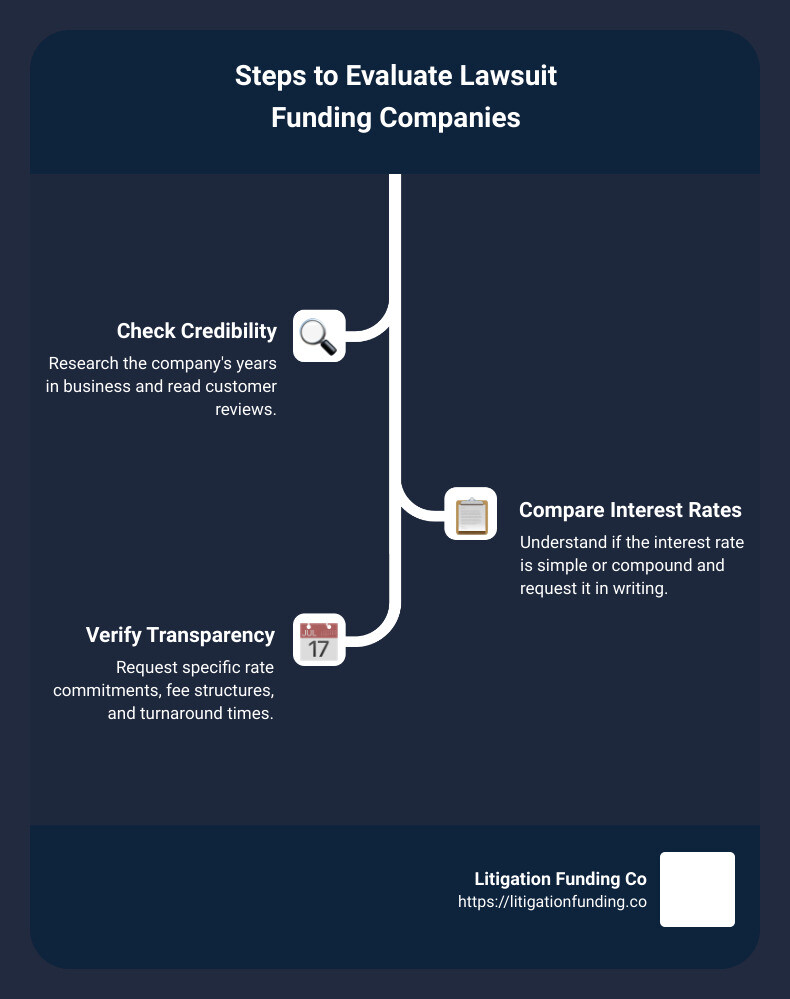
Selecting the right pre-settlement funding company requires careful review of fee structures, ethical compliance, and contractual clarity. To compare options effectively, plaintiffs and their legal counsel should evaluate providers using several core criteria:
- Interest Calculation Structure: Companies generally charge either simple or compounding interest. Simple interest calculates fees solely on the principal advance amount, making long-term costs predictable. Compounding interest calculates rates on the principal plus accumulated fee balances, causing the total debt to escalate rapidly over multi-year litigation.
- Cap on Total Repayments: Top-tier funders often include repayment caps (e.g., limiting total repayment to no more than two or three times the original advance amount), protecting plaintiffs from losing their entire recovery to fees during protracted appeals.
- Industry Accreditation: Participation in industry oversight bodies, such as the American Legal Finance Association (ALFA), signals adherence to ethical standards, full contractual disclosure, and prohibition of predatory practices.
- Fee Transparency: Reliable companies present clear fee schedules without hidden application costs, broker commissions, or mandatory underwriting fees that are quietly tacked onto the principal balance.
- Processing Speed and Direct Communication: Reputable firms coordinate directly with the plaintiff's attorney to review case files swiftly, disbursing funds within 24 to 48 hours of contract execution.
Top 5 Legal Funding Companies Reviewed
1. Oasis Financial
Oasis Financial is one of the largest and longest-operating consumer pre-settlement funding providers in the United States. Established in 1996, the company has funded hundreds of thousands of plaintiffs across various personal injury and civil litigation categories. Oasis is a founding member of ALFA and operates under strict guidelines regarding disclosures and consumer rights.
Offerings and Underwriting
Oasis provides advances ranging from $500 to over $100,000, depending on case evaluation and policy coverage limits. The company handles standard personal injury claims, including motor vehicle accidents, slip-and-fall injuries, medical malpractice, product liability, and workplace injuries. Applications require legal representation, as Oasis underwriters coordinate directly with the managing law firm to review accident reports, medical records, and insurance responses.
Pros and Cons
- Pros: Highly established operational framework; fast processing times (often within 24 hours); strong compliance with state-level regulatory guidelines.
- Cons: Funding availability and fee structures vary by state due to local statutory caps; interest rates can be higher for complex or high-risk litigation.
2. US Claims
Founded in 1996, US Claims is widely recognized for offering lower long-term costs due to its transparent non-compounding, simple interest fee models. The company specializes in personal injury litigation and works extensively with law firms nationwide to streamline funding workflows for injured parties.
Offerings and Underwriting
US Claims provides pre-settlement advances and post-settlement funding for personal injury claims, wrongful death suits, mass torts, and civil rights actions. Advance sizes range from $500 to several hundred thousand dollars for major catastrophic injury claims. The company prioritizes capped, simple interest structures, which prevents fee ballooning in cases that take several years to resolve.
Pros and Cons
- Pros: Simple, non-compounding interest rates reduce total repayment burdens over extended litigation; transparent fee disclosures; caps on total maximum repayment.
- Cons: Strict underwriting requirements mean high rejection rates for cases with uncertain liability; requires active cooperation from legal counsel.
3. Nova Legal Funding
Nova Legal Funding is a prominent direct funder known for fast approvals, high-limit advances, and nationwide availability. Operating with a commitment to fee transparency, Nova focuses on personal injury, employment discrimination, labor law claims, and mass tort litigation.
Offerings and Underwriting
Nova provides pre-settlement funds starting at $1,000, with upper limits exceeding $2,500,000 for catastrophic injury or high-value commercial claims. Underwriting relies on electronic case document submission, allowing for expedited review. Nova emphasizes non-recourse funding with zero upfront fees, zero monthly payments, and clear repayment terms detailed in the primary contract.
Pros and Cons
- Pros: Ability to fund extremely large advances for complex cases; rapid underwriting response; offers funding for employment law and non-standard injury cases.
- Cons: Compounding rate options may apply depending on risk profile; higher interest rates apply to non-standard or high-risk legal claims.
4. Cartiga
Cartiga was formed through the consolidation of experienced legal funding brands, including LawCash and Arcuris Risk Management. Cartiga combines lawsuit funding for plaintiffs with risk-management data tools for law firms, positioning itself as a comprehensive legal finance partner.
Offerings and Underwriting
Cartiga delivers pre-settlement advances, surgical/medical funding, and post-settlement liquidity to plaintiffs nationwide. Because Cartiga works directly with legal teams to analyze case metrics through proprietary data models, case review times are often shorter for clients whose attorneys already maintain a relationship with the platform. Advances are non-recourse and scaled based on estimated claim recovery value.
Pros and Cons
- Pros: Deep legal industry integration; provides specialized funding options for case-related medical procedures; clear non-recourse contracts.
- Cons: Best suited for plaintiffs represented by established law firms; fee structures reflect sophisticated case risk calculations that require detailed legal documentation.
5. Peachtree Financial Services
Peachtree Financial Services has provided structured settlement purchasing, annuity monetization, and pre-settlement legal funding for decades. It remains a well-known choice for plaintiffs needing flexible cash solutions during or after lawsuit proceedings.
Offerings and Underwriting
Peachtree offers pre-settlement funding for personal injury, motor vehicle claims, and slip-and-fall cases, alongside post-settlement funding and structured settlement buyouts. Their underwriting process involves direct consultation with the plaintiff’s attorney to confirm case facts and settlement negotiations. Funding amounts are tailored to immediate living and medical expense needs.
Pros and Cons
- Pros: Broad financial services portfolio allowing seamless transition from pre-settlement advances to post-settlement structured payouts; national footprint and established corporate backed stability.
- Cons: Less specialized in boutique or complex mass tort claims; underwriting turnaround times can be longer than specialized quick-turnaround funders.
Comparison of Leading Legal Funding Companies
The table below outlines key features, interest structures, and operational focuses across the top five legal funding providers:
| Company Name | Primary Specialty | Interest Rate Structure | Approval Timeline | Best For |
|---|---|---|---|---|
| Oasis Financial | Personal Injury, Auto Accidents | Simple & Compounding Options (State-Dependent) | 24–48 Hours | General personal injury claims requiring fast turnaround |
| US Claims | Personal Injury, Wrongful Death | Non-Compounding Simple Interest | 24–48 Hours | Multi-year litigation requiring fee cost control |
| Nova Legal Funding | High-Value Injury, Mass Torts | Simple Rate Structures Available | 24 Hours | Large advance amounts and employment discrimination claims |
| Cartiga | Personal Injury, Medical Funding | Case-Value Based Non-Recourse | 24–72 Hours | Plaintiffs needing medical procedure financing along with living cash |
| Peachtree Financial Services | Personal Injury, Structured Buyouts | Fixed Non-Recourse Rate Quotes | 48–72 Hours | Litigants seeking long-term financial planning or annuity options |
Costs, Rates, and Financial Risks
While pre-settlement funding helps plaintiffs resist unfair, lowball settlement offers from insurance companies, the financial commitment is substantial. Understanding cost dynamics helps protect the final payout.
Rates and Fees Breakdown
- Interest Rates: Typical legal funding rates range between 2% and 4% per month. Expressed as an annual percentage, simple interest of 3% per month equals 36% per year, whereas a 3% monthly compounding rate results in an effective annual rate (EAR) exceeding 42%.
- Underwriting and Document Fees: Funders often add an administrative or processing fee (ranging from $250 to $750) directly to the principal balance at the time of funding.
- Payoff Capping: A critical metric is whether the contract caps the maximum payout (e.g., 2x or 3x the principal). Without a cap, a lawsuit that takes four years to settle could consume the entirety of the plaintiff's net compensation.
Legal and Regulatory Oversight
Pre-settlement legal funding regulations vary significantly across jurisdictions:
- State-Level Rate Regulation: Certain states (such as Indiana, Maine, Missouri, and Oklahoma) classify legal funding under consumer credit statutes or cap monthly rates, while other states treat transactions under traditional commercial contract law.
- Consumer Protections: Regulatory guidelines established by the Consumer Financial Protection Bureau (CFPB) and state attorneys general recommend clear disclosure of fee tables, total repayment schedules at 6-month intervals, and a mandatory 5-day right of rescission allowing plaintiffs to return funds penalty-free.
Step-by-Step Guide to Applying for Lawsuit Funding
Applying for lawsuit funding involves a structured process that relies heavily on cooperation between the applicant and their legal counsel.
- STEP 1: Attorney Consultation
- Discuss financial needs with legal counsel and get consent.
- STEP 2: Application Submission
- Submit personal and case details online or by phone.
- STEP 3: Case Document Review
- Funder reviews medical records, police reports, and insurance.
- STEP 4: Contract Execution
- Plaintiff and attorney sign the non-recourse funding agreement.
- STEP 5: Disbursement & Settlement Distribution
- Funds disbursed; repayment occurs automatically upon settlement.
Step 1: Consult Your Legal Counsel
Before contacting a funder, discuss your financial needs with your lawyer. Lawsuit funding contracts require your attorney's signature, confirming they will withhold and remit the repayment amount directly from the settlement proceeds before distributing your final check.
Step 2: Submit an Application
Provide basic contact details, your attorney's contact information, the type of lawsuit, and the requested advance amount. Most top funding companies offer free online or phone applications.
Step 3: Case Documentation Review
Underwriters from the funding firm contact your law firm to request key documentation, including:
- Police or incident reports
- Medical records and bills
- Insurance policy limits and coverage verification
- Formal complaints or court filings
Step 4: Review and Sign the Agreement
If approved, the funding company sends a non-recourse agreement detailing the advance principal, monthly interest structure, processing fees, and full repayment schedule. Both you and your attorney must carefully review and sign the contract.
Step 5: Receive Funds and Automate Settlement Repayment
Upon execution, funds are transferred via direct deposit, wire, or check within 24 to 48 hours. Repayment requires no ongoing monthly out-of-pocket payments. When the lawsuit resolves, your attorney pays the funder directly out of the trust account holding the settlement check.
Alternatives to Pre-Settlement Legal Funding
Because of the high cost of pre-settlement advances, plaintiffs should evaluate alternative options before signing a funding agreement:
- Medical Liens and Healthcare Provider Arrangements: Many healthcare providers treat personal injury victims on a lien basis, agreeing to await payment until the case settles without charging heavy monthly compounding interest.
- Credit Cards or Personal Lines of Credit: If a plaintiff maintains good credit, traditional bank loans or credit lines carry significantly lower annual percentage rates (APRs) than legal funding advances.
- Disability Insurance Benefits: Short-term and long-term disability policies can supplement lost wages during recovery, preventing the need to leverage an ongoing lawsuit.
- Attorney Settlement Advances: While attorneys cannot lend funds directly for living expenses in most jurisdictions under legal ethics rules (e.g., ABA Model Rule 1.8(e)), they can often pay litigation costs directly, freeing up plaintiff resources.
- Post-Settlement Funding: If a case has already reached a settlement agreement but payout processing is delayed, post-settlement advances carry substantially lower risk and lower fees than pre-settlement loans.
Frequently Asked Questions
What happens to pre-settlement funding if I lose my lawsuit?
Because legal funding is structured as a non-recourse purchase of future asset proceeds, you are not required to repay the advance if your lawsuit is unsuccessful. The funding company absorbs the loss, and you owe zero out-of-pocket money.
Do I need a credit check or proof of employment to qualify?
No. Approval for pre-settlement legal funding depends entirely on the legal merits, liability clarity, and insurance limits of your lawsuit. Funding providers do not evaluate credit scores, income statements, or employment history.
Can I get lawsuit funding without a lawyer?
No. All reputable pre-settlement funding companies require applicants to retain a licensed attorney working under a contingency fee agreement. The funder relies on your attorney to verify case facts and handle repayment distribution from the legal trust account.
How much money can I borrow against my lawsuit?
Most companies cap pre-settlement funding advances at 10% to 20% of the estimated net settlement value of your claim. This cap ensures that after medical liens, legal fees, and loan repayment are fulfilled, a meaningful portion of the settlement goes to the plaintiff.
Is interest on lawsuit funding simple or compounding?
Fee structures depend on the funding company and the contract terms. Companies like US Claims emphasize simple interest models, while other providers use compounding interest. Always insist on simple interest terms or a firm repayment cap to keep long-term costs manageable.
Strategic Guidance for Litigants
When facing extended litigation, pre-settlement legal funding can prevent financial distress and buy your attorney time to negotiate a full and fair settlement. However, because fees accumulate over time, legal funding should be used as a targeted financial tool rather than a first choice.
Discuss funding needs thoroughly with your attorney, request quotes from multiple accredited providers, choose non-compounding or capped interest structures, and limit your advance to the minimum amount necessary to cover essential living expenses.
Disclaimer: This article provides general educational information regarding legal funding options and does not constitute formal legal, financial, or tax advice. Consult a qualified legal attorney or financial professional regarding your specific situation before executing funding contracts.