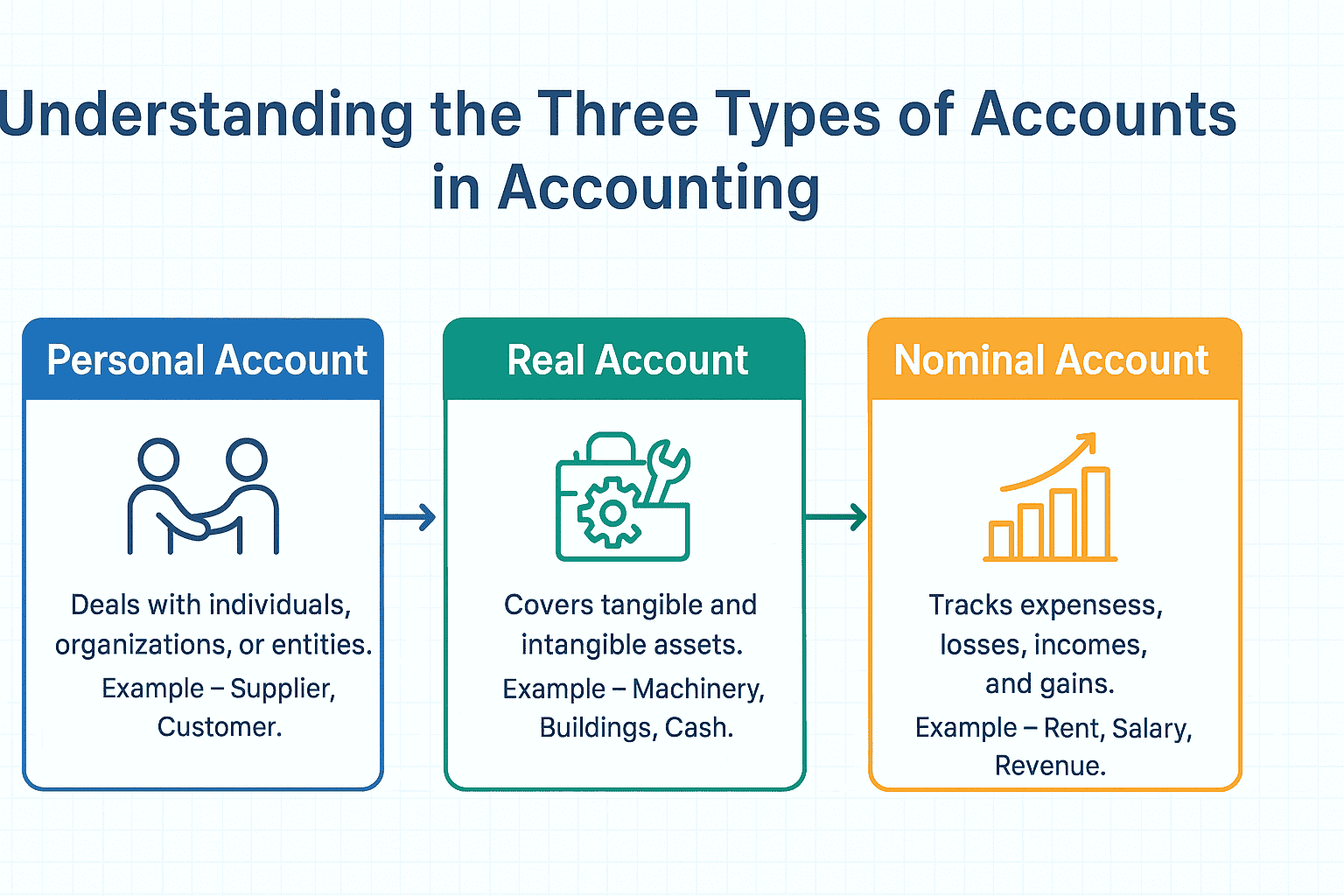
In the modern financial landscape of 2026, the three primary types of accounts are Personal, Real, and Nominal accounts. These categories serve as the bedrock of the double-entry bookkeeping system, dictating how every financial transaction is classified and recorded through specific "Golden Rules" that determine debit and credit entries.
While digital payment systems and AI-driven ledgers have automated much of the data entry process, the underlying logic of account classification remains unchanged. Whether you are a small business owner navigating cloud-based ERP systems or a student of finance, mastering these three categories is essential for maintaining accurate financial statements and ensuring regulatory compliance.
The Foundation of Account Classification
To understand the three types of accounts, one must first grasp the concept of the double-entry system. This system, which has been the standard for centuries, operates on the principle that every financial transaction has a dual effect: one account is debited, and another is credited. The classification of an account into Personal, Real, or Nominal determines which side of the ledger a transaction will fall upon.
In 2026, even as decentralized finance (DeFi) and automated smart contracts gain traction, the traditional classification provides the necessary structure for traditional Balance Sheets and Profit and Loss (P&L) statements. Without this categorization, financial data would lack the organization required for audits, tax filings, and strategic analysis.
1. Personal Accounts: Transactions with Entities
Personal accounts are ledger accounts that record transactions related to individuals, firms, companies, or any other legal associations. The fundamental purpose of a personal account is to track how much the business owes to others and how much others owe to the business.
Sub-categories of Personal Accounts
Personal accounts are not limited to actual human beings. In accounting theory, they are divided into three distinct sub-groups to ensure every entity is properly represented:
- Natural Personal Accounts: These relate to actual human beings. Examples include "John Smith’s Account" or "Sarah’s Capital Account." These accounts track transactions directly involving a specific person.
- Artificial Personal Accounts: These represent entities that are recognized as "persons" by law but do not have a physical human presence. In 2026, this includes Limited Liability Companies (LLCs), corporations, NGOs, clubs, and government bodies. For example, "Microsoft Corp Account" or "The Red Cross Account" are artificial personal accounts.
- Representative Personal Accounts: These are accounts that represent a specific person or group of people indirectly. They are usually linked to expenses or incomes that are outstanding or paid in advance. For example, "Wages Outstanding Account" represents the employees to whom the business owes money. Similarly, "Prepaid Insurance Account" represents the insurance provider who has received payment for future services.
The Golden Rule for Personal Accounts
The rule for recording transactions in a personal account is straightforward: Debit the Receiver, Credit the Giver.
If a business pays $5,000 to a supplier (an artificial person), the supplier’s account is debited because they are the receiver of the value. Conversely, if a client pays the business, the client’s account is credited because they are the giver.
2. Real Accounts: Tracking Assets and Possessions
Real accounts are those that relate to the assets, properties, or possessions of a business. These accounts are called "real" because they represent tangible or intangible items that have a continuing existence and do not "reset" to zero at the end of a fiscal year. Instead, their balances are carried forward to the next year on the Balance Sheet.
Tangible vs. Intangible Real Accounts
As the economy has evolved toward digital and intellectual property, the distinction between tangible and intangible assets has become increasingly significant:
- Tangible Real Accounts: These are assets that have a physical form and can be touched or felt. Common examples in 2026 include machinery, office equipment, land, buildings, and inventory. For a logistics company, their fleet of autonomous delivery vehicles would be recorded under a tangible real account.
- Intangible Real Accounts: These are assets that lack physical substance but hold significant monetary value. In the current 2026 market, these include patents, copyrights, trademarks, brand goodwill, and software licenses. Digital assets such as proprietary algorithms or verified carbon credits are also classified here.
The Golden Rule for Real Accounts
The governing rule for these accounts is: Debit what comes in, Credit what goes out.
When a business purchases a new server for its data center, the "Server Account" (a real account) is debited because the asset is coming into the business. If the business later sells an old piece of machinery, the "Machinery Account" is credited because the asset is going out of the business.
3. Nominal Accounts: Revenue, Expenses, and Losses
Nominal accounts are temporary accounts used to record transactions related to expenses, losses, incomes, and gains. Unlike real accounts, nominal accounts are closed at the end of each accounting period. Their balances are transferred to the Trading and Profit & Loss Account to determine the net profit or loss for the year.
In the 2026 fiscal environment, nominal accounts are vital for real-time performance tracking. Because they track the "activity" of the business rather than its "state," they provide the data for most modern business intelligence dashboards.
Examples of Nominal Accounts
- Expenses: Rent, salaries, electricity, advertising costs, and travel expenses.
- Losses: Loss on sale of an asset or loss by theft/fire.
- Incomes: Sales revenue, interest received, and commission earned.
- Gains: Profit on the sale of an investment or an unexpected legal settlement in favor of the company.
The Golden Rule for Nominal Accounts
The rule for nominal accounts is: Debit all expenses and losses, Credit all incomes and gains.
If a company pays $1,200 for a subscription to a cloud-based AI tool, the "Software Subscription Account" is debited as it is an expense. If the company receives a $500 dividend from an investment, the "Dividend Income Account" is credited because it represents a gain/income.
Comprehensive Comparison Table
The following table provides a quick reference for distinguishing between the three types of accounts and applying their respective rules.
| Account Type | Scope | Sub-types | Golden Rule | 2026 Examples |
|---|---|---|---|---|
| Personal | Individuals & Entities | Natural, Artificial, Representative | Debit the Receiver; Credit the Giver | Suppliers, Customers, Banks, Outstanding Rent |
| Real | Assets & Properties | Tangible, Intangible | Debit what comes in; Credit what goes out | Cash, Inventory, Patents, Crypto-assets, Buildings |
| Nominal | Gains & Losses | Income, Expense | Debit Expenses/Losses; Credit Income/Gains | Sales Revenue, Interest, Office Supplies, Wage Expense |
Why Classification Matters in 2026
Accurate classification is not merely an academic exercise; it has practical implications for how a business operates and how it is perceived by stakeholders.
Financial Statement Accuracy
The Balance Sheet is composed primarily of Personal and Real accounts. If a transaction that should be in a Nominal account (like a repair expense) is incorrectly placed in a Real account (like an asset), the business’s profit will be overstated, and its assets will be inflated. This is known as an error of principle and can lead to severe legal and tax consequences.
Regulatory and Tax Compliance
Tax authorities in 2026 utilize automated auditing tools that flag inconsistencies in account classification. For instance, the treatment of "Representative Personal Accounts" like Accrued Expenses is a common area of scrutiny. Ensuring these are categorized correctly ensures that the company pays the correct amount of tax based on the actual timing of its financial obligations.
Business Intelligence and AI Integration
Most modern accounting software uses "tagging" systems that correspond to these three types. When a business uses AI to predict future cash flow, the AI relies on the distinction between Real accounts (what we have) and Nominal accounts (how we are spending/earning) to generate accurate forecasts. Misclassification leads to "garbage in, garbage out" scenarios in financial forecasting.
Common Pitfalls in Account Classification
Even seasoned professionals can occasionally struggle with certain transactions. Understanding these pitfalls is key to maintaining a clean ledger.
Mixing Personal and Business Accounts
In small businesses or sole proprietorships, it is common for owners to use business funds for personal expenses. From an accounting perspective, the owner's personal life is a "Natural Personal Account" (Drawings Account). If these are not separated from the business's nominal accounts (expenses), the financial health of the business becomes impossible to track.
The "Cash" Ambiguity
Newcomers often wonder if "Cash" is a Personal account (because it’s in a bank) or a Real account. Technically, physical cash and the "Cash in Hand" account are Real Accounts because they are assets. However, a "Bank Account" is technically an Artificial Personal Account because it represents a relationship with a banking institution. In practice, many modern systems treat them similarly, but the distinction is vital for rigorous theoretical accounting.
Expense vs. Asset
One of the most frequent errors is failing to distinguish between a Nominal account (Expense) and a Real account (Asset). For example, buying a laptop is usually a Real account (Asset) because it provides value for several years. Buying printer paper is a Nominal account (Expense) because it is consumed quickly. In 2026, the threshold for "Capitalizing" an expense (moving it from Nominal to Real) is often defined by corporate policy and tax law.
Strategic Guidance for Implementation
To ensure your organization or personal books are managed effectively using these three types of accounts, consider the following steps:
- Standardize Your Chart of Accounts (COA): Organize your COA so that it is grouped by these three categories. This makes it easier for staff to identify where a transaction belongs.
- Use Automation for Repetitive Nominal Entries: Set up automatic rules for recurring nominal accounts like utility bills or monthly software subscriptions to reduce manual entry errors.
- Perform Regular Reconciliations: At least once a month, reconcile your Personal accounts (specifically accounts receivable and payable) to ensure that your records match those of your vendors and clients.
- Audit Your Real Accounts Annually: Conduct a physical or digital audit of your assets to ensure the balances in your Real accounts reflect the actual existence and value of the assets (considering depreciation).
Frequently Asked Questions
What are "Permanent" and "Temporary" accounts?
Permanent accounts consist of Real and Personal accounts. They are called permanent because their balances are not wiped out at the year's end; they are carried over to the next period. Temporary accounts are Nominal accounts. They are "closed" at the end of the fiscal year, meaning their balances are reset to zero after being transferred to the income statement.
Does a bank account count as a Real or Personal account?
A bank account is classified as an Artificial Personal Account. This is because the account represents the legal entity (the bank) that holds your money and owes it back to you. However, some simplified accounting frameworks treat "Cash at Bank" as a Real account because it represents a liquid asset. For professional examinations and rigorous bookkeeping, it is Personal.
How do modern digital assets like NFTs fit into these three types?
In 2026, most digital assets like NFTs (Non-Fungible Tokens) or cryptocurrency held for investment are classified as Intangible Real Accounts. They are assets owned by the business that "come in" and "go out" and maintain value over time. If the business is a digital asset trader, they might be classified as inventory (also a Real account).
Why is there no "Expense Account" category in the primary three types?
Expenses are actually a subset of Nominal Accounts. The three-type framework is the broadest level of classification. Under the "Nominal" umbrella, you find both expenses/losses and income/gains. This grouping exists because both categories are used to calculate the net profit or loss for a specific period.
Can an account change its type?
An account's fundamental type (Personal, Real, or Nominal) does not change. However, a transaction might involve multiple types. For example, when you pay a supplier (Personal) with cash (Real), you are impacting two different categories of accounts simultaneously.
Next Steps for Financial Management
To apply this knowledge effectively, begin by reviewing your current Chart of Accounts. Ensure that every account is clearly identified as Personal, Real, or Nominal. This clarity will not only make your period-end closing smoother but will also provide a solid foundation for any 2026 tax audits or financial reviews. If you are using modern accounting software, verify that the "account type" settings for each ledger entry align with these classic Golden Rules of Accounting to prevent reporting errors.