Maintaining the transmission fluid in a 2015 Nissan Sentra is essential for ensuring the longevity and smooth operation of its Continuously Variable Transmission (CVT). Nissan specifies the exclusive use of Nissan NS-3 CVT Fluid for this model year, and utilizing the correct fluid type combined with adhering to proper change intervals prevents premature belt wear, overheating, and catastrophic transmission failure.
Understanding the 2015 Nissan Sentra Transmission System
The 2015 Nissan Sentra utilizes an Xtronic Continuously Variable Transmission (CVT) paired with its 1.8-liter 4-cylinder engine (MRA8DE). Unlike traditional automatic transmissions that rely on a fixed set of planetary gear ratios, a CVT uses a system of variable-width pulleys connected by a high-strength steel pushbelt. This design allows the engine to operate at its most efficient RPM across various driving speeds, resulting in optimal fuel economy.
However, the operational mechanics of a CVT place unique demands on its transmission fluid. The fluid must provide exceptional friction characteristics to prevent belt slip against the pulley faces while simultaneously lubricating bearings, cooling internal components, and acting as a hydraulic medium to actuate the pulley sheaves. Because of these intense shear forces and thermal loads, the condition and chemical composition of the fluid degrade over time, making periodic maintenance non-negotiable for vehicle owners.
Required Transmission Fluid Specifications and Capacity
Using the correct fluid specification is critical for the survival of the 2015 Nissan Sentra transmission. Nissan explicitly mandates Nissan NS-3 CVT Fluid for this model year.
Why Fluid Specification Matters
Earlier Nissan models (typically those produced before 2013) utilized Nissan NS-2 CVT Fluid. While NS-2 and NS-3 may appear similar, their additive packages and viscosity profiles at high operating temperatures are distinct. NS-3 fluid was engineered specifically for newer generations of Xtronic CVTs to handle higher temperatures and improve cold-weather performance. Mixing NS-2 into an NS-3 system—or using generic, multi-vehicle aftermarket CVT fluids that claim universal compatibility—can alter the friction coefficient, leading to shuddering, belt slip, pressure control valve faults, and premature internal wear.
Fluid Capacity
- Total Dry Capacity (Complete Overhaul): Approximately 7.4 to 7.8 quarts (approx. 7.0 to 7.4 liters).
- Drain and Refill Service Capacity: Typically 4.5 to 5.0 quarts will drain out during a standard pan drop and fluid change, as a significant amount remains trapped inside the torque converter and valve body.
Recommended Service Intervals and Operating Conditions
Nissan's official maintenance schedules outline specific guidelines for inspecting and replacing transmission fluid. However, environmental factors and driving habits heavily influence when the fluid should actually be changed.
Normal vs. Severe Driving Conditions
Under ideal operating conditions—such as primarily highway driving at moderate speeds with minimal stop-and-go traffic—many manufacturers historically labeled CVT fluid as "lifetime fill." Experience and technical service bulletins have since proven that no transmission fluid lasts the entire lifetime of a vehicle.
For the 2015 Nissan Sentra, a service interval of every 30,000 to 60,000 miles is widely recommended by experienced technicians, particularly for vehicles exposed to "severe service" conditions. Severe operating conditions include:
- Frequent heavy city driving, stop-and-go gridlock, and excessive idling.
- Driving in mountainous terrain or hilly environments that require constant gear ratios and high torque loads.
- Operating in extreme ambient temperature climates (very hot summer regions or sub-zero winters).
- Frequent short trips where the engine and transmission never reach normal operating temperatures.
Signs Your 2015 Nissan Sentra Needs a Transmission Service
Waiting for a scheduled mileage interval can sometimes be risky if the transmission begins showing distress early. Recognizing the physical and auditory symptoms of degraded CVT fluid allows owners to intervene before mechanical failure occurs.
Common Symptoms of Degraded Fluid or CVT Wear
- Transmission Whining or Humming: A noticeable high-pitched whine or drone that increases in pitch with vehicle speed often indicates worn bearings or oil pump cavitation caused by broken-down fluid.
- Shuddering or Hesitation: If the vehicle hesitates, stutters, or shudders when accelerating from a stop, the steel belt may be momentarily slipping against the pulleys due to inadequate fluid pressure or friction degradation.
- Delayed Engagement: Shifting the gear selector from Park to Drive (D) or Reverse (R) results in a noticeable, sluggish delay before the transmission engages.
- Limp Mode (Fail-Safe): Modern powertrain control modules (PCMs) monitor transmission temperature and pressure. If the fluid overheats, the vehicle may enter a restricted power mode (limp mode) accompanied by a Check Engine Light or transmission diagnostic trouble code (DTC).
- Dark or Burnt Fluid: Healthy Nissan NS-3 fluid is typically green or clear-blueish when fresh, turning light brown with age. If the fluid appears dark brown or black and emits a distinct burnt odor, it has suffered from severe thermal breakdown.
Step-by-Step Overview: 2015 Nissan Sentra Transmission Fluid Drain and Fill
Performing a fluid change on a 2015 Nissan Sentra requires patience, basic hand tools, and strict adherence to cleanliness to prevent dirt and debris from entering the sensitive valve body.
| Step | Action Description | Key Considerations |
|---|---|---|
| 1. Preparation & Safety | Safely lift the vehicle on a level surface using jack stands. Ensure the transmission is at operating temperature, then let it cool slightly to prevent burns. | Never work under a vehicle supported only by a hydraulic jack. Wear protective gloves and eyewear. |
| 2. Draining Old Fluid | Locate the transmission drain plug on the bottom of the aluminum pan. Remove the plug and allow the old fluid to drain completely into a calibrated catch pan. | Measure the exact amount of fluid drained to help gauge how much fresh fluid will be required initially. |
| 3. Pan Removal & Cleaning (Optional) | Remove the transmission oil pan bolts to clean the pan and the internal magnetic traps designed to capture metal shavings. Replace the pan gasket. | Ensure the mating surfaces are completely clean of old gasket material before reinstalling. |
| 4. Reinstallation & Sealing | Reinstall the drain plug with a new crush washer, torque it to factory specifications, and secure the oil pan bolts in a criss-cross pattern. | Over-tightening drain plugs on aluminum transmission pans can strip the threads. Use a torque wrench. |
| 5. Filling with Fresh Fluid | Locate the filler neck / dipstick tube in the engine bay. Using a long-neck funnel, slowly add fresh genuine Nissan NS-3 CVT Fluid matching the measured drain amount. | Keep the filling area pristine; even microscopic debris can clog micro-passages in the valve body. |
| 6. Level Verification & Adaptation | Start the engine, cycle through all gear selections (P-R-N-D), and check the fluid level using the transmission dipstick while the engine idles at operating temperature. | Verify fluid levels according to factory temperature charts; overfilling or underfilling can cause foaming and pressure loss. |
Cost Analysis and Professional vs. DIY Service
Vehicle owners approaching this maintenance milestone face a choice between tackling the job in their home garage or entrusting it to a professional service center.
Financial Breakdown
- DIY Cost: Purchasing 5 quarts of genuine Nissan NS-3 fluid, a new crush washer, and a gasket generally costs between $65 and $110, depending on fluid source and whether the pan is dropped.
- Professional Service Cost: Independent repair shops or dealerships typically charge between $200 and $400 for a standard drain and refill service. Dealership pricing may trend higher due to labor rates and the markup on genuine OEM fluids.
Pros and Cons of DIY Service
- Pros: Substantial financial savings; complete control over the materials used; satisfaction of proper vehicle maintenance.
- Cons: Requires proper vehicle lifting equipment, precise fluid level measurement tools, and careful disposal of hazardous waste oil. Additionally, working without a diagnostic tool to monitor exact fluid temperature can make precise level checks challenging.
Frequently Asked Questions
Can I use universal or aftermarket CVT fluid in my 2015 Nissan Sentra?
No, it is strongly advised against using universal or multi-vehicle CVT fluids. Nissan Xtronic transmissions have extremely tight tolerances and specialized friction requirements. Using non-OEM fluids frequently voids warranty protections (if applicable) and has been directly linked to belt slip, shuddering, and premature transmission failure. Stick exclusively to Nissan NS-3 CVT Fluid.
Does the 2015 Nissan Sentra have a transmission filter that needs replacement?
Yes, the transmission system features a primary internal wire-mesh strainer (accessible by dropping the pan) and often a secondary cartridge-type fluid cooler filter located externally or inside the wheel well housing, depending on the exact build configuration. During a comprehensive service, inspecting and replacing these filters prevents restricted fluid flow.
How do I check the transmission fluid level on a 2015 Sentra?
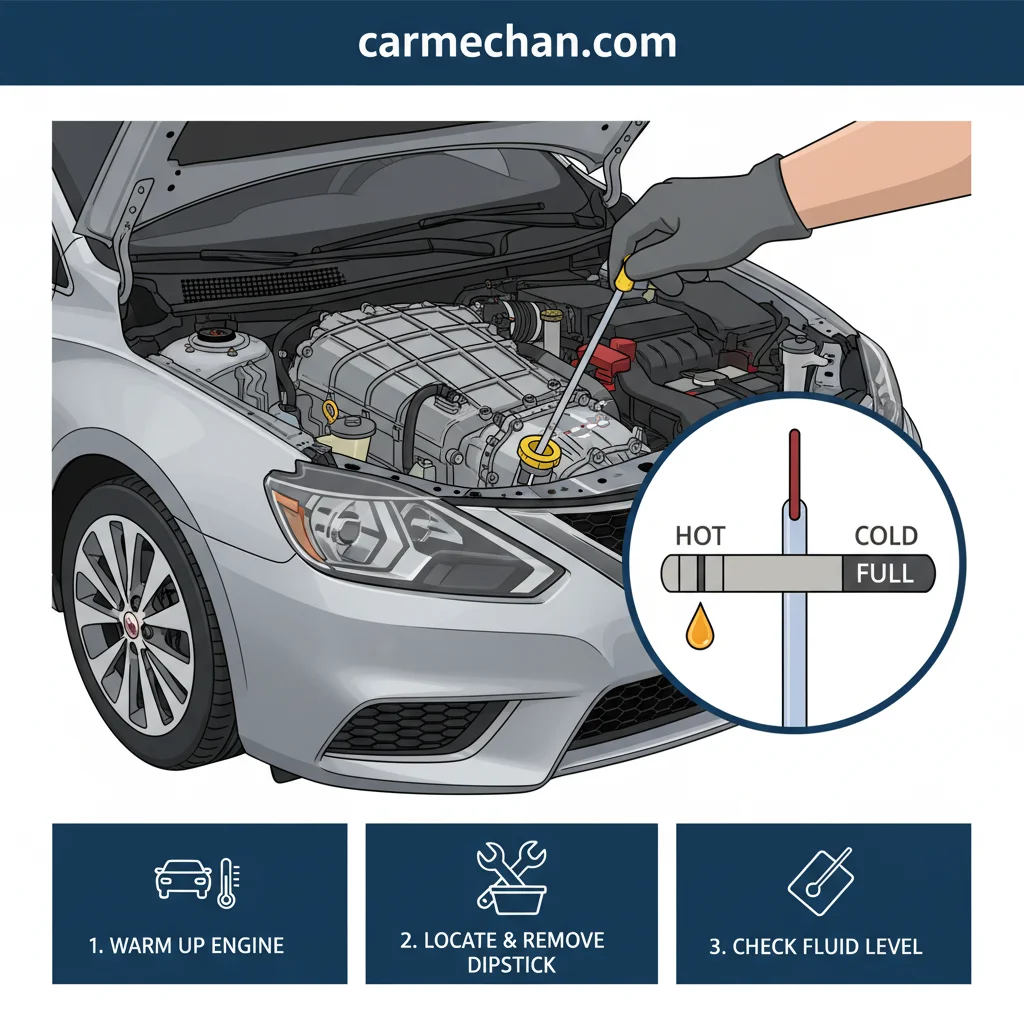
Unlike older vehicles where transmission fluid could be checked easily while cold, the 2015 Sentra CVT requires the transmission fluid to be at a specific operating temperature (usually around 122°F to 140°F / 50°C to 60°C). The vehicle must be running on a level surface, and the dipstick—which is often secured with a locking clip—must be read against the hot or cold calibration marks stamped into the stick.
What happens if I overfill the transmission fluid?
Overfilling a CVT is just as dangerous as underfilling it. Excess fluid allows the rotating internal components to whip the oil into a foam. Aerated fluid cannot maintain hydraulic pressure or properly lubricate the steel belt and pulleys, resulting in overheating, erratic shifting, erratic pressure control codes, and potential transmission damage.
Final Recommendations for Long-Term Reliability
Protecting the investment in your 2015 Nissan Sentra requires proactive care rather than reactive repairs. Because the Xtronic CVT is sensitive to thermal stress and fluid degradation, establishing a consistent fluid change interval—such as every 30,000 to 45,000 miles, especially in heavy traffic environments—drastically extends the lifespan of the transmission. Always source genuine Nissan NS-3 fluid, verify fluid levels meticulously, and address any early warning signs such as whining or shuddering before minor wear escalates into major mechanical failure.