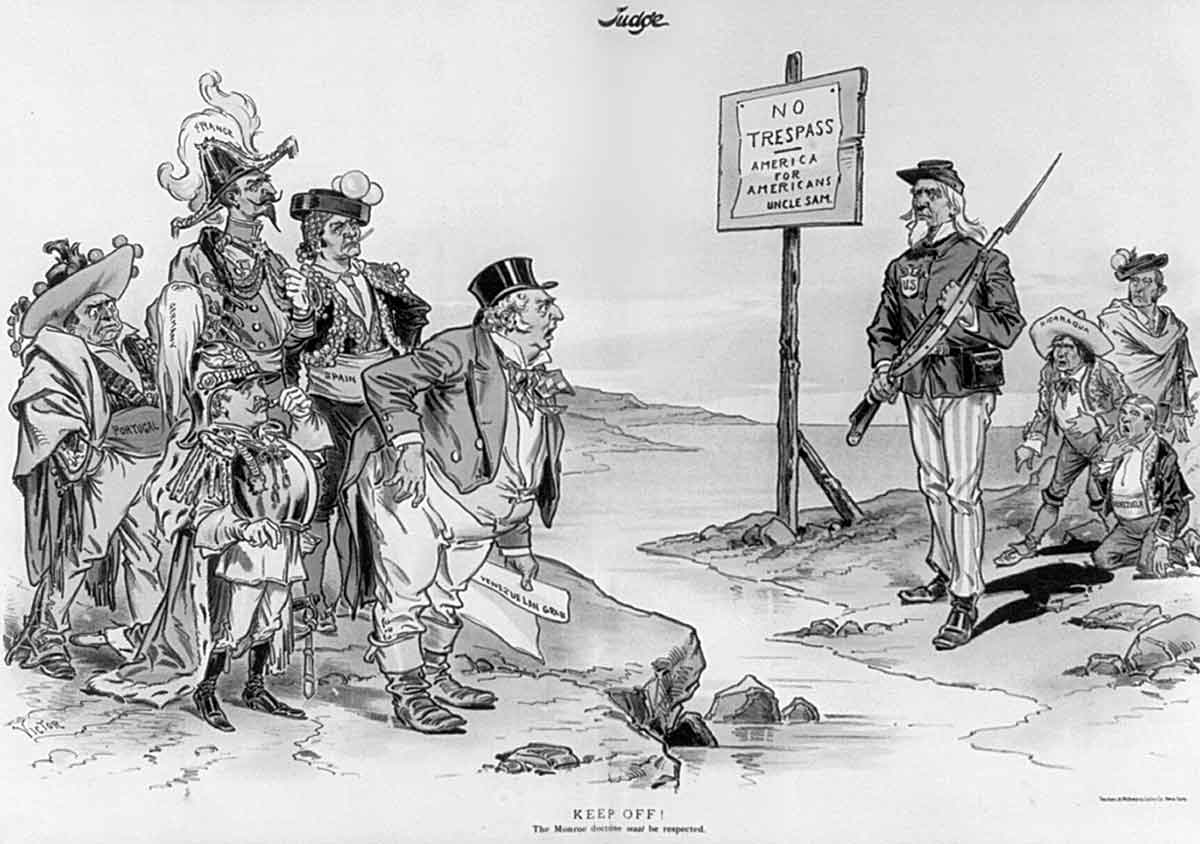
A significant theme of the Monroe Doctrine was that the Western Hemisphere was no longer to be considered a subject for future colonization by any European power. By declaring the Americas off-limits to imperial expansion, President James Monroe established a policy of geopolitical insulation, asserting that the United States would view any attempt by European nations to interfere with independent American states as a hostile act.
The Historical Genesis of the Monroe Doctrine
The Monroe Doctrine was articulated during President James Monroe’s seventh annual message to Congress on December 2, 1823. At the time, the young United States was navigating a precarious international landscape. The Napoleonic Wars had concluded, and the European powers—organized loosely under the "Holy Alliance" of Russia, Prussia, and Austria—were seeking to restore monarchical order across the globe. Concurrently, several Latin American nations, including Mexico, Colombia, and Chile, had recently fought for or were in the process of securing their independence from the Spanish Empire.
The fear within the U.S. administration, guided by Secretary of State John Quincy Adams, was that the European powers would intervene to assist Spain in reclaiming its lost territories. Simultaneously, there was concern regarding Russian claims in the Pacific Northwest, which encroached upon territory the United States deemed its own. The doctrine was not a formal treaty or a piece of legislation, but a clear diplomatic proclamation that defined the American stance on continental sovereignty.
Core Principles and Geopolitical Assertions
To understand why a significant theme of the Monroe Doctrine was that of non-colonization, one must examine the specific components of Monroe's message. The document is generally categorized into three major pillars:
- Non-Colonization: This was the primary theme. Monroe asserted that the American continents, by virtue of their free and independent condition, were henceforth not to be considered subjects for future colonization by any European power. This was a direct challenge to the traditional mercantilist model where territories were acquired and exploited by overseas empires.
- Separate Spheres of Influence: The doctrine posited that the political system of European nations was essentially different from that of the Americas. Consequently, any attempt by European powers to extend their political systems to any portion of the Western Hemisphere would be viewed as dangerous to the peace and safety of the United States.
- Non-Interference: In exchange for this protection, the United States pledged a reciprocal commitment: it would not interfere with existing European colonies or dependencies in the Americas, nor would it involve itself in the internal affairs of European nations or their active conflicts.
The Role of Non-Colonization in National Security
The assertion that the Americas were no longer open for colonization served a dual purpose. First, it was a protective measure for the nascent republics of Latin America, which the United States identified as ideological peers. By creating a shield around these newly independent nations, the U.S. aimed to foster a regional environment conducive to republicanism rather than imperial subjugation.
Second, the policy was a matter of domestic national security. The presence of European colonial outposts in close proximity to the United States was viewed as a strategic liability. If European empires held vast swaths of land near American borders, the potential for military engagement, shifting alliances, and territorial disputes was immense. By discouraging further colonization, the U.S. sought to limit the number of hostile or unpredictable European entities on its doorstep.
Comparison of Diplomatic Policy Approaches
The Monroe Doctrine marked a significant departure from earlier U.S. foreign policy. Before 1823, the U.S. had generally followed the advice of George Washington’s Farewell Address, which cautioned against "entangling alliances." The Monroe Doctrine transformed this passive neutrality into a proactive, regional defensive posture.
| Feature | Pre-1823 Policy | Post-1823 (Monroe Doctrine) |
|---|---|---|
| Regional Focus | Primarily Atlantic/European trade | Focus on the Western Hemisphere |
| Primary Goal | Survival and neutrality | Regional dominance and security |
| View on Empire | Caution against involvement | Active rejection of new colonization |
| Diplomatic Stance | Reactive/Isolationist | Assertive/Protective |
Evolution and Application Throughout the 19th and 20th Centuries
While the Monroe Doctrine was initially a statement of intent, it evolved into a foundational element of American foreign policy. In the mid-19th century, President James K. Polk invoked the doctrine to oppose British influence in Oregon and California. Later, during the 20th century, the doctrine was expanded and reinterpreted.
The "Roosevelt Corollary," introduced by President Theodore Roosevelt in 1904, significantly altered the original meaning. While the original doctrine stated that Europe should not interfere in the Americas, the Roosevelt Corollary stated that the United States would intervene in the domestic affairs of Latin American nations to prevent European powers from doing so due to financial instability or "chronic wrongdoing." This shifted the theme from mutual regional protection to a form of U.S. hegemony, often referred to as "Big Stick" diplomacy.
Challenges and Criticisms
The Monroe Doctrine was not without its detractors, both at home and abroad. Throughout the 19th century, critics argued that the United States lacked the naval capacity to enforce the doctrine against a determined European power, particularly Great Britain. In many instances, it was the British Royal Navy that effectively enforced the spirit of the doctrine, not because they supported U.S. policy, but because they wished to keep other European powers out of the lucrative trade markets in Latin America.
Furthermore, many Latin American nations viewed the doctrine with suspicion. While they welcomed the opposition to European recolonization, they eventually came to fear the rising power of the United States. Many leaders in Central and South America questioned the U.S. right to act as the self-appointed "policeman" of the hemisphere, viewing the policy as a tool for American imperialism rather than a genuine effort to foster liberty.
The Doctrine in Modern Context
In 2026, the Monroe Doctrine remains a topic of significant historical analysis and debate within international relations. Scholars assess its legacy not merely as a set of rules for the 19th century, but as the precursor to the modern geopolitical concept of the "sphere of influence." The historical precedent established by Monroe continues to inform discussions regarding how global powers define their "near-abroad" and how national security interests are articulated through regional policy.
Frequently Asked Questions
1. Was the Monroe Doctrine a law passed by Congress? No. The Monroe Doctrine was a policy statement made by President James Monroe in his annual message to Congress. It did not have the force of law, but it established the official foreign policy stance of the Executive Branch.
2. Did the Monroe Doctrine actually prevent colonization? It played a significant psychological and diplomatic role, but its effectiveness in the 19th century was often supported by the British Royal Navy’s desire to maintain open trade, rather than solely by U.S. military power.
3. How did Latin American nations react to the doctrine? Responses were mixed. Initially, some nations felt encouraged by the U.S. support for their independence. Over time, however, many became wary of the doctrine as it was used to justify U.S. military interventions in their internal affairs.
4. How does the Roosevelt Corollary differ from the original doctrine? The original doctrine aimed to keep Europe out of the Americas. The Roosevelt Corollary expanded the U.S. role to justify intervening within the American nations themselves, effectively positioning the U.S. as an international police power.
5. Is the Monroe Doctrine still in effect today? While the original document is a historical artifact, the spirit of the doctrine—the idea that the U.S. has specific security interests in the Western Hemisphere—continues to influence contemporary U.S. foreign policy and regional strategic debates.
Practical Next Steps for Researchers
For those looking to deepen their understanding of this historical framework, it is advisable to consult the primary text of the message preserved in the Annals of Congress or the Papers of James Monroe. When analyzing the policy, ensure you cross-reference the text with the contemporary journals of the period to understand the nuance of international reactions in 1823. Furthermore, examine the specific correspondence between John Quincy Adams and British Foreign Secretary George Canning to observe the diplomatic tensions that necessitated the announcement.