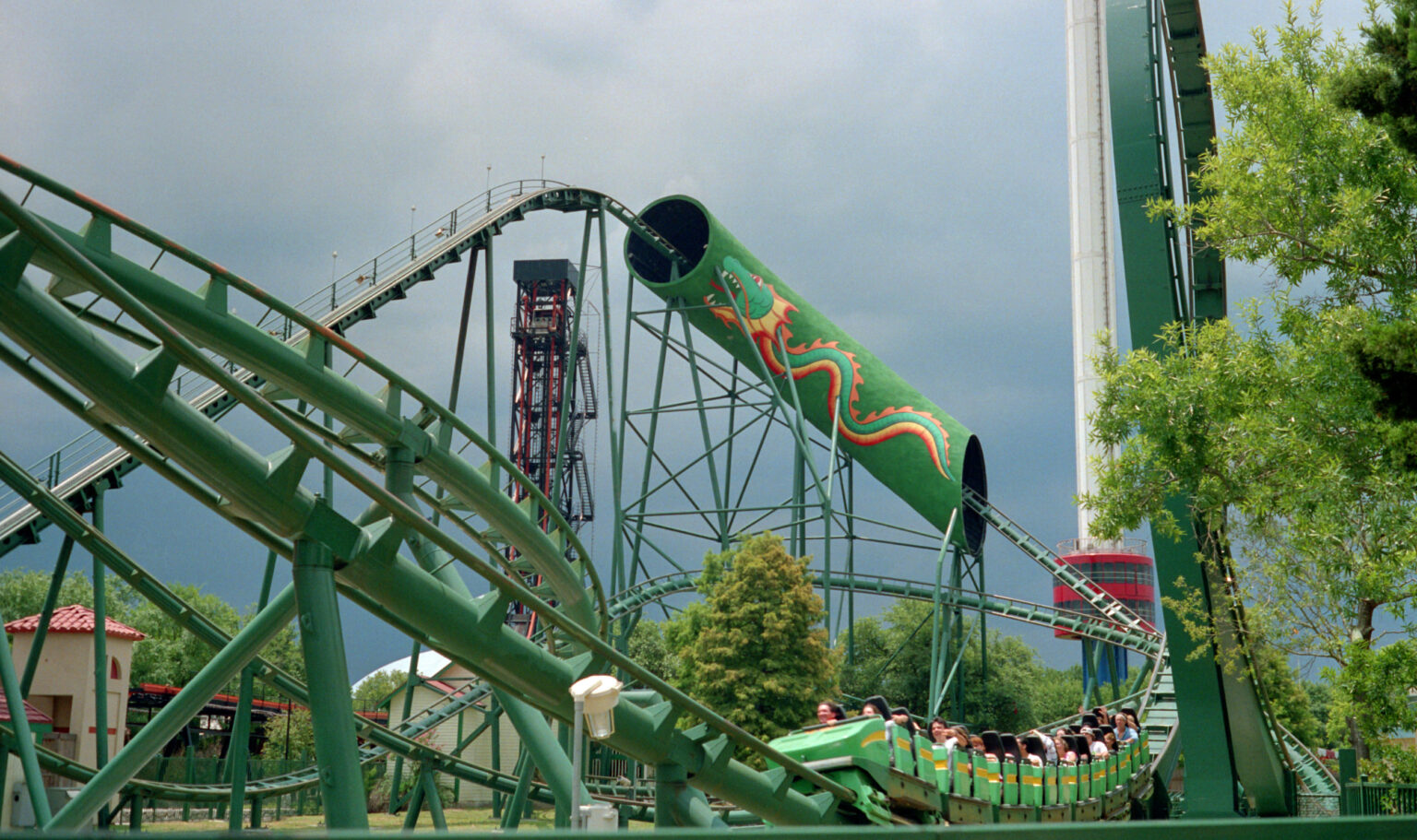
Six Flags AstroWorld permanently closed its gates on October 30, 2005, ending a 37-year run as Houston, Texas’s premier amusement park. Driven primarily by escalating real estate values, high property taxes, and the surging profitability of adjacent parking assets for the Houston Texans and Reliant Stadium complex, corporate ownership made the strategic decision to shutter the property, liquidate its rides, and clear the land for future commercial development.
The Origins and Golden Era of AstroWorld
Conceived by former Houston judge Roy Hofheinz, who also spearheaded the development of the adjacent Astrodome, AstroWorld opened its doors on June 1, 1968. Hofheinz envisioned the theme park as an extension of the Astrodomain—a sprawling sports and entertainment complex that redefined leisure in Harris County. Designed originally by theme park pioneer Randall Duell, AstroWorld was initially themed around distinct lands and cultural concepts, blending classic amusement park thrills with cinematic storytelling and meticulously landscaped grounds.
During its first decade, the park operated under the ownership of Hofheinz’s Judge Hofheinz Enterprises before being acquired by Six Flags in 1975. Under Six Flags management, AstroWorld integrated heavily with the broader corporate portfolio, introducing licensed characters, expanded seasonal events like Fright Fest, and a steady rotation of landmark roller coasters. For generations of Houstonians, the park served as an indispensable cultural anchor, offering an escape from the relentless Texas heat via water rides like Tidal Wave and Thunder River, alongside legendary wooden and steel roller coasters.
Iconic Rides and Architectural Evolution
AstroWorld’s engineering history reflects the broader evolution of the amusement park industry from family-oriented scenic attractions to high-velocity thrill engineering. The introduction of the Texas Cyclone in 1976—a mirror-image clone of the famous Coney Island Cyclone built by legendary designer Dinn Corporation—put the park on the national map for coaster enthusiasts. Standing over 90 feet tall with a steep initial drop, the wooden coaster became the undisputed symbol of the park.
Over the decades, the park continually updated its ride roster to compete with regional rivals like Six Flags Over Texas. Notable additions included:
- XLR-8: An early suspended roller coaster that offered a flying sensation above the park's lagoons.
- Ultra Twister: A unique pipeline coaster featuring heartline rolls and vertical ascents.
- Viper: A classic steel looping coaster that tested riders with intense G-forces.
- Serial Thriller: A modern inverted coaster that brought contemporary suspended looping technology to the park in 1999.
Economic Pressures and the 2005 Closure Decision
Despite maintaining steady attendance figures, the financial calculus surrounding AstroWorld shifted dramatically at the turn of the 21st century. The park occupied roughly 105 acres of prime real estate directly adjacent to Interstate 610 and the Reliant Park complex. By 2004, the land value had escalated exponentially, driven by urban expansion and the construction of Reliant Stadium (now NRG Stadium) and the subsequent relocation of the Houston NFL franchise.
Parent company Six Flags, Inc. faced mounting corporate debt and shifting strategic directives under new management. Analysts and financial reports from the era highlighted that the land beneath AstroWorld was worth significantly more to the corporation as vacant commercial real estate or game-day parking than as a traditional seasonal theme park. Furthermore, surging property taxes in Harris County squeezed operating margins.
On September 12, 2005, Six Flags announced that the 2005 season would be AstroWorld's last. Management cited real estate valuation and economic viability as the core drivers behind the decision. Unlike some theme parks that slowly decline and fade away, AstroWorld closed at the height of its operational footprint, hosting final crowds through October before shutting down permanently on October 30, 2005.
| Feature / Metric | Astroworld Operational Era | Final Year (2005) |
|---|---|---|
| Opening Date | June 1, 1968 | N/A |
| Closing Date | N/A | October 30, 2005 |
| Acreage | ~57 acres (initial) | ~105 acres |
| Peak Ownership | Judge Roy Hofheinz / Six Flags | Six Flags, Inc. |
| Primary Reason for Closure | N/A | High land value and parking demand |
Liquidation, Demolition, and Relocation of Assets
Following the closure, Six Flags orchestrated a massive asset liquidation process. Rather than selling the park as a functioning enterprise, the corporation auctioned off memorabilia, signs, and smaller rides, while relocating major roller coasters to other properties within the Six Flags chain.
The fate of AstroWorld’s premier attractions illustrates how park assets are redistributed post-closure:
- Texas Cyclone: Despite pleas from preservationists and enthusiasts, the iconic wooden coaster was deemed too costly to dismantle and reconstruct safely. It was demolished on-site in 2006.
- Serial Thriller: Relocated to Six Flags Great Escape in Queensbury, New York, where it currently operates as Steeplechase.
- Viper: Dismantled and shipped to Six Flags Kentucky Kingdom in Louisville, Kentucky, operating as T2 (and later Kentucky Flyer / T3).
- Alpen Blitz: A classic steel credit that found a second life at various independent fairs and parks.
By the end of 2006, heavy machinery had leveled the remaining structures, including the park's iconic entrance gate and water features. The land was stripped bare, paved over, and converted into an asphalt parking lot utilized primarily for events hosted at the adjacent NRG Park complex.
Cultural Legacy and Houston Memory
More than two decades after its permanent closure, AstroWorld maintains a powerful hold on Houston’s collective cultural memory. The park’s sudden disappearance became a cautionary tale regarding the friction between historical urban landmarks and aggressive real estate development. For those who grew up in Houston during the 1970s, 1980s, and 1990s, AstroWorld represented a communal backyard where summer vacations, high school graduations, and weekend outings converged.
The park’s cultural footprint experienced a massive global resurgence thanks to Houston-born recording artist Travis Scott, who named his critically acclaimed 2018 third studio album Astroworld and launched an eponymous annual music festival. Scott frequently cited the demolished park as a symbol of lost Houston youth and unbridled imagination, bringing the park's vintage logo, color palette, and aesthetic back into mainstream pop culture consciousness.
Frequently Asked Questions
Why did Astroworld close in 2005?
AstroWorld closed primarily because parent company Six Flags determined that the 105 acres of prime real estate it occupied was worth substantially more as vacant land and parking infrastructure for the adjacent Reliant Park complex than as a seasonal amusement park. Surrounding land appreciation and corporate debt pressures accelerated the decision.
Were any of Astroworld's roller coasters saved?
Yes and no. While major steel coasters like Serial Thriller and Viper were dismantled and relocated to other Six Flags parks across the country, the legendary wooden roller coaster, the Texas Cyclone, was completely demolished on-site because it could not be economically or structurally salvaged for relocation.
What is located on the former Astroworld site today?
Today, the land where AstroWorld once stood functions primarily as a massive asphalt surface parking lot. It is owned and operated as part of the NRG Park complex, providing event parking for NRG Stadium, NRG Center, and NRG Arena.
Did Travis Scott own Astroworld?
No. Travis Scott never owned the amusement park, as it closed long before his rise to fame. However, he adopted the name, aesthetic, and nostalgic spirit of the park for his 2018 album Astroworld and his multi-year Astroworld Festival, cementing the park's legacy for a new generation.
Final Recommendation and Next Actions
For those seeking to explore AstroWorld's history further, archival digital communities, localized historical societies in Houston, and documentary projects offer comprehensive visual logs, ride logs, and personal accounts. Visitors interested in the physical site can view the modern NRG Park parking grounds off Interstate 610 South, though no historical markers or remnants of the original park remain accessible to the public.