Studying the 27 Amendments to the United States Constitution is a foundational requirement for students of civics, law, and history. This comprehensive guide serves as a primary resource for mastering the amendments from 1 to 27, detailing the historical context, legal significance, and core protections offered by each addition to the supreme law of the land.
The United States Constitution is a living document, designed to evolve alongside the nation it governs. While the original seven articles established the framework of the federal government, the 27 amendments ratified since 1791 provide the specific protections for individual liberties and the procedural adjustments necessary for a functioning democracy. Navigating a quiz on Amendments 1-27 requires more than rote memorization; it requires an understanding of how these laws interact with daily life and the balance of power in 2026.
The Bill of Rights: Amendments 1–10
The first ten amendments, known collectively as the Bill of Rights, were ratified in 1791 to address the concerns of Anti-Federalists who feared a central government with too much power. These amendments are the most frequently cited in legal disputes and form the core of American civil liberties.
The First Amendment: Five Essential Freedoms
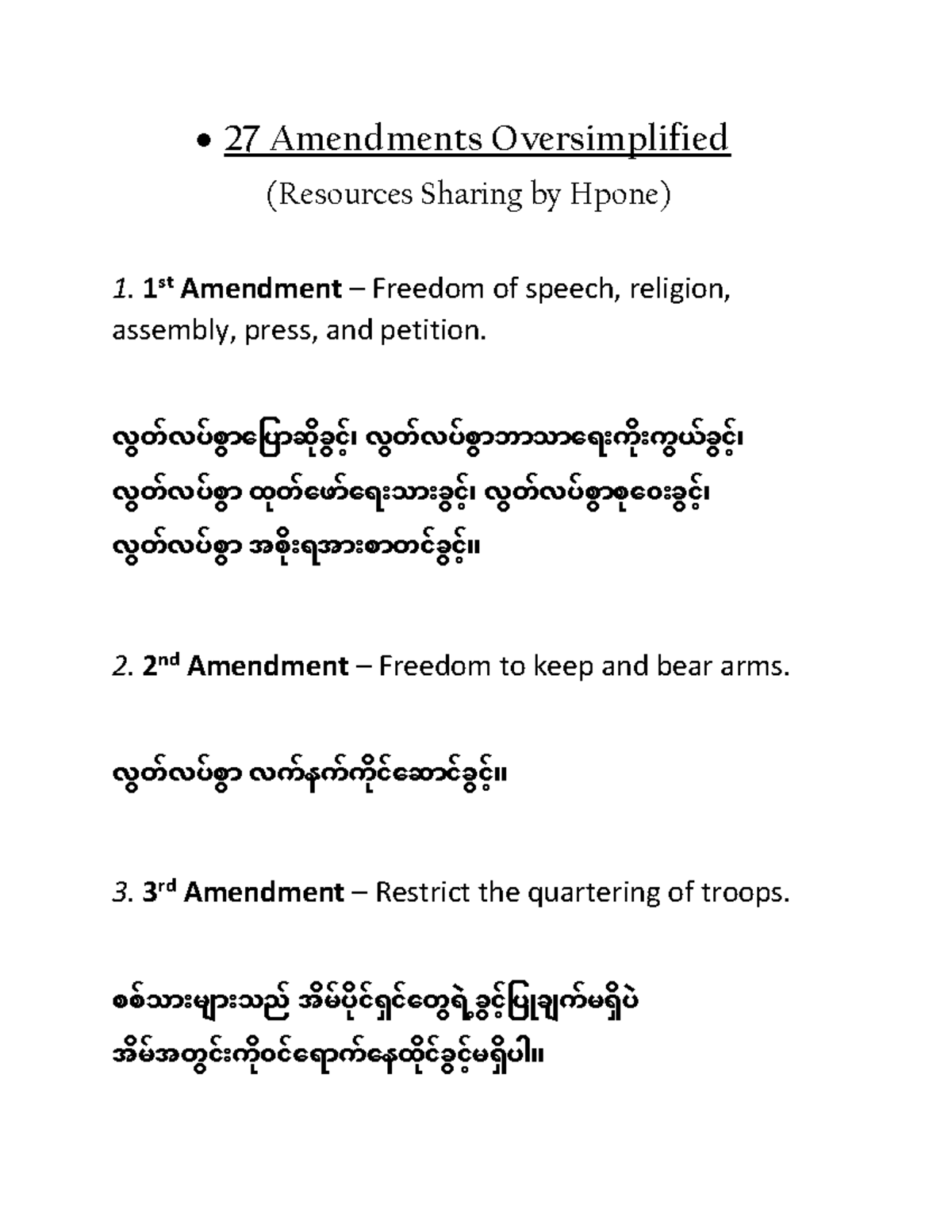
The First Amendment is often considered the most important. It prohibits the government from making laws that establish a religion or prohibit the free exercise thereof, and it protects the freedoms of speech, press, assembly, and the right to petition the government. In a quiz setting, remember the distinction between the Establishment Clause (government cannot favor one religion) and the Free Exercise Clause (government cannot stop you from practicing your religion).
The Second, Third, and Fourth Amendments: Privacy and Protection
- The Second Amendment protects the right to keep and bear arms. Historically, this has been a point of significant judicial debate regarding the balance between "a well regulated Militia" and the individual right to self-defense.
- The Third Amendment prohibits the forced quartering of soldiers in private homes during peacetime. While rarely litigated today, it established the principle that a person’s home is their castle.
- The Fourth Amendment protects against unreasonable searches and seizures. It requires that warrants be supported by probable cause and specifically describe the place to be searched and the persons or things to be seized.
The Fifth, Sixth, and Seventh Amendments: Judicial Process
These amendments define the rights of the accused. The Fifth Amendment introduces the concept of due process, protects against double jeopardy (being tried twice for the same crime), and ensures the right against self-incrimination (the "right to remain silent").
The Sixth Amendment guarantees a speedy and public trial by an impartial jury in criminal cases, the right to be informed of charges, and the right to legal counsel. The Seventh Amendment extends the right to a jury trial to federal civil cases involving a certain value, ensuring that the common law tradition of jury trials remains a staple of the American legal system.
The Eighth, Ninth, and Tenth Amendments: Limits on Government
The Eighth Amendment forbids excessive bail, excessive fines, and cruel and unusual punishments. The Ninth Amendment is a "safety net," stating that just because a right isn't listed in the Constitution doesn't mean it doesn't exist. Finally, the Tenth Amendment reinforces federalism by stating that powers not delegated to the federal government are reserved for the states or the people.
The Post-Civil War Amendments: 13, 14, and 15
Known as the Reconstruction Amendments, these three additions were pivotal in transforming the United States from a collection of states into a unified nation with federal protections for individual rights regardless of race.
Amendment 13: The Abolition of Slavery
Ratified in 1865, the Thirteenth Amendment formally abolished slavery and involuntary servitude, except as punishment for a crime. This was the first major step in dismantling the legal institution of slavery following the Civil War.
Amendment 14: Citizenship and Equal Protection
Perhaps the most litigated amendment in modern history, the Fourteenth Amendment (1868) granted citizenship to all persons born or naturalized in the United States. It contains the Equal Protection Clause and the Due Process Clause, which have been used by the Supreme Court to apply the Bill of Rights to state governments—a process known as "incorporation."
Amendment 15: Voting Rights Regardless of Race
The Fifteenth Amendment (1870) prohibited the federal and state governments from denying a citizen the right to vote based on "race, color, or previous condition of servitude." While this amendment was a landmark, it would take nearly a century and the Voting Rights Act of 1965 to fully realize its intent.
The Progressive Era and Structural Changes: Amendments 16–19
The early 20th century saw a wave of reforms that changed how the government collected revenue and how leaders were selected.
- Amendment 16 (1913): Authorized the federal government to collect an income tax without apportioning it among the states. This provided a steady stream of revenue for the expanding federal government.
- Amendment 17 (1913): Established the direct election of United States Senators by the people. Previously, Senators were chosen by state legislatures, a process prone to corruption.
- Amendment 18 (1919): Instituted Prohibition by banning the manufacture, sale, or transportation of intoxicating liquors. This is the only amendment to be entirely repealed by a later amendment (the 21st).
- Amendment 19 (1920): Guaranteed that the right of citizens to vote shall not be denied or abridged by the United States or by any State on account of sex, effectively granting women the right to vote.
Modern Adjustments and Refinements: Amendments 20–27
As the nation entered the mid-20th century and moved toward the present day, amendments focused on administrative efficiency, presidential succession, and expanding the electorate.
Amendments 20 and 22: Presidential Terms
The Twentieth Amendment, known as the "Lame Duck" amendment, shortened the time between election day and the beginning of Presidential and Congressional terms. It moved the Presidential inauguration from March to January 20th. The Twenty-Second Amendment, ratified following Franklin D. Roosevelt's four terms, limited the President to serving only two terms in office.
Amendments 23, 24, and 26: Expanding the Vote
- Amendment 23 (1961): Gave residents of Washington, D.C., the right to vote in Presidential elections by granting the district three electors in the Electoral College.
- Amendment 24 (1964): Prohibited the use of poll taxes in federal elections, removing a significant barrier that had been used to disenfranchise low-income and minority voters.
- Amendment 26 (1971): Lowered the legal voting age from 21 to 18. This was largely driven by the argument that if 18-year-olds were old enough to be drafted to fight in Vietnam, they were old enough to vote.
Amendments 25 and 27: Succession and Pay
The Twenty-Fifth Amendment clarified the process of presidential succession and disability. It outlines how a Vice President becomes President and how a vacancy in the Vice Presidency is filled.
The Twenty-Seventh Amendment has a unique history. Originally proposed in 1789 along with the Bill of Rights, it was not ratified until 1992—over 202 years later. It prevents members of Congress from granting themselves a pay raise that takes effect during the current session; any raise must wait until after the next election.
Summary Table of Amendments 1-27
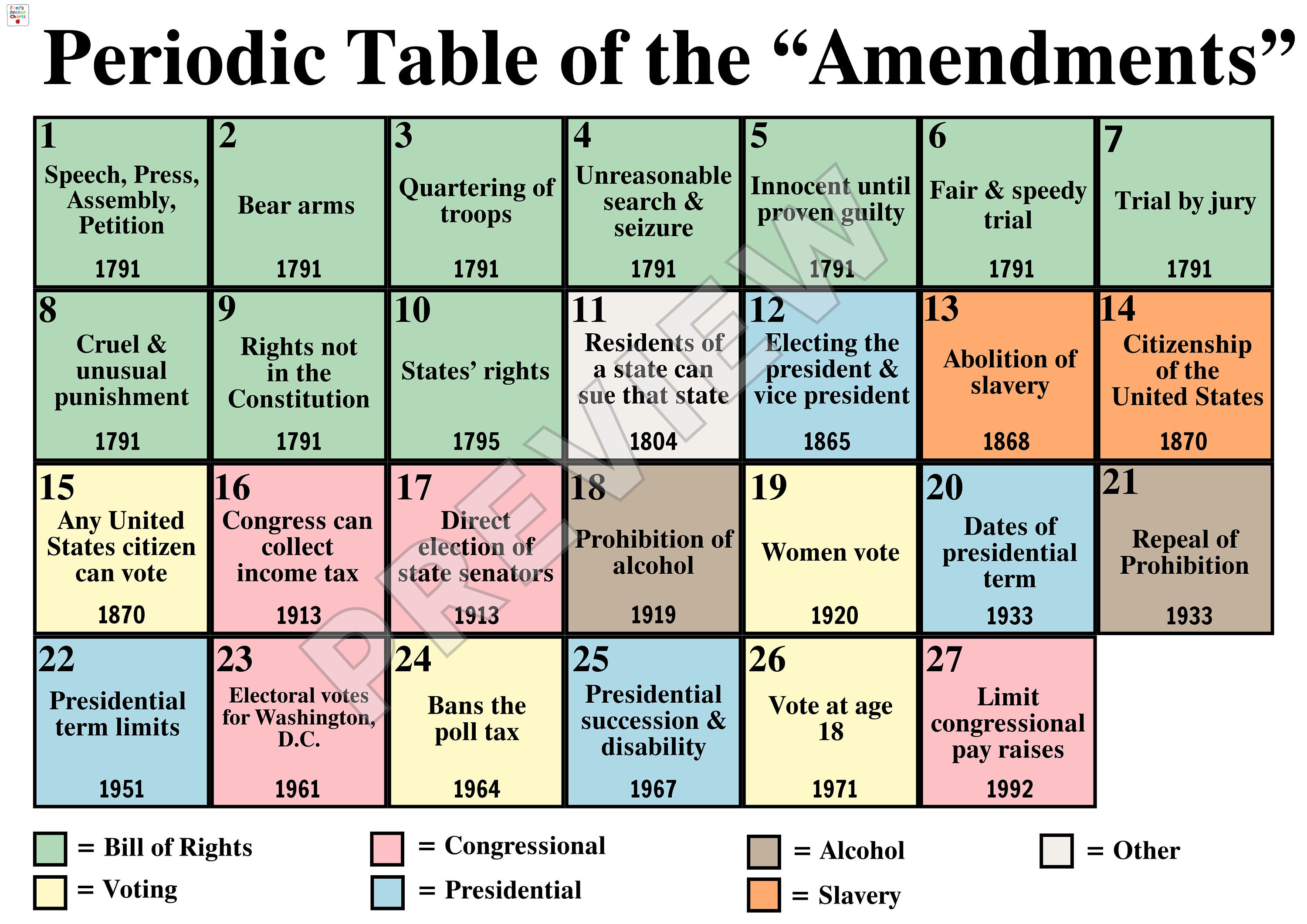
This table provides a quick-reference guide for your "amendments quiz 1 27" preparation.
| Amendment | Year Ratified | Primary Subject Matter |
|---|---|---|
| 1 | 1791 | Freedom of speech, religion, press, assembly, and petition. |
| 2 | 1791 | Right to keep and bear arms. |
| 3 | 1791 | Protection against quartering of soldiers. |
| 4 | 1791 | Protection against unreasonable search and seizure. |
| 5 | 1791 | Due process, double jeopardy, self-incrimination, eminent domain. |
| 6 | 1791 | Right to a speedy and public trial, counsel, and confrontation of witnesses. |
| 7 | 1791 | Right to trial by jury in civil cases. |
| 8 | 1791 | Protection against excessive bail and cruel/unusual punishment. |
| 9 | 1791 | Protection of rights not specifically enumerated in the Constitution. |
| 10 | 1791 | Powers of states and the people (Federalism). |
| 11 | 1795 | Immunity of states from certain lawsuits (State Sovereign Immunity). |
| 12 | 1804 | Changes in Electoral College procedures for President/Vice President. |
| 13 | 1865 | Abolition of slavery and involuntary servitude. |
| 14 | 1868 | Citizenship, equal protection, and due process for all persons. |
| 15 | 1870 | Voting rights cannot be denied based on race. |
| 16 | 1913 | Federal income tax authorized. |
| 17 | 1913 | Direct election of U.S. Senators. |
| 18 | 1919 | Prohibition of alcohol (later repealed). |
| 19 | 1920 | Women’s suffrage (right to vote). |
| 20 | 1933 | "Lame Duck" period shortened; terms start in January. |
| 21 | 1933 | Repeal of Prohibition (18th Amendment). |
| 22 | 1951 | Presidential term limits (two terms). |
| 23 | 1961 | D.C. residents granted Presidential electors. |
| 24 | 1964 | Abolition of poll taxes in federal elections. |
| 25 | 1967 | Presidential succession and disability procedures. |
| 26 | 1971 | Voting age lowered to 18. |
| 27 | 1992 | Congressional pay raises delayed until after next election. |
Common Quiz Challenges and How to Overcome Them
When taking an amendments quiz covering 1 through 27, test-takers often confuse amendments with similar themes. For example, differentiate between the 15th, 19th, 24th, and 26th amendments, which all deal with voting rights.
- 15th: Race.
- 19th: Gender.
- 24th: Money (Poll Taxes).
- 26th: Age.
Another common point of confusion is the 5th and 6th Amendments. To remember the difference, think of the 5th Amendment as the "pre-trial" and "rights of the person" (silence, grand jury, due process), whereas the 6th Amendment focuses on the "mechanics of the trial" (lawyer, speedy trial, witnesses).
Finally, the 10th Amendment and 14th Amendment are often contrasted. The 10th Amendment protects state power, while the 14th Amendment limits state power by requiring states to uphold federal standards of due process and equal protection. Understanding this tension is vital for higher-level civics assessments.
Frequently Asked Questions
Which amendment is the longest to be ratified?
The Twenty-Seventh Amendment holds the record for the longest ratification process. It was submitted to the states in 1789 as part of the original Bill of Rights but did not receive the required number of state ratifications until 1992. It ensures that any changes to Congressional salary do not take effect until after an election has intervened.
Can an amendment be repealed?
Yes, an amendment can be repealed by a subsequent amendment. The only instance of this in U.S. history is the Twenty-First Amendment, which repealed the Eighteenth Amendment. This ended the period of National Prohibition in 1933.
What is the "Incorporation Doctrine"?
The Incorporation Doctrine is a constitutional doctrine through which the first ten amendments of the United States Constitution (the Bill of Rights) are made applicable to the states through the Due Process Clause of the Fourteenth Amendment. Prior to this, the Bill of Rights only applied to the federal government.
Does the Constitution mention the right to privacy?
The word "privacy" does not appear in the Constitution or the amendments. However, the Supreme Court has ruled that several amendments (notably the 1st, 3rd, 4th, 5th, and 9th) create a "penumbra" or zone of privacy. This interpretation has been a cornerstone of many landmark legal decisions throughout the 20th and 21st centuries.
How is an amendment officially proposed?
Under Article V of the Constitution, an amendment can be proposed in two ways: by a two-thirds vote in both the House of Representatives and the Senate, or by a constitutional convention called for by two-thirds of the State legislatures. To date, all 27 amendments have been proposed via the Congressional method.
Practical Recommendations for Study
To succeed in an "amendments quiz 1 27," you should move beyond list-based learning and engage with the material contextually. Use the following steps for mastery:
- Group the Amendments: Categorize them into the Bill of Rights (1-10), the Civil War Era (13-15), the Progressive Era (16-19), and the Modern Era (20-27).
- Use Mnemonic Devices: Create short phrases for the more difficult numbers. For example, "2-6 is for the young to fix" (26th amendment, age 18) or "1-8 is what we hate" (18th amendment, prohibition).
- Consult Primary Sources: Read the actual text of the amendments on the National Archives website. Seeing the historical language helps solidify the "intent" of the law in your mind.
- Practice Active Recall: Use flashcards or digital quiz platforms to test yourself daily. Do not simply read the list; force your brain to retrieve the information without prompts.
By 2026, the interpretation of these 27 amendments continues to be shaped by the Supreme Court and legislative action. Understanding their history and current application is not just a requirement for a quiz; it is a prerequisite for informed citizenship in the United States.