Securing an accurate and competitive auto insurance quote in Alabama requires understanding how evolving market conditions affect baseline policy pricing. Drivers can navigate shifting premium rates by matching Alabama mandatory minimum liability requirements with adequate protective limits, shopping quotes 15 to 30 days prior to policy renewal, and leveraging state-specific discounts like policy bundling and telematics monitoring.
The Shifting Landscape of Auto Insurance Rates in Alabama
The auto insurance market in Alabama has experienced significant shifts driven by macroeconomic pressures, increased claims severity, and changing regulatory environments. For vehicle owners, these dynamics mean that policy rates fluctuate more frequently, making annual rate checks and quote comparisons an essential task rather than an optional chore.
Several interconnected macroeconomic and localized factors influence premium adjustments across the state:
- Inflation and Vehicle Repair Costs: Modern vehicles are equipped with complex technology, including advanced driver-assistance systems (ADAS) such as sensors, radar, and cameras embedded in bumpers and windshields. Minor collisions that once required simple body repair now involve recalibration and expensive component replacements.
- Severe Weather Risk: Alabama's geography exposes vehicle owners to severe weather risks, including coastal hurricanes, inland severe thunderstorms, hail, and localized flooding. Insurance carriers factor region-wide storm losses into their broader rating models, which can cause comprehensive coverage rates to rise state-wide.
- Uninsured Motorist Volume: Historical data from the National Association of Insurance Commissioners (NAIC) indicates that states with higher rates of uninsured motorists experience upward pressure on liability and uninsured motorist premiums. Alabama consistently maintains a notable percentage of drivers operating without valid insurance, prompting insurers to adjust rates to absorb potential losses.
- Regulatory Rate Filings: Insurance rates in Alabama are overseen by the Alabama Department of Insurance (ALDOI). Insurers submit rate filings based on actuarial projections of future losses. As loss ratios increase due to medical cost inflation and litigation trends, carriers adjust their base rate filings to maintain solvency.
Understanding these market realities empowers policyholders to evaluate their coverage proactively rather than accepting automatic policy renewal increases.
Alabama Mandatory Insurance Requirements vs. Real-World Protection
To legally operate a motor vehicle on Alabama roadways, vehicle owners must satisfy the provisions of the Alabama Mandatory Liability Insurance Act (Ala. Code § 32-7A). However, maintaining only the state-mandated minimum limits leaves policyholders exposed to substantial personal financial liability during severe accidents.
Minimum Mandatory Liability Limits (25/50/25)
Alabama law dictates that every motor vehicle policy issued within the state must carry at least the following liability limits:
- $25,000 Bodily Injury Liability per Person: The maximum amount your policy pays for medical bills and injuries sustained by one individual in an accident you cause.
- $50,000 Bodily Injury Liability per Accident: The cumulative maximum amount your policy pays for all injured parties in a single multi-person accident you cause.
- $25,000 Property Damage Liability per Accident: The maximum amount your coverage pays for repair or replacement of damaged third-party property, such as another driver's vehicle, guardrails, or structures.
The Gap Between Legal Minimums and Financial Security
While 25/50/25 liability coverage fulfills legal registration requirements verified through the Alabama Online Insurance Verification System (OIVS), it rarely offers sufficient financial protection in moderate-to-severe crashes.
For instance, the average cost of a new vehicle exceeds $45,000. If an at-fault accident damages a modern vehicle beyond repair, a $25,000 property damage limit leaves the driver personally responsible for the remaining balance. Similarly, emergency medical care, surgeries, and intensive care stays can exceed $50,000 for a single injured party.
| Mandatory Legal Limits | Recommended Financial Protection |
|---|---|
| - $25k Bodily Injury / Person | - $100k Bodily Injury / Person |
| - $50k Bodily Injury / Accident | - $300k Bodily Injury / Accident |
| - $25k Property Damage | - $100k Property Damage |
Essential Optional Coverages
To build a secure auto insurance policy in Alabama, drivers must evaluate essential additions to basic liability:
- Uninsured/Underinsured Motorist (UM/UIM) Coverage: Alabama law requires insurance providers to offer UM/UIM coverage on every policy, though consumers may reject it in writing. Given the state's rate of uninsured drivers, retaining UM/UIM protection is vital. Alabama also permits "stacking" of UM limits across multiple vehicles under certain policy conditions, providing extended financial protection.
- Comprehensive Coverage: Covers non-collision vehicle damage, including weather events (hail, hurricane damage), theft, vandalism, fire, and collisions with animals (such as deer).
- Collision Coverage: Covers repairs to your own vehicle resulting from an impact with another vehicle or object, regardless of fault.
- Medical Payments (MedPay): Pays immediate medical expenses for you and your passengers following an accident, regardless of who caused the collision, helping bridge gaps prior to health insurance claims processing.
Key Factors Influencing Your Alabama Auto Insurance Quote
Insurance companies utilize proprietary rating algorithms to calculate underwriting risk. Understanding the underlying factors enables policyholders to identify areas where they can take action to lower their premiums.
- Alabama Quote Pricing
- Driving Record & Claims
- Credit-Based Insurance Score
- Vehicle Profile & Usage
- Geographic Location & ZIP Code
Driving Record and Claims History
Your Motor Vehicle Record (MVR) remains the most influential factor in quote pricing. Insurers examine past moving violations, speeding tickets, reckless driving convictions, and at-fault accidents over a 3- to 5-year lookback period. Maintaining a clean driving record signals low risk, unlocking preferred rating tiers.
Credit-Based Insurance Scores
Alabama law permits auto insurance companies to evaluate credit-based insurance scores during policy underwriting. Actuarial data demonstrates a statistical correlation between credit management and insurance claim frequency. Drivers with strong credit profiles generally receive significantly lower quote estimates than drivers with lower scores, even when driving histories are identical.
Geographic Location and ZIP Code Variations
Insurance premiums vary across different regions of Alabama. Rates reflect localized risk metrics, including traffic density, theft statistics, severe weather vulnerability, and historical litigation frequency:
- Urban Centers (e.g., Birmingham, Mobile, Montgomery): Typically see higher baseline premiums due to heavy commuter traffic, higher accident rates, and elevated risk of vehicle vandalism or theft.
- Coastal Areas (e.g., Baldwin and Mobile Counties): Comprehensive rates reflect heightened risk profiles from tropical weather events and storm surges.
- Rural Counties (e.g., Pike or Marion Counties): Generally benefit from lower baseline rates due to lower traffic volumes, though risks related to animal collisions remain higher.
Vehicle Characteristics and Safety Features
The year, make, and model of your vehicle directly impact collision and comprehensive quote lines. Insurers evaluate:
- Safety Rating: High crash-test ratings lower injury-related risk.
- Repair Costs: High-end import vehicles requiring specialized parts and labor cost more to insure.
- Theft Statistics: Vehicles commonly targeted by auto thieves carry higher comprehensive costs.
- Safety Technology: Automated emergency braking, lane-departure warnings, and anti-theft tracking systems often earn policy discounts.
Strategic Guide to Obtaining Accurate Auto Insurance Quotes
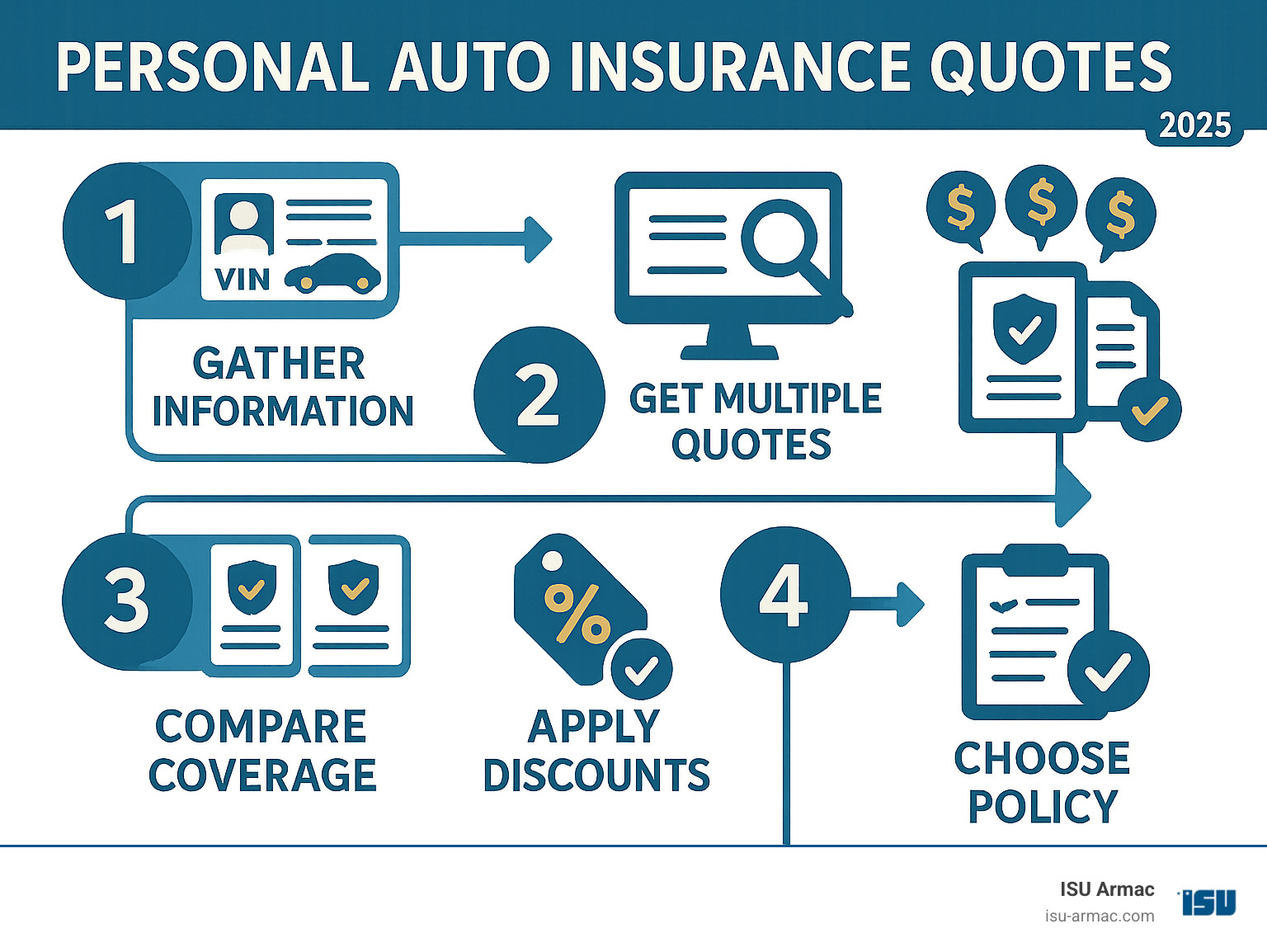
Gathering auto insurance quotes during a shifting market requires precise strategy. Sloppy comparisons or incomplete information can result in accurate-looking initial quotes that jump dramatically once formal underwriting is complete.
- Gather Documents (VIN, Driver Info)
- Select Limits (Apple-to-Apple)
- Request Quotes (3-4 Carriers)
- Review OIVS (Avoid Lapses)
Step 1: Gather Required Documentation
Before requesting quotes from carriers or independent agents, assemble essential details to ensure accurate underwriting quotes:
- Driver’s license numbers and birth dates for all household members.
- Vehicle Identification Numbers (VINs) for all covered automobiles.
- Current policy Declarations Page showing existing coverage limits, deductibles, and effective dates.
- Accurate annual mileage estimates for each vehicle.
Step 2: Establish Consistent Coverage Parameters
To evaluate carriers accurately, request quotes using identical parameters. Comparing a quote with a $500 deductible and 100/300/100 limits against a quote with a $1,500 deductible and state minimum limits prevents meaningful price evaluation.
Set standard benchmark criteria for all quote requests:
- Liability Limits: e.g., $100,000 / $300,000 / $100,000
- Uninsured Motorist Limits: Equal to selected liability limits
- Comprehensive & Collision Deductibles: e.g., $500 or $1,000
Step 3: Compare Quote Sources
Obtain quotes across multiple market channels to review broad availability:
- Direct-to-Consumer Carriers: Online portals allowing direct policy setup.
- Captive Insurance Agents: Agents representing a single insurance company (e.g., State Farm, Allstate) who possess deep product knowledge for that carrier.
- Independent Insurance Brokers: Brokers representing multiple insurance carriers who can quote across several underwriting platforms simultaneously.
Step 4: Avoid Policy Lapses During Transitions
Never cancel an existing auto policy until your new Alabama auto insurance policy is bound, activated, and effective. The Alabama Online Insurance Verification System (OIVS) monitors vehicle registrations against active insurance carrier databases in real time. Even a short 24-hour lapse in coverage can result in registration suspension, administrative fines, and higher quote pricing from carriers that penalize continuous coverage gaps.
Market Comparison: Coverage Levels and Savings Strategies
Selecting policy features involves balancing affordable monthly costs against out-of-pocket financial exposure during a loss event. The table below details common Alabama policy configurations, target driver profiles, and strategic rate considerations:
| Coverage Configuration | Target Profile | Mandatory vs. Optional | Risk Exposure Level | Primary Savings Strategy |
|---|---|---|---|---|
| State Minimum (25/50/25) | Vehicle owners with older cars of low market value and minimal personal assets. | Mandatory state minimum liability only. | Extreme: High out-of-pocket exposure for injuries or property damage exceeding basic limits. | Maintain clean MVR; shop rates annually to capture low baseline tier pricing. |
| Standard Financial Protection (50/100/50 + UM) | Middle-income drivers, single-vehicle households, vehicles with minor loan balances. | Liability + optional Uninsured Motorist coverage. | Moderate: Covers typical accident scenarios; potential exposure during catastrophic multi-car incidents. | Bundle home or renters policies; complete state-approved defensive driving courses. |
| Comprehensive Protection (100/300/100 + Comp/Coll) | Homeowners, drivers with newer vehicles, financed/leased vehicles, higher net worth. | Liability + UM + Physical Damage (Comprehensive & Collision). | Low: Strong defense against major financial losses, bodily injury claims, and repair costs. | Select higher physical damage deductibles ($1,000 instead of $250); opt into telematics tracking. |
| High-Asset Shield (250/500/100 + Umbrella) | High net worth individuals, multi-vehicle families, young drivers on policy. | Full coverage plus underlying requirements for a $1M+ Umbrella policy. | Minimal: Comprehensive protection across bodily liability, legal defense, and severe loss. | Multi-vehicle discounts; broad account bundling with commercial or secondary property policies. |
Actionable Strategies to Lower Auto Insurance Costs in Alabama
Navigating rate increases in a shifting market requires actionable risk management. Drivers can implement targeted strategies to lower premiums without compromising key policy protections.
- Cost Reduction Strategic Matrix
- Policy Bundling (15-25% Off)
- Telematics & Usage-Based (10-30% Off)
- Deductible Structure Optimization
- Credit & Driving MVR Maintenance
1. Leverage Multi-Policy Bundling
Combining auto coverage with home, condo, or renters insurance remains one of the most effective ways to lower policy costs. Insurers routinely grant multi-policy discounts ranging between 15% and 25% across total premium lines. Bundling also simplifies administrative oversight through single billing platforms.
2. Enroll in Telematics / Usage-Based Insurance (UBI)
Most major insurers operating in Alabama offer telematics programs that track driving habits via mobile applications or plug-in OBD-II devices. Parameters measured include:
- Total driving mileage and time of day.
- Hard braking and sudden acceleration instances.
- Cornering speeds and mobile device usage while driving.
Safe drivers can earn initial enrollment discounts (typically 5% to 10%) that scale up to 30% upon policy renewal if driving data validates low-risk behavior.
3. Optimize Physical Damage Deductibles
If your financial reserves permit absorbing a higher out-of-pocket expense during a claim, raising your comprehensive and collision deductibles reduces overall premium fees:
- Increasing deductibles from $250 to $500 can lower physical damage costs significantly.
- Increasing deductibles from $500 to $1,000 can yield additional annual savings.
Caution: Ensure deductible funds are held in an accessible emergency savings account so funds are readily available if a loss occurs.
4. Audit Policy Drivers and Vehicle Usage Ratings
Over time, policy details can become outdated, leading to unnecessary insurance expenses:
- Annual Mileage: If your commute shortened due to remote or hybrid work, request an adjustment to your vehicle's annual mileage rating.
- Driver Status: Remove household members who have permanently relocated or established their own separate auto insurance policies.
- Vehicle Usage Classification: Ensure vehicles driven solely for personal use are not mistakenly categorized under business or long-distance commercial commuting rates.
Common Pitfalls to Avoid When Shopping for Alabama Insurance Quotes
In an attempt to secure low quote prices, drivers often fall into structural traps that compromise their long-term financial security.
Dropping Uninsured Motorist Coverage
Given economic pressures, declining Uninsured Motorist (UM/UIM) coverage to cut monthly premium costs is a risky trade-off. Because Alabama does not require physical vehicle inspections or constant proof-of-insurance checks on older vehicles after registration, uninsured drivers remain a real risk on state roadways. Dropping UM coverage leaves you financially responsible for medical costs and lost wages if an uninsured or hit-and-run driver strikes your vehicle.
Under-reporting Household Drivers
Failing to declare licensed household members (such as resident relatives or teenagers) on your insurance application to secure a lower quote estimate constitutes misrepresentation. In the event of an accident involving an unlisted household driver, the insurer may deny the claim entirely or rescind the policy.
Focusing Exclusively on the Bottom-Line Price
Evaluating an insurance policy purely on its initial monthly quote ignores critical operational considerations:
- Financial Stability Ratings: Check insurance carrier rating scores through independent credit rating agencies like A.M. Best to confirm the carrier maintains sufficient reserves to pay claims.
- Claims Handling Reputation: Research carrier-specific satisfaction indices through customer surveys and regulatory complaint ratios published by state insurance departments.
- Policy Terms & Exclusions: Read policy definitions carefully regarding step-down provisions, non-OEM replacement parts usage, and custom equipment limits.
Frequently Asked Questions
What are the legal minimum auto insurance limits in Alabama?
Alabama law requires minimum liability limits of $25,000 for bodily injury per person, $50,000 total bodily injury per accident, and $25,000 for property damage per accident (25/50/25). Operating a vehicle without meeting these minimum requirements violates the Alabama Mandatory Liability Insurance Act.
How does the Alabama Online Insurance Verification System (OIVS) track coverage?
OIVS allows law enforcement officers and county licensing officials to instantly verify a vehicle's insurance status against insurer databases. Insurance companies report policy activations, updates, and cancellations in real time. Uninsured status can result in registration suspensions, reinstatement fees, and traffic citations.
Can Alabama insurance companies use my credit score to determine quote rates?
Yes. Alabama law permits insurance companies to evaluate credit-based insurance scores during risk underwriting and pricing calculations. Maintaining a healthy credit history helps secure lower base insurance rates across most major carriers operating in the state.
What is the difference between stacked and non-stacked Uninsured Motorist coverage in Alabama?
Stacked Uninsured Motorist (UM) coverage allows policyholders to combine UM coverage limits across multiple vehicles listed on the policy (or across multiple policies under the same household). Non-stacked UM limits restrict coverage to the policy limit assigned to the single vehicle involved in the crash. Stacking increases total available protection for severe bodily injury claims.
How far in advance should I start shopping for auto insurance quotes in Alabama?
It is best to start requesting quotes 15 to 30 days before your existing policy expires. Early shopping allows adequate time to compare terms, avoids rushed decisions, and unlocks early-shopping discounts offered by many insurance carriers.
Practical Next Steps for Alabama Policyholders
Navigating auto insurance quotes in a shifting rate market requires proactive review and deliberate decision-making. Vehicle owners should audit their current auto insurance declarations page today to confirm their existing liability limits, deductibles, and endorsement structures.
If your current policy rates have increased upon renewal, gather your vehicle details and solicit at least three side-by-side quotes from competing direct, captive, and independent agency channels. Maintain legal continuous coverage throughout the process to protect your personal assets, keep your vehicle registration active through OIVS, and secure competitive auto insurance pricing in 2026.