Pay-per-click (PPC) advertising costs are shaped by real-time ad auctions, Quality Score metrics, bid strategy settings, and network delivery algorithms. Rather than paying a fixed fee, advertisers bid for placements where actual cost-per-click (CPC) is determined dynamically by competitor aggressiveness, ad relevance, landing page experience, and daily budget pacing policies.
The Mechanics of Pay-Per-Click: How Ad Auctions Determine Cost
In click-based advertising, your budget is not consumed by a static price tag. Instead, every search query or ad placement triggers an instant automated auction. When a user enters a search phrase on a search engine or visits a website within a display network, the advertising platform evaluates thousands of eligible campaigns within milliseconds to determine which ads appear and in what order.
The foundational pricing model used by major networks like Google Ads and Microsoft Advertising relies on a modified second-price auction system. In a traditional first-price auction, the highest bidder wins and pays the exact amount bid. In a second-price ad auction, the winning advertiser pays only the minimum amount required to clear the auction threshold or outrank the competitor directly below them, plus a nominal fee (typically $0.01).
Actual CPC = (Ad Rank of Next Competitor Below You / Your Quality Score) + $0.01
Because of this formula, your maximum CPC bid acts as a ceiling rather than an automatic charge. If you set a maximum bid of $5.00 for a keyword, but the competitor beneath your rank position only requires a $2.50 bid equivalent to hold their position, your actual cost for that click will be significantly lower than your cap. Consequently, how quickly your budget depletes depends on the competitive density of every individual auction your campaign enters throughout the day.
Core Factors That Shape Your Click Costs and Daily Spend
Understanding how advertising platforms shape your overall spend requires breaking down the core metrics and parameters that dictate cost per click. Several primary variables determine your auction performance and financial velocity.
1. Quality Score and Ad Relevance
Quality Score is a diagnostic rating scale from 1 to 10 assigned by ad platforms to gauge the structural health of your keywords, ad creative, and landing pages. It directly acts as a multiplier or discount factor in the ad auction formula.
- Expected Click-Through Rate (eCTR): The likelihood that a user will click your ad when displayed, estimated from historical performance across similar search queries.
- Ad Relevance: How closely the language and intent of your ad copy match the user's explicit search phrase.
- Landing Page Experience: The speed, mobile responsiveness, transparency, and semantic relevance of the webpage users land on after clicking.
A high Quality Score lowers the effective cost required to achieve a top ad placement. An advertiser with a Quality Score of 9 can secure top position at a much lower cost per click than a competitor with a Quality Score of 3, even if the competitor offers a higher maximum bid.
2. Search Intent and Keyword Competition
Keywords reflect user intent, and user intent dictates commercial value. Keywords associated with high buyer intent (such as "enterprise CRM software price" or "emergency plumber near me") attract fierce competition among businesses vying for high-converting traffic.
Conversely, informational queries (such as "how does plumbing work") feature lower commercial value and lower average CPCs. When structuring your budget, keyword selection dictates how many clicks your allocated funds can buy. A $1,000 monthly budget might purchase 500 clicks for informational terms at $2.00 per click, but only 20 clicks for highly competitive legal or financial terms priced at $50.00 per click.
3. Audience Demographics, Geography, and Device Modifiers
Cost per click varies substantially by location, user demographics, and hardware platform. Advertisers frequently apply bid modifiers—percentage adjustments to baseline bids—based on performance data:
- Geographic Targeting: Dense metropolitan areas often exhibit higher CPCs than rural markets due to increased localized market competition.
- Device Modifiers: Mobile devices, desktop computers, and tablets experience different conversion rates and user behavior patterns. Adjusting bids downward on low-converting devices reduces spend leakage.
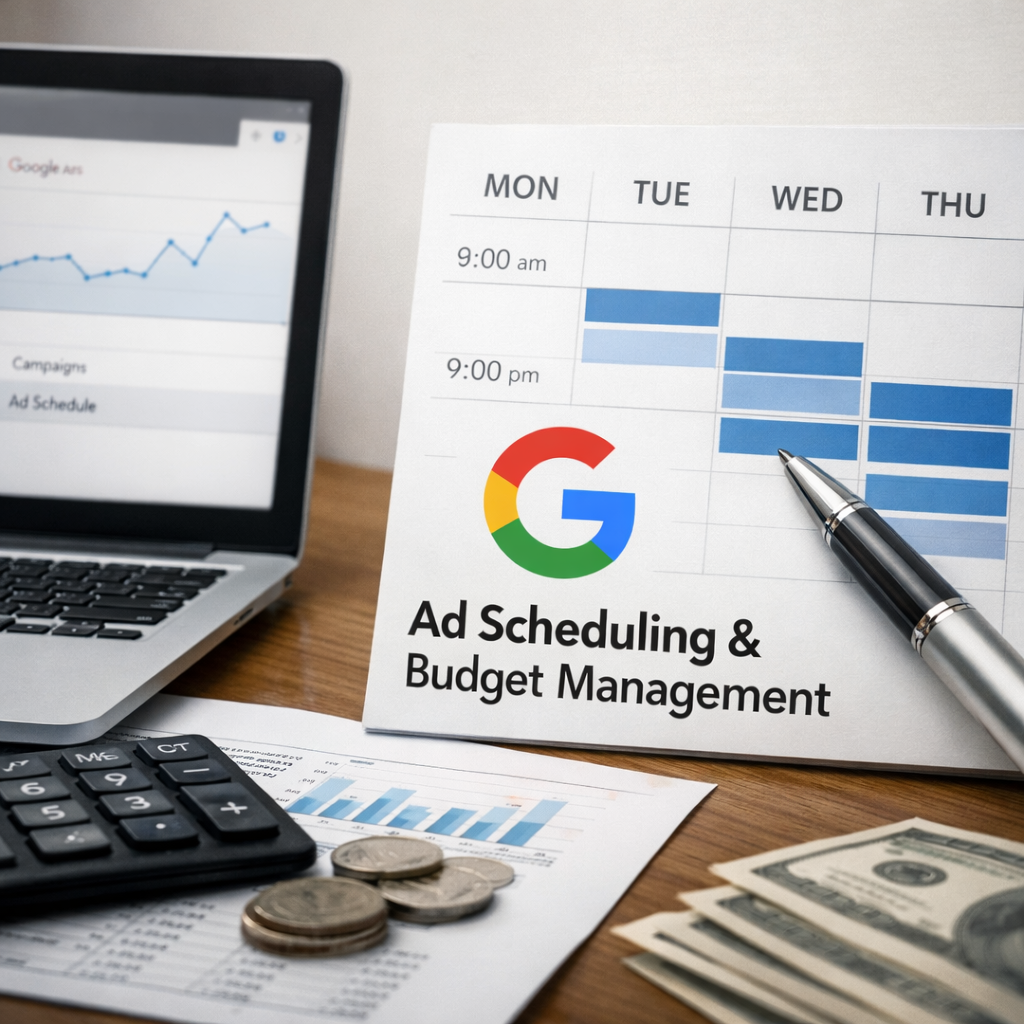
- Ad Scheduling (Dayparting): Setting custom operational hours ensures bids increase during peak business hours and drop when customer service or sales teams are inactive.
Daily Budgets vs. Monthly Spend: How Platforms Pace Allocation
A common point of confusion for campaign managers is why daily ad spend frequently fluctuates above or below the set daily limit. Digital ad networks utilize automated budget pacing algorithms to accommodate variations in daily search traffic volume.
Overdelivery Rules and Monthly Caps
Major ad platforms use flexible daily spending caps. For instance, in Google Ads Help Documentation, daily spend can reach up to twice your target daily budget on days with high search volume or strong conversion opportunities.
However, platforms enforce a strict monthly charging limit to protect advertisers. For campaigns running across a full billing month, you will never be charged more than your daily budget multiplied by the average number of days in a month (30.4 days).
$$\text{Monthly Budget Cap} = \text{Average Daily Budget} \times 30.4$$
If your average daily budget is $100, your spend may reach $180 on a Tuesday and $40 on a Sunday, but total billing will not exceed $3,040 across a full month. If the platform inadvertently delivers more impressions and clicks than this monthly cap permits, overdelivery credits are automatically applied to your invoice to offset the excess charges.
Bidding Strategies and Their Direct Impact on Budget Consumption
The bidding framework you select fundamentally alters how your budget is spent across different search queries throughout the day. Modern advertising management separates bidding into manual structures and automated, machine-learning-driven frameworks.
Manual CPC Bidding
Manual CPC allows advertisers to establish explicit maximum bid limits for individual keywords or ad groups. This strategy yields granular control over maximum spend per click, ensuring that no single click exceeds the predetermined limit. However, manual bidding requires continuous performance monitoring and does not automatically adapt to real-time user signals such as browser choice, precise location, or micro-demographics.
Smart and Automated Bidding Strategies
Automated bidding delegates real-time bid adjustments to machine-learning algorithms. Platforms evaluate contextual signals at the exact millisecond an auction occurs to adjust bids dynamically:
- Maximize Clicks: Automatically sets bids to secure the highest possible volume of clicks within your overall daily budget ceiling. This strategy prioritizes traffic volume over immediate conversion quality.
- Target CPA (Cost Per Acquisition): Adjusts individual click bids to maintain an average cost per desired customer conversion action. Individual click costs may swing dramatically to secure high-likelihood converters.
- Target ROAS (Return on Ad Spend): Sets real-time bids to maximize revenue based on predicted transaction values, bidding aggressively on users likely to complete high-value purchases.
- Maximize Conversions: Expends your allocated daily budget to achieve the maximum total count of conversions, regardless of individual click price volatility.
Comparative Matrix: How PPC Bidding Models Shape Cost Structure
Selecting the right bidding framework requires balancing budget risk against strategic goals. The following table highlights how common bidding models interact with your ad spend:
| Bidding Strategy | Primary Objective | Budget Risk Level | Control Level | Best Used For |
|---|---|---|---|---|
| Manual CPC | Control click costs tightly | Low | High | Campaigns with strict budget constraints and established baseline data. |
| Enhanced CPC (eCPC) | Adjust manual bids for conversions | Moderate | Moderate | Transitioning from manual bidding toward automated optimization. |
| Maximize Clicks | Maximize total traffic volume | Low to Moderate | Low | Launching brand awareness efforts or fast data-gathering phases. |
| Target CPA | Secure conversions at fixed target cost | Moderate | Low | Lead generation campaigns with clear customer acquisition cost targets. |
| Target ROAS | Maximize total revenue yield | High | Low | E-commerce stores with varied product pricing and conversion values. |
| Maximize Conversions | Exhaust daily budget for maximum actions | High | Low | Accounts focused on rapid scale where budget ceiling is firm. |
Common Budget Pitfalls in Click-Based Advertising
Campaign budgets often experience inefficient drain due to structural account misconfigurations. Eliminating broad structural waste ensures every dollar spent contributes directly to business goals.
Unmanaged Broad Match Keyword Expansion
Broad match keyword matching allows search engines to show your ad on queries related to your keyword, including synonyms, misspellings, related searches, and relevant variations. While broad match expands audience reach, it frequently introduces non-converting intent. Without adequate monitoring, broad match can spend significant portions of your daily budget on irrelevant user searches.
Omitting Negative Keyword Libraries
Negative keywords prevent your ads from triggering on queries that include specific non-converting terms (such as "free," "jobs," "repair," or "DIY"). Failing to build, maintain, and update negative keyword lists allows unqualified clicks to consistently chip away at your campaign budget.
Unintentional Ad Network Expansions
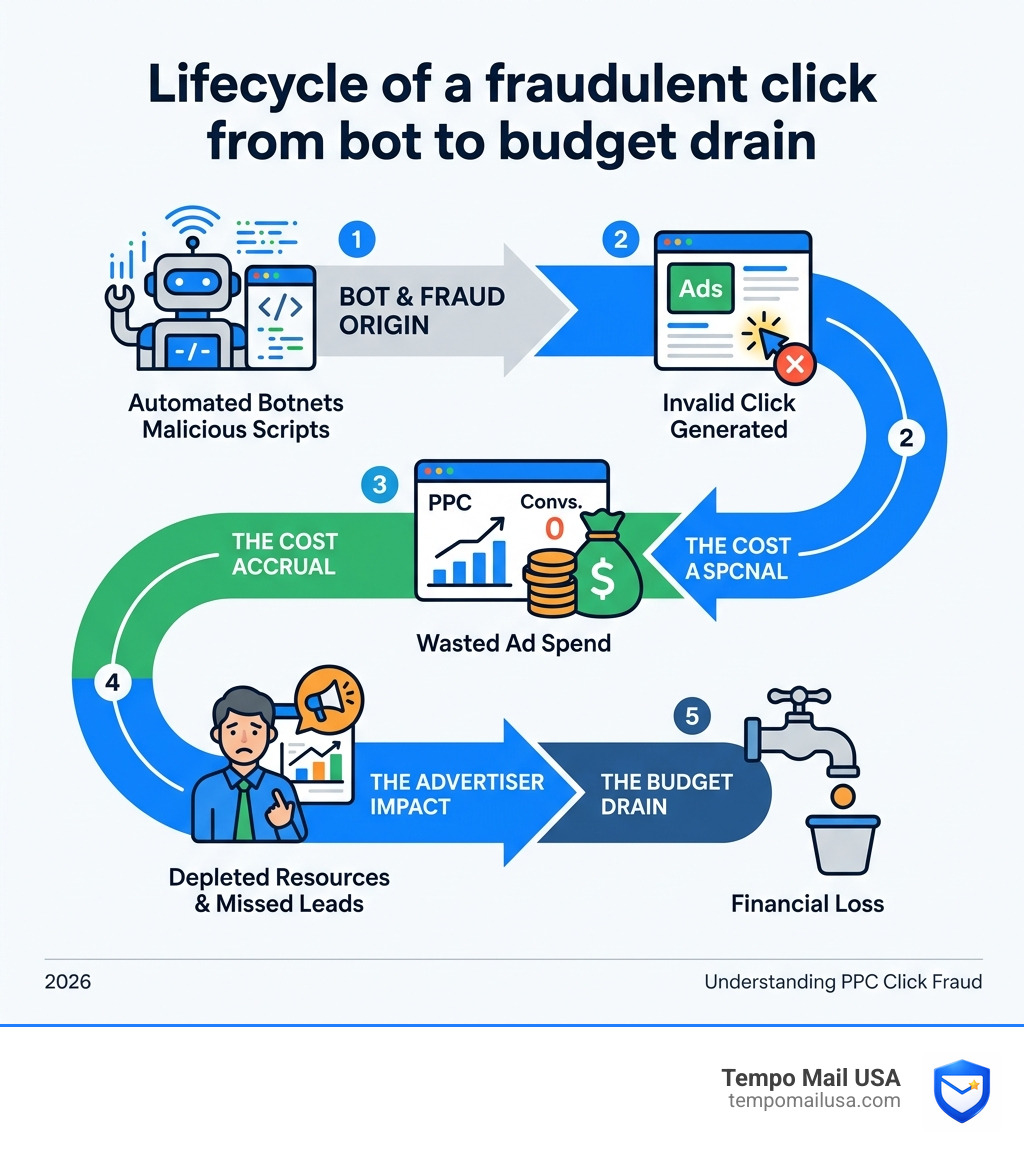
When creating search campaigns, platform defaults often opt campaigns into secondary distribution channels, such as search partner networks or display expansions. These networks exhibit distinct click characteristics, lower conversion rates, or differing click volumes compared to primary search engine results pages. Unmonitored network expansion can shift budget away from primary intent channels.
Strategic Steps to Optimize Click Costs and Maximize Return on Spend
To prevent aggressive auction dynamics from consuming your budget without yielding returns, implement a systematic optimization framework focused on efficiency, targeting precision, and conversion alignment.
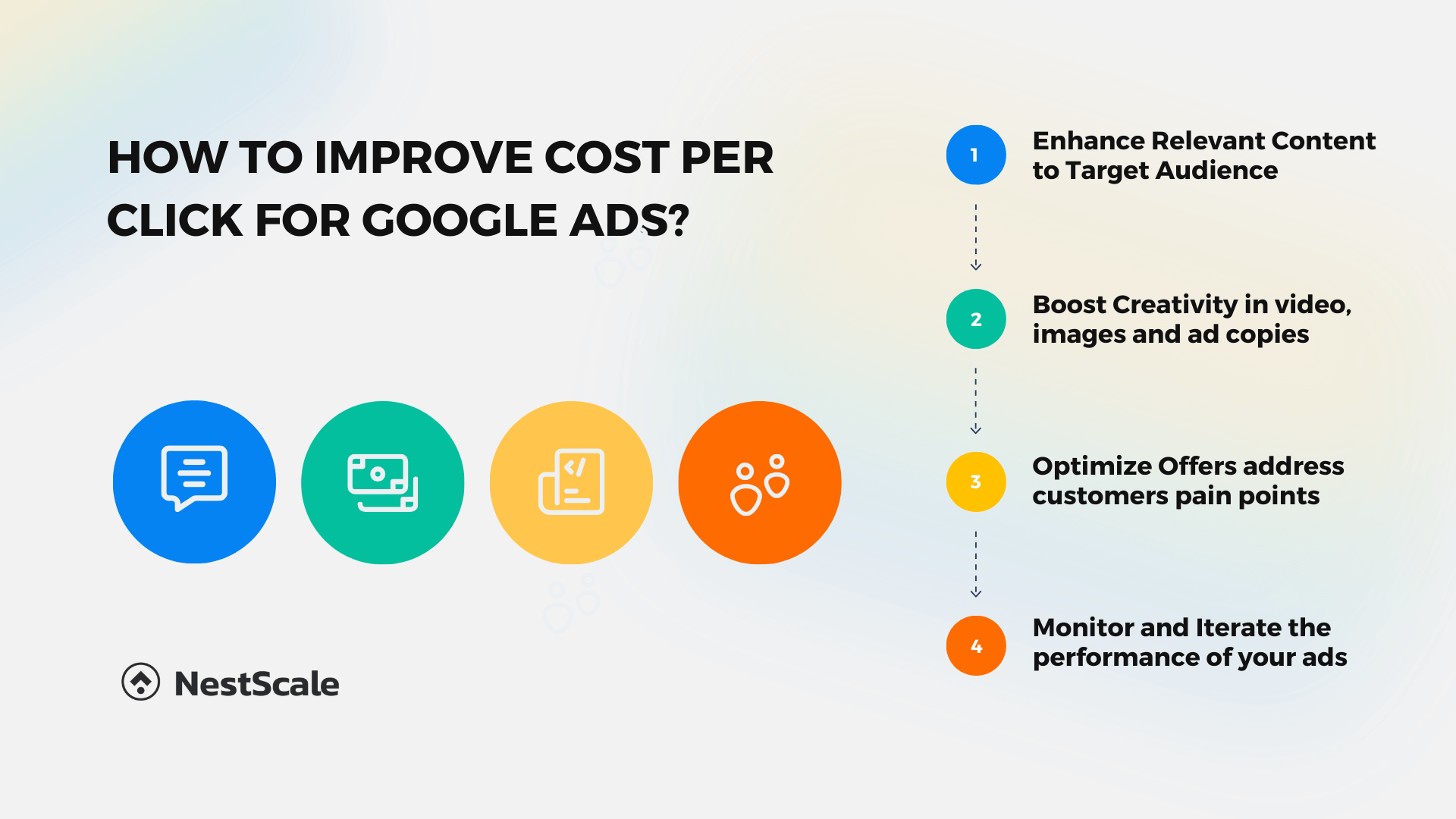
- Audit Search Terms
- Identify non-converting queries: Add as Negative Keywords
- Improve Quality Score
- Refine Ad Copy & Landing Page: Lower Cost-Per-Click (CPC)
- Apply Bid Modifiers
- Adjust bids by Device, Location & Time of Day
- Align Bid Strategy
- Transition to Smart Bidding (Target CPA/ROAS) with data
1. Maintain Comprehensive Negative Keyword Lists
Continuously audit your Search Terms Report to evaluate the actual queries driving traffic to your site. Isolate search phrases that demonstrate zero conversion intent or fail to match your product capabilities, and add them immediately as exact or phrase match negative keywords.
2. Boost Quality Score Through Asset Relevance
Since Quality Score acts as an auction discount mechanism, systematically improving its core components reduces your required cost per click:
- Organize campaigns into tightly themed ad groups with highly specific keyword sets (single-theme ad groups).
- Write customized ad headlines and descriptions that directly mirror the intent of the ad group's target keywords.
- Ensure landing pages load quickly, display prominent call-to-action buttons, and reflect the exact search intent of the ad copy.
3. Deploy Performance-Based Bid Modifiers
Review historical campaign analytics across geographic locations, device types, and times of day. Reduce bids by negative percentage modifiers on segments that generate traffic but historically yield low conversion rates. Reallocate the saved capital by applying positive percentage modifiers to peak-performing demographics and locations.
4. Align Landing Page Conversion Architecture
Lowering cost per click is only one side of budget management; converting those paid clicks into revenue completes the equation. Optimize landing page headline alignment, remove site navigation friction, implement trust signals, and optimize form length to maximize the conversion rate of incoming paid traffic.
Frequently Asked Questions
How does a pay-per-click auction calculate the actual amount charged per click?
In a standard second-price ad auction model, the actual cost per click (CPC) is calculated by taking the Ad Rank of the competitor placed immediately below you, dividing it by your Quality Score, and adding $0.01. This structure ensures you only pay the minimum amount necessary to clear the auction threshold and maintain your ad position.
Why does my daily ad spend exceed the exact daily budget I set?
Ad platforms utilize automated daily budget pacing to capture peak traffic opportunities on high-volume days. Spend can reach up to 200% of your configured daily budget on any given day. However, platforms enforce a strict monthly charging cap equal to your daily budget multiplied by 30.4 days, ensuring total billing across a full month does not exceed your limit.
How does Quality Score directly affect CPC and total budget utilization?
Quality Score measures ad relevance, expected click-through rate, and landing page experience on a 1–10 scale. High Quality Scores lower the effective price needed to reach top ad positions. This discount allows you to acquire more clicks within the same daily budget compared to competitors with lower Quality Scores.
What is the difference between Manual CPC and Automated Bidding for budget control?
Manual CPC gives advertisers hard control over the absolute maximum dollar amount spent per click for individual keywords. Automated Bidding uses machine learning to dynamically raise or lower click bids in real time based on contextual signals to hit targeted goals like CPA, ROAS, or total conversion volume.
How do negative keywords protect an ad budget from wasted clicks?
Negative keywords explicitly prevent your ads from showing when users include specified terms in their search queries. Filtering out irrelevant, non-commercial, or mismatched search queries prevents unproductive ad clicks, reserving your budget exclusively for qualified prospective customers.
Strategic Recommendation
To maximize the impact of your PPC advertising budget, begin with a detailed audit of your historical search terms report. Identify non-converting or irrelevant query patterns and immediately add them to a shared account-level negative keyword list. Next, evaluate low Quality Score keywords (rated 1 to 5) and align their ad copy and landing page content to boost relevance ratings.
Once baseline click quality is stabilized under controlled manual or Maximize Clicks bidding, transition your mature campaigns to automated smart bidding strategies like Target CPA or Target ROAS to allow real-time auction algorithms to shape your spend toward optimal return on investment.