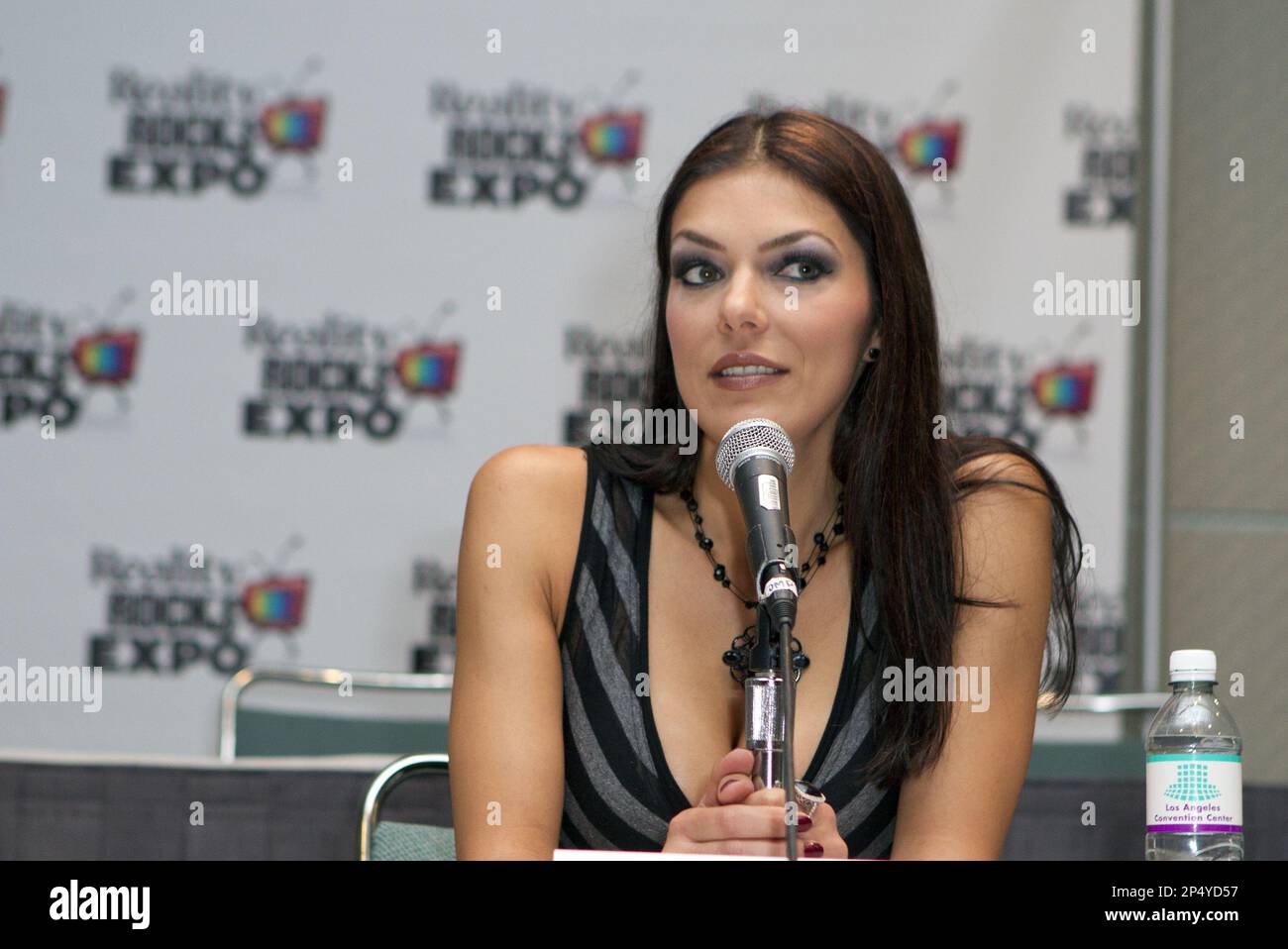
Adrianne Curry's career on the fashion show runway began with her historic win as the first-ever champion of America's Next Top Model (ANTM) in 2003. Her runway presence was defined by a signature "edgy" walk, standing 5'10" with a look that bridged the gap between commercial appeal and high-fashion rebellion.
The trajectory of Adrianne Curry’s career provides a unique case study in the evolution of the modeling industry. As the inaugural winner of a reality television competition, she was a pioneer who faced the daunting task of translating a televised victory into a sustainable career on the elite runways of New York and beyond. While the industry in the early 2000s was notoriously skeptical of "reality stars," Curry managed to secure several high-profile bookings that cemented her place in fashion history.
The Catalyst: The America’s Next Top Model Cycle 1 Finale
The foundation of Adrianne Curry’s runway experience was built during the high-stakes environment of the America's Next Top Model Cycle 1 finale. This wasn't just a television segment; it was a professional-grade production for Baby Phat, the urban-chic line helmed by Kimora Lee Simmons.
During this show, Curry had to demonstrate her ability to handle the "pressure cooker" environment of a major fashion event. The runway for Baby Phat was known for its energy, requiring models who could project confidence and attitude rather than a traditional, stoic high-fashion gait. Curry’s performance was characterized by a strong, rhythmic pace and a "piercing" gaze that the judges, including Tyra Banks and Janice Dickinson, cited as the deciding factor in her victory. This specific show proved she could hold her own alongside established professional models, setting the stage for her post-show career.
Professional Runway Bookings and New York Fashion Week
Following her win, Adrianne Curry moved to New York City to fulfill her contract with Wilhelmina Models. Her presence on the runway during the mid-2000s coincided with a specific era of fashion often referred to as "Indie Sleaze" or "McBling," where the lines between celebrity culture and the catwalk were beginning to blur.
Mercedes-Benz Fashion Week (NYFW)
Curry was a recurring face at Mercedes-Benz Fashion Week (then held at Bryant Park). Her bookings often leaned toward designers who appreciated her unconventional, rock-and-roll persona.
- Jamie Pressly’s J’Aime Line: Curry was a featured model for actress Jamie Pressly’s fashion venture, which required a mix of commercial femininity and runway edge.
- Pamela Anderson and Richie Rich: She walked for several shows associated with the "Club Kid" aesthetic of Richie Rich (of Heatherette fame). These shows were characterized by theatricality, vibrant colors, and non-traditional runway presentations.
- Ed Hardy by Christian Audigier: During the height of the brand's popularity, Curry appeared on the runway to showcase the tattoo-inspired streetwear that defined mid-2000s pop culture.
International and Specialized Shows
Beyond the primary tents of NYFW, Curry traveled for various trade shows and specialized fashion events. Her runway work extended to:
- Macy's Passport: A long-running charitable fashion event that featured a mix of high-end designers and accessible retail brands.
- Direct-to-Consumer Runway Events: Because of her fame from ANTM, Curry was often booked for large-scale consumer fashion shows where her "star power" could draw crowds, bridging the gap between a model and a brand ambassador.
Technical Analysis of Adrianne Curry’s Runway Style
To understand Curry’s impact on the runway, one must look at the technical aspects of her performance. The "runway walk" is a specialized skill involving posture, timing, and foot placement.
The Gait and Footwork
Curry utilized a "crossover" step—placing one foot directly in front of the other—which created a natural sway in the hips. This technique is essential for showcasing the movement of fabrics like silk or chiffon. Unlike the "power walk" of the 1990s supermodels, Curry’s style was more contained and focused, reflecting the minimalist trends of the early 2000s.
Facial Expression and "The Smize"
Long before Tyra Banks coined the term "smize" (smiling with your eyes), Adrianne Curry was practicing it. On the runway, her facial expressions were noted for being "deadpan yet intense." This was a necessary skill for high-fashion shows where the designer wants the audience to focus on the garment rather than the model’s personality. However, in more commercial shows, she was able to transition into a more approachable, smiling persona, demonstrating a versatility that many of her peers lacked.
Height and Proportions
Standing at 5'10" (178 cm), Curry met the industry standard for runway models. Her proportions allowed her to fit into "sample sizes," which is the prerequisite for any model hoping to walk in major fashion weeks. Her athletic build also made her a favorite for swimwear and lingerie segments, which require a different type of runway presence than standard ready-to-wear.
Comparison: ANTM Performance vs. Professional Industry Standards
The transition from a reality TV contestant to a working runway model involves a steep learning curve. The following table highlights the differences between Curry’s televised experience and her actual professional runway career.
| Feature | ANTM Finale (Baby Phat) | Professional NYFW Bookings |
|---|---|---|
| Atmosphere | Controlled for television cameras | Chaotic, fast-paced backstage |
| Pacing | Staged for dramatic effect | Precise timing based on music cues |
| Garment Changes | Usually 1-2 looks | Often 3-4 rapid-fire changes |
| Audience | Judges and invited guests | Buyers, editors, and photographers |
| Objective | To win a competition | To sell the designer's collection |
| Feedback | Immediate verbal critique | Subtle (booked again or not) |
The Industry Shift: Reality TV Stigma on the Catwalk
Adrianne Curry’s time on the runway was often overshadowed by the "reality TV stigma." In 2026, we look back and see that she was the first to navigate the difficult path that later models like Kendall Jenner or Gigi Hadid would perfect. However, in 2003–2005, the fashion establishment was protective of its exclusivity.
Curry has been vocal in various interviews and retrospectives about the challenges she faced. While she was booked for several shows, she often felt that the "high-fashion" world (Vogue-level designers) remained out of reach because of her association with a commercial reality show. This forced her to pivot toward "celebrity modeling," where her runway appearances were as much about her name as they were about her walk. This shift actually paved the way for the "Influencer Model" era that dominates the industry today.
Beyond the Runway: A Transition to New Media
By the late 2000s, Adrianne Curry began to move away from the traditional runway. The physical demands of the industry, combined with the shelf-life of a runway model, led her to explore reality television (such as The Surreal Life and My Fair Brady) and later, digital content creation.
Her runway experience remained a vital part of her professional identity. It gave her the poise and public speaking confidence required for her later ventures into gaming and lifestyle hosting. By 2026, she is widely recognized not just as a former model, but as a pioneer of the "multi-hyphenate" career path. Her runway history serves as the "proof of concept" that a girl from Joliet, Illinois, could indeed ascend to the highest stages of the fashion world through sheer determination and a distinctive look.
Challenges and Technical Limitations
While Curry had the height and the look, she also faced the technical limitation of the "post-show" slump. The modeling world moves in cycles, and the "look" that was popular in 2003—very thin, slightly "grunge"—began to change by 2006.
Furthermore, the contractual obligations of winning a reality show sometimes conflicted with the rapid-fire booking schedule of an independent model. Runway models often need to attend dozens of "go-sees" (auditions) in a single week. Curry’s fame made her a recognizable figure, which was a double-edged sword; she was easily remembered, but sometimes designers felt she would "distract" from the clothes.
Legacy of the Cycle 1 Winner in 2026
In 2026, the fashion industry has fully embraced the "celebrity model," but Adrianne Curry remains the original blueprint. Her runway shows for Ed Hardy and Richie Rich are now seen as iconic time capsules of early 2000s fashion.
Her contribution to the runway wasn't just about the clothes she wore, but about breaking the barrier for reality television contestants in professional spaces. Every time a contemporary reality star walks in a major fashion show, they are walking a path that Adrianne Curry first cleared—often through thickets of industry prejudice and logistical hurdles.
Frequently Asked Questions
Which major designers did Adrianne Curry walk for? Adrianne Curry walked for several notable mid-2000s designers, most notably Kimora Lee Simmons (Baby Phat), Jamie Pressly (J'Aime), and various shows by Richie Rich and Christian Audigier (Ed Hardy/Von Dutch). While she didn't become a "house model" for brands like Chanel or Dior, she was a staple in the more "celebrity-driven" shows of New York Fashion Week.
How tall is Adrianne Curry and why did it matter for her runway career? Adrianne Curry is 5'11" (often listed as 5'10" in early stats). This height is the "sweet spot" for runway modeling. It allows the model to carry the length of gowns and trousers without the clothes trailing on the floor. Her height was a primary reason she was able to secure professional work after ANTM, as she met the physical requirements that many other contestants did not.
Did Adrianne Curry ever walk in international fashion weeks? While her primary runway career was centered in the United States—specifically New York and Los Angeles—she did participate in various international appearances and trade shows. However, she did not have a significant presence in the "Big Four" European cities (London, Milan, Paris) to the same extent as she did in the American market.
Why did Adrianne Curry stop walking in fashion shows? Curry’s transition away from the runway was due to a combination of factors: the natural aging process of a model's career, a shift in interest toward television and digital media, and her outspoken nature regarding the realities of the modeling industry. By the late 2000s, she had successfully leveraged her runway fame into a sustainable career as a media personality.
What was unique about Adrianne Curry's runway walk? Her walk was often described as "purposeful" and "intense." She avoided the overly bouncy "pageant walk" and instead focused on a rhythmic, steady gait. This made her particularly suited for streetwear and "edgy" fashion lines that wanted a model who looked like they were walking with a specific destination and attitude in mind.
Practical Advice for Aspiring Models
If you are looking to emulate the runway success of figures like Adrianne Curry, focus on versatility. Curry succeeded because she could adapt her walk from the high-energy environment of Baby Phat to the more theatrical demands of Richie Rich. Aspiring models should record their walk from multiple angles and practice adjusting their pace to different genres of music. Additionally, understanding that a runway career is often a "stepping stone" to other media ventures—as it was for Curry—can help in planning a long-term career strategy in the fashion industry.