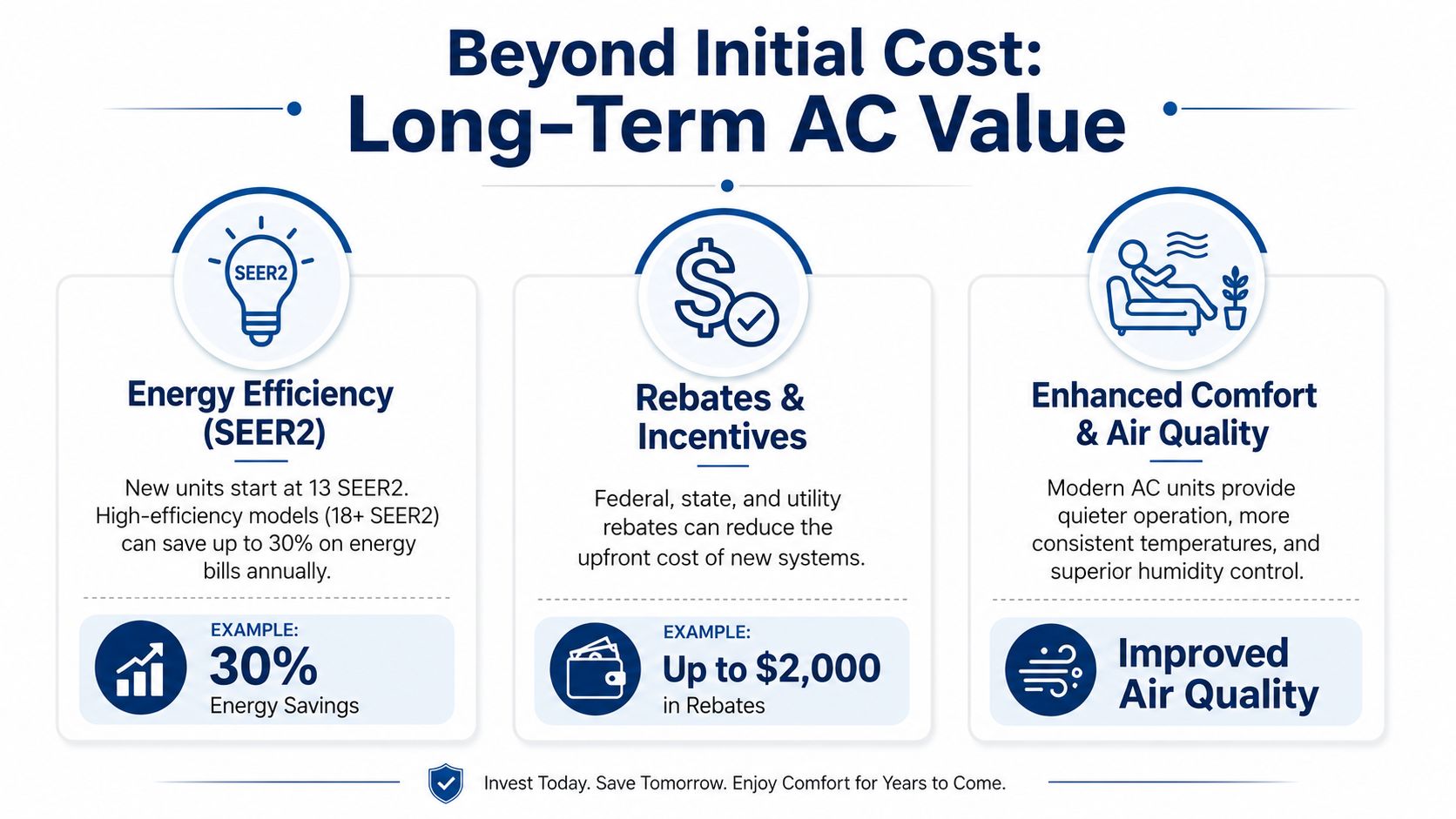
Upgrading your home’s air conditioning can be expensive, but various federal, state, and utility-sponsored ac unit rebates can significantly lower the upfront cost. Homeowners can often secure thousands of dollars in financial incentives by choosing high-efficiency heat pumps and central air conditioning systems that meet specific energy performance standards.
Replacing an aging, inefficient air conditioning system represents one of the most substantial capital investments a homeowner can make in property maintenance and daily comfort. Beyond the equipment and installation costs, older cooling units drive up monthly utility bills and carry a higher risk of costly mechanical failure. Fortunately, a robust ecosystem of financial incentives exists to offset these expenses. By understanding how ac unit rebates work, homeowners can transform an expensive necessity into a smart financial investment.
Navigating these programs requires careful attention to detail. Financial incentives stem from multiple tiers of government, local utility providers, and manufacturer promotions. Each program maintains strict eligibility criteria regarding equipment efficiency ratings, installation protocols, and contractor certifications. Misjudging a single requirement can invalidate an application, leaving the homeowner responsible for the full retail cost. This comprehensive guide details the types of rebates available, the technical standards required for qualification, the application process, and strategic steps to maximize financial savings on a new cooling system.
Understanding the Landscape of AC Unit Rebates
Financial incentives for heating, ventilation, and air conditioning (HVAC) upgrades are distributed across several distinct jurisdictions. To capture every available dollar, homeowners must look past single-source discounts and examine the overlapping programs operating in their local market.
Federal incentives form the foundational layer of modern energy-efficient upgrades. Under national legislation such as the Energy Efficient Home Improvement Credit, significant tax incentives reward the installation of qualifying heat pumps and central air conditioners. Unlike traditional rebates that arrive as checks or prepaid cards, tax credits directly reduce a taxpayer's federal income liability, dollar for dollar.
State and municipal programs add another layer of savings. State energy offices frequently administer funds allocated for residential decarbonization and grid reliability. These programs often target lower- and middle-income households with point-of-sale discounts, meaning the deduction is applied directly on the contractor's invoice rather than requiring a post-installation mail-in application.
Local electric and gas utilities represent the most common and accessible source of direct ac unit rebates. Electric utilities manage demand response and energy efficiency portfolios designed to reduce peak summer loads on the electrical grid. By encouraging consumers to adopt high-efficiency cooling, utilities minimize the need to build expensive new power generation infrastructure. Consequently, these providers offer generous cash-back rebates for equipment that surpasses baseline federal efficiency standards.
Technical Specifications and Qualification Standards
Qualifying for ac unit rebates requires strict adherence to technical performance metrics. Regulatory bodies and utility companies do not issue financial incentives for standard-efficiency equipment; rewards are reserved for systems that demonstrate exceptional energy conservation. Homeowners must familiarize themselves with standard industry rating metrics to ensure their chosen equipment meets eligibility thresholds.
Key Efficiency Metrics Explained
Energy efficiency ratings dictate whether a cooling system qualifies for financial assistance. The primary metrics include:
- SEER2 (Seasonal Energy Efficiency Ratio 2): This metric measures the cooling output of an air conditioner or heat pump over a typical cooling season, divided by the total electric energy consumed. SEER2 reflects updated, more rigorous testing procedures introduced to simulate real-world duct conditions more accurately than legacy SEER ratings.
- EER2 (Energy Efficiency Ratio 2): EER2 measures a system's energy efficiency at a specific, high outdoor temperature (typically 95 degrees Fahrenheit). This metric is critical for evaluating performance during peak summer heat waves.
- HSPF2 (Heating Seasonal Performance Factor 2): Applicable exclusively to heat pumps, HSPF2 measures heating efficiency over the winter season. Because many modern incentive programs emphasize heat pumps for both heating and cooling, HSPF2 compliance is frequently mandatory for maximum rebate collection.
AHRI Certification and Matching Systems
Meeting efficiency numbers on paper is insufficient; the physical equipment must be certified as a complete system. The Air-Conditioning, Heating, and Refrigeration Institute (AHRI) maintains a directory of certified equipment combinations.
To qualify for most utility rebates and tax credits, the outdoor compressor, indoor evaporator coil, and matching furnace or air handler must be certified as a matched system. Mixing mismatched brands or installing a high-efficiency outdoor unit with an old, substandard indoor coil will ruin the system's efficiency rating and disqualify the installation from rebate programs. Contractors must supply an AHRI certificate proving the matched system meets the required threshold before filing any paperwork.
| Rebate Type | Primary Governing Body | Typical Savings Range | Core Technical Requirement |
|---|---|---|---|
| Federal Tax Credits | Federal Government (IRS) | Up to $2,000 | Highest tier ENERGY STAR certification (SEER2/EER2 thresholds) |
| State Clean Energy Grants | State Energy Offices | Variable ($500 – $8,000) | High HSPF2/SEER2 ratings; income verification often applies |
| Utility Cash Rebates | Local Electric/Gas Providers | $200 – $1,500 | AHRI-matched system meeting local utility efficiency tiers |
| Manufacturer Promos | Equipment Manufacturers | $100 – $1,000 | Purchase of specific proprietary model tiers during promotional windows |
Step-by-Step Guide to Claiming AC Unit Rebates
Securing financial incentives requires a methodical approach. Skipping a step or missing a strict submission deadline can permanently forfeit rebate eligibility. Homeowners should treat the rebate acquisition process as an integral part of the HVAC purchasing timeline.
Step 1: Audit Current Equipment and Assess Needs
Before contacting contractors, document the specifications of the existing system, including its age, fuel type, and operational issues. Review past utility bills to establish baseline energy consumption. Identifying these parameters helps determine whether a standard central air conditioner or a cold-climate heat pump represents the best replacement option.
Step 2: Consult with Qualified, Certified Contractors
Never purchase an HVAC system independently and attempt a DIY installation or hire an uncertified handyman if rebates are desired. Most utility and government programs mandate that installation be performed by a licensed, insured HVAC professional. Furthermore, many programs require the contractor to hold specific certifications, such as North American Technician Excellence (NATE) certification or specific manufacturer credentials. During the quoting phase, explicitly inform contractors of the intent to pursue all available ac unit rebates and request that they propose AHRI-certified matched systems.
Step 3: Verify Pre-Approval Requirements
Certain utility providers and state programs require formal pre-approval before old equipment is removed and new equipment is installed. Submitting an application after the fact will result in automatic rejection. Review the utility's portal guidelines to determine if an application must be filed and approved before scheduling the installation date.
Step 4: Complete the Installation and Duct Testing
During installation, ensure the contractor performs any mandatory auxiliary services. Modern incentive programs increasingly require duct sealing, leakage testing, or refrigerant charge verification. Contractors must itemize these services on the final invoice, as program auditors often request proof of these supporting procedures.
Step 5: Gather Documentation and Submit Applications
Once the system is operational, collect all required documentation. A complete submission packet typically requires:
- The itemized, paid-in-full contractor invoice showing equipment model and serial numbers.
- The AHRI certificate proving system compatibility and efficiency ratings.
- Proof of the contractor’s active licensing and insurance.
- Completed utility rebate application forms or state portal submissions.
Submit these documents well in advance of program deadlines. Utility rebate funds are frequently limited and distributed on a first-come, first-served basis until annual budgets are exhausted.
Common Pitfalls and How to Avoid Them
Navigating complex incentive structures leaves room for error. Recognizing frequent missteps prevents costly financial surprises.
- Ignoring Program Deadlines: Rebate programs operate on fixed funding cycles or calendar years. A delay in filing can push an application into a new fiscal year where funding has lapsed or efficiency requirements have increased.
- Purchasing Unqualified Equipment: Trusting verbal assurances from a salesperson is risky. Always independently verify the AHRI certificate and ensure the exact model numbers match the utility's eligible equipment list. Minor discrepancies in suffix letters can invalidate a model number.
- Failing to Keep Detailed Records: Retain all paperwork, including permits, invoices, diagnostic test results, and correspondence with the utility, for at least three to five years in the event of an audit.
- Overlooking Local Building Permits: Many rebate programs require proof of a local municipal building permit as a prerequisite for payout. Skipping the permitting process to save money upfront can disqualify a multi-thousand-dollar rebate.
Frequently Asked Questions
Can I combine federal tax credits with local utility rebates?
Yes. Federal tax credits and local utility rebates can generally be stacked. Receiving a cash-back rebate from a local electric utility does not reduce the basis used to calculate federal energy efficiency tax credits, allowing homeowners to maximize savings from multiple distinct sources.
Do mini-split heat pumps qualify for the same rebates as central air conditioners?
Ductless mini-split heat pumps frequently qualify for even higher rebates than traditional central air systems. Because modern inverter-driven mini-splits achieve exceptional efficiency ratings, they are heavily favored by state decarbonization programs and utility demand-response initiatives.
What happens if my contractor installs the wrong equipment model?
If the installed model numbers do not match the pre-approval documents or the utility's eligible product list, the rebate will likely be denied. Homeowners must verify the physical data plates on the outdoor compressor and indoor unit against the invoice and AHRI certificate before the contractor departs.
Are DIY installations eligible for utility rebates?
Utility and government rebate programs universally require professional installation by a licensed HVAC contractor. DIY installations forfeit all rebate eligibility due to safety, building code, and proper sizing verification requirements.
How long does it take to receive a utility rebate check?
Processing times vary widely depending on the utility provider and the time of year. Summer and early fall represent peak HVAC replacement seasons, leading to processing backlogs. Homeowners should generally expect payment within four to twelve weeks following final application approval.
Maximizing Your Investment
Replacing an air conditioning system represents a major household expenditure, but strategic navigation of available financial incentives softens the financial blow. Prioritize high-efficiency, AHRI-certified equipment, partner with knowledgeable and licensed contractors, and meticulously document every step of the procurement and installation process. By taking advantage of federal tax credits, state grants, and utility rebates, homeowners can secure reliable home comfort while keeping thousands of dollars in their pockets.