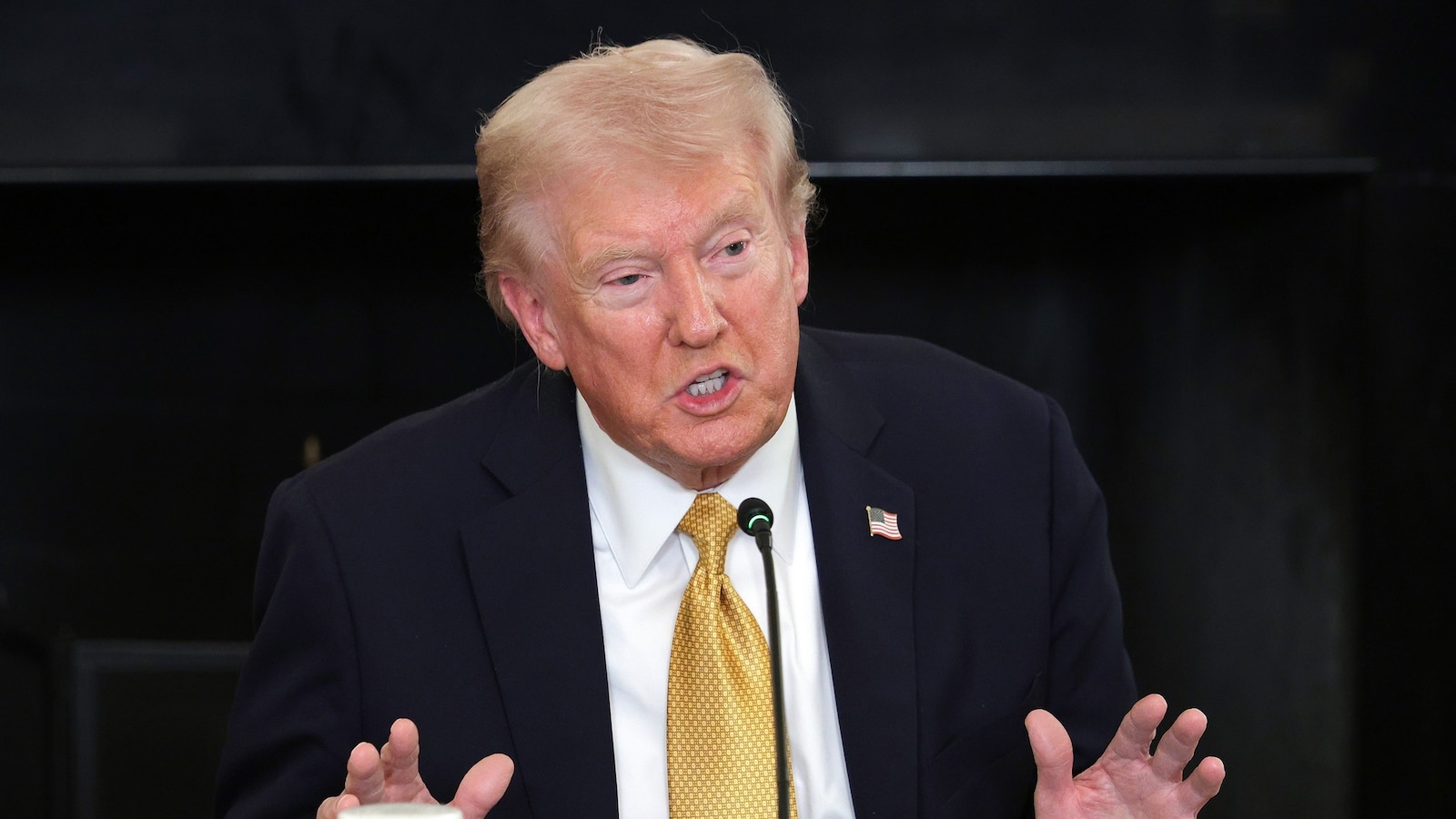
When major political figures sit down for high-profile broadcast interviews, the ensuing public discourse often centers on a battle of assertions and empirical evidence. An analysis of the claims made during significant ABC News interviews featuring Donald Trump, paired against independent counterdata, provides a case study in modern political fact-checking, journalistic accountability, and the complexities of verifying real-time public statements.
Understanding the Context of Political Interviews and Claims
High-stakes political interviews serve as primary arenas for candidates and public officials to communicate their policy positions, defend their track records, and critique opponents. However, the live, unscripted nature of these broadcast formats frequently results in statements that diverge from established data, official statistics, or historical records.
When organizations like ABC News broadcast such interviews, viewers and media analysts are tasked with evaluating the veracity of the assertions made. This verification process relies on established counterdata—empirical information sourced from non-partisan government agencies, academic research, economic indicators, and independent investigative reporting. Understanding how these claims are measured against factual datasets requires examining specific recurring policy domains, including economic performance, immigration statistics, crime rates, and foreign policy outcomes.
The Mechanics of Journalistic Fact-Checking
Journalists and professional fact-checkers approach political claims through a structured methodology designed to separate verifiable objective statements from subjective opinions or political rhetoric. The process typically involves several critical steps:
- Identification of Testable Claims: Reviewing interview transcripts to isolate assertions that contain measurable data points, historical references, or specific policy outcomes.
- Consultation of Primary Sources: Examining official records from entities such as the Bureau of Labor Statistics (BLS), the Census Bureau, the Department of Justice (DOJ), and international bodies.
- Contextualization: Evaluating whether a statement utilizes misleading timeframes, omits crucial baseline data, or conflates correlation with causation.
- Publication of Counterdata: Presenting the verified data alongside the original claim to provide the public with a comprehensive view of the subject matter.
Major Policy Categories and Empirical Counterdata
Discussions during major broadcast interviews frequently span several core policy areas. Each category possesses distinct datasets used by economists, statisticians, and journalists to assess the accuracy of political statements.
Economic Policy, Inflation, and Employment
Economic assertions are among the most frequently scrutinized elements of political media appearances. Figures related to inflation rates, job creation, stock market performance, and trade deficits are easily cross-referenced against historical government metrics.
- Inflation Metrics: When claims are made regarding consumer price indices or the cost of living during specific presidential terms, fact-checkers rely on data compiled by the Bureau of Labor Statistics to establish month-over-month and year-over-year trends.
- Job Growth: Statements concerning employment numbers are measured against nonfarm payroll reports, distinguishing between job recovery phases and long-term economic expansion.
- Trade and Tariffs: Discussions involving trade deficits and tariff revenues are verified using data from the U.S. Bureau of Economic Analysis and U.S. Customs and Border Protection.
Immigration and Border Security
Immigration policy frequently generates intense debate, with discussions often focusing on border apprehensions, enforcement operations, and demographic shifts.
- Apprehension and Encounter Data: Claims regarding border crossing volumes are cross-referenced with operational statistics published by U.S. Customs and Border Protection (CBP).
- Policy Impacts: Assessments of specific deterrence measures or enforcement actions rely on longitudinal studies examining migration patterns and legal asylum processing metrics.
Public Safety and Crime Statistics
Statements regarding crime rates, urban safety, and law enforcement efficacy require careful navigation of varying reporting systems.
- Crime Reporting: National statistics are primarily drawn from the FBI’s Uniform Crime Reporting (UCR) program and the Bureau of Justice Statistics (BJS) National Crime Victimization Survey.
- Geographic Scope: Fact-checkers must distinguish between localized municipal crime trends and nationwide aggregates to provide accurate counterdata.
Comparative Overview of Interview Claims vs. Verified Data Sources
To understand how claims are evaluated, the following table outlines the typical domains examined during major political interviews, the standard nature of the claims, and the primary counterdata sources utilized by researchers.
| Policy Domain | Common Claim Focus | Primary Counterdata Source | Verification Methodology |
|---|---|---|---|
| Economy | Inflation rates and purchasing power | Bureau of Labor Statistics (BLS) | Comparing Consumer Price Index (CPI) changes across specific administration timelines. |
| Employment | Job creation and unemployment figures | Bureau of Labor Statistics (BLS) | Analyzing monthly nonfarm payroll reports and historical employment-population ratios. |
| Immigration | Border crossing volumes and enforcement | U.S. Customs and Border Protection (CBP) | Reviewing monthly encounter statistics and historical apprehension trends. |
| Public Safety | National crime trends and violent crime rates | Federal Bureau of Investigation (FBI) | Examining Uniform Crime Reporting data and victimization surveys. |
| Federal Budget | National debt and deficit accumulation | Department of the Treasury | Auditing monthly treasury statements and congressional budget office projections. |
Methodological Challenges in Political Fact-Checking
Evaluating political discourse is rarely a straightforward exercise in matching a statement to a single data point. Several inherent complexities influence how claims and counterdata are interpreted by the public and media analysts.
The Problem of Definition and Baseline
Politicians and fact-checkers often utilize different baselines when calculating economic or social metrics. For instance, measuring job growth from an economic trough versus a cyclical peak can yield drastically different statistical narratives. Similarly, definitions of terms like "secure border," "middle class," or "energy independence" can vary significantly between political rhetoric and technical policy definitions.
The Timing of Data Releases
Official government data is frequently subject to subsequent revisions. Preliminary employment reports or inflation estimates released in real-time during a news cycle may differ from final audited figures published months later. This temporal gap creates challenges for immediate fact-checking, as journalists must rely on provisional data while maintaining analytical accuracy.
Nuance Versus Soundbite Culture
Broadcast journalism often operates within strict time constraints, favoring concise soundbites over deep statistical analysis. Consequently, complex economic or geopolitical realities can be oversimplified by both the speaker and the interviewing network, leading to public confusion regarding the actual state of empirical evidence.
Frequently Asked Questions
What role do fact-checkers play during televised political interviews?
Fact-checkers evaluate public statements against verifiable data from authoritative sources such as government agencies and academic institutions. Their goal is to provide context, correct factual inaccuracies, and ensure that public discourse is informed by empirical evidence.
Why do politicians and fact-checkers often cite different numbers for the same issue?
Discrepancies usually arise from differing baseline dates, cherry-picked timeframes, or distinct definitions of statistical terms. For example, comparing job growth over a four-year term versus a post-recession recovery window will produce different numerical outcomes.
Where can the public access official counterdata for political claims?
Citizens can access primary source data through official government websites, including the Bureau of Labor Statistics (bls.gov), the Bureau of Economic Analysis (bea.gov), the Federal Bureau of Investigation (fbi.gov), and non-partisan research organizations like the Congressional Budget Office (cbo.gov).
How do journalists handle claims that involve subjective interpretations rather than objective facts?
When a statement expresses an opinion, a prediction, or a value judgment, professional journalists generally refrain from rating it as definitively true or false. Instead, they provide the relevant background, expert commentary, and historical context to help the audience evaluate the perspective independently.
Conclusion and Recommended Next Actions
Evaluating the interplay between high-profile broadcast claims and independent counterdata requires a critical, multi-sourced approach to media consumption. Viewers seeking a comprehensive understanding of political assertions should consult primary government datasets, examine cross-partisan analytical reports, and pay close attention to the specific timeframes and definitions referenced during interviews. For ongoing analysis, readers can monitor updates from independent non-partisan research institutions and verified government statistical agencies to maintain an accurate perspective on complex policy debates.