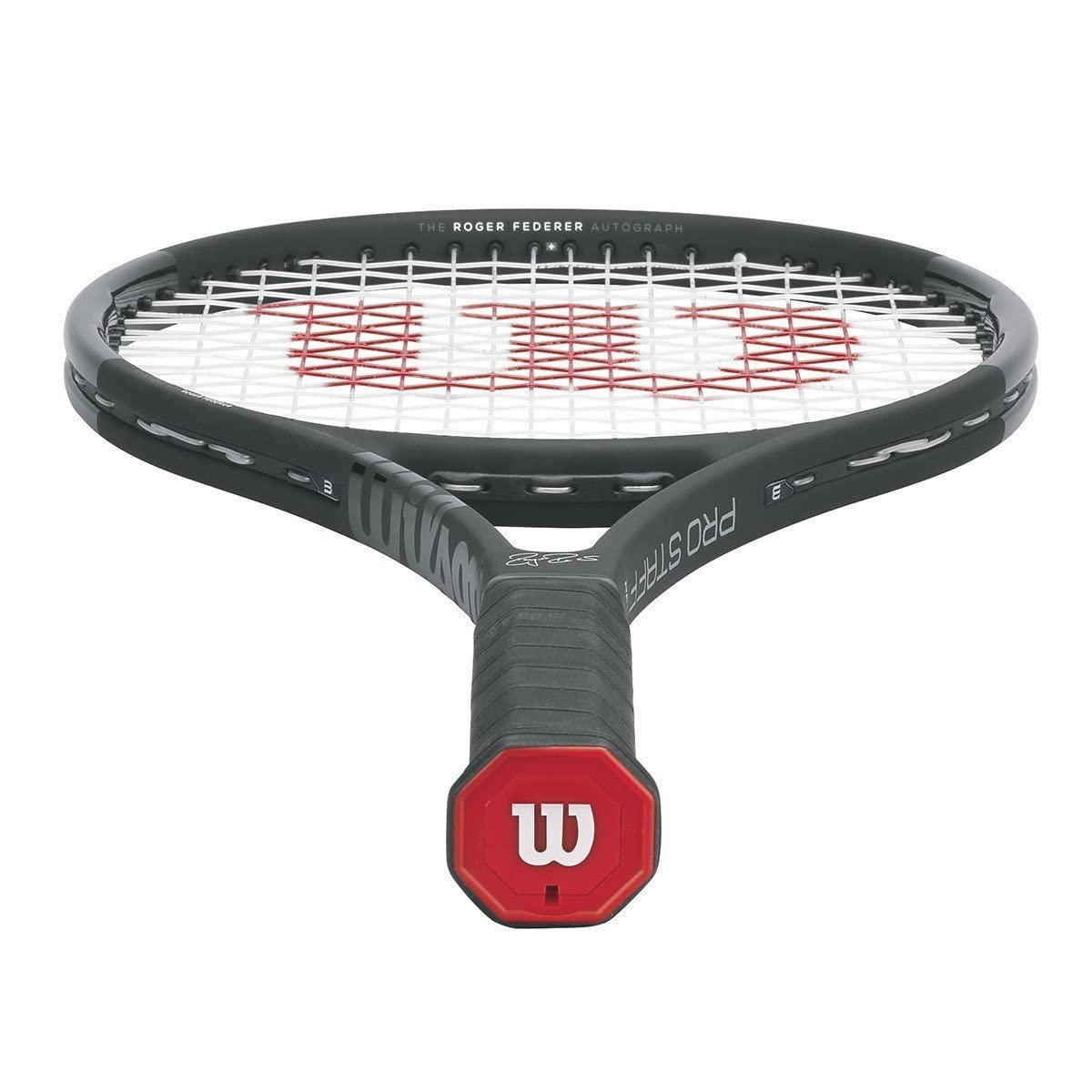
The Wilson Pro Staff RF97 Autograph is a high-performance tennis racket co-designed by Roger Federer, featuring a 97-square-inch head, a heavy 340g (unstrung) static weight, and a head-light balance. It is engineered for advanced players seeking maximum stability, precision, and "plow-through" power, representing the pinnacle of the traditional player’s frame.
The Legacy of the 97-Square-Inch Pro Staff
For decades, the Wilson Pro Staff line was defined by its small head sizes—most notably the 85-square-inch frame used by Pete Sampras and the 90-square-inch version used by Roger Federer during the first half of his career. However, as the modern game evolved toward heavier topspin and faster ball speeds, even the greatest players required a larger "sweet spot" and more forgiving geometry.
The introduction of the 97 Wilson RF97 Autograph marked a historic shift. Launched officially in 2014 after extensive testing by Federer, the RF97 moved the Pro Staff into the modern era without sacrificing the classic feel of braided graphite. In 2026, while newer models like the RF 01 series have entered the market to suit a more versatile, faster-swinging game, the RF97 remains a gold standard for "heavy" frames. It is a racket that does not assist the player; rather, it rewards those who possess the strength and technique to wield it.
Technical Specifications and Engineering
Understanding the RF97 requires a deep dive into its physical properties. This is not a "tweener" racket designed for the average club player; it is a professional-spec tool.
Weight and Balance
The most defining characteristic of the RF97 is its mass. At 340 grams (12.0 oz) unstrung, and approximately 357-360 grams (12.6 oz) strung, it is one of the heaviest rackets available in the retail market. This mass provides incredible stability. When facing a 100 mph serve, the RF97 does not flutter or twist in the hand; the weight of the frame absorbs the energy of the ball and redirects it with minimal effort.
The balance is traditionally set at 12 points Head Light (HL). This significant head-light balance is crucial because it allows the player to whip the heavy frame through the air. Without this balance, a 340g racket would feel sluggish and would likely cause wrist or shoulder fatigue within minutes.
Frame Composition and Feel
The RF97 utilizes a Braided Graphite + Kevlar construction. This double-braid process creates a unique dampening effect while maintaining a "crisp" feel at impact. Unlike modern rackets that use dampening polymers or "vibration-reducing" technologies that can make the hit feel muted or disconnected, the RF97 provides raw, honest feedback. You know exactly where the ball hit the string bed.
Perimeter Weighting System (PWS)
The "bulges" at the 3 and 9 o'clock positions on the hoop are known as the Perimeter Weighting System. This Wilson signature technology adds mass to the sides of the head, increasing torsional stability. This means that even on off-center hits, the racket resists twisting, keeping the ball on its intended trajectory.
Evolution of the RF97 Versions (v10 to v13)
Since its debut, the RF97 Autograph has seen four major cosmetic and slight structural iterations. While the core specifications remained largely consistent to satisfy Federer’s exacting standards, each version brought something new to the aesthetic and tactile experience.
- Version 10 (2014): The "Red and Black" frame. This was the first retail RF97. It featured a glossy finish and was the boldest departure from the classic Pro Staff look. It established the 97-square-inch head as the new standard for the elite Pro Staff.
- Version 11 (2016): Often called the "Tuxedo" or "Black Velvet" version. This introduced the matte black elastic paint that became synonymous with Federer’s late-career style. The texture was soft to the touch, and the "Autograph" branding was etched into the frame for a premium feel.
- Version 12 (2018): This version added white accents at the 3 and 9 o'clock positions, mimicking the classic look of the Pro Staffs from the 80s and 90s. It maintained the matte finish but returned to a more heritage-inspired color block.
- Version 13 (2020/2021): The "v13" featured a return to exposed carbon fiber weave at the tip of the hoop, protected by a clear coat. This version was designed to showcase the Pro Staff's construction heritage while introducing a slightly more aerodynamic feel.
Performance Analysis: The "Plow-Through" Factor
The primary reason players choose the RF97 is for plow-through. In physics terms, this is the result of the racket's high swingweight (typically around 330–335 kg·cm²). When the racket meets the ball, the ball yields more than the racket does.
Groundstrokes
On the baseline, the RF97 produces a heavy, penetrating ball. It is particularly effective for players with long, traditional strokes. If you can get the racket moving, the weight does the work for you. However, it is not a "spin monster." While the 16x19 string pattern provides adequate grip, the RF97 is more about "flat" power and precision than the extreme arching trajectories found with the Wilson Burn or Babolat Pure Aero.
Volleys
The RF97 is arguably one of the best volleying rackets ever made. Its mass makes it an immovable object at the net. It provides the "punch" needed to put away high volleys and the stability to handle low, digging volleys. The feedback from the frame allows for exceptional touch on drop volleys and angles.
Serves
The weight of the RF97 can be a double-edged sword on serves. If you have the shoulder strength to accelerate the frame, it produces massive pace and "heavy" serves that are difficult for opponents to return. However, if your technique is flawed, the weight can lead to a drop in racket-head speed, resulting in a flatter, less effective serve.
| Specification | Wilson Pro Staff RF97 Autograph (v13) | Wilson RF 01 Pro (The 2025/26 Alternative) |
|---|---|---|
| Head Size | 97 sq in / 626 sq cm | 98 sq in / 632 sq cm |
| Unstrung Weight | 340g / 12.0 oz | 320g / 11.3 oz |
| Balance | 12 pts HL | 9 pts HL |
| Beam Width | 21.5mm Flat Beam | 23.2mm / 24mm / 22mm (Variable) |
| String Pattern | 16x19 | 16x19 |
| Stiffness (RA) | 68 | 64 |
| Primary Goal | Stability & Tradition | Maneuverability & Modern Speed |
The 2026 Perspective: RF97 vs. the RF 01 Series
As of 2026, Wilson has shifted its primary focus to the RF 01 series, which was developed to reflect the faster, more vertical swing paths of the current generation of players. Many fans of the RF97 wonder if they should make the switch.
The RF97 is a stationary power racket. It excels when you have time to set up and drive through the ball. The RF 01, conversely, is built for dynamic speed. It is lighter, features a more aerodynamic SABR Frame Design, and a slightly larger 98-square-inch head.
For the traditionalist who grew up with heavy graphite frames, the RF97 remains irreplaceable. No other modern racket captures that specific "thud" at impact. However, for players looking to reduce arm fatigue or those who play a more defensive, "scrambling" style of tennis, the transition to the lighter RF 01 or the standard Pro Staff 97 (315g) is often recommended.
Maintenance and Stringing Recommendations
Because the RF97 is a stiff and heavy frame, your choice of strings and tension is critical to preventing injury (such as tennis elbow) and maximizing performance.
String Choice
- Polyester (Monofilament): Most advanced players use a poly string for control. However, because the RF97 is already stiff (RA 68), a "soft" polyester like Luxilon ALU Power Soft or Solinco Confidential is preferred.
- Natural Gut Hybrid: This is the "Federer Setup." Using natural gut in the mains and polyester in the crosses provides the ultimate blend of power, comfort, and control. It is expensive but offers the best playability.
- Multifilament: Generally not recommended for the RF97 unless you have a very slow swing, as the frame's power will cause you to over-hit.
Tension Guidelines
Historically, Federer strung his rackets in the high 40s to low 50s (lbs). For the average club player, a tension between 48 and 54 lbs is ideal. Stringing too tight (above 58 lbs) on such a heavy, stiff frame can lead to significant shock being transferred to the arm.
Common Pitfalls and Considerations
Before purchasing or committing to the RF97 Autograph, consider the following technical hurdles:
- The "Weight Wall": Many players love the feel of the RF97 during a 15-minute demo but find that after two sets of competitive play, they can no longer swing it fast enough to keep the ball in the court.
- Technical Demand: If you do not hit the ball in the center of the strings consistently, the RF97's stiffness can be punishing. It does not provide the "free power" found in rackets like the Babolat Pure Drive.
- Customization Limits: Because the racket is already so heavy, there is very little room for adding lead tape or silicone without making the racket unplayable for most humans.
Frequently Asked Questions
Is the Wilson RF97 Autograph still being manufactured in 2026?
While Wilson has shifted its marketing focus to the RF 01 series, the RF97 Autograph is often kept in "legacy production" or available through specialized tennis retailers. It remains a staple for collectors and high-level competitive players who refuse to switch to lighter frames.
What is the difference between the RF97 Autograph and the Pro Staff 97?
The "Autograph" (RF97) is 340g unstrung and is the exact spec used by Federer (minus his personal customization). The standard "Pro Staff 97" is 315g unstrung. The 315g version is much more accessible for the average high school or club player, as it allows for easier maneuverability while maintaining the Pro Staff feel.
Can a beginner use the RF97?
It is strongly discouraged. A beginner lacks the strength and timing required to handle a 340g racket. Using a racket this heavy as a novice can lead to poor stroke mechanics and potential injury, as the player will likely "push" the ball rather than swinging through it.
Why did Roger Federer switch to a 97-square-inch head?
Federer switched from his 90-square-inch frame to the 97 in early 2014 to gain more power on his serve and more consistency on his backhand. The larger head size provided a bigger sweet spot, which helped him compete against the heavy-spin baseline games of rivals like Rafael Nadal and Novak Djokovic.
How can I tell if my RF97 is a genuine "Autograph" model?
Genuine Autograph models will have "RF97" and Roger Federer’s signature printed on the inside of the throat. They will also clearly state the 340g / 12.0oz weight on the frame. Be wary of "counterfeit" frames that lack the distinct matte/elastic paint finish characteristic of v11 through v13.
Final Recommendation
The Wilson Pro Staff RF97 Autograph is more than just a piece of sports equipment; it is a piece of tennis history. In 2026, it stands as a testament to a specific era of "heavy" tennis—an era defined by precision, stability, and the elegant aggression of Roger Federer.
If you are an advanced player (NTRP 4.5+) who possesses short-to-medium swing paths and prefers to dictate play with heavy, flat groundstrokes and crisp volleys, the RF97 is unparalleled. However, if your game relies on defensive speed and high-RPM topspin, you may find better success with the modern RF 01 Pro or the standard Pro Staff 97. To truly appreciate the RF97, one must respect its weight; it is a racket that demands excellence but gives back pure, unadulterated control in return.