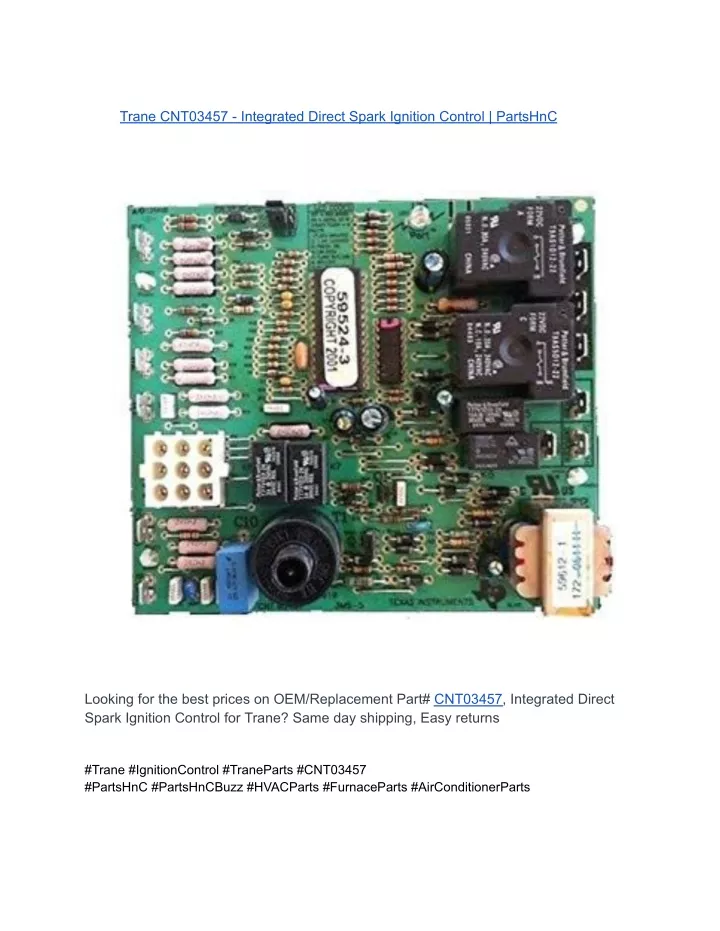
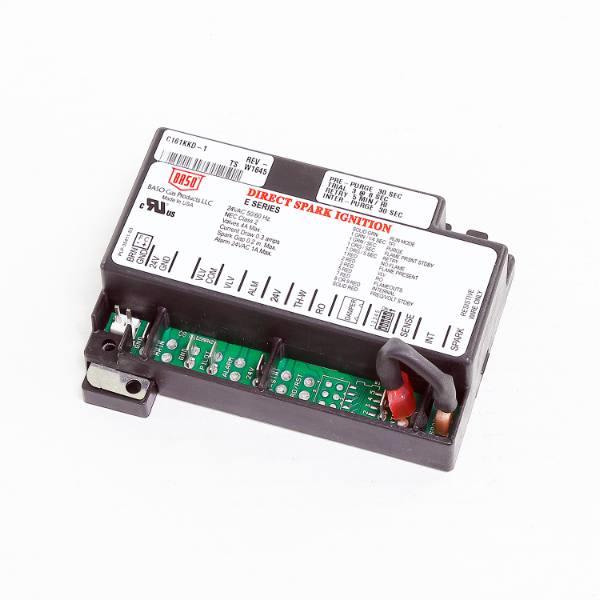
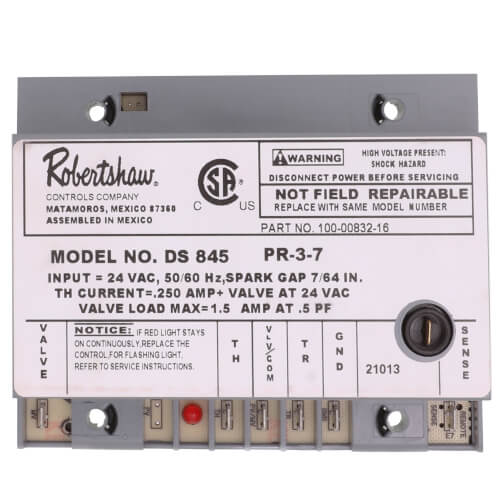
The Robertshaw 780-502 is a universal direct spark ignition (DSI) control module designed for use in gas-fired heating equipment, including furnaces, boilers, and commercial cooking appliances. It functions by providing a high-voltage spark to ignite the main burner directly, eliminating the need for a standing pilot light while monitoring flame safety through the principle of flame rectification.
Understanding the Robertshaw 780-502 DSI Module
In the landscape of HVAC and commercial combustion controls in 2026, the Robertshaw 780-502 remains a cornerstone component for both legacy system maintenance and specialized heating applications. As a member of the Uni-Line series, this specific control is engineered as a "universal" replacement, meaning it is designed to consolidate a wide variety of original equipment manufacturer (OEM) ignition boards into a single, versatile footprint.
Direct Spark Ignition (DSI) represents a significant leap in efficiency over older standing pilot systems. In a standing pilot setup, a small flame burns 24/7, wasting fuel and posing a slight risk of blowout. The 780-502, however, only initiates an ignition sequence when the thermostat calls for heat. It uses a high-voltage transformer to jump a gap at the burner, creating a spark that ignites the gas immediately. Because it handles both the spark and the gas valve timing, it is often referred to as an "integrated" or "automatic" ignition control.
The 780-502 is primarily a 24VAC control. Its primary role is to ensure that gas does not flow unless there is a confirmed source of ignition and, subsequently, a confirmed flame. This safety-first architecture is critical in residential and commercial settings to prevent the buildup of unburned gas, which could lead to combustion events outside the heat exchanger.
Technical Specifications and Performance Data
When evaluating the 780-502, technical precision is paramount. This module is categorized as a "three-try" ignition control. If the burner fails to ignite on the first attempt, the module will reset, purge the combustion chamber, and try again up to two more times before entering a "hard lockout" mode for safety.
| Feature | Specification Details |
|---|---|
| Input Voltage | 24 VAC, 50/60 Hz |
| Transformer Rating | 20 VA (Minimum) |
| Trial for Ignition (TFI) | 4 Seconds or 7 Seconds (Selectable/Model dependent) |
| Pre-Purge Time | 0 to 30 Seconds (Typically 15-second default on 502) |
| Flame Sensing Method | Flame Rectification (Local or Remote) |
| Spark Rate | 3 to 4 sparks per second |
| Operating Temperature | -40°F to 175°F (-40°C to 80°C) |
| Lockout Type | 1-Try or 3-Try (Configurable via jumpers on some variations) |
One of the defining characteristics of the 780-502 is its flexibility regarding flame sensing. It supports both "local" sensing (where the spark electrode also acts as the flame sensor) and "remote" sensing (where a separate flame rod is positioned elsewhere on the burner). This versatility is what allows it to replace over 100 different OEM part numbers from brands like Fenwal, Johnson Controls, and Honeywell.
The Sequence of Operations: How the 780-502 Controls Combustion
Understanding the "Why" behind the 780-502 requires a deep dive into its sequence of operations. This is the programmed logic the module follows every time a "Call for Heat" is initiated.
- Call for Heat: The thermostat closes, sending 24VAC to the "TH" (Thermostat) terminal on the 780-502.
- Pre-Purge Phase: The module enters a pre-purge delay. During this time, the combustion blower (if equipped) clears the heat exchanger of any residual gases. This ensures a clean, oxygen-rich environment for the upcoming spark.
- Trial for Ignition (TFI): Once the pre-purge is complete, the module does two things simultaneously: it opens the main gas valve and activates the high-voltage spark generator. You will hear a rapid "clicking" sound as the spark jumps the electrode gap.
- Flame Recognition: As the gas ignites, a flame is established across the burner. The 780-502 uses the flame to complete an electrical circuit between the flame rod and the burner ground. This is the "rectification" process.
- Steady State: If the flame signal is strong enough (typically measured in microamps), the module deactivates the spark but keeps the gas valve energized. The system is now in "Run" mode.
- Safety Shutdown/Lockout: If the flame is not sensed within the TFI window (e.g., 4 or 7 seconds), the module shuts off the gas. It may wait for an "Inter-purge" period before trying again. If after three attempts no flame is sensed, the module enters lockout. In 2026 standards, this remains the primary method for preventing hazardous gas accumulation.
Wiring and Terminal Configuration
Correct wiring is the most common hurdle during the installation of a 780-502. Because it is a universal module, it may have more terminals than the original board it is replacing. Each terminal serves a specific, non-negotiable purpose.
- TH / W: This is the input from the 24V thermostat or the limit string. When this terminal sees 24VAC, the sequence begins.
- VALVE (or MV): This terminal sends 24VAC power to the main gas valve. It is only energized during the Trial for Ignition and the subsequent "Run" phase.
- GND (Burner): This is perhaps the most critical connection for flame sensing. The burner itself must be bonded to this terminal to provide a path for the flame rectification current.
- SENSE: This is used if the system employs a separate flame rod. If the system uses "local" sensing (spark and sense on the same wire), this terminal is often bridged or left open depending on the specific model instructions.
- SPARK: The high-voltage output terminal. It requires a specialized, heavily insulated ignition wire to prevent the voltage from "leaking" or grounding out before it reaches the electrode.
When retrofitting an older unit with the 780-502, it is essential to ensure the 24VAC transformer has sufficient VA (Volt-Ampere) capacity. If the transformer is undersized, the voltage may drop when the gas valve and spark generator engage simultaneously, leading to "chattering" relays or intermittent lockouts.
The Science of Flame Rectification in DSI Systems
To troubleshoot the 780-502 effectively, one must understand the physics of flame rectification. A gas flame is actually a plasma that contains ionized particles. These ions can conduct a small amount of electricity.
The 780-502 sends an alternating current (AC) signal to the flame rod. Because the burner head (ground) is much larger than the flame rod (source), the flame acts as a diode, allowing electricity to flow more easily in one direction than the other. This converts the AC signal into a pulsating direct current (DC) signal.
The module's internal circuitry looks specifically for this DC "offset." If it sees a pure AC signal, it assumes there is a short circuit (the rod is touching the burner). If it sees no signal, it assumes there is no flame. Only a rectified DC signal tells the 780-502 that a healthy flame exists. In a professional diagnostic setting in 2026, a technician would use a digital multimeter set to the microamps (µA) scale to verify this signal. A healthy 780-502 usually requires at least 0.7 to 1.0 µA to maintain the gas valve, with a target of 2.0 to 5.0 µA for reliable operation.
Troubleshooting the 780-502 Ignition System
If a heating system equipped with a 780-502 is not functioning, a systematic approach to troubleshooting is required. Safety is the first priority; gas and high-voltage electricity are both present.
No Spark and No Gas Valve Operation
Check for 24VAC at the TH terminal. If there is no power, the issue is likely the thermostat, a blown fuse, or a tripped limit switch (such as a high-limit or rollout switch). If power is present at TH but nothing happens, check the module's ground. A poor ground is the leading cause of "dead" boards.
Spark is Present but No Gas
If you hear the spark clicking but the burner does not light, check for 24VAC at the VALVE terminal during the Trial for Ignition. If voltage is present, the gas valve itself may be stuck, or the manual gas cock might be closed. If no voltage is present at the VALVE terminal during the spark, the module's internal relay has likely failed, and the board must be replaced.
Burner Ignites but Shuts Off After a Few Seconds
This is the classic symptom of a flame sensing failure. The module is doing its job of igniting the gas, but it doesn't "know" the flame is there.
- Clean the flame rod: Use a non-conductive abrasive (like a Scotch-Brite pad) to remove carbon buildup or oxidation.
- Check Polarity: Ensure the 24VAC transformer's "Hot" and "Neutral" (Common) wires are not reversed. Many DSI modules are polarity-sensitive and will not sense flame if the ground is not referenced correctly to the neutral side of the transformer.
- Check the Ground: Ensure a solid copper wire runs from the module's GND terminal directly to the burner assembly.
Compatibility and Replacement Considerations
By 2026, many original ignition modules for commercial ovens and mid-efficiency furnaces have been discontinued. The 780-502 serves as a vital bridge, but it is not a "plug-and-play" for every single scenario. It is a 24V control; it cannot be used to replace 120V ignition systems without significant modification and a step-down transformer, which is generally not recommended for safety reasons.
The 780-502 is most effective when replacing modules with similar TFI (Trial for Ignition) timings. If the original equipment required a 15-second TFI for a large burner, replacing it with a 4-second 780-502 might result in frequent "nuisance lockouts" because the gas doesn't reach the sensor fast enough. Always match the TFI window to the original manufacturer's specifications.
Common Mistakes During Installation
- Improper Grounding: Relying on the furnace chassis for ground instead of a dedicated wire to the burner. Rust and vibration can create high resistance, breaking the flame rectification circuit.
- Incorrect Spark Gap: The electrode gap should typically be 1/8 of an inch. If the gap is too wide, the spark may not jump; if too narrow, the spark may be too weak to ignite the gas.
- Using the Wrong Ignition Wire: Using standard thermostat wire for the spark connection. This will result in "arcing" through the insulation to the nearest metal surface, potentially damaging the module.
- Ignoring the Pre-Purge: If the original board had no pre-purge and the 780-502 is set for a 30-second pre-purge, the user might think the unit is broken because it "sits there doing nothing" for half a minute after the call for heat.
4-6 Intent-Relevant FAQs
Q1: Can I replace a 780-502 with a newer integrated furnace control (IFC)? A1: Generally, no. An IFC usually controls the indoor blower motor and the inducer motor in addition to ignition. The 780-502 is a dedicated ignition module. While an IFC includes ignition logic, you cannot easily swap a standalone module for a full furnace board without rewiring the entire appliance's logic.
Q2: What is the difference between the 780-502 and the 780-845? A2: The 780-845 is often a lockout-type control that might have different timings or be designed for Hot Surface Ignition (HSI) to DSI conversions. The 780-502 is specifically geared toward universal DSI-to-DSI replacement with a focus on 24V commercial and residential atmospheric burners.
Q3: How do I reset the module after a lockout? A3: To reset a 780-502 in lockout, you must interrupt the 24VAC power to the module. This is typically done by turning the thermostat to "Off" or "Cool" and then back to "Heat," or by cycling the main power switch on the furnace/appliance for at least 30 seconds.
Q4: Why does my spark continue even after the burner is lit? A4: This indicates the module is not "seeing" the flame. While the burner is lit, the module continues to spark for the remainder of the TFI window. If it still doesn't see the flame by the end of that window, it will shut off the gas. Check the flame rod cleanliness and the ground connection.
Q5: Is the 780-502 compatible with Propane (LP) gas? A5: Yes, the 780-502 is gas-type agnostic. It controls the electrical timing and safety. However, the burner orifices and the gas valve itself must be correctly rated and adjusted for LP gas pressures, as LP is much more volatile than natural gas.
Q6: Can I use this on a water heater? A6: If the water heater uses a 24V DSI system (common in large commercial or "power vent" residential models), the 780-502 may be an appropriate replacement. However, always consult the specific wiring diagram of the water heater to ensure compatibility with the temperature control string.
Practical Recommendation for 2026
If you are maintaining a heating system in 2026 that utilizes the Robertshaw 780-502, the most proactive step you can take is to verify the flame signal strength annually. As these modules age, the internal capacitors responsible for the flame sensing circuit can drift. A signal that measures at the lower threshold (e.g., 0.8 µA) is a leading indicator that either the flame rod needs cleaning or the module is nearing the end of its functional life.
When replacing a 780-502, always replace the ignition wire at the same time. High-voltage insulation breaks down over decades, and a "invisible" leak in the wire can cause intermittent ignition failures that are notoriously difficult to diagnose. By ensuring a clean rod, a solid ground, and a fresh ignition lead, you maximize the reliability of this venerable DSI control.