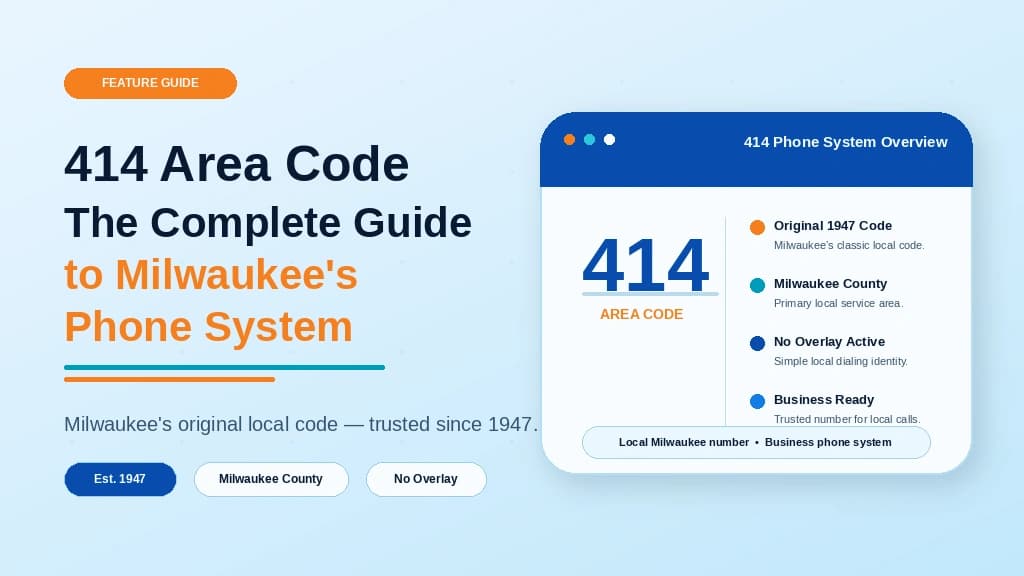
As of 2026, the 414 area code remains the primary telecommunications identifier for Milwaukee County, Wisconsin, encompassing the City of Milwaukee and its immediate suburbs like Wauwatosa, West Allis, and Oak Creek. It is one of the original North American area codes established in 1947 and serves as a significant cultural and economic anchor for Southeast Wisconsin.
The 414 area code is more than just a sequence of numbers for routing telephone calls; it is a geographic badge of identity for the "Cream City" and its surrounding municipalities. In a world where mobile numbers are increasingly portable and decoupled from physical locations, the 414 prefix continues to signal a deep-rooted connection to the industrial heart and cultural soul of Wisconsin. Understanding its history, geographic boundaries, and the technical requirements for dialing is essential for residents, business owners, and visitors alike.
The Historical Significance of Area Code 414
The story of the 414 area code begins in 1947, when the North American Numbering Plan (NANP) was first implemented by AT&T and the Bell System. At its inception, 414 was one of the original 86 area codes and originally covered the entire southern and northeastern portions of Wisconsin. This vast territory included not just Milwaukee, but also Madison, Racine, Kenosha, Green Bay, and the Fox Valley.
As Wisconsin’s population and industrial output grew during the post-war era, the demand for new telephone lines surged. This necessitated several "splits" to the original 414 territory:
- The 1955 Split: The western portion of the 414 territory was carved out to create the 608 area code, serving Madison and the southwestern part of the state.
- The 1997 Split: Rapid growth in the Fox Valley and Green Bay regions led to the creation of the 920 area code. This significantly reduced the 414 footprint to the southeastern corner of the state.
- The 1999 Split: Just two years after the 920 split, the explosion of cell phones, pagers, and dial-up internet modems threatened to exhaust the 414 supply again. This led to the creation of the 262 area code, which took over the "WOW" counties (Waukesha, Ozaukee, and Washington) as well as Racine and Kenosha counties.
Following the 1999 split, the 414 area code was localized almost exclusively to Milwaukee County. This concentrated focus has allowed the number to become synonymous with the urban identity of Milwaukee itself.
Geographic Coverage and Municipalities
While often referred to simply as the "Milwaukee area code," 414 covers a dense collection of municipalities within Milwaukee County. It is unique in Wisconsin for its compact, high-density coverage.
Principal Cities and Communities
- Milwaukee: The largest city in the state and the primary anchor of the area code.
- Wauwatosa: Located immediately west of Milwaukee, known for its medical center and vibrant village area.
- West Allis: A historic industrial and residential hub.
- Shorewood and Whitefish Bay: Affluent North Shore communities along Lake Michigan.
- Oak Creek and Franklin: Rapidly growing southern suburbs with a mix of residential and commercial development.
- Cudahy, St. Francis, and South Milwaukee: The "South Shore" communities with strong working-class roots.
- Greenfield and Greendale: Central and southwestern suburban residential areas.
It is important to note that a few very small slivers of neighboring counties might still route through 414 exchanges due to historical wireline boundaries, but for 99% of users, 414 equals Milwaukee County.
Technical Requirements: 10-Digit Dialing and the 988 Transition
For decades, residents within the 414 area code enjoyed the convenience of 7-digit local dialing. However, a major shift occurred recently that changed how Milwaukeeans interact with their phones.
In 2020, the Federal Communications Commission (FCC) designated 988 as the 3-digit dialing code for the National Suicide Prevention Lifeline. For 988 to work as a shortcut, any area code that used "988" as a central office prefix (the middle three digits of a 7-digit number) was required to transition to 10-digit dialing. Because 414 had active numbers beginning with 988, the transition became mandatory.
As of 2026, all local calls made from a 414 number must include the area code (e.g., 414-XXX-XXXX). This change was finalized nationally by mid-2022. Failure to use the 10-digit format usually results in an intercepted recording informing the caller that the call cannot be completed as dialed.
Comparing 414 to Surrounding Wisconsin Area Codes
To understand the 414 area code, one must understand its relationship with its neighbors. Southeast Wisconsin is a patchwork of different prefixes that reflect the state's development.
| Area Code | Primary Region | Major Cities Served | Established/Split Year |
|---|---|---|---|
| 414 | Milwaukee County | Milwaukee, West Allis, Wauwatosa | 1947 (Original) |
| 262 | Southeastern WI (Suburbs) | Waukesha, Racine, Kenosha, Mequon | 1999 (Split from 414) |
| 920 | Northeastern WI | Green Bay, Appleton, Oshkosh, Sheboygan | 1997 (Split from 414) |
| 608 | Southwestern WI | Madison, La Crosse, Beloit | 1955 (Split from 414) |
| 715 / 534 | Northern WI | Eau Claire, Wausau, Superior | 1947 / 2010 (Overlay) |
The distinction between 414 and 262 is particularly sharp in the local culture. The "262" area code covers the wealthier, more suburban counties surrounding Milwaukee. This geographic divide often surfaces in discussions about regional transit, politics, and economics.
Cultural Identity: The "414 Day" Phenomenon
In Milwaukee, 414 is more than a utility; it is a brand. This is most evident in the celebration of Milwaukee Day, which takes place every year on April 14th (4/14).
The grassroots holiday began in the early 2010s as a way to celebrate local music, art, and business. Since then, it has grown into an official city-wide event. Local businesses offer specials priced at $4.14, and the "414" logo—originally designed by local entrepreneur Fred Gillich—has become a ubiquitous symbol on t-shirts, flags, and even tattoos.
For businesses, having a 414 area code is a strategic choice. It signals that the company is "Milwaukee-made" and physically present in the community. Many modern businesses that rely on VoIP (Voice over Internet Protocol) services specifically request 414 numbers to maintain this local credibility, even if their physical office is technically across the county line.
Obtaining and Managing a 414 Number
As we move through 2026, the availability of new 414 numbers has become more constrained. Because the area code is geographically limited to one county and has not yet received an "overlay" (a second area code covering the same region), the pool of available 7-digit combinations is finite.
How to Get a 414 Number
- Mobile Carriers: Most major carriers (Verizon, AT&T, T-Mobile) still have blocks of 414 numbers. When starting a new line in Milwaukee, you can typically request one, though availability may vary by specific exchange.
- VoIP Services: Providers like Google Voice, RingCentral, and Grasshopper allow users to search for specific area codes. This is a popular option for entrepreneurs who want a professional Milwaukee presence on their existing mobile devices.
- Number Porting: Under FCC rules, you can "port" or move your number between carriers. If you move from Milwaukee to another city, you can generally keep your 414 number, allowing you to maintain your "Milwaukee identity" regardless of where you live.
The Threat of Scams and Spoofing
Like many high-density area codes, 414 is frequently targeted by "neighbor spoofing." This is a tactic used by robocallers where the caller ID displays a 414 number to increase the likelihood that a local resident will answer. Experts recommend using call-blocking apps or carrier-provided services (like T-Mobile’s Scam Shield or AT&T ActiveArmor) to filter these calls. Always remember that government agencies like the IRS or the Social Security Administration will never call and demand immediate payment via gift cards, regardless of the area code displayed.
Future Outlook: Will 414 Run Out of Numbers?
According to the North American Numbering Plan Administrator (NANPA), every area code has an "exhaustion date"—the projected time when all possible prefixes within that code will be assigned.
For many years, 414 was on the verge of exhaustion. However, more efficient number pooling (where carriers return unused blocks of numbers to the central pool) has extended its life. As of current 2026 projections, 414 is expected to remain stable for several more years. If exhaustion does eventually occur, the Wisconsin Public Service Commission (PSC) would likely implement an overlay area code.
In an overlay scenario, a new area code would be assigned to the same geographic area as 414. Existing 414 users would keep their numbers, but new customers would be assigned the new prefix. This would not change the geographic boundaries but would permanently cement 10-digit dialing as the absolute standard.
Frequently Asked Questions
Is the 414 area code only for the city of Milwaukee?
No. While it is the primary code for the city, it also covers all of Milwaukee County. This includes suburbs like Wauwatosa, West Allis, Greenfield, Shorewood, Glendale, and Oak Creek. It does not, however, cover the adjacent counties of Waukesha, Ozaukee, or Washington, which use the 262 area code.
Do I have to dial "1" before 414 when calling from a local mobile phone?
Generally, no. On mobile phones, you simply dial the 10 digits (414-XXX-XXXX). On many landline systems, you may need to dial "1" before the area code for "long-distance" calls, although the distinction between local and long-distance is increasingly irrelevant in modern flat-rate calling plans.
What happened to the 414 numbers in Waukesha?
In 1999, Waukesha County (along with several others) was split away from the 414 area code and moved to the 262 area code. At the time, this was a controversial move, as many businesses had to reprint stationery and update signage. Today, the boundary between 414 and 262 is a well-recognized dividing line between the urban/inner-suburban core and the outer suburbs.
Can I get a 414 number if I live in another state?
Yes, through various VoIP and digital phone services. Many former Milwaukee residents choose to keep their 414 numbers when they move to stay connected to their roots. Similarly, businesses located elsewhere that do significant work in Milwaukee often acquire a 414 number to appear local to their clients.
Is 414 a "toll" call from 262 or 920?
In the era of modern smartphones and unlimited talk plans, the concept of a "toll call" has largely disappeared for the average consumer. However, for some legacy landline services, calling between 414 and 262 may still be classified as "regional long distance," depending on the specific service provider and plan.
Practical Recommendations for Residents and Businesses
Whether you are moving to the Milwaukee area or looking to establish a business presence there, the 414 area code is a valuable asset. Here are a few final tips:
- For Businesses: If you are targeting customers in Milwaukee County, prioritize obtaining a 414 number. It builds immediate trust and local relevance that a toll-free 800 number or an out-of-state area code cannot match.
- For New Residents: If you are setting up a new mobile plan, don't settle for whatever number the system auto-generates. Ask the representative specifically for a 414 prefix to ensure you fit into the local community's digital ecosystem.
- For Everyone: Ensure all your stored contacts are saved in the 10-digit format (Area Code + Number). This prevents call failures and ensures that features like "Siri" or "Google Assistant" can dial correctly while you are driving.
The 414 area code is a rare example of a technical utility that has transformed into a cultural icon. As Milwaukee continues to evolve in 2026 and beyond, this three-digit prefix will remain a constant reminder of the city's place in the history of American communication and its enduring regional identity.