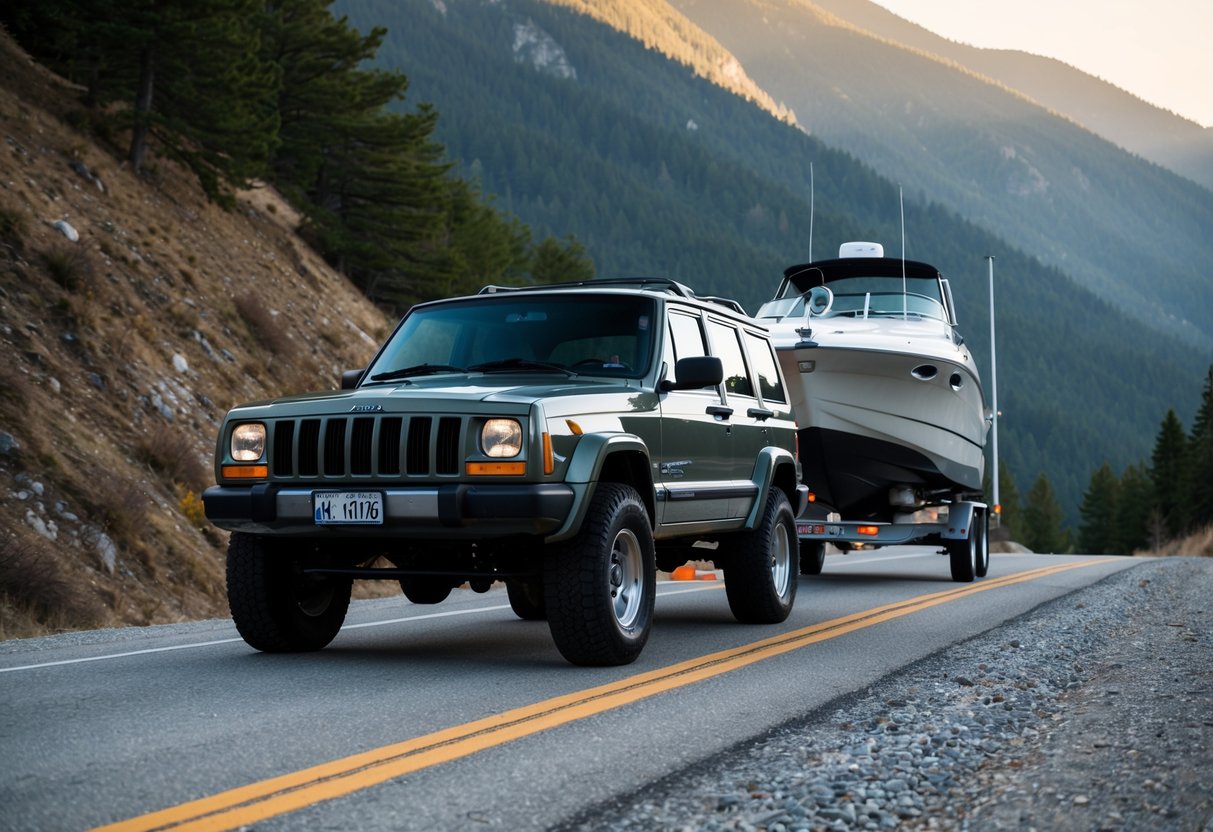
The maximum towing capacity of a 1999 Jeep Cherokee (XJ) ranges from 2,000 to 5,000 pounds, depending on the engine, transmission, and optional equipment installed. To reach the 5,000-pound limit, the vehicle must be equipped with the 4.0L Inline-6 engine, an automatic transmission, and the factory-installed Heavy Duty Towing Package.
The 1999 Jeep Cherokee remains a favorite among off-road enthusiasts and vintage SUV collectors. However, because these vehicles are now nearly three decades old, understanding their trailering limits requires a look at both the original engineering specifications and the practical realities of operating an aging unibody vehicle in 2026. This guide breaks down the specific ratings, necessary equipment, and safety considerations for towing with a classic XJ.
Understanding the Base and Maximum Towing Ratings
The 1999 Jeep Cherokee was offered with two distinct powertrain configurations, and the difference in their towing capability is substantial. Because the Cherokee uses a unibody construction (UniFrame) rather than a traditional body-on-frame design, its structural integrity and cooling capacity are the primary bottlenecks for heavy loads.
The 2.5L Inline-4 Engine
The base 2.5L four-cylinder engine was primarily designed for fuel economy and light-duty commuting. It produces approximately 125 horsepower and 150 lb-ft of torque. Due to the limited power and the lighter-duty cooling systems typically paired with this engine, the towing capacity is strictly limited to 2,000 pounds. Attempting to pull more than this with the 4-cylinder model often leads to engine overheating and premature clutch or transmission failure.
The 4.0L Inline-6 Engine
The legendary 4.0L "PowerTech" I6 is the engine of choice for any towing task. Producing 190 horsepower and 225 lb-ft of torque, this engine provides the low-end grunt necessary to move a trailer from a standstill.
- Standard 4.0L Rating: Without the specialized towing package, the 4.0L Cherokee is generally rated for 2,000 pounds.
- Maximum 4.0L Rating: With the factory Heavy Duty Towing Package and an automatic transmission, the rating jumps to 5,000 pounds.
Manual vs. Automatic Transmission
Crucially, Jeep restricted the 5,000-pound maximum rating to vehicles equipped with the AW4 four-speed automatic transmission. While the AX-15 and NV3550 manual transmissions are robust, the clutch surface area and the potential for driver error during hill starts under heavy load led Chrysler to cap manual transmission towing at 2,000 pounds, regardless of the engine. The automatic transmission includes a torque converter that can better manage the stresses of heavy loads, provided it is kept cool.
The Heavy Duty Towing Package: Essential Components
To safely reach the 5,000-pound threshold, several mechanical upgrades were included in the factory towing package. If you are looking at a 1999 Cherokee today that lacks these features, you must install them as aftermarket upgrades before attempting to tow a heavy trailer.
1. Auxiliary Transmission Oil Cooler
The AW4 automatic transmission is known for its durability, but heat is its primary enemy. When towing 5,000 pounds, the transmission generates significantly more heat than during normal driving. The towing package included an external oil-to-air cooler mounted in front of the radiator. Without this, the transmission fluid can oxidize quickly, leading to internal slipping and eventual failure.
2. Heavy-Duty Cooling System
Towing puts an immense thermal load on the engine. The 1999 Cherokee's engine bay is notoriously cramped, which can lead to heat soak issues. The tow package upgraded the radiator to a higher-capacity unit and often included a different fan clutch or an auxiliary electric fan to ensure consistent airflow at low speeds.
3. Class III Receiver Hitch and Wiring
A standard bumper hitch is never sufficient for more than 1,000–2,000 pounds. A frame-mounted Class III receiver hitch is required to distribute the tongue weight across the rear section of the UniFrame. Furthermore, the 1999 model requires a 7-way wiring harness if the trailer is equipped with electric brakes, which is mandatory for trailers over 2,000 pounds in most jurisdictions.
4. 3.55 or 3.73 Axle Gearing
The gear ratio in the differential plays a vital role in how easily the Jeep can move a load. Most 4.0L automatics came with 3.55 gears, which are adequate for the 5,000-pound rating. However, some special editions or those with the Up-Country suspension package might have had different ratios. If you have installed larger tires (31 inches or larger) on your 1999 Cherokee, your effective gear ratio has decreased, and your towing capacity is significantly compromised unless you have re-geared the differentials.
1999 Jeep Cherokee Towing Specifications Table
The following table summarizes the maximum weight ratings based on the powertrain configuration for the 1999 model year.
| Engine | Transmission | Max Towing Capacity | Max Tongue Weight |
|---|---|---|---|
| 2.5L I4 | 5-Speed Manual | 2,000 lbs | 200 lbs |
| 2.5L I4 | 3-Speed Automatic | 2,000 lbs | 200 lbs |
| 4.0L I6 | 5-Speed Manual | 2,000 lbs | 200 lbs |
| 4.0L I6 | 4-Speed Automatic | 2,000 lbs (Standard) | 200 lbs |
| 4.0L I6 | 4-Speed Automatic | 5,000 lbs (w/ Tow Package) | 500 lbs |
Note: All towing over 2,000 lbs requires a weight-distributing hitch and trailer brakes.
Weight Definitions and Safety Limits
When calculating your load, you must look beyond the "towing capacity" number. There are several other weight ratings that dictate the safety of your setup.
Gross Vehicle Weight Rating (GVWR)
The GVWR is the maximum allowable weight of the Jeep itself, including fuel, passengers, cargo, and the tongue weight of the trailer. For a 1999 Cherokee, the GVWR is typically around 4,900 pounds. If you have heavily armored your Jeep with steel bumpers, winches, and rock sliders, you have significantly reduced the remaining payload capacity for passengers and trailer tongue weight.
Gross Combined Weight Rating (GCWR)
The GCWR is the total weight of the loaded Jeep plus the loaded trailer. For a 4.0L automatic with the tow package, the GCWR is approximately 9,000 pounds. Exceeding this limit places dangerous levels of stress on the braking system and the structural welds of the unibody.
Tongue Weight
Tongue weight should be between 10% and 15% of the total trailer weight. For a 5,000-pound trailer, that means 500 pounds of downward force on the hitch. Because the Cherokee has a relatively soft leaf-spring rear suspension, 500 pounds will cause significant "squat," which lifts the front wheels and reduces steering traction. Using a weight-distributing hitch is highly recommended for any trailer over 3,500 pounds to level the vehicle.
Practical Considerations for Towing in 2026
As of 2026, the youngest 1999 Jeep Cherokee is 27 years old. Time and mileage change the math regarding towing safety. Before hitching a trailer to an XJ today, several critical maintenance areas must be addressed.
Unibody Integrity and Corrosion
The Cherokee does not have a separate steel frame. The hitch is bolted directly to the "frame rails" which are part of the floor pan. In regions where road salt is used, these rails are prone to internal rusting. A hitch bolted to weakened metal can tear away under the stress of a 5,000-pound load. A thorough inspection of the rear floor pan and "frame" sections is mandatory.
Braking Performance
The stock braking system of the 1999 Cherokee consists of front discs and rear drums. Even in 1999, these brakes were considered just "adequate." When towing, the Jeep's brakes are not designed to stop the trailer; the trailer must have its own braking system. In 2026, many owners upgrade to rear disc brakes (often sourced from a Jeep Grand Cherokee ZJ or WJ) to improve stopping power and heat dissipation.
Rear Suspension Sag
The factory leaf springs on the Cherokee are known to sag over time, even without a trailer. Towing with worn-out springs is dangerous, as it leads to unpredictable handling and bottoming out over bumps. If you plan to tow, consider upgrading to heavy-duty leaf springs or adding a "helper" leaf. Avoid using "air shocks" to fix sag, as they put too much stress on the upper shock mounts, which are not designed to carry the vehicle's weight.
Modern Tire Standards
Ensure your tires have the correct Load Range for towing. While "C" rated tires are common for off-roading, "D" or "E" rated tires provide stiffer sidewalls, which reduces the "swaying" sensation when a trailer is pushed by crosswinds or passing semi-trucks.
Critical Equipment for Safe Operation
If you intend to utilize the full 5,000-pound capacity, the following aftermarket additions are essentially required for modern safety standards:
- Electronic Brake Controller: This is a device mounted in the cab that activates the trailer's electric brakes. Without this, a 5,000-pound trailer will likely push the Jeep through an intersection during an emergency stop.
- Sway Control Bar: The Cherokee has a short 101.4-inch wheelbase. Short-wheelbase vehicles are more susceptible to "trailer sway," where the trailer begins to oscillate side-to-side. A friction-based sway control bar is a low-cost way to prevent a potential rollover.
- Extended Side Mirrors: The Cherokee is a narrow vehicle. Standard side mirrors will not allow you to see down the side of an 8-foot-wide trailer. Clip-on or replacement towing mirrors are necessary for lane changes.
- Temperature Gauge: Installing an aftermarket transmission temperature gauge allows you to monitor the health of the AW4 in real-time. If you see temperatures climbing above 220°F, you know it is time to pull over and let the system cool.
Common Pitfalls and Troubleshooting
Overheating on Inclines: If your Cherokee starts to overheat while towing uphill, the first step is to turn off the air conditioning and turn on the cabin heater to maximum. This acts as a secondary radiator. If the problem persists, your radiator may be clogged internally with scale, or your water pump impeller may be worn.
Transmission "Hunting": The AW4 transmission may "hunt" between 3rd gear and Overdrive (4th) when towing. This creates excessive heat. It is standard practice to tow in "3" rather than "D" (Overdrive) when on hilly terrain or when the trailer weight exceeds 2,000 pounds. This keeps the engine in its power band and prevents the torque converter from constantly locking and unlocking.
Rear End Sway: If the trailer feels like it is "steering" the Jeep, you likely have too little tongue weight. Ensure the trailer is loaded with more weight toward the front (in front of the trailer axle). If the Jeep feels light in the front, you have too much tongue weight and need a weight-distributing hitch.
Frequently Asked Questions
Can a 1999 Jeep Cherokee tow a car trailer?
Yes, but with caveats. A typical aluminum car hauler weighs about 1,500 pounds, and a small car weighs 2,500–3,000 pounds, putting you right at the 4,000–4,500 pound mark. This is within the 5,000-pound limit of a 4.0L automatic with a tow package, but it requires a brake controller and extreme caution due to the Jeep's light weight compared to the load.
What happens if I tow 5,000 lbs with a manual transmission?
The primary risk is burning out the clutch. The 1999 manual transmissions (AX-15 or NV3550) are strong, but the clutch is the weak link. Additionally, the lack of a torque converter makes it very difficult to start on a hill without excessive slipping, which can overheat the flywheel and pressure plate quickly.
Is the 2-door Cherokee towing capacity different from the 4-door?
No. Both the 2-door and 4-door models share the same wheelbase, frame structure, and engine options. The towing capacity is determined by the powertrain and the presence of the towing package, not the number of doors.
Can I add the 5,000 lb tow capacity to a Jeep that didn't have it?
Technically, yes. You would need to install a Class III hitch, a large auxiliary transmission cooler, a heavy-duty radiator, and ensure you have the 4.0L engine with an automatic transmission. You should also verify your axle gearing; if you have 3.07 gears (common in some manuals), you will struggle to pull 5,000 pounds even with the other upgrades.
Final Recommendations
The 1999 Jeep Cherokee is a capable small tower, but it is not a heavy-duty truck. To safely tow with an XJ in 2026:
- Verify your equipment: Ensure you have the 4.0L engine, the AW4 automatic transmission, and an external transmission cooler.
- Inspect the structure: Check the rear unibody rails for rust before mounting a hitch.
- Stay within limits: While 5,000 pounds is the "max," the Jeep is much more comfortable and safer at or below 3,500 pounds.
- Equip for safety: Never tow more than 2,000 pounds without trailer brakes and a dedicated brake controller.
If you plan to tow frequently, upgrading the cooling system and the rear leaf springs will significantly improve the experience and longevity of your vehicle.