The primary key feature of whole life insurance is its cash value component, a living benefit that accumulates over time on a tax-deferred basis. Unlike term insurance, which only provides a death benefit for a set period, whole life insurance functions as a permanent financial asset that can be accessed during the policyholder's lifetime.
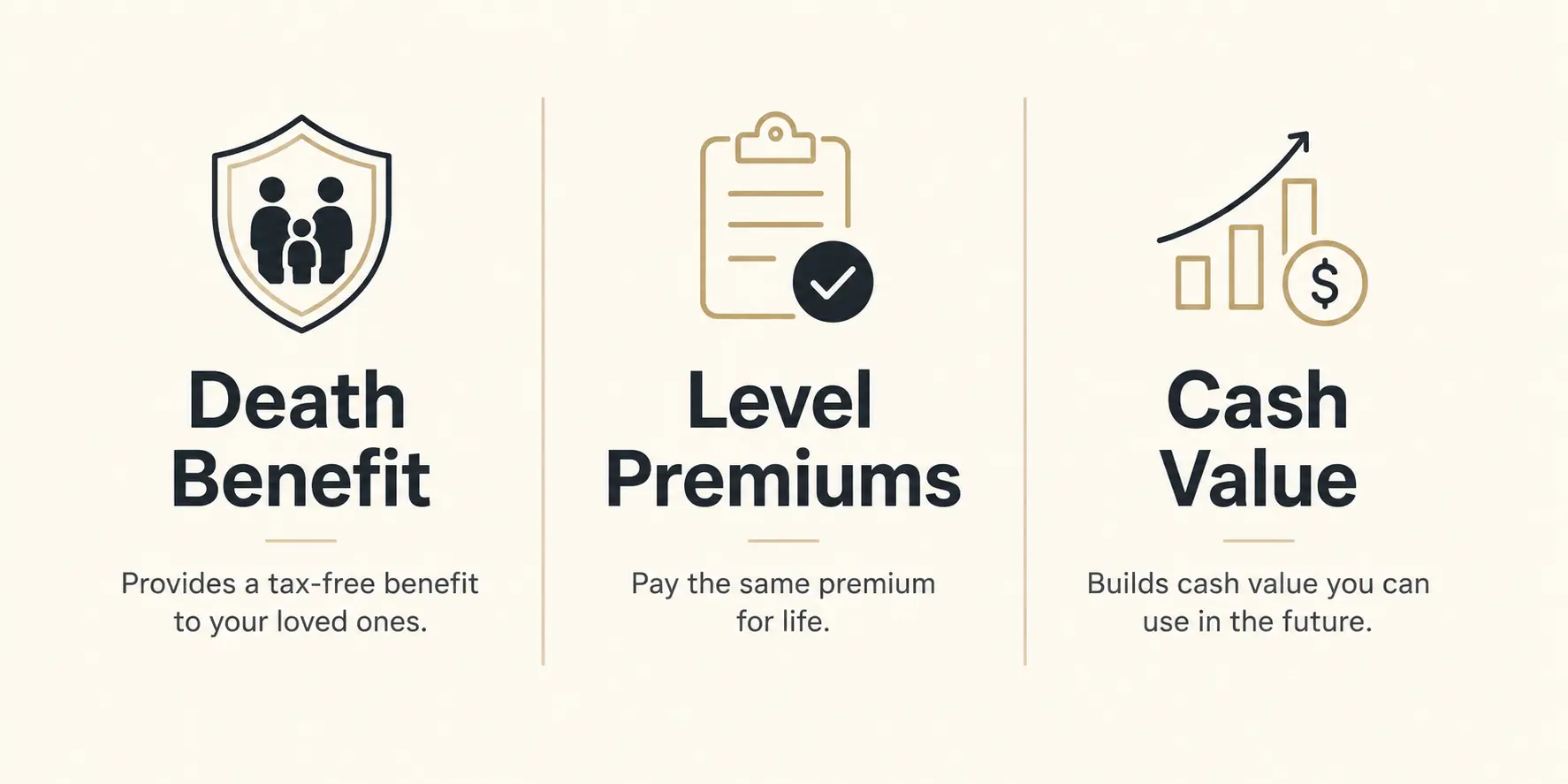
Whole life insurance is often categorized as "permanent" life insurance because it is designed to remain in force for the duration of the insured’s life, provided premiums are paid. While the guaranteed death benefit and level premiums are foundational, the cash value is what distinguishes whole life from simpler risk-management products. In 2026, as financial markets continue to exhibit volatility, the guaranteed growth and liquidity of this cash value remain a cornerstone of conservative estate planning and wealth preservation strategies.
Understanding the Mechanics of Cash Value Accumulation
The cash value of a whole life policy does not appear overnight. It is a mathematical byproduct of the policy's structure. When you pay a premium for a whole life policy, the insurance company allocates those funds into three primary buckets: the cost of insurance (mortality charges), administrative expenses and commissions, and the cash value account.
In the early years of a policy, a significant portion of the premium is directed toward the cost of insurance and the high upfront administrative costs of establishing the contract. Consequently, the cash value grows slowly during the first five to ten years. However, as the policy matures, the compounding effect takes over. Because whole life premiums are "level" (meaning they stay the same for life), the policyholder effectively overpays for the risk of death in their younger years to subsidize the much higher risk of death in their later years. This excess premium is what fuels the cash value growth.
Guaranteed vs. Non-Guaranteed Growth
A hallmark of whole life insurance is the guaranteed minimum interest rate. The insurance company contractually promises that the cash value will grow by at least a certain percentage every year, regardless of the performance of the stock market or the broader economy. This makes it a "non-correlated" asset, meaning its value does not fluctuate with the S&P 500 or Nasdaq.
Beyond the guarantees, many policies—specifically those issued by "mutual" insurance companies—are participating policies. This means the policyholders are eligible to receive dividends. While dividends are not guaranteed, many major insurers have paid them every year for over a century. These dividends can be used to purchase "paid-up additions," which further increase the cash value and the total death benefit, creating a powerful compounding engine over several decades.
Methods for Accessing Your Cash Value
One of the most practical reasons for the popularity of the cash value feature is the flexibility it provides the policyholder. You do not have to die to receive value from your whole life policy. In 2026, with evolving banking regulations and lending environments, having a "private reserve" of capital can be a significant strategic advantage.
Policy Loans
The most common way to access cash value is through a policy loan. Unlike a bank loan, there is no credit check, no lengthy application process, and no required repayment schedule. You are essentially borrowing against the death benefit of your own policy, using the cash value as collateral.
When you take a policy loan:
- The insurance company continues to credit interest (and potentially dividends) to the full cash value, even the portion you have "borrowed."
- The insurer charges a loan interest rate, which is often lower than commercial unsecured loan rates.
- If you die with an outstanding loan, the balance is simply deducted from the death benefit paid to your beneficiaries.
Partial Withdrawals and Surrenders
Policyholders can also choose to withdraw cash directly. Up to the "cost basis" (the total amount of premiums paid into the policy), these withdrawals are generally tax-free. However, unlike a loan, a withdrawal permanently reduces the cash value and the death benefit.
If the policy is no longer needed, the owner can "surrender" the policy entirely. The insurance company will pay out the net cash surrender value (the total cash value minus any outstanding loans or surrender charges). While this ends the insurance coverage, it provides a lump sum that can be used for retirement or other major life expenses.
The Role of Dividends in Enhancing Value
For many, the true power of the cash value feature is unlocked through dividends. When an insurance company performs better than expected—by having lower mortality costs than projected, managing expenses efficiently, or earning higher returns on its investment portfolio—it distributes a portion of those profits to participating policyholders.
There are several ways to utilize these dividends:
- Paid-Up Additions (PUA): This is generally the most efficient choice for wealth building. The dividend is used to buy a small "mini-policy" that is fully paid for. This increases the total death benefit and immediately adds to the total cash value, which then earns more dividends in the future.
- Premium Reduction: The dividend is applied toward the annual premium, reducing the policyholder’s out-of-pocket costs.
- Cash Payments: The insurer sends the policyholder a check for the dividend amount.
- Accumulate at Interest: The dividends are left in a separate account within the company to earn interest, similar to a savings account.
Technical Comparison: Whole Life vs. Term Life Features
To understand why the cash value is considered the "key" feature, it is helpful to compare it to the standard term life structure.
| Feature | Whole Life Insurance | Term Life Insurance |
|---|---|---|
| Duration of Coverage | Permanent (for life) | Temporary (e.g., 10, 20, or 30 years) |
| Premium Structure | Level (Fixed for life) | Level during term; increases sharply after |
| Cash Value | Yes (Builds equity over time) | No (Pure insurance protection) |
| Tax Advantages | Tax-deferred growth; Tax-free loans | None (unless linked to a health account) |
| Dividend Potential | Yes (Participating policies) | No |
| Policy Loans | Available after 1-3 years | Not available |
| Complexity | High (Requires financial planning) | Low (Simple risk management) |
Tax Advantages and the Modified Endowment Contract (MEC)
The tax treatment of the cash value feature is governed by the Internal Revenue Code (specifically Section 7702). Under these rules, the growth of the cash value is not taxed as it accumulates. This allows for "triple compounding": you earn interest on your principal, interest on your interest, and interest on the money that would have otherwise gone to the government in taxes.
However, there is a limit to how much money you can "stuff" into a policy. If the premium payments exceed certain limits—known as the 7-pay test—the policy becomes a Modified Endowment Contract (MEC). If a policy is classified as a MEC, it loses many of its tax advantages. For example, loans and withdrawals from a MEC are taxed on a "last-in, first-out" (LIFO) basis, meaning the growth is taxed first, and a 10% penalty may apply if the owner is under age 59½.
In 2026, most insurance companies use automated systems to monitor these limits, but it remains a critical technical detail for high-net-worth individuals using whole life for tax-efficient wealth storage.
Strategic Uses of Whole Life in 2026
In the current financial landscape, the cash value feature serves several strategic purposes beyond simple life insurance.
The "Volatility Buffer" in Retirement
Retirees often face "sequence of returns risk"—the danger of a market downturn occurring just as they begin taking withdrawals from their 401(k) or IRA. If the stock market drops, a retiree with a whole life policy can pause their market-based withdrawals and instead take a loan from their policy's cash value. This gives their equity portfolio time to recover without being forced to sell assets at a loss.
Business Planning and Key Person Insurance
Many businesses use whole life insurance to fund buy-sell agreements or to provide "Golden Handshake" executive benefits. The cash value sits on the company's balance sheet as an asset, providing liquidity for the business while simultaneously insuring the life of a key employee or partner.
Estate Liquidity
For families with significant illiquid assets, such as real estate or a family business, the cash value and eventual death benefit of a whole life policy provide the liquidity needed to pay estate taxes or equalize inheritances among heirs without forcing a fire sale of the family’s legacy assets.
Common Pitfalls and Considerations
While the cash value is a powerful feature, it is not without its complexities. Prospective buyers should be aware of the following:
- Surrender Charges: If you cancel the policy in the first few years, the "surrender value" may be zero or significantly less than the total premiums paid. Whole life is a long-term commitment.
- Loan Interest: While policy loans are flexible, the interest does accrue. If left unpaid, the interest can compound, potentially eating into the death benefit or, in extreme cases, causing the policy to lapse (which could trigger a significant tax bill).
- Opportunity Cost: The internal rate of return (IRR) on the cash value of a whole life policy is generally lower than the long-term historical returns of the stock market. It should be viewed as a bond-alternative or a cash-equivalent asset, not as a replacement for high-growth equity investments.
Eligibility and Requirements
To secure a whole life policy with a robust cash value feature, applicants must undergo medical underwriting. The cost of the insurance (and thus the efficiency of the cash value growth) is determined by the insured's age, health, and lifestyle.
- Application: Detailed health history and financial information.
- Medical Exam: In 2026, many companies use "accelerated underwriting" which uses data algorithms to bypass physical exams for healthy applicants, but a paramedical exam (blood, urine, vitals) is still common for large death benefits.
- Policy Issue: Once approved, the policyholder must commit to the premium schedule to ensure the cash value builds as illustrated.
The National Association of Insurance Commissioners (NAIC) provides resources for consumers to verify the financial strength of insurance companies, which is vital since the cash value guarantees are only as strong as the company making them.
FAQs
Can I lose the cash value if the stock market crashes?
No. The cash value in a traditional whole life insurance policy is guaranteed by the insurance company and is not directly invested in the stock market. It will not decrease in value due to market fluctuations, making it one of the most stable assets in a financial portfolio.
Is the cash value paid out in addition to the death benefit?
Generally, no. In a standard whole life policy, the beneficiaries receive the face amount (death benefit) of the policy, and the cash value is kept by the insurance company. However, if you use dividends to buy paid-up additions, both your cash value and your death benefit increase over time.
How long does it take for the cash value to equal the premiums paid?
This is known as the "break-even point." Depending on the policy's design and the company's dividend performance, the break-even point typically occurs between years 8 and 15. Policies designed specifically for high early cash value may break even sooner but might have lower long-term growth.
Can I stop paying premiums and keep the cash value?
Yes, through a feature called "Reduced Paid-Up Insurance." If you can no longer afford the premiums, you can use the existing cash value to "buy" a smaller death benefit that is fully paid for. This stops the premium requirement while keeping a portion of the coverage and cash value in place.
Are policy loans really tax-free?
Yes, as long as the policy remains in force. Because a loan is not considered income by the IRS, you do not pay taxes on the money you receive. However, if the policy lapses or is surrendered while there is an outstanding loan balance that exceeds your cost basis, that "forgiven" loan amount may be treated as taxable income.
Final Recommendation
For those seeking a combination of permanent protection and a conservative, tax-advantaged savings vehicle, the cash value feature of whole life insurance is an invaluable tool. Before committing, ensure you review a "full ledger illustration" which shows the projected cash value growth year-by-year. In 2026, it is advisable to work with a specialized financial professional who understands "high-cash-value" designs to ensure the policy is structured for maximum efficiency rather than just maximum death benefit.