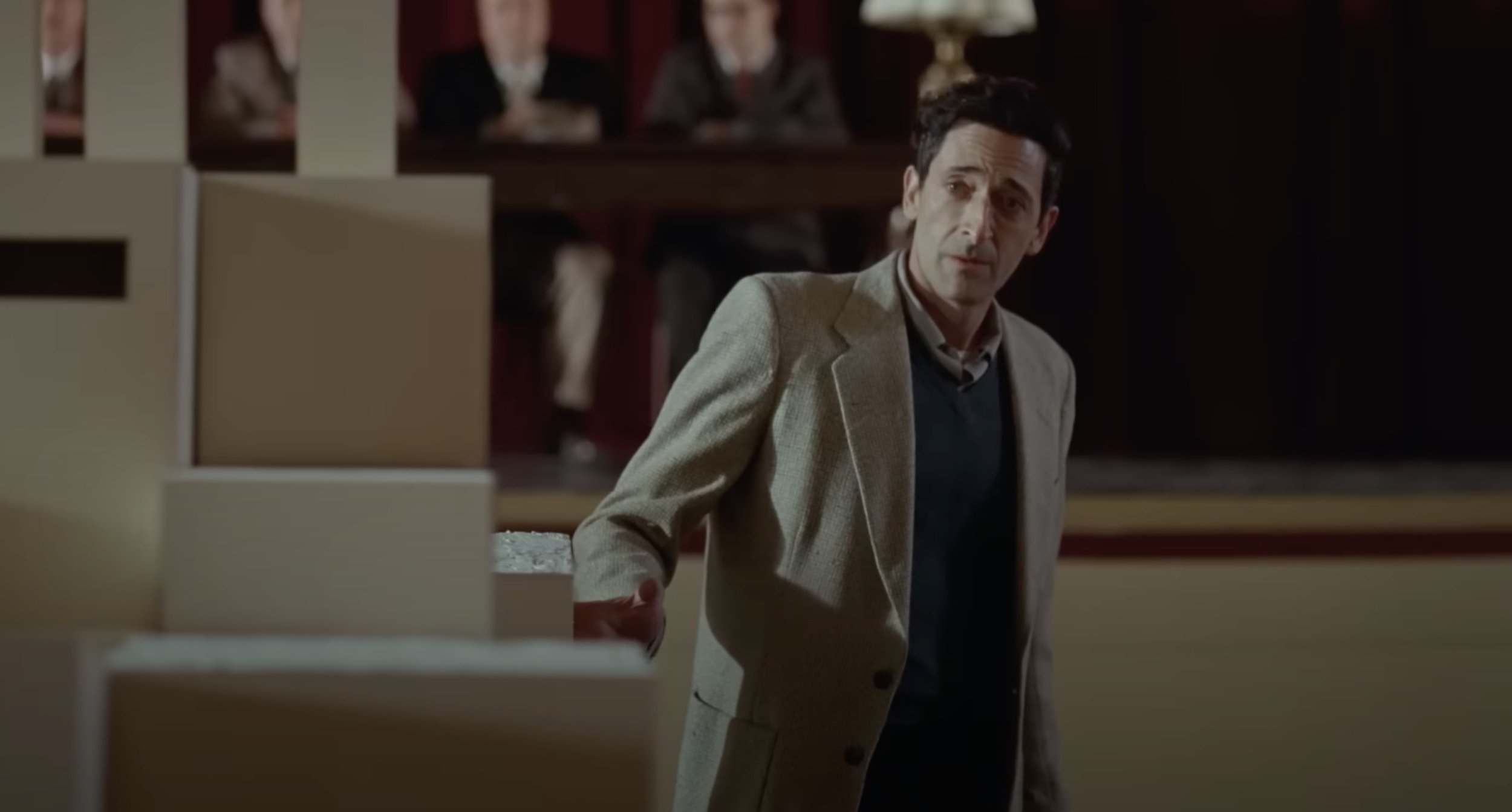
Adrien Brody stars as László Tóth in Brady Corbet’s The Brutalist, a 215-minute historical epic chronicling a Hungarian architect’s three-decade struggle in post-war America. Shot on 70mm VistaVision, the film is a technical masterpiece that explores immigration, architectural ambition, and the lasting scars of the Holocaust through a fictional yet deeply resonant lens.
The Magnitude of Adrien Brody’s Portrayal of László Tóth
In the landscape of 21st-century cinema, few performances have commanded as much gravity as Adrien Brody’s turn in The Brutalist. As we look back from 2026, the film has solidified its place as a cornerstone of modern epic filmmaking. Brody, who previously achieved historical acclaim for The Pianist (2002), finds a spiritual and professional companion piece in the character of László Tóth.
Tóth is a visionary Hungarian-Jewish architect who survives the horrors of the Holocaust and arrives in the United States in 1947. Unlike many immigrant stories that focus solely on the "rags-to-riches" trope, The Brutalist examines the friction between artistic purity and the demands of American capitalism. Brody portrays Tóth not as a saintly victim, but as a complex, often difficult man whose genius is inseparable from his trauma. The actor utilizes his physical presence—his angular features and expressive eyes—to convey a man who is literally and figuratively trying to rebuild a world that has been pulverized.
The performance requires a massive emotional range, covering thirty years of the character's life. Brody navigates the transition from a desperate, starving immigrant in Pennsylvania to an architect tasked with building a monumental community center for a wealthy, erratic benefactor. His chemistry with Felicity Jones, who plays his wife Erzsébet, provides the film's emotional heartbeat, illustrating a marriage strained by distance, illness, and the shared burden of survival.
Narrative Structure and the Epic Scale of Brady Corbet’s Vision
Directed by Brady Corbet and co-written with Mona Fastvold, The Brutalist is notable for its audacious scale. Clocking in at three hours and thirty-five minutes, the film includes a built-in 15-minute intermission, a rarity in contemporary cinema that recalls the grand mid-century epics like Lawrence of Arabia or Ben-Hur.
The narrative is divided into distinct chapters, tracking the construction of a massive, brutalist-style library and community center commissioned by Harrison Lee Van Buren (played by Guy Pearce). The project becomes Tóth’s obsession and his curse. The film does not shy away from the technicalities of architecture; it treats the act of building as a philosophical endeavor.
Corbet utilizes the 70mm VistaVision format to capture both the intimacy of the characters’ faces and the overwhelming scale of the industrial American landscape. The cinematography by Lol Crawley emphasizes the "Brutalist" aesthetic—raw concrete, sharp angles, and monumental shadows—mirroring the internal state of a protagonist who refuses to soften his edges for a society that views him as an outsider.
The Significance of the Brutalist Aesthetic
To understand the film, one must understand the architectural movement it is named after. Brutalism, which flourished from the 1950s to the 1970s, is characterized by "béton brut" (raw concrete). It was a movement often associated with social utopianism—an attempt to create honest, functional structures for the masses.
In the context of the film, Brutalism serves several functions:
- Metaphor for Survival: Just as concrete is durable and unyielding, László Tóth must harden himself to survive the post-war world.
- Immigrant Experience: The stark, often misunderstood beauty of Brutalist buildings mirrors the experience of the European intellectual arriving in an America that values profit over avant-garde expression.
- Historical Continuity: The movement was heavily influenced by the reconstruction of Europe after WWII, grounding the film's fictional narrative in real-world architectural evolution.
The fictional "Van Buren" project in the film is a masterclass in production design. It is not merely a backdrop; it is a character that evolves alongside Brody’s Tóth. As the building grows, we see the physical and psychological cost of its creation.
Comparative Overview: The Brutalist vs. Modern Cinematic Epics
The following table provides a comparison of The Brutalist alongside other significant films that deal with architecture, the immigrant experience, or large-scale historical narratives.
| Feature | The Brutalist (2024/2025) | The Pianist (2002) | There Will Be Blood (2007) | Oppenheimer (2023) |
|---|---|---|---|---|
| Primary Theme | Architecture & Immigration | Survival & Art (Holocaust) | Industrialism & Greed | Science & Moral Burden |
| Lead Actor | Adrien Brody | Adrien Brody | Daniel Day-Lewis | Cillian Murphy |
| Director | Brady Corbet | Roman Polanski | Paul Thomas Anderson | Christopher Nolan |
| Runtime | 215 Minutes | 150 Minutes | 158 Minutes | 180 Minutes |
| Visual Format | 70mm VistaVision | 35mm | 35mm / 70mm | IMAX / 70mm |
| Key Symbolism | Concrete (Brutalism) | The Piano / Music | Oil / The Derrick | The Atomic Bomb |
Technical Mastery: 70mm VistaVision and Sound Design
One of the most discussed aspects of The Brutalist is its commitment to analog filmmaking. The choice of 70mm VistaVision—a high-resolution format famously used by Alfred Hitchcock for Vertigo—allows for a level of detail that digital sensors often struggle to replicate. In 2026, the film is frequently cited in film schools as a primary example of why celluloid remains a vital medium.
The visual depth allows the audience to see the texture of the materials Tóth works with: the grain of the wood, the pores of the concrete, and the fabric of the period-accurate costumes. This tactile quality grounds the "epic" nature of the film in a physical reality.
Complementing the visuals is the score by Daniel Blumberg. The music avoids traditional orchestral swells, opting instead for a dissonant, industrial, and deeply emotional soundscape that reflects the clashing of Old World sensibilities with New World industry. The sound design captures the cacophony of the construction site, making the viewer feel the physical weight of the stones being laid.
Supporting Cast and Character Dynamics
While Brody is the undisputed center of the film, the supporting cast provides essential counterpoints to his intensity.
- Felicity Jones (Erzsébet Tóth): Her performance is a harrowing look at the long-term effects of the Holocaust. She portrays a woman whose physical health is failing but whose intellectual spirit remains sharp. The dynamic between Erzsébet and László is one of intellectual equals, which was rare for depictions of the era.
- Guy Pearce (Harrison Lee Van Buren): Pearce plays the wealthy industrialist with a mixture of charm and terrifying entitlement. He represents the "American Dream" as a double-edged sword—offering the resources for greatness while demanding total submission to the whims of the benefactor.
- Joe Alwyn: Appearing in a significant supporting role, Alwyn represents the younger generation of American wealth, showcasing the cultural divide between those who lived through the war and those who only know its aftermath as a history lesson.
The Historical Context: Fact vs. Fiction
It is important for viewers to distinguish between the film’s historical setting and its narrative. László Tóth is a fictional character. While he shares a name with the man who famously attacked Michelangelo's Pietà in 1972, the film’s Tóth is an entirely separate creation by Corbet and Fastvold.
The film draws inspiration from several real-world figures, including architects like Marcel Breuer and Louis Kahn, who were Jewish immigrants that significantly influenced American modernism. By creating a fictional protagonist, Corbet is able to weave a more symbolic tale that serves as a collective biography of the "Greatest Generation" of architects who rebuilt the world in concrete and steel.
Critical Reception and Cultural Legacy in 2026
Since its premiere at the Venice Film Festival (where Brady Corbet won the Silver Lion for Best Director), The Brutalist has undergone a transition from a "festival darling" to a cultural landmark. In the awards season of 2025, Adrien Brody was a frontrunner for every major acting prize, with many critics noting that he had finally found a role that surpassed his work in The Pianist.
In 2026, the film is discussed not just as a movie, but as an "event." Its length and the inclusion of an intermission have sparked a renewed interest in the "theatrical experience." It has become a touchstone for discussions on the necessity of high-budget, uncompromising adult dramas in an era dominated by franchise filmmaking.
The film’s exploration of the "immigrant contribution" also remains highly relevant. It depicts the United States as a place that is simultaneously welcoming and hostile, a land where genius is both exploited and celebrated.
Frequently Asked Questions
Is "The Brutalist" based on a true story?
No, The Brutalist is a work of fiction. While the film uses historical settings and reflects the real-life experiences of Jewish architects who emigrated to America after WWII, the character of László Tóth and the specific events of the Van Buren project are invented. It is a "fictional biography" designed to represent a broader historical truth.
Why is the film so long, and is there an intermission?
The film runs for approximately 215 minutes (3 hours and 35 minutes). Director Brady Corbet chose this length to properly capture the 30-year span of the story and the epic scale of the architectural projects involved. Most theatrical screenings include a 15-minute intermission, intended to give the audience a break and to honor the tradition of mid-century roadshow cinema.
What is 70mm VistaVision, and why was it used?
VistaVision is a higher-resolution version of 35mm film where the film runs horizontally through the camera, creating a larger frame area. In The Brutalist, this was used to provide immense visual detail and a grand "painterly" quality that digital formats cannot easily replicate. It emphasizes the architectural themes of the film by making the structures look more monumental.
Does Adrien Brody speak Hungarian in the film?
Yes, Adrien Brody speaks several languages in the film, including English and Hungarian. To prepare for the role, Brody worked extensively on his accent and linguistic skills to authentically portray a first-generation immigrant from Budapest.
Where can I watch "The Brutalist" in 2026?
By 2026, The Brutalist is available on high-definition physical media (4K UHD) and major streaming platforms like A24's own distribution channels. However, due to its 70mm cinematography, it is highly recommended to seek out "repertory screenings" at independent cinemas or IMAX theaters that still project film, as this is how the director intended it to be seen.
Who directed the film and what are their other works?
The film was directed by Brady Corbet. He is known for other ambitious, historically-minded films such as The Childhood of a Leader (2015) and Vox Lux (2018). His style is characterized by intense performances, striking visuals, and a focus on the intersection of personal psychology and historical movements.
Final Recommendation: How to Experience The Brutalist
For those who have not yet experienced The Brutalist, it is best approached as an immersive historical experience rather than a standard movie. If you have the opportunity to attend a 70mm screening, do so. The physical scale of the architecture and the nuance of Adrien Brody’s performance are significantly enhanced by the large-format projection.
Prepare for the runtime by viewing it as two distinct halves separated by the intermission. The first half focuses on the struggle of the immigrant and the hope of new beginnings, while the second half delves into the darker complexities of power, legacy, and the ultimate cost of artistic immortality. It is a demanding film, but one that rewards the viewer with a profound understanding of how we build our world—and how that world, in turn, builds us.