The OWASP Application Security Verification Standard (ASVS) version 4.0.3 provides a detailed benchmark for architects, developers, testers, and security professionals to define, build, and verify secure web applications. Available widely as a reference manual and PDF document, ASVS establishes a structured framework that maps functional security requirements to verification levels, enabling organizations to systematically evaluate application defenses against modern threat landscapes.
Introduction to the OWASP ASVS Framework
Modern software development requires rigorous, predictable security controls to protect against sophisticated cyber threats. The Open Worldwide Application Security Project (OWASP) Application Security Verification Standard (ASVS) serves as an industry-accepted baseline for establishing secure software design, development, and testing practices.
When security teams reference the 4 0 3 owasp asvs pdf overview, they are typically looking at version 4.0.3 of the standard. This release represents a mature iteration of the framework that shifts the security verification paradigm from vulnerability-driven checklists to proactive, architecture-aligned requirements.
Understanding this document requires familiarity with how the standard categorizes security controls, structures verification levels, and integrates into software development life cycles (SDLC). By treating the ASVS PDF as a blueprint rather than a rigid checklist, engineering organizations can bridge the gap between compliance mandates and practical engineering execution.
Core Structure and Architecture of ASVS 4.0.3
The architecture of ASVS 4.0.3 is structured around fourteen core verification chapters, moving logically from high-level architectural requirements down to specific implementation controls. Each chapter addresses a distinct domain of application security, ensuring comprehensive coverage across the entire attack surface.
- OWASP ASVS 4.0.3 Structure
- Architecture
- Authentication
- Session Management
- Access Control (incoming connection)
- Validation & Encoding
- Access Control
- Business Logic
- Files & Resources
- API Security
- Authentication
- Architecture
To understand how the standard is organized, examine the primary operational domains covered within the specification document:
- V1: Architecture, Design and Threat Modeling: Focuses on secure design principles, threat modeling exercises, and defense-in-depth strategies.
- V2: Authentication: Details requirements for credential management, multi-factor authentication (MFA), password policies, and brute-force mitigations.
- V3: Session Management: Governs session token generation, lifecycle management, logout handling, and cookie security attributes.
- V4: Access Control: Defines authorization enforcement, principle of least privilege, vertical and horizontal access control validation, and stateful access checks.
- V5: Validation, Sanitization and Encoding: Sets rules for input handling, output encoding, data validation, and memory safety considerations.
- V6: Stored Cryptography: Guides data protection at rest, key management lifecycles, and cryptographic algorithm selection.
- V7: Error Handling and Logging: Prescribes secure exception management and audit trail generation without exposing sensitive data.
- V8: Data Protection: Outlines requirements for handling sensitive data within browser storage, transport layers, and application memory.
- V9: Communications: Mandates robust transport layer security (TLS) implementation and certificate validation checks.
- V10: Malicious Code: Addresses defenses against unauthorized code execution, backdoors, and third-party dependency risks.
- V11: Business Logic: Focuses on verifying logic flows to prevent abuse of application workflows and state transitions.
- V12: Files and Resources: Controls file upload mechanisms, external entity resolution, and resource exhaustion vectors.
- V13: API and Web Service: Secures REST, GraphQL, and SOAP endpoints against improper asset management and injection vectors.
- V14: Configuration: Governs build pipelines, dependency management, error pages, and server hardening.
Understanding the Three Verification Levels
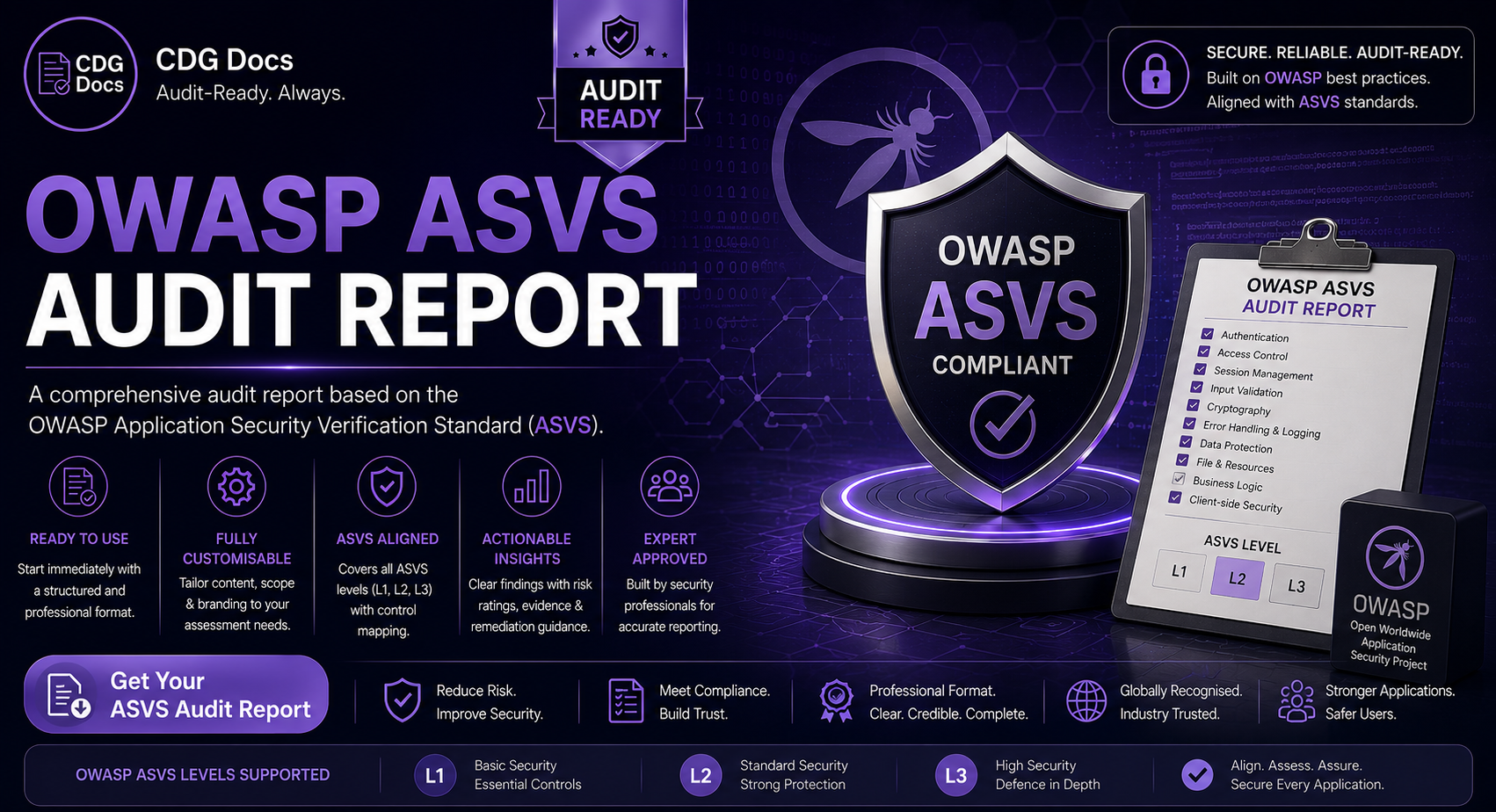
A foundational element of the ASVS framework is its tiered verification model. The standard establishes three distinct security verification levels, allowing organizations to tailor their security investments based on application risk profiles.
| Verification Level | Target Risk Profile | Primary Focus | Verification Methodology |
|---|---|---|---|
| Level 1 (ASVS L1) | Low-value applications, internal tools, or standard enterprise apps. | Basic security controls; defense against common automated and opportunistic vulnerabilities. | Automated scanning, basic manual code review, and lightweight configuration checks. |
| Level 2 (ASVS L2) | Applications processing sensitive data, financial portals, and healthcare systems. | Comprehensive defense against active threat actors; robust session and access controls. | Rigorous manual penetration testing, comprehensive code review, and architectural validation. |
| Level 3 (ASVS L3) | High-risk, critical infrastructure, military, or life-safety applications. | Maximum security posture; resilience against advanced persistent threats (APTs). | Deep source code analysis, formal verification, threat modeling, and extensive penetration testing. |
Selecting the appropriate verification level requires evaluating the sensitivity of the data processed, the potential impact of a security breach, and the regulatory environment governing the software. Most enterprise applications aim for Level 2 compliance, whereas foundational tools may operate effectively at Level 1.
Practical Integration into the Software Development Life Cycle (SDLC)
Implementing the ASVS 4.0.3 standard effectively requires integrating its requirements across every phase of the software development life cycle. Treating security verification as a post-development gate inevitably leads to costly rework and delayed releases.
Requirements and Design Phase
During the initial planning stages, product owners and security architects should review the ASVS requirements to define explicit security stories. Instead of writing generic tickets like "make the login secure," teams can reference specific ASVS requirements—such as ensuring password hashing adheres to V2.4 requirements. This establishes clear acceptance criteria that developers can code against and testers can verify.
Implementation and Development Phase
Developers utilize the standard as a technical reference guide during coding. By adhering to input validation (V5) and session management (V3) rules, engineering teams avoid common pitfalls that lead to OWASP Top 10 vulnerabilities. Peer code reviews should incorporate ASVS checkpoints to catch logic flaws, improper authorization checks, and insecure cryptographic implementations before code is merged into trunk branches.
Testing and Verification Phase
Quality assurance engineers and security auditors leverage the ASVS PDF to construct comprehensive test plans. Because every requirement in the standard is testable and objective, security assessors can provide concrete verification reports indicating precisely which controls passed or failed. This eliminates ambiguity in vulnerability reporting and gives stakeholders a quantifiable measure of application security readiness.
Benefits of Utilizing the ASVS Standard
Adopting the OWASP ASVS framework offers structural advantages for development organizations, procurement teams, and security auditors alike.
- Standardized Vocabulary: Teams share a common, unambiguous language for discussing security requirements, eliminating subjective interpretations of what constitutes "secure code."
- Regulatory Alignment: Many regulatory frameworks and compliance standards map naturally to ASVS requirements, streamlining audits for SOC 2, ISO 27001, and HIPAA.
- Measurable Security Posture: Organizations can track their security maturity over time by measuring the percentage of Level 1, 2, or 3 controls successfully implemented across their application portfolio.
- Procurement Clarity: Enterprises can incorporate ASVS levels directly into vendor contracts, requiring third-party software suppliers to certify compliance with specific ASVS verification levels.
Common Challenges and Implementation Pitfalls
While ASVS 4.0.3 is a powerful tool, organizations frequently encounter obstacles when attempting to adopt it across large engineering teams.
- Scope Overload: Attempting to enforce Level 3 compliance across all internal applications leads to severe developer friction and project delays. Organizations should right-size verification levels according to application risk.
- Lack of Developer Training: Handing developers a dense specification document without proper training results in misinterpretation of technical controls. Teams must pair the standard with practical secure coding workshops.
- Static Documentation Drift: Relying solely on static PDF copies can lead to version control issues if internal teams do not synchronize updates with official OWASP releases.
Frequently Asked Questions
What is the primary purpose of the OWASP ASVS 4.0.3 PDF?
The document serves as a comprehensive standard that defines security requirements and verification criteria for web applications, helping organizations design, build, and test secure software systematically.
How does ASVS differ from the OWASP Top 10?
While the OWASP Top 10 highlights the ten most critical web application vulnerabilities, ASVS provides an exhaustive, testable checklist of hundreds of detailed security controls required to prevent those vulnerabilities and secure an application end-to-end.
Which verification level should my organization choose?
Level 1 is suited for low-risk applications, Level 2 is recommended for applications handling sensitive or confidential data, and Level 3 is reserved for high-risk applications requiring maximum security assurance against advanced threats.
Can ASVS be used for automated security testing?
Yes, many ASVS requirements are written in an objective, testable manner, allowing security teams to map automated dynamic application security testing (DAST) rules and static analysis (SAST) queries directly to specific standard controls.
Is ASVS limited only to web applications?
While historically focused on web applications, modern iterations of the ASVS framework include extensive coverage for APIs, web services, microservices architecture, and cloud-native application components.
Practical Next Actions
To begin utilizing the OWASP ASVS 4.0.3 standard within your organization, start by conducting a risk assessment of your application portfolio to assign appropriate verification levels (L1, L2, or L3) to each system. Next, download the official specification document from the OWASP foundation website and distribute relevant chapters to your development and QA leads. Integrate specific ASVS requirement identifiers into your internal issue-tracking system to turn abstract security goals into verifiable engineering tasks.