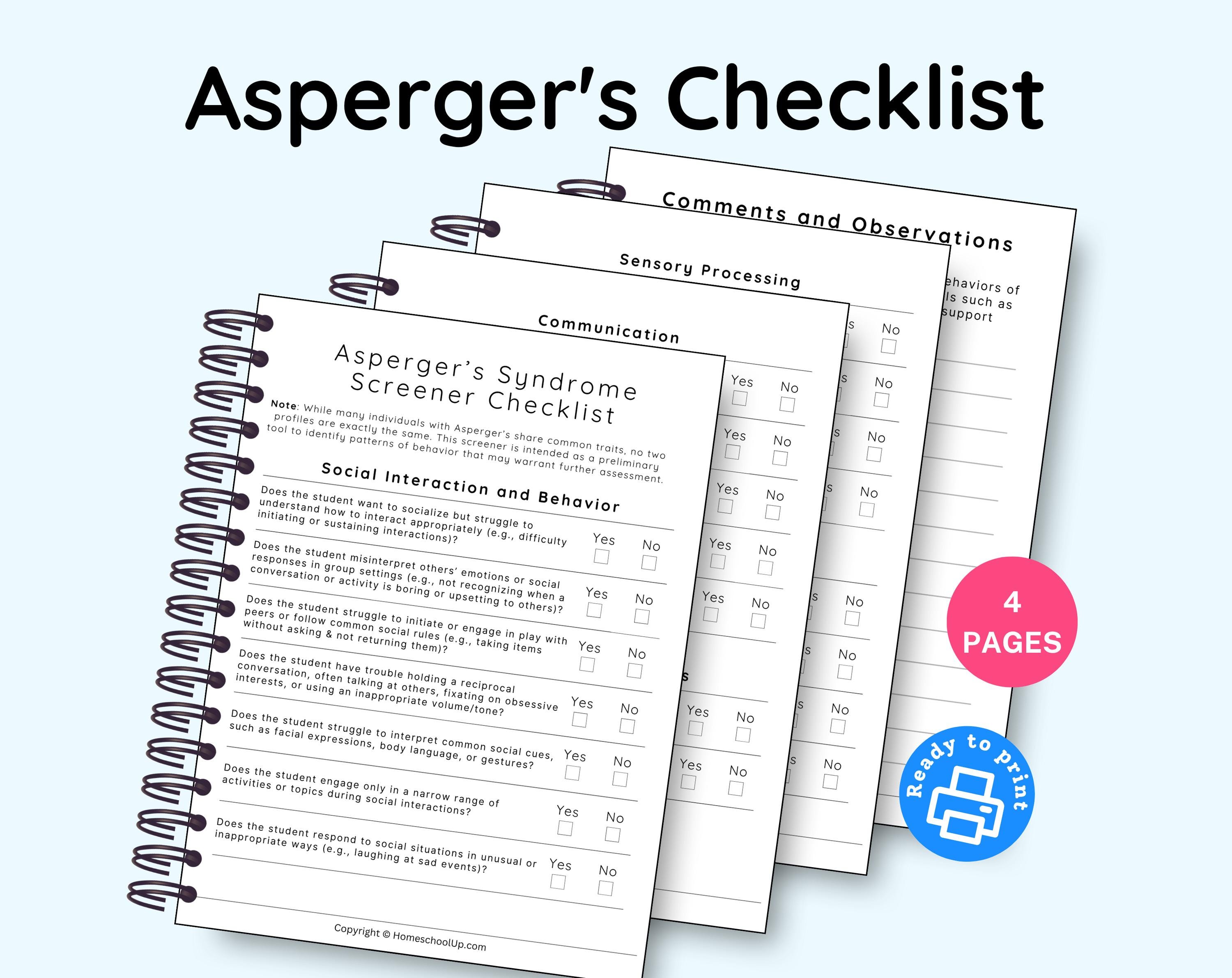
An Asperger traits checklist is a screening tool used to identify behavioral, social, and cognitive patterns associated with what was formerly known as Asperger’s Syndrome. While clinicians now use the umbrella term Autism Spectrum Disorder (ASD) Level 1, this checklist helps individuals and families recognize specific markers like social communication challenges, sensory sensitivities, and intense focal interests.
Navigating the landscape of neurodivergence can feel overwhelming, especially with the shifting terminology of the last decade. As of 2026, the medical community continues to refine its understanding of how "Asperger’s-style" traits manifest across different ages, genders, and environments. Whether you are an adult seeking self-understanding or a parent observing specific behaviors in a child, a traits checklist serves as a vital first step toward obtaining a professional evaluation and accessing appropriate support systems.
The Evolution of the Asperger Diagnosis
To use a traits checklist effectively, one must understand its historical and clinical context. For decades, Asperger’s Syndrome was recognized as a distinct diagnosis characterized by significant difficulties in social interaction and nonverbal communication, alongside restricted and repetitive patterns of behavior and interests. Crucially, it was distinguished from other forms of autism by the relative preservation of linguistic and cognitive development.
In 2013, the American Psychiatric Association’s Diagnostic and Statistical Manual of Mental Disorders, Fifth Edition (DSM-5), merged Asperger’s into the broader category of Autism Spectrum Disorder (ASD). Today, individuals who would have previously received an Asperger’s diagnosis are typically diagnosed with ASD Level 1. Despite this clinical shift, many people still prefer the term "Asperger’s" or "Aspie" to describe their identity and specific profile of strengths and challenges.
By 2026, the focus has shifted significantly toward neuro-affirming care, which views these traits not merely as "deficits" to be cured but as different ways of processing information that require specific accommodations and understanding.
Core Categories of the Asperger Traits Checklist
A comprehensive checklist is generally divided into several domains of human experience. These traits rarely exist in isolation; rather, they form a "constellation" that defines the individual’s neurodivergent profile.
1. Social Communication and Interaction
This is often the most visible area of difference. Unlike the "classic" presentation of autism where an individual might be non-verbal, those with an Asperger profile often have advanced vocabularies but struggle with the "unwritten rules" of social engagement.
- Literal Interpretation of Language: Difficulty understanding sarcasm, idioms, or metaphors. For example, if someone says "break a leg," an individual might feel genuine confusion or concern.
- Challenges with Reciprocity: Finding it difficult to engage in the "give and take" of conversation. This may manifest as "monologuing" about a favorite topic or failing to ask follow-up questions.
- Non-Verbal Cues: Struggling to read or use body language, facial expressions, and varying tones of voice. Eye contact may feel physically uncomfortable or distracting rather than helpful.
- Social Exhaustion: A phenomenon often called "autistic burnout" or "social hangover," where interacting with others requires so much manual processing that it leads to extreme fatigue.
2. Restrictive Interests and Repetitive Behaviors
What others might call "obsessions," the neurodivergent community often refers to as Special Interests (SpIns). These are not merely hobbies; they are intense, focused areas of study that provide deep joy and regulation.
- High Focus and Mastery: The ability to spend hours researching a specific topic (e.g., 19th-century locomotives, specific coding languages, or marine biology) and retaining vast amounts of data.
- Need for Predictability: A strong preference for routines and rituals. Unexpected changes to a schedule—even minor ones—can cause significant distress or "meltdowns."
- Repetitive Motor Movements: Often called "stimming" (self-stimulatory behavior), this might include hand-flapping, rocking, or repetitive finger tapping used to manage emotions or sensory input.
3. Sensory Processing Differences
The way the brain interprets input from the five senses (and internal senses like proprioception) is often fundamentally different in those with an Asperger profile.
- Hypersensitivity (Over-responsiveness): Finding everyday sounds (like a ticking clock or a humming refrigerator) painful or impossible to ignore. Certain clothing textures or food consistencies may be intolerable.
- Hyposensitivity (Under-responsiveness): A high pain threshold or a need for intense sensory input, such as weighted blankets or loud music, to feel grounded.
Comparing Traits Across Life Stages
The manifestation of these traits can change significantly as a person ages. In children, traits are often externalized through play and school behavior. In adults, especially those who have gone undiagnosed, traits are often internalized or hidden through a process known as masking.
| Trait Domain | Manifestation in Children | Manifestation in Adults |
|---|---|---|
| Social | Prefers playing alone; struggles to join groups; may lecture peers. | Difficulty with office politics; "socially awkward" reputation; avoids small talk. |
| Interests | Intense focus on specific toys, facts, or repetitive games. | Highly specialized career paths; "deep dives" into niche hobbies; expert-level knowledge. |
| Routine | Distress over changes in school schedule or route home. | Rigidity in daily habits; distress when plans are canceled at the last minute. |
| Sensory | Picky eating; refuses certain fabrics; covers ears at loud noises. | Strategic avoidance of crowds; specific lighting preferences; sensory-friendly wardrobes. |
| Communication | Advanced "pedantic" vocabulary; takes instructions very literally. | Precise speech; perceived as "too blunt" or "rude" in emails and meetings. |
The Concept of Masking and Its Impact
One of the most critical developments in our understanding of the Asperger traits checklist by 2026 is the recognition of masking (or camouflaging). Masking is the conscious or subconscious suppression of natural autistic traits to fit into a neurotypical society.
For many adults—particularly women and those assigned female at birth—this masking is so effective that they may not "appear" autistic to a casual observer. They may force themselves to make eye contact, script conversations in their head before speaking, and suppress the urge to stim. However, the internal cost of masking is high, often leading to anxiety, depression, and a loss of self-identity. A checklist used for adults must account for these internal experiences rather than just outward behaviors.
Cognitive Strengths and "Bottom-Up" Processing
It is essential to view a traits checklist not just as a list of hurdles, but as a description of a different cognitive style. Many people with an Asperger profile exhibit bottom-up processing.
While neurotypical individuals often see the "big picture" first and fill in the details later, neurodivergent individuals often perceive every detail first and then assemble them into a whole. This leads to:
- Exceptional Attention to Detail: Detecting errors or patterns that others miss.
- Deep Logical Reasoning: Approaching problems without the bias of social expectations.
- Hyper-Systemizing: A natural affinity for systems, whether they are mathematical, musical, or linguistic.
Seeking a Diagnosis: Steps and Considerations
If a checklist suggests that you or a loved one aligns with an Asperger profile, the next steps depend on your goals. Some seek a formal diagnosis for workplace accommodations or disability services, while others find peace of mind through "self-identification."
- Screening Tools: Utilize validated instruments such as the AQ-10 (Autism Spectrum Quotient) or the RAADS-R (Ritvo Autism Asperger Diagnostic Scale). These are not diagnostic but provide a data-driven basis for further inquiry.
- Consulting a Specialist: It is vital to find a clinician who specializes in adult autism or "female-leaning" presentations. Many general practitioners may still hold outdated stereotypes of what autism "looks like."
- The Diagnostic Interview: A formal evaluation in 2026 typically involves a series of interviews, a developmental history (often involving a parent or older relative), and standardized observations.
- Neuro-Affirming Post-Diagnostic Support: Once a diagnosis is confirmed, the focus should be on understanding your specific needs—such as occupational therapy for sensory issues or finding a neuro-affirming therapist—rather than trying to "fix" the autism.
Note: This guide is for informational purposes only and does not constitute medical advice. For a clinical diagnosis, please consult a licensed psychologist or psychiatrist.
Frequently Asked Questions
Can someone "grow out" of Asperger traits?
No, neurodivergence is a fundamental difference in how the brain is wired. However, individuals often develop coping mechanisms and strategies to navigate the world more effectively. While the traits remain, the person’s ability to manage their environment and energy levels usually improves with self-awareness and support.
Is there a difference between Asperger traits in men and women?
Research has shown that traits often manifest differently due to social conditioning. Women and girls are frequently more adept at masking and may have "socially acceptable" special interests (such as animals, psychology, or literature) that go unnoticed, whereas boys may have more stereotypical interests like statistics or machinery. This often leads to women being diagnosed much later in life.
How does the 2026 medical view differ from previous years?
By 2026, there is a much greater emphasis on the social model of disability. This means that many of the "challenges" of having an Asperger profile are viewed as a mismatch between the individual and a society built for neurotypical people. Support now focuses more on changing the environment and providing accommodations rather than forcing the individual to change their core nature.
Does an Asperger traits checklist cover mental health issues?
While the checklist focuses on neurodevelopmental traits, it is common for neurodivergent individuals to experience "co-occurring" conditions like ADHD, anxiety, or Ehlers-Danlos Syndrome (EDS). If you find you check many boxes on the list, it is worth discussing these potential overlaps with a professional.
Is self-diagnosis valid in the autistic community?
Within most neurodivergent communities, self-identification is widely respected and accepted. This is due to the high cost and limited accessibility of adult diagnostic services. A checklist can be a powerful tool for self-understanding even without a formal piece of paper.
Moving Forward with Knowledge
Identifying with an Asperger traits checklist is often a "lightbulb moment" that explains a lifetime of feeling "different." Whether you use this information to seek a formal diagnosis or simply to better understand your own needs, the goal is self-accommodation.
Start by identifying which environments trigger sensory overload and where your greatest strengths lie. By leaning into your natural cognitive style—rather than fighting against it—you can build a life that honors your neurodivergent profile. Organizations like the Autistic Self Advocacy Network (ASAN) and the Neurodivergent Insights platform provide ongoing resources for those navigating this journey in 2026.