For insurance purposes, an antique auto is generally defined as a motor vehicle that is at least 25 years old, has been restored or maintained in a condition that is consistent with the original manufacturer's specifications, and is used primarily for exhibitions, club activities, parades, and occasional leisure driving rather than daily transportation.
In 2026, the landscape of vehicle collecting has expanded significantly. The definition of an "antique" car is no longer restricted to the brass-era vehicles or the chrome-heavy cruisers of the 1950s. Today, vehicles from the early 2000s are beginning to qualify for these specialized policies. However, qualifying a vehicle as an antique for insurance is a distinct process from obtaining "antique" or "historic" license plates from a state Department of Motor Vehicles (DMV). While the DMV focuses on age and registration fees, insurance carriers focus on risk management, preservation, and valuation. Understanding these nuances is critical for owners of vintage machinery to ensure their assets are protected at their true market value.
The Age Requirement: When a Car Becomes an Antique
The most widely accepted threshold for a vehicle to be classified as an antique for insurance purposes is 25 years. This means that as of 2026, vehicles manufactured in 2001 or earlier are typically eligible for antique status. However, age is merely the first gate a vehicle must pass.
Insurance companies use this 25-year marker because it typically represents the point at which a vehicle’s depreciation curve has bottomed out and its value begins to appreciate based on scarcity, nostalgia, and historical significance. It is important to note that some specialty insurers may offer "classic" coverage for vehicles between 20 and 24 years old, while reserving the "antique" designation strictly for those that have hit the quarter-century mark.
Furthermore, the "antique" designation can sometimes be subdivided. For example, some organizations and insurers may refer to "pioneer" cars (pre-1905), "veteran" cars (1905–1918), and "vintage" cars (1919–1930). For the average 2026 insurance policy, however, the 25-year rule remains the industry standard for the broad "antique" category.
Condition and Preservation Standards
An antique auto is not simply an "old car." For insurance purposes, the vehicle must be maintained in a condition that honors its original design or has been restored to a high standard. This means that a 1995 sedan that is rusted, dented, and used as a "beater" will not qualify for antique insurance regardless of its age.
Insurers look for "pride of ownership." The vehicle should ideally be in "excellent" or "fine" condition, as defined by organizations like the Old Cars Price Guide. This includes:
- Mechanical Soundness: The vehicle should be operable and well-maintained.
- Aesthetic Integrity: The paint, interior, and trim should reflect the era in which the car was built.
- Authenticity: While minor safety upgrades (like improved brakes or seatbelts) are often permitted, radical modifications—such as "hot rodding" or "resto-modding"—might move the vehicle out of the "antique" category and into a "modified" or "custom" collector category.
In 2026, insurers are increasingly flexible regarding "survivor" cars—vehicles that have original, unrestored paint and interiors but show signs of age. These are often valued highly for their historical purity and are readily accepted for antique policies.
Usage Restrictions: The "No Commute" Rule
The primary reason antique insurance is more affordable than standard auto insurance is the restricted usage. Because these vehicles are seen as historical artifacts rather than utility tools, insurers assume they will spend most of their time parked in a safe environment.
To qualify for an antique policy, the owner must typically adhere to the following usage guidelines:
- Limited Annual Mileage: Most policies cap annual mileage between 2,500 and 5,000 miles. Some carriers offer "tiered" mileage plans, but the core principle remains: the car is for occasional use.
- No Daily Commuting: You cannot use an antique auto to drive to work, school, or for routine errands like grocery shopping. The vehicle is intended for "pleasure use," which includes club meets, exhibitions, tours, and Sunday drives.
- Secondary Vehicle Requirement: Almost all antique insurance providers require that every licensed driver in the household has a modern, "regular use" vehicle insured elsewhere. This proves to the insurer that the antique is not being used as a primary mode of transportation.
Storage and Protection Requirements
Where you keep your antique auto is just as important as how often you drive it. Because these vehicles are susceptible to theft, vandalism, and weather damage, insurers have strict storage mandates.
An antique auto must generally be stored in a fully enclosed, locked permanent structure. This usually means a private residential garage, a specialized car storage facility, or a sturdy barn. Carports, driveways, and street parking are almost universally disqualified for antique insurance.
In 2026, some insurers have added requirements for climate control or fire suppression systems for extremely high-value antiques (those valued over $250,000), but for the average enthusiast with a 25-year-old sports car, a standard locked garage is the baseline requirement.
Agreed Value vs. Actual Cash Value
The most significant difference between standard insurance and antique insurance lies in how the vehicle is valued. This is the primary reason why owners seek out the "antique" definition.
Actual Cash Value (Standard Insurance)
Most standard policies pay out "Actual Cash Value" (ACV) in the event of a total loss. ACV is calculated as the replacement cost minus depreciation. For an old car, this is disastrous. If you total a mint-condition 1990 Porsche 911 on a standard policy, the insurer might only offer you a few thousand dollars, viewing it as just an "old car."
Agreed Value (Antique Insurance)
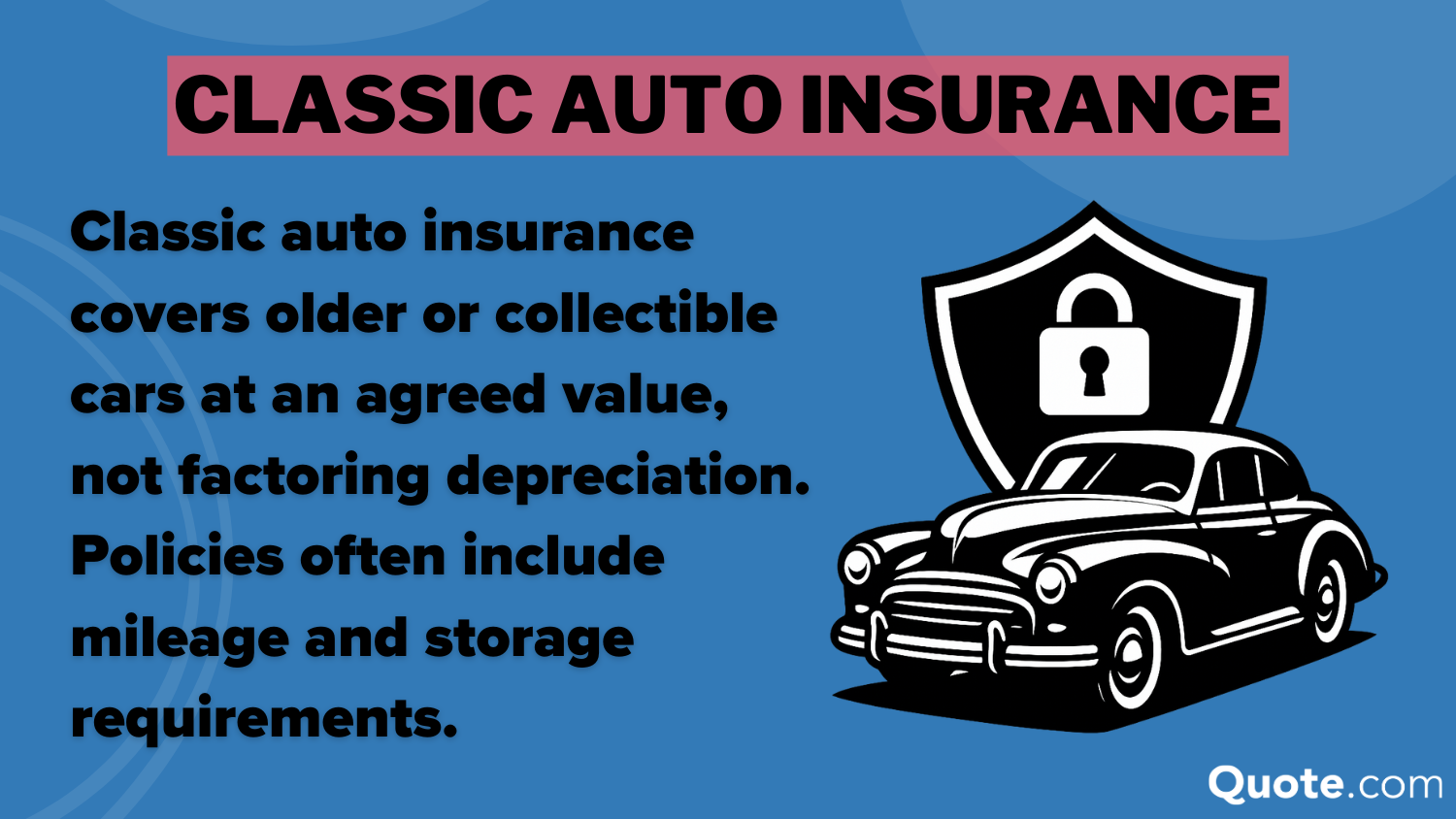
Antique policies utilize "Agreed Value." You and the insurance company agree on the vehicle's value at the time the policy is written. This value is usually based on professional appraisals, market data (such as the Hagerty Valuation Tool or Bring a Trailer auction results), and the vehicle's specific condition. If the car is stolen or totaled, the insurer pays the full agreed amount without any depreciation.
Stated Amount
Be wary of "Stated Amount" policies. These allow you to state what the car is worth, but the insurer may still attempt to pay only the ACV or the stated amount—whichever is less—at the time of a claim. Genuine antique insurance should always be "Agreed Value."
Insurance vs. DMV Registration: A Critical Distinction
It is common for enthusiasts to confuse a "Historic" or "Antique" license plate with antique insurance. They are not the same.
- State DMV: Allows you to register a car as an antique based strictly on its age (usually 20–30 years). This often grants you a permanent registration or a lower fee, but it may also legally restrict your driving to "educational" or "club" events.
- Insurance Company: Uses its own underwriting criteria. You can have a "Historic" plate from the DMV and still be denied antique insurance if you don't have a garage or if you intend to drive 10,000 miles a year.
Conversely, you can have standard license plates on a 30-year-old car and still qualify for antique insurance, provided you meet the insurer's storage and usage requirements.
Comparison of Vehicle Designations in 2026
The following table outlines the general differences between vehicle categories for insurance purposes in 2026. Note that specific carrier definitions may vary slightly.
| Feature | Standard Auto | Classic Auto | Antique Auto | Exotic / Supercar |
|---|---|---|---|---|
| Typical Age | 0–19 years | 20–24 years | 25+ years | Any (New or Old) |
| Usage | Daily/Commuting | Occasional/Pleasure | Exhibition/Occasional | Limited/Pleasure |
| Valuation | Actual Cash Value | Agreed Value | Agreed Value | Agreed Value |
| Storage | No specific requirement | Garage preferred | Locked Garage Required | Locked Garage Required |
| Mileage Limit | Unlimited | 2,500–5,000 / year | 2,500–5,000 / year | Usually < 2,500 / year |
| Daily Driver | Is the primary car | Must have another car | Must have another car | Must have another car |
How to Verify Your Vehicle Qualifies
If you believe your vehicle meets the criteria for an antique auto, the verification process involves several steps to ensure the "Agreed Value" is accurate and the risk is acceptable to the carrier.
- Documentation of Condition: You will need to provide high-resolution photographs of all four sides of the exterior, the interior (dashboard, seats, and carpets), the engine bay, and the odometer.
- Market Research: Consult valuation guides. In 2026, insurers heavily weigh recent auction data. If your vehicle has seen a recent spike in popularity—as many Japanese domestic market (JDM) cars from the late 90s have—ensure your valuation reflects this.
- Appraisal (Optional but Recommended): For vehicles with a value exceeding $50,000 or those with unique historical provenance (e.g., a former racing car or a celebrity-owned vehicle), a certified professional appraisal is often required.
- Driving Record Check: Antique insurers are more selective about the driver than standard insurers. A history of multiple moving violations or DUIs may disqualify you from a specialty antique policy, as the insurer is looking for "low-risk" caretakers of historical property.
Professional Advice Limitation
This article provides general information regarding antique auto insurance definitions as of 2026. Insurance laws and carrier requirements vary by jurisdiction and specific policy terms. It does not constitute legal, financial, or professional insurance advice. To obtain coverage tailored to your specific vehicle and location, you should consult with a licensed insurance agent or a specialty collector car insurance broker.
Frequently Asked Questions
Can I use my antique auto for a wedding or a paid photoshoot?
Most antique insurance policies are strictly for personal pleasure use. Using the vehicle for hire (such as a paid wedding transport or as a commercial prop) usually requires a commercial endorsement or a specific rider. Using the car for profit without informing the insurer can lead to a denied claim if an accident occurs during that event.
What happens if I exceed my annual mileage limit?
If you realize you are going to exceed your mileage limit (for example, if you decide to take a long-distance cross-country tour), you should contact your insurer immediately. Many carriers allow for a one-time mileage extension for a small fee. If you exceed the limit without notification, you risk losing your "Agreed Value" status or having your policy non-renewed.
Does "antique" status cover the car while it is being restored?
Yes, many specialty insurers offer "Restoration Coverage" or "Vehicle Under Construction" policies. These are designed for antique autos that are not yet road-worthy. The coverage usually includes specialized protection for tools and spare parts, and the "Agreed Value" can be increased as the restoration progresses and the vehicle’s value rises.
Are "Resto-mods" considered antiques?
Technically, no. A resto-mod (a vintage car with modern engine, suspension, and technology) is usually covered under a "Modified Collector" policy rather than a traditional "Antique" policy. While the valuation is still handled via "Agreed Value," the premiums might differ because the modern performance components increase the risk of higher-speed accidents.
Is an 80s or 90s car really an "antique"?
In the eyes of the insurance industry in 2026, yes. Age is the primary factor. A 1999 Mazda Miata or a 1992 Chevrolet Suburban can qualify for antique insurance if they meet the condition, storage, and usage requirements. The hobby has evolved to include "Youngtimers," recognizing that these vehicles are now 30+ years old and deserve preservation.
Practical Recommendation for Owners
If you own a vehicle that is 25 years or older, your first action should be to move away from a standard "Actual Cash Value" policy. The financial risk of losing an appreciating asset to a depreciated settlement is too high.
Contact a specialty insurer such as Hagerty, Grundy, or the collector car division of a major carrier like State Farm or GEICO. Request a quote for an Agreed Value policy. Before calling, ensure you have a locked garage space available and a secondary vehicle for your daily needs. By aligning your vehicle with the insurance industry's definition of an antique, you not only save money on premiums but also ensure that the historical and monetary value of your automotive investment is fully protected.