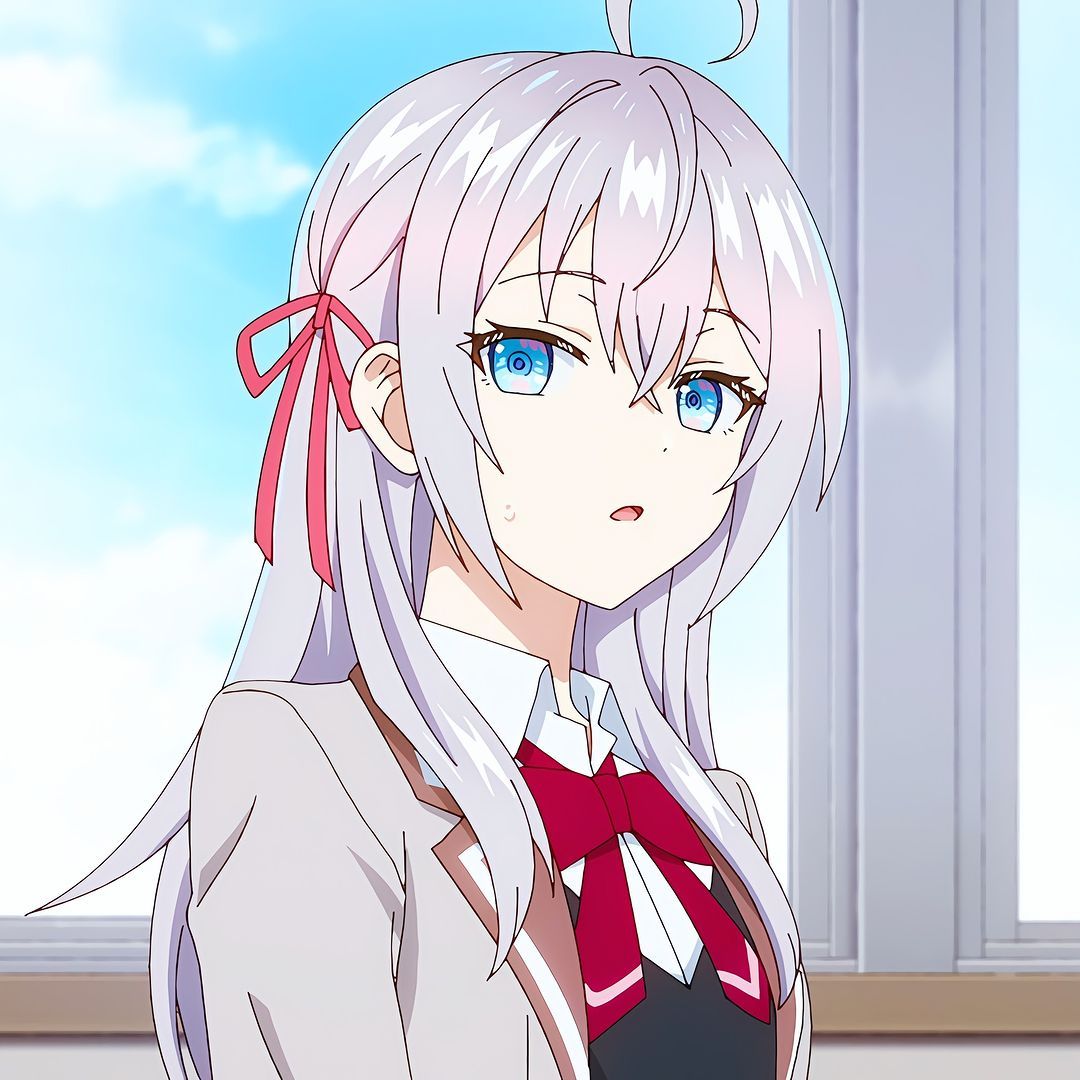
Alisa "Alya" Mikhailovna Kujou is the central heroine of the celebrated series Alya Sometimes Hides Her Feelings in Russian. As a half-Russian, half-Japanese student at Seirei Academy, she is defined by her striking silver hair, academic excellence, and her habit of whispering affectionate secrets in Russian to her classmate, Masachika Kuze, unaware that he understands her perfectly.
The Persona of the "Lone Princess" at Seirei Academy
In the academic landscape of Seirei Academy, Alisa Mikhailovna Kujou—famously known by her nickname Alya—occupies a space that is both enviable and isolating. From her first introduction, she is framed as the "Lone Princess" (or sometimes the "Ice Princess" depending on the translation nuances), a title earned through her seemingly untouchable perfection. Alya is a top-tier student who excels not only in academics but also in sports and extracurricular leadership. Her character design, characterized by her flowing silver hair and piercing blue eyes, reinforces this ethereal, distant image.
However, the "spotlight" Alya finds herself in is often one of her own making, fueled by a relentless drive for self-improvement and a refusal to settle for mediocrity. This perfectionism is a double-edged sword. While it places her at the top of the school hierarchy, it also creates a barrier between her and her peers. Most students view her with a mixture of awe and intimidation, assuming she is too far above them to approach. This social distance is a core component of her early character arc, highlighting the loneliness that often accompanies high achievement. By 2026, literary critics and fans alike have noted that Alya’s "Lone Princess" persona serves as a poignant commentary on the pressures faced by high-achieving youth in modern educational systems.
The Russian Language as a Narrative Tool
The most defining characteristic of Alya’s personality is her use of the Russian language. Born to a Russian father and a Japanese mother, she is bilingual, yet she treats her Russian heritage as a private sanctuary. When she is overwhelmed by emotion—be it embarrassment, affection, or frustration—she reverts to Russian. She does this under the mistaken assumption that her seatmate, Masachika Kuze, cannot understand her. This linguistic barrier (or perceived barrier) provides the "spotlight" with its primary comedic and romantic tension.
Alya’s Russian whispers are her "true" voice. While her Japanese interactions are polished, polite, and often cold, her Russian outbursts are raw, vulnerable, and deeply "deredere" (sweet and affectionate). This creates a fascinating psychological profile: Alya uses a foreign tongue as a psychological defense mechanism, allowing her to express feelings she is too proud or too shy to voice in the common language of her environment. The dramatic irony—where the audience and Masachika know what she is saying while she remains blissfully ignorant of his fluency—is the engine that drives the narrative.
The Significance of "Mikhailovna"
In Russian naming conventions, "Mikhailovna" is a patronymic, indicating that her father’s name is Mikhail. The inclusion of the full name in the series title and marketing materials serves to emphasize her dual identity. It isn't just a middle name; it is a marker of her lineage. Throughout the series, Alya’s struggle to balance her Russian roots with her life in Japan is a recurring subtext. She is often seen as "foreign" or "exotic" by her classmates, which further contributes to her sense of being a spectacle in the spotlight rather than just another student.
Relationship Dynamics: Alya and Masachika Kuze
The heart of Alya’s journey is her evolving relationship with Masachika Kuze. Masachika is the antithesis of Alya: he appears lazy, unmotivated, and content to fade into the background. Yet, he is the only one who truly "sees" her. Because he understands her Russian, he is privy to her inner thoughts, making him her unintentional confidant.
Alya’s attraction to Masachika stems from his refusal to treat her like a "Princess." He teases her, challenges her, and speaks to her as an equal. In the spotlight of the school, everyone else treats her like a statue or a symbol; Masachika treats her like a girl. This dynamic forces Alya to confront her own vulnerabilities. As the series progresses toward its later volumes and its 2024-2025 anime peak, their relationship shifts from a one-sided linguistic joke to a deep, mutual support system. Masachika helps Alya navigate the complexities of the Student Council, while Alya inspires Masachika to reclaim his own lost potential.
The Contrast with Maria "Masha" Mikhailovna Kujou
One cannot discuss Alya in the spotlight without mentioning her older sister, Maria (Masha). Masha serves as a foil to Alya in almost every way. Where Alya is sharp, focused, and occasionally prickly, Masha is soft, bubbly, and seemingly airheaded. Masha is also popular, but her popularity is rooted in her approachability and "big sister" energy, which stands in stark contrast to Alya’s intimidating brilliance.
The sisterly bond is a vital part of Alya’s character development. Masha is often the one who sees through Alya’s stoic facade without needing the Russian language as a guide. Their interactions reveal a more childish, competitive, and loving side of Alya that is rarely seen in the school hallways. This internal family dynamic humanizes Alya, reminding the audience that her "Lone Princess" status is a role she plays, rather than the entirety of who she is.
Technical Profile and Visual Evolution
Since the light novel's debut and the subsequent anime adaptation by Doga Kobo, Alya's visual representation has become iconic within the rom-com genre. Her design balances the "cool beauty" aesthetic with expressive facial animations that betray her inner turmoil.
| Attribute | Specification | Narrative Significance |
|---|---|---|
| Full Name | Alisa Mikhailovna Kujou | Represents her dual Russian-Japanese heritage. |
| Heritage | Half-Russian (Father), Half-Japanese (Mother) | Drives her linguistic habits and social isolation. |
| Hair Color | Silver / Platinum Blonde | Visual shorthand for her "foreign" and "regal" status. |
| Key Skill | Bilingual Fluency (Russian/Japanese) | The primary plot device for emotional expression. |
| School Role | Student Council Candidate / Member | Focuses her perfectionism into a tangible goal. |
| Voice Actor (JP) | Sumire Uesaka | Uesaka is a known Russophile, adding authenticity to the Russian lines. |
| Primary Conflict | Pride vs. Honesty | The internal struggle to be herself without hiding behind a language. |
Alya’s Impact on the Rom-Com Genre
As of 2026, Alya Sometimes Hides Her Feelings in Russian has solidified its place as a modern classic in the romantic comedy genre. Alya herself has been a frequent winner of "Best Girl" polls, largely due to the unique blend of her "Tsundere" and "Kuudere" traits. Unlike traditional Tsundere characters who might be physically aggressive, Alya’s "harshness" is purely a result of her high standards and social awkwardness. Her "derere" side is not just a hidden quirk but a fundamental part of her identity that she expresses through a literal different language.
The series has been praised for its production quality, particularly the way it handles the Russian dialogue. In the anime, the use of subtitles for Alya’s Russian thoughts creates a layered viewing experience where the audience is "in on the secret" alongside Masachika. This creates a sense of intimacy between the character and the viewer, placing Alya in a spotlight that feels both grand and personal.
Themes of Identity and Social Expectation
Alya’s story is fundamentally one of identity. She is constantly performing—performing as the perfect student, performing as the stoic Russian beauty, performing as the future Student Council President. The spotlight she inhabits is a stage where she feels she cannot afford to make a mistake.
The narrative explores the "imposter syndrome" that often affects high achievers. Alya feels that if she isn't perfect, she has no value. This is why her Russian outbursts are so critical; they are the only moments where she allows herself to be "imperfectly" human. The series encourages readers to look past the surface-level achievements of individuals and recognize the vulnerable person underneath. In the context of 2026, where social media often forces individuals to maintain a "perfect" digital persona, Alya’s struggle remains incredibly relatable to a global audience.
Key Milestones in Alya's Character Arc
- The Introvert's Shell: The beginning of the series establishes Alya's isolation and her reliance on Masachika as her only "safe" outlet.
- The Student Council Election: This arc is a major turning point. Alya decides to run for president, stepping out of her solitary comfort zone and into a role that requires her to connect with others.
- The Cultural Festival: A moment where Alya's Russian heritage is celebrated rather than hidden, marking a significant step in her self-acceptance.
- The Conflict with Masha: Navigating the hidden history between Masachika and her sister forces Alya to confront her jealousy and her deepest feelings.
- Direct Confessions: As the light novels progressed toward the 2026 era, the shift from "hiding feelings in Russian" to attempting to express them in Japanese represents the ultimate growth for her character.
Frequently Asked Questions
Why does Alya speak Russian specifically to Masachika?
Alya speaks Russian to Masachika because she believes he is the only person who won't judge her for her emotional outbursts, primarily because she thinks he doesn't understand her. It is her way of being honest without the perceived consequences of being vulnerable. She feels a subconscious comfort around him that she doesn't feel with others, leading her to "slip up" more frequently in his presence.
Is Alya's Russian voice acting accurate?
In the anime adaptation, Alya is voiced by Sumire Uesaka, who has a well-documented passion for Russian culture and language. While no non-native speaker is perfect, the pronunciation is generally regarded as high-quality for an anime production, and the grammatical structures used in the light novels and anime are significantly more accurate than typical "Engrish" or "broken" foreign language tropes found in other series.
What is the relationship between Alya and Maria?
Maria (Masha) is Alya’s older sister. While they are very close, they have a complex dynamic. Masha is more socially naturally gifted and holds secrets regarding Masachika’s past that Alya is initially unaware of. Despite their different personalities, Masha is Alya’s biggest supporter and often pushes her to be more honest with her feelings.
Does Masachika ever tell Alya he understands Russian?
The tension of the series relies heavily on the fact that Masachika keeps his fluency a secret. However, as the story progresses, there are several "close calls" where Masachika nearly reveals his secret or hints at it. The eventual revelation is a major plot point that shifts the dynamic of their relationship from one of hidden secrets to one of mutual understanding.
What makes Alya different from a typical Tsundere?
A traditional Tsundere is defined by a "hot and cold" personality where they are often mean to their love interest to hide their feelings. Alya is more of a "Kuudere" (cool and stoic) who uses a literal language barrier to hide her "Derere" (sweet) side. Her "mean" moments are usually directed at herself or the situation, rather than being unprovoked attacks on Masachika.
Recommendation for New Readers and Viewers
For those looking to experience Alya’s journey in the spotlight, the best starting point is the original light novel series by SunSunSun. The novels provide the deepest insight into Alya’s internal monologues and the specific nuances of her Russian phrases. Following the novels, the anime adaptation by Doga Kobo is highly recommended for its vibrant animation and the standout performance by Sumire Uesaka.
If you are interested in character-driven romantic comedies that balance humor with genuine emotional stakes, Alya Sometimes Hides Her Feelings in Russian is an essential title. By 2026, the series has completed a significant portion of its narrative, making it an excellent time to marathon the story and witness Alya’s transformation from the "Lone Princess" into a confident young woman who no longer needs to hide her heart behind a foreign tongue.