Standard air hockey table dimensions vary significantly depending on their intended use, ranging from 8-foot regulation models used in professional tournaments to 4-foot tabletop versions for children. For a full-size professional experience, the standard playing surface is typically 96 inches long by 48 inches wide, requiring a total room clearance of at least 14 feet by 10 feet for comfortable gameplay.
Selecting the right air hockey table involves more than just measuring the length of the cabinet. In 2026, as home game rooms continue to evolve into multi-functional entertainment hubs, understanding the nuances of playing surface area, cabinet footprints, and player clearance zones is essential for both performance and safety. This guide provides a technical breakdown of standard dimensions across all categories of air hockey equipment.
Understanding the Regulation Standard (8-Foot Tables)
In the world of competitive air hockey, "standard" is defined by the governing bodies such as the United States Air-Hockey Association (USAA) and the Air Hockey Players Association (AHPA). These organizations mandate specific dimensions to ensure consistency in puck speed, rebound physics, and player movement.
Professional Dimensions
A regulation-sized table is almost universally 8 feet long. To be precise, the external dimensions of the cabinet usually measure approximately 99 to 101 inches in length and 51 to 56 inches in width. However, the most critical measurement is the playing surface, which should be 96 inches (8 feet) by 48 inches (4 feet).
The playing surface is usually made of high-density MDF (Medium Density Fiberboard) or a specialized laminate, though some high-end commercial models utilize polished aluminum. The thickness of this surface matters; standard professional tables feature a surface thickness of at least 1 inch to prevent warping over time, which would otherwise disrupt the "true" path of the puck.
Weight and Stability
A professional 8-foot table is not merely large; it is heavy. Most regulation tables weigh between 350 and 500 pounds. This mass is a functional requirement; it prevents the table from shifting during aggressive play. When calculating floor load or assembly requirements, this weight must be factored into your space planning.
Home and Recreational Table Standards
Because not every home has the space for a massive 8-foot tournament table, manufacturers have standardized several smaller sizes that cater to different age groups and room configurations.
7-Foot Intermediate Tables
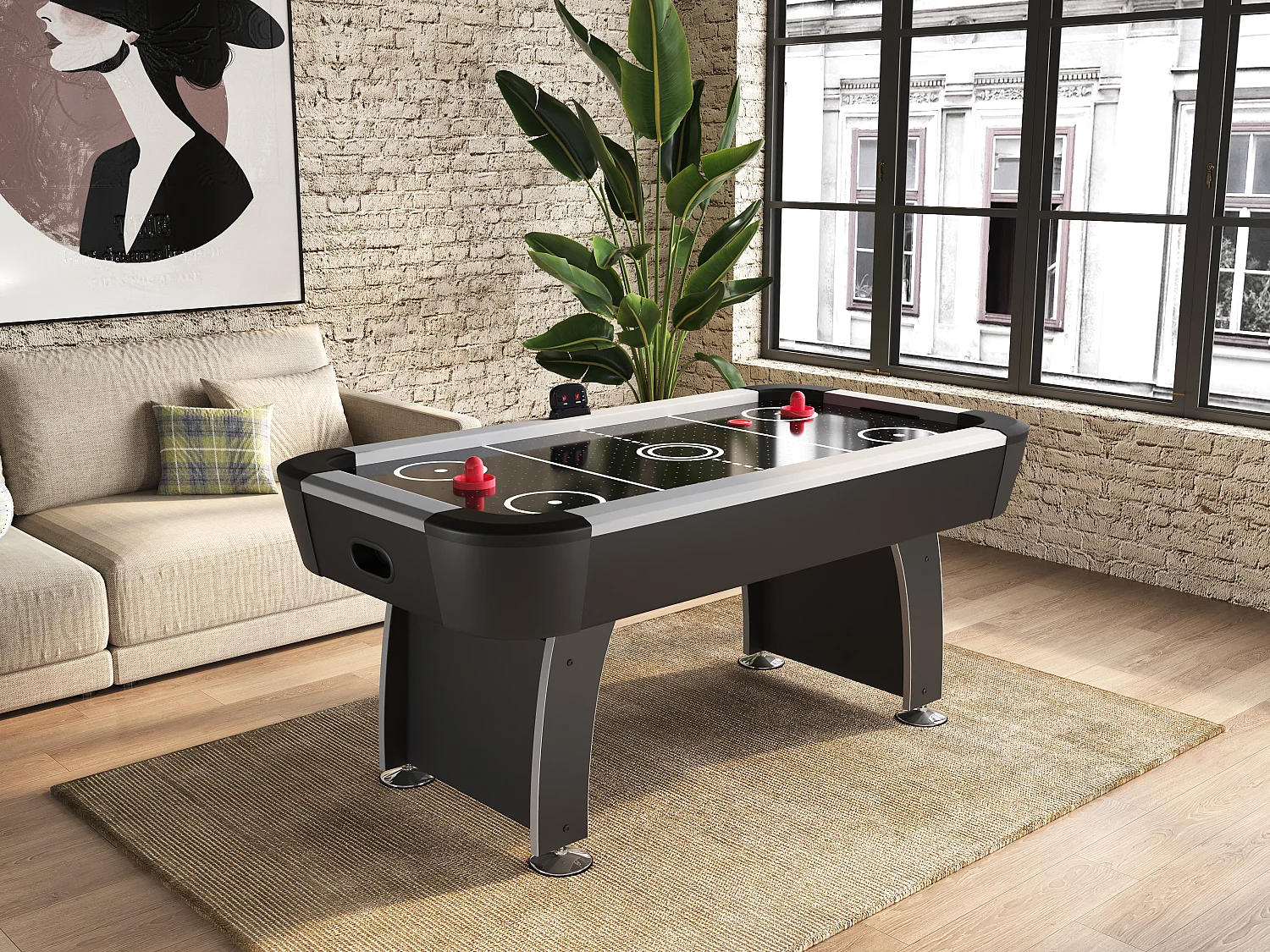
Often referred to as "home-pro" tables, 7-foot models are the most popular choice for serious enthusiasts who face space constraints.
- Cabinet Length: Approximately 84 inches.
- Cabinet Width: Approximately 42 to 46 inches.
- Ideal For: Adults and teenagers who want a "full" feel without the footprint of a tournament-grade unit.
A 7-foot table provides enough runway for the puck to reach high speeds, allowing for advanced banking shots and defensive maneuvers that are difficult to execute on smaller surfaces.
6-Foot Family Tables
The 6-foot table is the standard "mid-size" option. These are typically designed with lighter materials to allow for easier movement within a home.
- Cabinet Length: Approximately 72 inches.
- Cabinet Width: Approximately 36 to 40 inches.
- Ideal For: Casual play in secondary bedrooms or smaller basements.
4-Foot and 5-Foot Junior Tables
These are strictly recreational and are designed for younger children. At this scale, the physics of the game changes significantly. The pucks and mallets (strikers) are usually smaller and lighter to match the reduced airflow of the smaller blower motors found in these units.
- Length: 48 to 60 inches.
- Width: 24 to 30 inches.
The "Swing Zone": Calculating Necessary Room Clearance
One of the most common mistakes when purchasing an air hockey table is measuring only the table itself. Unlike a pool table, where you need clearance for a cue stick, air hockey requires clearance for the human body in motion.
The End-Zone Clearance
Players do not stand still; they lean, lunge, and move laterally. To play safely and effectively, you must account for a minimum of 3 to 4 feet of clearance at each end of the table.
- Example: For an 8-foot table (96 inches), the room length should be at least 14 feet (168 inches). This allows a player to stand behind the goal and move their arms freely without hitting a wall or furniture.
The Side-Zone Clearance
While less movement occurs on the sides of the table, you still need space for spectators or for players to move around the table between rounds. A minimum of 2 feet of clearance on each side is recommended.
- Example: For a standard 4-foot wide table, the room width should be at least 8 feet.
Ceiling Height and Lighting
Standard table height is approximately 32 inches. When considering the "dimensions" of your setup, ensure that any hanging light fixtures are at least 65 to 70 inches above the floor. Low-hanging lights can be a hazard if a puck is lofted off the table during a high-speed collision—a common occurrence in competitive play.
Standard Table Height and Ergonomics
The vertical dimension of an air hockey table is just as important as its length and width. Standard table height for adult-oriented models is 30 to 32 inches from the floor to the top of the rail.
This height is optimized for the "crouch" position used by most players. If a table is too high, it puts undue strain on the player's shoulder; if it is too low, it leads to back fatigue. Professional tables often include adjustable leg levelers, which can add 1 to 2 inches of height. These levelers are critical for ensuring the playing surface is perfectly flat, as even a fraction of a degree of tilt will cause the puck to drift toward one side.
Detailed Comparison of Standard Air Hockey Dimensions
The following table summarizes the typical specifications for the most common table sizes available in 2026.
| Table Category | Cabinet Length | Cabinet Width | Playing Surface Size | Recommended Room Size |
|---|---|---|---|---|
| Regulation (Pro) | 99" - 101" | 51" - 56" | 96" x 48" | 15' x 10' |
| Intermediate | 84" | 42" - 46" | 80" x 40" | 13' x 9' |
| Standard Home | 72" | 36" - 40" | 68" x 34" | 12' x 8' |
| Junior/Small | 60" | 30" | 56" x 28" | 10' x 7' |
| Tabletop | 40" - 48" | 20" - 24" | Varies | N/A (Desktop) |
Technical Specifications: Rails and Goals
When evaluating the dimensions of a "standard" table, the internal geometry of the rails and goals determines the quality of play.
Rail Height and Rebound
The side rails (or "banks") on a professional table are typically 1.5 to 2 inches high. They are usually constructed from solid aluminum or high-density plastic. The interior face of the rail must be perfectly vertical. If the rails are angled or made of soft material, the puck will "chatter" or jump off the table rather than rebounding cleanly.
Goal Width
On an 8-foot regulation table, the goal opening is standard at 7 inches wide. For 6-foot and 7-foot tables, the goal may be narrowed to 6 inches to maintain the difficulty level, as the puck has less distance to travel, making it easier to score.
Materials and Their Impact on Footprint
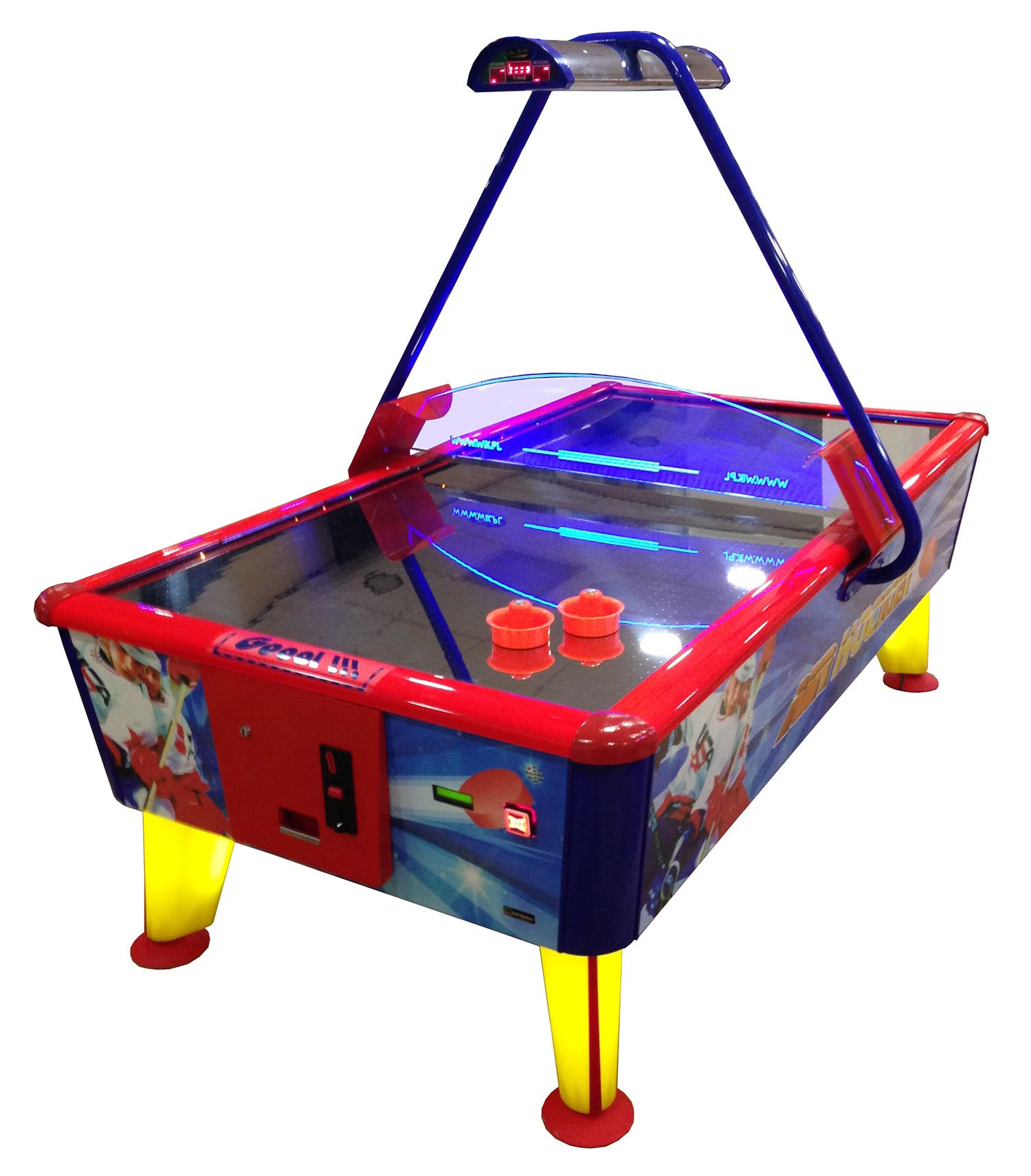
The choice of materials affects the overall "bulk" of the table. Commercial-grade tables (like those found in arcades) feature wider top rails to house scoring sensors and electronics.
- Commercial Grade: These tables have a much larger exterior footprint relative to their playing surface. A 50-inch wide playing surface might result in a 56-inch wide cabinet due to the heavy-duty rails.
- Foldable/Space-Saver: Some 5-foot and 6-foot tables are designed with "X-frame" legs that allow the table to be flipped vertically when not in use. While the playing dimensions remain standard, the storage footprint is significantly reduced, often requiring only 2 feet of depth.
- Multi-Game Tables: Dimensions for 3-in-1 tables (Air Hockey, Billiards, and Table Tennis) are usually dictated by the billiards surface. Since standard home pool tables are 7 feet, these combo units almost always follow the 7-foot intermediate air hockey dimensions.
Power and Component Clearance
Beyond the physical dimensions of the wood and metal, you must account for the electrical components.
- Blower Motor Housing: Most standard tables have the blower motor mounted underneath the center of the table. You need at least 10 to 12 inches of open air beneath the table to allow the motor to draw in enough air to create the necessary cushion. Placing a table on a thick shag carpet can sometimes obstruct this intake, reducing puck float.
- Power Cord Routing: Standard power cords are 6 to 10 feet long. When planning your room dimensions, ensure the table is positioned so the cord doesn't become a trip hazard across the "swing zone" where players move.
Frequently Asked Questions
What is the official size for a tournament air hockey table?
The official size for tournament play, as recognized by the USAA, is 8 feet long. The specific playing surface dimensions are 96 inches by 48 inches. While some smaller tables are marketed as "professional," they do not meet the legal requirements for sanctioned competitive play.
How much space do you really need around an air hockey table?
You need a minimum of 36 inches (3 feet) at each end of the table for the players to move. If you are a tall adult or an aggressive player, 48 inches (4 feet) is preferred. Without this space, you risk hitting your elbows or strikers against the walls, which can lead to injury or equipment damage.
Are 7-foot air hockey tables good for adults?
Yes, 7-foot tables are considered the standard "full-size" option for residential use. They provide a very similar experience to 8-foot tables but are much easier to fit into standard basement or garage layouts. Most adults find 7-foot tables perfectly adequate for high-speed play.
Can I fit an 8-foot air hockey table in a 12x10 room?
No, it is not recommended. An 8-foot table is 96 inches long. In a 12-foot (144-inch) room, you would only have 24 inches of space at each end (144 - 96 = 48, divided by 2). This is insufficient for a player to stand and move. You would likely find the room too cramped for a functional game.
Does the thickness of the table affect the dimensions?
The thickness of the "apron" (the side walls of the table) affects the cabinet's outer dimensions but not the playing surface. Thicker aprons generally indicate a more robust blower system and better structural integrity, which are hallmarks of commercial-grade "standard" tables.
What is the standard height for an air hockey table?
The standard height is between 30 and 32 inches. This height allows for a comfortable stance where the player can lean over the table to reach the center while maintaining a stable defensive position near the goal.
Practical Recommendation for Buyers
Before finalizing a purchase in 2026, perform a "tape-out" on your floor. Use painter's tape to mark the exact footprint of the cabinet, then mark a second boundary 3 feet out from each end. If your "swing zone" overlaps with walls, expensive electronics, or high-traffic walkways, consider dropping down one size (e.g., from an 8-foot to a 7-foot table).
For the best balance of playability and space efficiency, the 7-foot intermediate table remains the gold standard for home environments. It offers the necessary surface area for complex play while fitting comfortably into a 13' x 9' space, which is common in modern residential floor plans.