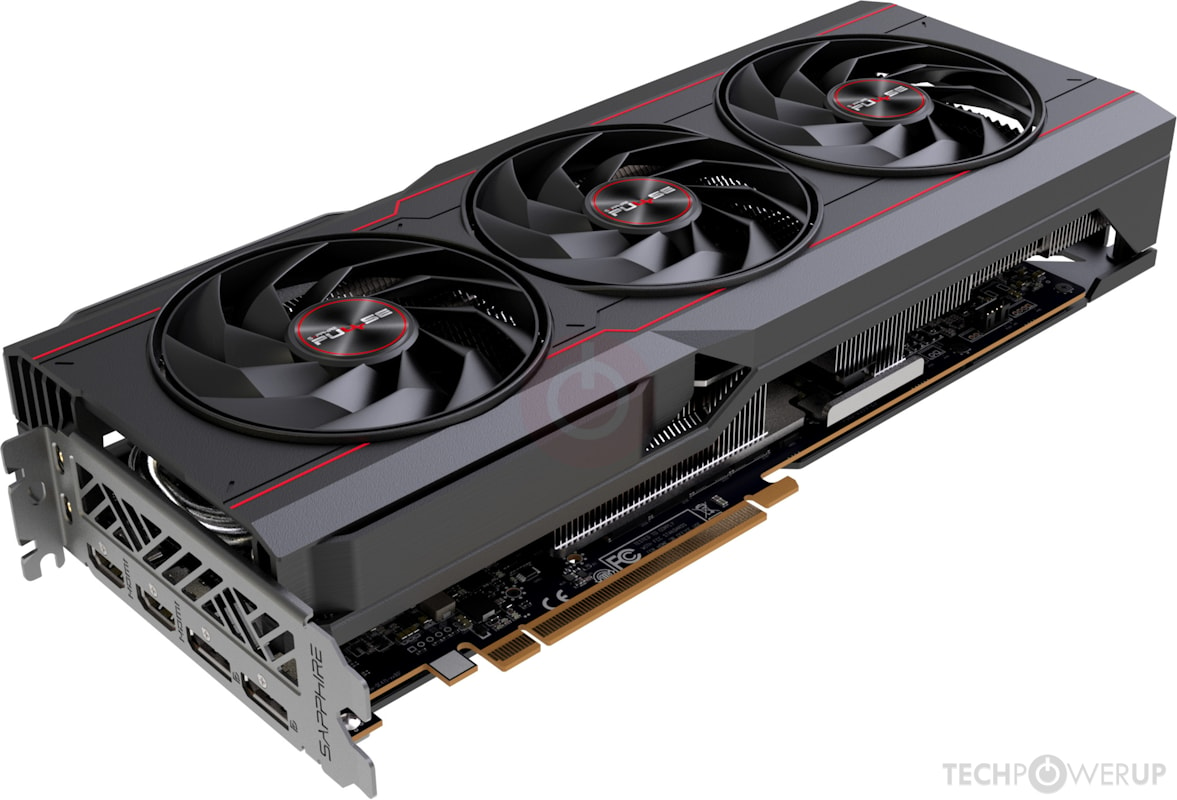
The AMD Radeon RX 7900 XT is a high-performance graphics card based on the RDNA 3 architecture, featuring 20GB of GDDR6 memory, a 320-bit memory interface, and 84 Compute Units. It delivers exceptional 4K and 1440p gaming performance, sustained by a 315W Total Board Power and advanced chiplet design.
The Architectural Foundation: RDNA 3 and Chiplet Technology
The Radeon RX 7900 XT represents a significant milestone in GPU engineering as one of the first consumer-grade graphics cards to utilize a chiplet-based design. Developed by AMD, this approach mirrors the successful strategy used in their Ryzen processors. Instead of a single, massive piece of silicon (a monolithic die), the RX 7900 XT’s Navi 31 GPU is split into a Graphics Compute Die (GCD) and several Memory Cache Dies (MCDs).
The GCD, built on a 5nm process node, contains the primary logic, including the Stream Processors and Ray Tracing accelerators. The MCDs, built on a more mature and cost-effective 6nm process, house the GDDR6 memory controllers and the 2nd Generation AMD Infinity Cache. This decoupling allows AMD to optimize manufacturing yields and tailor the specific process technology to the function of each component.
In the 2026 hardware landscape, this architectural choice has proven its longevity. By separating the memory controllers from the main compute logic, the RX 7900 XT maintains high efficiency and lower latency than traditional monolithic designs of the same era. The interconnect between the GCD and MCDs operates at an incredibly high bandwidth, ensuring that data moves seamlessly across the chiplet boundaries without creating bottlenecks during intensive gaming or rendering sessions.
Core Specifications: Compute Units and Processing Power
The heart of the RX 7900 XT consists of 84 RDNA 3 Compute Units (CUs). Each CU is equipped with dual-issue stream processors, which effectively double the instruction issue rate for certain mathematical operations compared to previous RDNA 2 designs. This results in a total of 5,376 Stream Processors.
Clock Speeds and Frequency
The card operates with a dual-clock system: a Game Clock and a Boost Clock.
- Game Clock: Typically around 2,000 MHz. This is the expected frequency when running typical gaming workloads under standard thermal conditions.
- Boost Clock: Up to 2,400 MHz. This represents the maximum frequency the GPU can achieve during short bursts of intense activity, provided there is sufficient thermal and power headroom.
In 2026, many users utilize third-party AIB (Add-in-Board) versions from partners like Sapphire, PowerColor, or ASUS, which often come with factory overclocks that push these frequencies even higher. The architectural efficiency of RDNA 3 ensures that these clock speeds translate directly into higher frame rates in modern titles using DirectX 12 Ultimate and Vulkan APIs.
Ray Tracing and AI Acceleration
Each Compute Unit includes a 2nd Generation Ray Accelerator. While AMD’s ray tracing performance historically trailed behind competitors, the RX 7900 XT offers significant improvements over the 6000-series. It handles complex lighting, shadows, and reflections with much greater stability. Additionally, the inclusion of dedicated AI Accelerators within the CUs assists in tasks like FSR (FidelityFX Super Resolution) upscaling, which has become a standard requirement for 4K gaming in 2026.
Memory Subsystem: 20GB GDDR6 and Infinity Cache
One of the standout features of the RX 7900 XT is its generous memory buffer. Equipped with 20GB of GDDR6 VRAM, the card provides more than enough overhead for the most demanding titles released through 2025 and 2026.
The 320-bit Memory Interface
The VRAM is connected via a 320-bit memory bus. This wide interface allows for a high throughput of data, essential for maintaining high resolution textures and large open-world environments. The memory operates at an effective speed of 20 Gbps, resulting in a total memory bandwidth of approximately 800 GB/s when accounting for the assistance of the Infinity Cache.
2nd Generation AMD Infinity Cache
The RX 7900 XT features 80MB of 2nd Generation AMD Infinity Cache. This high-speed on-die cache acts as a massive "buffer" that keeps frequently used data close to the GPU cores. By reducing the number of times the GPU has to access the main GDDR6 VRAM, the Infinity Cache significantly reduces latency and lowers power consumption. In 2026, as game assets have grown in size and complexity, this cache remains a vital component in preventing stuttering and ensuring smooth frame delivery.
Power Consumption and Thermal Requirements
Managing the power and heat of a high-end enthusiast card requires careful planning. The RX 7900 XT is rated for a Total Board Power (TBP) of 315W. Unlike some of its competitors from the same era that moved to the 12VHPWR connector, most RX 7900 XT models utilize standard 8-pin PCIe power connectors (usually two), making it highly compatible with a wide range of existing power supplies.
Power Supply Recommendations
For a system equipped with an RX 7900 XT, a high-quality 750W to 850W power supply is recommended. This provides enough headroom for both the GPU and a high-end CPU, while also accounting for transient power spikes—short-lived bursts of power draw that can occur during rapid changes in graphical intensity.
Cooling and Form Factor
The reference design for the RX 7900 XT is a 2.5-slot card, making it relatively compact compared to some of the massive "triple-slot plus" designs seen in the 2026 market. However, thermal management is still critical. The card utilizes a vapor chamber and high-static-pressure fans to dissipate the 315W of heat. Users should ensure their PC case has adequate airflow, ideally with intake fans at the front and exhaust fans at the rear and top, to prevent thermal throttling during long gaming sessions.
2026 Performance: Gaming and Professional Workloads
As we look at the performance of the RX 7900 XT in 2026, it remains a powerhouse for both enthusiasts and creative professionals. The card was designed with "future-proofing" in mind, and its high VRAM capacity has allowed it to age gracefully.
4K and 1440p Gaming
At 1440p resolution, the RX 7900 XT is capable of pushing ultra-high refresh rates (144Hz+) in nearly all modern titles. At 4K resolution, it consistently stays above the 60 FPS mark in AAA games at "Ultra" settings. The maturity of AMD’s driver stack in 2026 has significantly improved performance in older titles while providing Day-0 support for new releases.
- FidelityFX Super Resolution (FSR): With FSR 3 and subsequent updates available by 2026, the RX 7900 XT can utilize Frame Generation to boost visual fluidity in demanding scenarios, making 4K Ray Tracing more viable on this hardware.
- Latency Reduction: Technologies like AMD Radeon Anti-Lag+ help reduce the delay between mouse clicks and on-screen actions, a feature highly valued by competitive eSports players.
Content Creation and Productivity
Beyond gaming, the RX 7900 XT is an excellent choice for video editors and 3D artists.
- AV1 Encoding: The card supports hardware-accelerated AV1 encoding and decoding. This is the modern standard for high-quality, low-bandwidth streaming and video production in 2026.
- Video Memory (VRAM) for Rendering: The 20GB buffer is particularly useful for 8K video editing and rendering complex 3D scenes in software like Blender or DaVinci Resolve, where smaller buffers would result in crashes or "out of memory" errors.
Technical Specifications Comparison
To better understand where the RX 7900 XT sits, it is helpful to compare it to its "big brother," the RX 7900 XTX, and its predecessor.
| Feature | Radeon RX 6900 XT | Radeon RX 7900 XT | Radeon RX 7900 XTX |
|---|---|---|---|
| Architecture | RDNA 2 | RDNA 3 | RDNA 3 |
| Compute Units | 80 | 84 | 96 |
| Stream Processors | 5120 | 5376 | 6144 |
| Memory Capacity | 16GB GDDR6 | 20GB GDDR6 | 24GB GDDR6 |
| Memory Bus | 256-bit | 320-bit | 384-bit |
| Infinity Cache | 128MB (Gen 1) | 80MB (Gen 2) | 96MB (Gen 2) |
| TBP (Power) | 300W | 315W | 355W |
| Display Support | DP 1.4 | DP 2.1 | DP 2.1 |
Connectivity and Display Features
The RX 7900 XT was ahead of its time regarding display technology. It features DisplayPort 2.1 support, a standard that has become much more relevant in 2026 with the proliferation of high-refresh-rate 8K monitors and ultra-wide 4K displays.
- Bandwidth: DisplayPort 2.1 offers significantly more bandwidth than the older DP 1.4, allowing for 4K resolutions at up to 480Hz or 8K at 165Hz without the need for heavy compression.
- HDMI 2.1a: The card also includes HDMI 2.1a support, ensuring compatibility with the latest OLED and QLED TVs, supporting Variable Refresh Rate (VRR) and Auto Low Latency Mode (ALLM).
- USB-C Port: Many reference and high-end models include a USB Type-C port for DisplayPort Alt Mode, which is useful for modern VR headsets or single-cable monitor setups.
Longevity, Drivers, and Troubleshooting
By 2026, the AMD Software: Adrenalin Edition has undergone numerous iterations, focusing on stability and user experience. AMD's commitment to "Fine Wine"—the concept that their GPUs improve significantly over time through driver optimizations—is evident with the 7900 XT.
Common Troubleshooting Steps
If users encounter issues with the 7900 XT in 2026, they usually fall into a few categories:
- Driver Conflicts: When upgrading from an older GPU, it is highly recommended to use a tool like Display Driver Uninstaller (DDU) to completely remove old drivers before installing the latest Adrenalin software.
- Power Stability: If the system crashes during gaming, verify that you are using two separate PCIe power cables from the PSU rather than a single "daisy-chained" cable. This ensures stable power delivery to the card's VRMs.
- Thermal Management: If the card reaches temperatures above 90°C (junction temperature), check for dust buildup in the heatsink or consider adjusting the fan curve within the Adrenalin software to be more aggressive.
Sustainability and Market Value
In 2026, the RX 7900 XT is often found at a very competitive price point on the secondary market or as a discounted "new-old-stock" item. Given its 20GB of VRAM and RDNA 3 feature set, it remains a more viable long-term investment than many mid-range cards released in 2024 or 2025 that may still be limited to 12GB or 16GB of memory.
Summary of Benefits and Limitations
Pros:
- High VRAM: 20GB is excellent for 4K gaming and professional creative tasks.
- Modern Features: Includes AV1 encoding and DisplayPort 2.1.
- Standard Power Connectors: Uses reliable 8-pin connectors, avoiding the need for new adapters.
- Strong Rasterization: Incredible performance in traditional non-ray-traced games.
Cons:
- Ray Tracing Performance: While improved, it still lags behind the top-tier competition in extremely heavy ray-traced workloads.
- Physical Size: Most AIB models are quite large and may not fit in small-form-factor (SFF) cases.
- Idle Power Draw: Some early users reported higher than expected idle power draw, though this has been largely mitigated by driver updates by 2026.
Frequently Asked Questions
What is the minimum PSU required for the RX 7900 XT?
AMD officially recommends a minimum of a 750W power supply. However, if you are pairing the card with a power-hungry processor like an Intel Core i9 or an AMD Ryzen 9, or if you plan to overclock the GPU, an 850W unit is highly recommended for better efficiency and safety. Ensure the PSU is rated 80 Plus Gold or higher for consistent power delivery.
Does the RX 7900 XT support 8K video?
Yes, the RX 7900 XT supports 8K resolution through its DisplayPort 2.1 and HDMI 2.1a outputs. Furthermore, it features hardware-accelerated AV1 decoding, which allows it to play 8K streaming content (such as on YouTube) smoothly without putting an excessive load on the CPU.
How does the 20GB VRAM benefit gaming in 2026?
By 2026, many open-world and highly detailed AAA titles utilize more than 12GB or 16GB of VRAM when running at 4K with high-resolution texture packs. The 20GB buffer on the RX 7900 XT ensures that the card does not run out of memory, preventing the stuttering, blurred textures, and crashes that can occur on cards with lower VRAM capacities.
Is the RX 7900 XT good for streaming?
Absolutely. The RX 7900 XT includes a dedicated media engine that supports the AV1 codec. AV1 provides better visual quality at lower bitrates compared to older codecs like H.264 or HEVC. This makes it ideal for streaming to platforms that support AV1, allowing for a professional-quality broadcast even with limited upload speeds.
Does the card support FSR 3 and Frame Generation?
Yes, the RX 7900 XT fully supports AMD FidelityFX Super Resolution (FSR) 3, including Frame Generation. This technology uses optical flow analysis and motion vectors to insert generated frames between traditionally rendered ones, significantly increasing the perceived smoothness of the game.
Final Recommendation
For enthusiasts looking for a high-end graphics solution in 2026, the AMD Radeon RX 7900 XT remains a stellar choice. Its combination of a massive 20GB memory buffer, efficient RDNA 3 chiplet architecture, and modern connectivity options like DisplayPort 2.1 make it a versatile component for both high-end gaming and intensive content creation. While it may not be the newest flagship on the market, its performance-per-dollar ratio—especially considering the VRAM overhead—makes it one of the most practical investments for users targeting a premium 4K or ultra-wide experience.