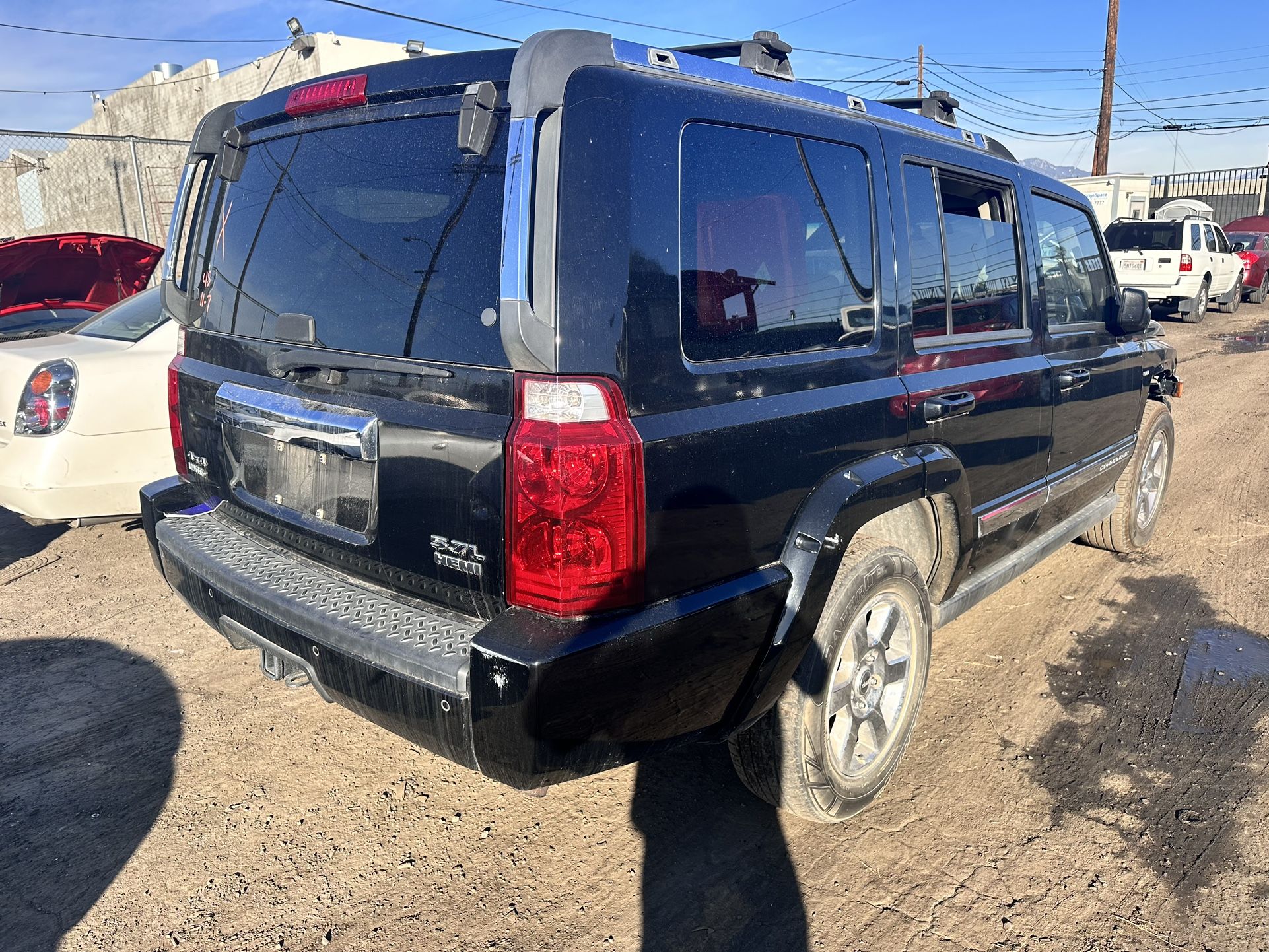
The 5.7-liter Hemi V8 Jeep Commander (XK platform) was produced from model years 2006 through 2010, offering three-row seating, up to 357 horsepower, and a maximum towing capacity of 7,200 pounds. Equipped with Chrysler’s Multi-Displacement System (MDS) and available Quadra-Drive II 4WD, it remains a uniquely capable boxy SUV, though prospective owners must manage specific valvetrain, cooling, and exhaust hardware vulnerabilities.
The Evolution of the 5.7L Hemi in the Jeep Commander (XK Platform)
Introduced for the 2006 model year, the Jeep Commander (XK) was engineered on the unibody architecture of the Grand Cherokee (WK), featuring integrated frame rails for structural rigidity. As Jeep’s first formal seven-passenger SUV, the Commander was designed to combine angular, classic Cherokee XJ-inspired styling with heavy-duty powertrain options. Among the available engines—which included a 3.7-liter PowerTech V6 and a 4.7-liter PowerTech V8—the 5.7-liter Hemi V8 stood out as the flagship powertrain, providing the torque and thermal headroom necessary for serious towing and steep terrain.
During its five-year production run, the 5.7-liter Hemi in the Commander underwent a major mid-cycle mechanical overhaul. Understanding the technical differences between these engine generations is essential for evaluating vehicle performance, longevity, and maintenance requirements.
Jeep Commander (XK) Powertrain Timeline
- 2006 - 2008: Pre-Eagle 5.7L Hemi V8
- Output: 330 hp / 375 lb-ft torque
- Fixed Camshaft Timing (Non-VVT)
- Multi-Displacement System (MDS)
- 545RFE 5-Speed Automatic Transmission
- 2009 - 2010: Eagle-Revised 5.7L Hemi V8
- Output: 357 hp / 389 lb-ft torque
- Variable Valve Timing (VVT) Added
- Revised Cylinder Heads & Dual-Length Intake Manifold
- Upgraded MDS & Strengthened Valvetrain
2006–2008 Model Years (Pre-Eagle Generation)
The initial iteration of the 5.7-liter Hemi V8 delivered 330 horsepower at 5,000 RPM and 375 lb-ft of torque at 4,000 RPM. This engine used cast-iron blocks with aluminum cylinder heads featuring hemispherical combustion chambers. Key design characteristics included:
- Fixed Camshaft Architecture: Non-Variable Valve Timing (non-VVT) setup driven by a single in-block camshaft operating two pushrod-actuated valves per cylinder.
- Multi-Displacement System (MDS): Chrysler’s early cylinder-deactivation technology, which used hydraulic solenoids to collapse the lifters on cylinders 1, 4, 6, and 7 under light load conditions, dropping the engine into four-cylinder operation to reduce fuel consumption.
- Dual Spark Plug Ignition: Two spark plugs per cylinder (16 total) to ensure fast flame propagation, complete combustion, and reduced emissions across varying load demands.
2009–2010 Model Years ("Eagle" Engine Revision)
For the 2009 model year, Chrysler introduced significant upgrades to the 5.7-liter Hemi across its vehicle lineup. Internal modifications in this "Eagle" variant elevated output to 357 horsepower and 389 lb-ft of torque in the Commander. The revised engine featured:
- Variable Valve Timing (VVT): A hydraulic phaser mounted on the camshaft allowed dynamic adjustment of valve timing relative to crankshaft position, vastly improving low-end torque and high-RPM breathing.
- Redesigned Cylinder Heads: Flow characteristics were enhanced with larger ports and reshaped combustion chambers, raising the static compression ratio from 9.6:1 to 10.5:1.
- Active Intake Manifold: A dual-length intake plenum switched between long and short intake runners depending on engine speed, optimizing airflow velocity across the power band.
- Updated MDS Solenoids and Lifters: Faster hydraulic response times minimized the transition lag between four-cylinder and eight-cylinder modes.
Powertrain, Transmission, and 4WD Systems
The performance of a 5.7 Hemi Jeep Commander depends heavily on its surrounding driveline hardware. Unlike light-duty crossover platforms, the XK utilized heavy-duty Chrysler truck components designed for off-road utility and high-payload operation.
- 5.7L Hemi V8 Powertrain
- Chrysler 545RFE 5-Speed Automatic
- NV245 Full-Time 2-Speed Transfer Case (2.72:1 Low Range)
- Quadra-Trac II (NV245): Brake Traction Control (Standard Package)
- Quadra-Drive II (NV245): Front & Rear Eaton ELSDs (Optional / Hemi Std.)
Chrysler 545RFE 5-Speed Automatic Transmission
Every 5.7 Hemi Commander came paired with the Chrysler 545RFE automatic transmission. This heavy-duty transmission featured a robust mechanical gear train including three planetary gearsets.
A unique software configuration gave the 545RFE dual second-gear ratios: a 1.67:1 ratio for upshifts and a wider 1.50:1 ratio for downshifts (kickdown). This provided smoother acceleration during passing maneuvers. When properly maintained with Chrysler-approved ATF+4 fluid and regular filter changes (both the main spin-on filter and the flat sump filter), the 545RFE handles the 5.7 Hemi's torque reliably.
Quadra-Trac II vs. Quadra-Drive II 4WD Systems
While some basic V6 Commanders were offered in two-wheel drive, 5.7 Hemi models were overwhelmingly equipped with sophisticated four-wheel-drive systems centered around the New Process NV245 full-time, two-speed transfer case featuring an electronically controlled center differential lock and a 2.72:1 low-range gear reduction.
- Quadra-Trac II: Utilizes the NV245 transfer case to continuously monitor wheel slippage via speed sensors. When wheel slip occurs, an internal electronically controlled clutch pack transfers up to 100% of available torque to the axle with traction. Side-to-side traction control is handled entirely by applying individual service brakes via the ABS module (Brake Traction Control).
- Quadra-Drive II (QDII): The flagship off-road configuration standard on or optioned with most 5.7 Hemi models. QDII pairs the NV245 transfer case with Eaton Electronic Limited-Slip Differentials (ELSD) built directly into both the front (Corporate 8.25-inch IFS) and rear (Chrysler 8.25-inch solid) axle assemblies. These gerotor-driven, solenoid-actuated clutch packs actively bind the left and right axle shafts together before wheel slip occurs. QDII can direct nearly 100% of engine torque to a single wheel with traction, making the 5.7 Hemi Commander one of the most capable factory-equipped off-road vehicles of its era.
Technical Specifications Comparison
The table below summarizes key mechanical specifications and fluid requirements for the 5.7-liter Hemi Jeep Commander across its production life cycle:
| Specification / Parameter | 2006–2008 (Pre-Eagle 5.7L V8) | 2009–2010 (Eagle VVT 5.7L V8) |
|---|---|---|
| Horsepower @ RPM | 330 hp @ 5,000 RPM | 357 hp @ 5,200 RPM |
| Torque @ RPM | 375 lb-ft @ 4,000 RPM | 389 lb-ft @ 4,200 RPM |
| Compression Ratio | 9.6:1 | 10.5:1 |
| Valve Train Architecture | OHV 16-Valve, Fixed Timing | OHV 16-Valve, VVT |
| Fuel System | Sequential Multi-Port Injection | Sequential Multi-Port Injection |
| Engine Oil Specification | SAE 5W-20 (MS-6395 Compliant) | SAE 5W-20 (MS-6395 Compliant) |
| Engine Oil Capacity | 7.0 Quarts (6.6 Liters) with filter | 7.0 Quarts (6.6 Liters) with filter |
| Spark Plug Specification | 16x Copper Core (0.045 in. gap) | 16x Platinum/Iridium (0.043 in. gap) |
| Spark Plug Service Interval | 30,000 Miles | 100,000 Miles |
| Transmission Model | 5-Speed Automatic (545RFE) | 5-Speed Automatic (545RFE) |
| Transfer Case Options | NV245 Full-Time 2-Speed | NV245 Full-Time 2-Speed |
| Max Towing Capacity | 7,200 lbs (3,266 kg) | 7,200 lbs (3,266 kg) |
| EPA Fuel Economy (4WD) | 13 City / 18 Hwy / 15 Combined | 13 City / 19 Hwy / 15 Combined |
Common Mechanical Reliability Issues and Solutions
While the 5.7-liter Hemi provides strong acceleration and towing power, high-mileage examples require attention to specific mechanical problem areas. Understanding these failure points helps prevent severe engine damage and diagnostic errors.
1. The "Hemi Tick" and Valvetrain Lifter Wear
The primary failure mode on modern pushrod Hemi engines involves the hydraulic roller lifters and camshaft lobes. The mechanical symptom manifests as a metallic tapping sound from under the valve covers that synchronizes with engine speed.
- Mechanism of Failure: Needle bearings inside the roller tip of the hydraulic lifter can fail, causing the roller wheel to seize. Once seized, the hard-faced roller turns into a sliding wedge that grinds away the lobe profile on the iron camshaft. This contamination sends fine metal particles through the oiling circuit.
- Role of Prolonged Idling: Idling reduces oil volume flung from the crankshaft journals to the camshaft lobes located high in the engine block. Combined with extended oil drain intervals, low lubrication under low-speed conditions accelerates needle bearing wear.
- MDS Lifter Sensitivity: The specialized deactivating MDS lifters on cylinders 1, 4, 6, and 7 are mechanically complex and prone to mechanical locking failure if wrong oil viscosity (such as 10W-30 instead of 5W-20) is used, restricting hydraulic pin actuation.
- Remedy: Resolving a failed lifter requires removing the cylinder heads, replacing the damaged camshaft, and installing a complete set of 16 new lifters along with a high-flow oil pump.
2. Valve Seat Dropping (Primarily 2006–2008 Pre-Eagle Engines)
Pre-Eagle 5.7 Hemi engines can experience dropped valve seats, a catastrophic condition where powder-metal valve seat inserts fall out of the aluminum cylinder head casting.
- Mechanism of Failure: The thermal expansion rate of the aluminum head differs from that of the pressed-in powder-metal valve seat. If the engine suffers an severe overheating event caused by a cooling system leak, stuck thermostat, or radiator fan failure, the aluminum expands beyond its elastic limit. Upon cooling, the press-fit pressure holding the valve seat is lost. The seat drops into the combustion chamber, where it is struck by the valve and piston, destroying the piston crown, cylinder wall, and cylinder head.
- Prevention: Maintain strict control over the cooling system. Never drive a 5.7 Hemi that is operating above normal operating temperatures. Any overheating incident warrants immediate mechanical inspection.
3. Exhaust Manifold Stud Shear and Exhaust Leaks
A frequent cause of engine bay noise on the 5.7 Hemi is a broken exhaust manifold bolt, often mistaken for internal valvetrain ticking.
- Mechanism of Failure: The heavy cast-iron exhaust manifolds expand and contract at different rates than the aluminum cylinder heads. Over thousands of heat cycles, the rear-most exhaust manifold bolts (typically cylinders 7 and 8) experience high shearing stress and snap off flush with or inside the cylinder head surface.
- Diagnosis & Repair: A failed exhaust manifold bolt creates a loud ticking noise on cold startup that fades as the cast-iron manifold heats up and expands to temporarily plug the leak. Repair requires removing the manifold, extracting the broken bolt shanks from the aluminum head, leveling the warped manifold mounting surface on a belt sander, and installing upgraded stainless-steel studs with fresh gaskets.
Cold Engine Noise Diagnostics
- Exhaust Manifold Leak
- Loud sharp tick when cold
- Fades or stops as engine warms and expands
- Soot marks near exhaust port
- Valvetrain / Lifter Tick
- Continuous rhythmic metallic clack across temperature
- Increases directly with RPM
- Unchanged after warm-up
4. Cooling System Vulnerabilities
The 5.7 Hemi generates substantial thermal output, and the Commander's engine bay packaging leaves limited room for heat dissipation.
- Radiator Side Tank Cracking: The factory radiator uses plastic side tanks crimped to an aluminum core. Over time, heat cycles degrade the plastic, causing hair-line stress cracks near the upper hose neck.
- Hydraulic/Mechanical Fan Failures: Commanders rely on a combination of an electric cooling fan and a mechanical belt-driven fan clutch (or a hydraulic fan motor run off the power steering pump on early models). A degraded fan clutch causes engine temperatures to spike rapidly when idling in traffic or during low-speed off-road crawling.
5. N23 Recall and Transfer Case Shift Actuator Glitches
Commanders equipped with the NV245 transfer case were subject to Safety Recall N23 (and subsequent follow-up service actions).
- Issue: Chrysler issued software updates intended to prevent low-range actuator circuit board traces from cracking and accidentally shifting the transfer case into neutral while parked. However, the initial software flash caused system diagnostic tolerances to become overly strict, frequently locking users out of 4WD Low range and illuminating the "Service 4WD System" message.
- Resolution: Verify that the transfer case control module (TCCM) has the corrected revision software applied, or replace the shift actuator motor on the transfer case if circuit faults persist.
Maintenance Schedules and Operational Requirements
To ensure powertrain durability and prevent common failure modes on a 5.7 Hemi Jeep Commander, adhere to these maintenance parameters:
| Component / Parameter | Crucial Maintenance Requirements |
|---|---|
| Engine Oil | SAE 5W-20 ONLY. Change every 3,000-5,000 miles. Strictly required for proper MDS hydraulic function. |
| Spark Plugs | 16 total (2 per cylinder).2006-2008: Change non-platinum copper every 30k mi.2009-2010: Change platinum/iridium every 100k mi. |
| Transmission | ATF+4 Fluid & Dual Filters. Change every 45,000 miles. |
| Axles (QDII) | 75W-140 Full Synthetic + 4 oz. Mopar Friction Modifier (MS-10111) per axle every 30,000 miles. |
Critical Fluid Standards
- Engine Oil Viscosity: Use SAE 5W-20 engine oil meeting Chrysler MS-6395 standards. Do not switch to heavier 10W-30 or 10W-40 viscosities; the MDS lifter solenoids rely on precise hydraulic oil pressures to actuate and disengage. Heavier oils can delay pin lock-up, causing false misfire codes (P0300, P0301-P0308) and lifter damage.
- Axle Lubrication for Quadra-Drive II: Front and rear differentials on QDII vehicles require SAE 75W-140 synthetic gear lubricant combined with 4 ounces of Mopar Limited Slip Additive (Friction Modifier) per differential housing. Omission of this additive causes chatter, binding, and premature clutch pack wear during tight turning maneuvers.
- Automatic Transmission Fluid: Service the 545RFE with Mopar ATF+4 fluid exclusively. Universal multi-vehicle fluids can alter clutch friction coefficients, leading to harsh shift quality or internal slippage.
Towing Performance and Off-Road Capabilities
Equipped with the 5.7 Hemi, the Jeep Commander becomes a capable tow rig and trail vehicle, though its short wheelbase and curb weight demand proper setup.
Towing Performance
- Maximum Capacity: Rated up to 7,200 pounds for 4WD models when equipped with the factory Class IV receiver hitch, 7-pin wiring harness, and integrated heavy-duty engine cooling.
- Practical Limitations: While the engine produces sufficient low-end torque for pulling heavy trailers, the Commander’s 112.9-inch wheelbase is shorter than full-size trucks. Using a quality Weight Distribution Hitch (WDH) with integrated sway control is critical when towing loads over 5,000 pounds to prevent trailer sway.
- Transmission Heat Management: When towing in mountainous terrain or high ambient temperatures, shift the gear selector manually to lock out 5th gear (Overdrive). Monitor transmission fluid temperatures, as overheating ATF+4 fluid degrades clutch materials inside the torque converter lock-up assembly.
Off-Road Capability
- Geometry: The XK platform offers a 34-degree approach angle, a 27-degree departure angle, and a 20-degree breakover angle in factory trim, with a ground clearance of approximately 8.6 inches.
- Quadra-Drive II Operation: On trails, QDII actively senses traction loss and locks the differential clutches instantly. This allows the vehicle to climb steep, cross-articulated obstacles even if three wheels lose traction entirely.
Buyer's Guide and Pre-Purchase Inspection Checklist
When inspecting a pre-owned 5.7 Hemi Jeep Commander, complete a step-by-step physical and diagnostic check:
1. Cold Engine Startup Test
- Start the engine when completely cold. Listen closely near the front wheel wells.
- A tick that disappears after two minutes points to a broken exhaust manifold bolt.
- A persistent, sharp metallic clack that increases speed directly with engine RPM signals hydraulic lifter or camshaft lobe failure.
2. Drivetrain and 4WD Functional Verification
- Drive the vehicle in tight slow-speed circles on pavement. Listen for grinding, chatter, or binding from the front or rear axles. Excessive binding indicates missing limited-slip friction modifier or damaged ELSD clutch packs.
- Stop the vehicle, place the transmission in Neutral, and pull the T-handle 4WD switch to engage 4WD Low. Verify that the transfer case shifts smoothly within three seconds and displays "4WD LOW" on the instrument cluster without illuminating a "Service 4WD System" fault light.
3. Cooling System Integrity Check
- Examine the plastic side tanks of the radiator for white, powdery residue or green/orange anti-freeze staining along the crimp seams.
- Check the engine oil fill cap and dipstick for milky, emulsified oil, which indicates a blown head gasket or cracked cylinder head resulting from prior overheating.
4. Body, Unibody Rail, and Sunroof Drain Inspection
- Inspect the unibody frame rails, rocker panels, and floorboards for rust perforation, especially behind the rear axle.
- Check for damp carpets in the front footwells. The Commander’s dual skylights and front sunroof feature drain tubes that clog easily with leaves and dirt. Water backing up into the cabin drips directly down into the dash area, corroding the Totally Integrated Power Module (TIPM) and kick-panel wiring blocks, leading to intermittent electrical failures.
Frequently Asked Questions
Is the 5.7 Hemi Jeep Commander reliable for long trips?
Yes, when cooling system components, oil changes, and fluid service intervals are properly maintained. The 5.7 Hemi engine block and 545RFE transmission are mechanically durable, but aging cooling hoses, radiators, and valvetrain components should be inspected before taking long highway drives or undertaking heavy towing trips.
Can you tow a camper with a 5.7 Hemi Jeep Commander?
Yes. When fitted with a factory Class IV hitch package, the 5.7 Hemi Commander is rated to tow up to 7,200 pounds. For travel trailers weighing over 4,000 pounds, use an auxiliary transmission cooler, a brake controller, and a weight-distribution hitch with integrated sway control for highway stability.
What causes the "Service 4WD System" light in a Jeep Commander?
This warning light is commonly caused by a faulted transfer case shift motor actuator, a failing wheel speed sensor, missing friction modifier in the differentials, or software issues related to the N23 recall flash on the Transfer Case Control Module (TCCM). Diagnostic trouble codes must be scanned using an OBD-II scanner capable of reading Chrysler chassis/4WD codes.
Is the 2009–2010 5.7 Hemi better than the 2006–2008 version?
Mechanically, the 2009–2010 "Eagle" Hemi is superior. It offers 27 additional horsepower, 14 more lb-ft of torque, Variable Valve Timing (VVT), upgraded cylinder heads, and improved valvetrain durability that reduces the risk of dropped valve seats compared to the 2006–2008 models.
Does turning off MDS fix the 5.7 Hemi lifter ticking issue?
No. Disabling the Multi-Displacement System electronically (via an aftermarket tuner or by driving in "Tow/Haul" mode) stops the engine from dropping into four-cylinder operation, but it does not fix a mechanically damaged lifter or worn camshaft lobe. If a lifter roller has seized or eroded the cam lobe, mechanical replacement is required.
Summary Recommendations
The 5.7-liter Hemi Jeep Commander remains a practical, heavy-duty alternative to traditional full-size body-on-frame SUVs. It offers high towing capacity, true three-row seating, and off-road performance through its optional Quadra-Drive II system.
When purchasing or maintaining a 5.7 Hemi Commander:
- Prioritize 2009–2010 Models: Select an "Eagle" engine model year if possible for superior valvetrain reliability, increased horsepower, and VVT torque delivery.
- Enforce Fluid Compliance: Use only SAE 5W-20 oil meeting MS-6395 standards to safeguard hydraulic lifters and MDS solenoids. Add Mopar Friction Modifier to Quadra-Drive II differentials during every gear oil service.
- Address Cooling Promptly: Replace aging plastic-tank radiators, mechanical fan clutches, and thermostats at the first sign of wear to prevent overheating events that damage aluminum cylinder heads.