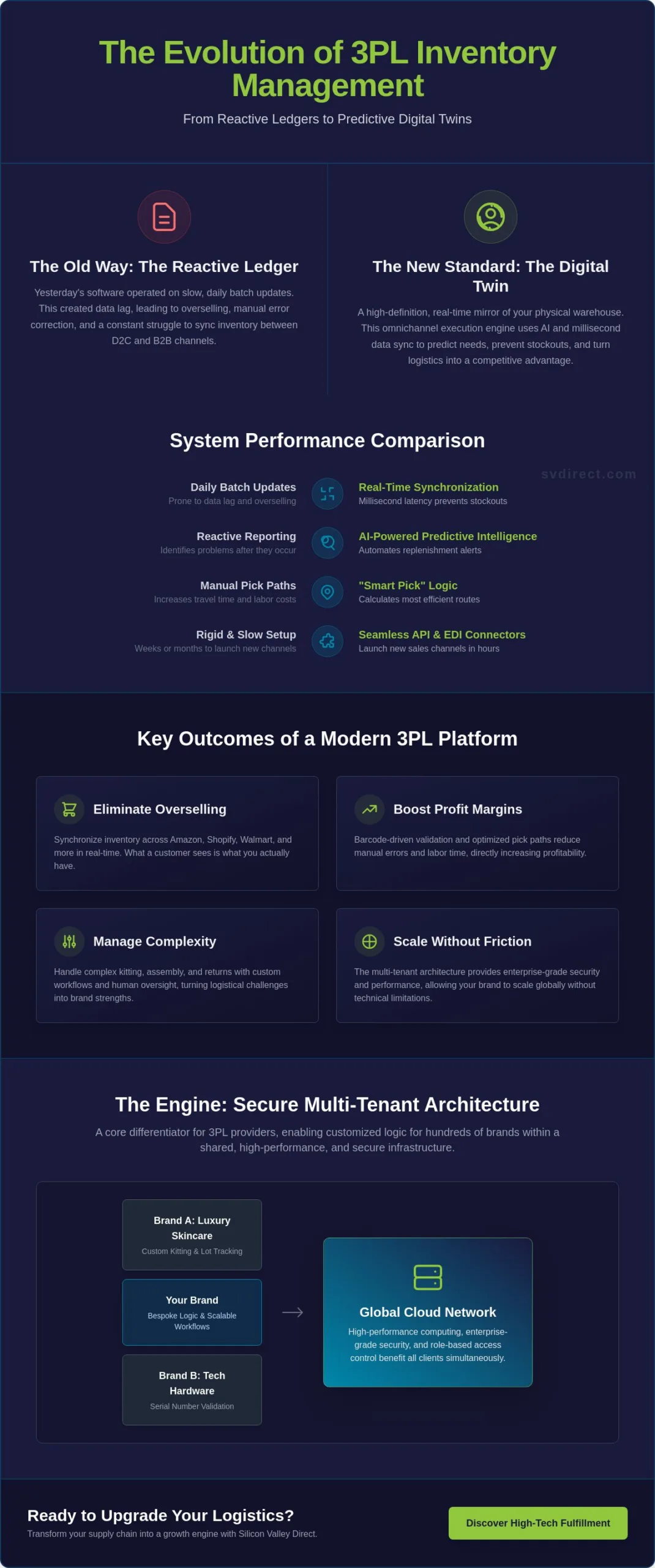
Effective 3PL inventory management involves outsourcing storage, tracking, and fulfillment processes to a third-party logistics provider while utilizing shared warehouse management software and barcode systems to maintain real-time visibility, optimize stock levels, and ensure accurate, timely order fulfillment for customers.
Understanding 3PL Inventory Management
In modern supply chain ecosystems, scaling a business often requires moving beyond the confines of a garage, spare room, or private micro-warehouse. When order volume surges, handling inbound shipments, organizing stock, picking items, packing boxes, and generating shipping labels becomes an administrative and physical bottleneck. This is where a third-party logistics (3PL) provider enters the picture. However, handing over physical inventory to an external partner does not mean relinquishing control over your stock data.
Inventory management within a 3PL framework acts as the digital and strategic bridge between an e-commerce brand and the physical warehouse floor. It encompasses the systems, protocols, and data exchanges that allow merchants to monitor stock levels, forecast demand, prevent stockouts, and audit fulfillment accuracy across one or multiple warehouse locations. Without a robust 3PL inventory management strategy, businesses quickly run into discrepancies, unexpected storage fees, and severe customer dissatisfaction due to delayed or incorrect shipments.
Core Components of 3PL Inventory Systems
To understand how third-party inventory oversight functions, you must examine the underlying architecture that connects merchants and warehouse operators. At its core, the system relies on specialized software, hardware integration, and tightly defined operational workflows.
Warehouse Management Systems (WMS)
The primary engine behind any efficient 3PL operation is the Warehouse Management System (WMS). A WMS tracks inventory from the moment it arrives at the loading dock until it leaves the facility in a delivery truck. For brands utilizing a 3PL, the provider's WMS must integrate seamlessly with the brand's sales channels—such as Shopify, WooCommerce, Amazon, or enterprise ERP systems. This integration ensures that every time a customer completes a purchase online, the 3PL's warehouse software immediately receives the order details, allocating the specific items from the correct bin or shelf.
Barcoding, RFID, and Data Capture
Manual counting is prone to human error, misplaced stock, and extended fulfillment windows. Professional 3PL facilities rely heavily on barcode scanning, GS1-compliant labels, and occasionally Radio Frequency Identification (RFID) technology. When inventory arrives at a 3PL warehouse, workers scan each master carton, pallet, or individual unit to log its receipt into the system. Subsequent movements—such as moving stock from bulk storage to picking zones—require additional scans, ensuring that the digital inventory ledger matches the physical reality on the floor.
Inventory Accounting and Valuation Methods
Accurate valuation of goods stored in a 3PL facility is essential for financial reporting, tax compliance, and insurance purposes. Common inventory valuation methods utilized in conjunction with 3PL data include:
- FIFO (First-In, First-Out): Assumes the oldest inventory items are sold first, which is critical for perishable goods or products with lifecycle trends.
- LIFO (Last-In, First-Out): Assumes newer inventory is sold first, often used for non-perishable goods during inflationary periods.
- Weighted Average Cost: Calculates inventory value based on the average cost of goods purchased across a specific period.
The Operational Workflow of 3PL Inventory Tracking
Managing inventory through an external partner follows a predictable lifecycle. Understanding each stage helps businesses identify potential friction points and optimize their supply chain performance.
[Inbound Receiving] ➔ [Put-Away & Storage] ➔ [Order Processing & Picking] ➔ [Packing & Shipping]
1. Inbound Receiving and Inspection
The lifecycle begins when a supplier or manufacturer ships products to the 3PL warehouse. Prior to arrival, the merchant must submit an Advanced Shipping Notice (ASN) to the 3PL. The ASN outlines the expected quantities, SKU numbers, and pallet configurations. Upon arrival, warehouse staff inspect the shipment for damaged goods, verify quantities against the ASN, and log the items into the WMS. Discrepancies identified during receiving are flagged immediately so the merchant can address them with their manufacturer.
2. Put-Away Strategies
Once received, inventory is assigned a specific storage location within the warehouse—a process known as "put-away." Advanced 3PLs use dynamic slotting algorithms, placing fast-moving items (Class A inventory) closer to the packing stations to minimize travel time for pickers, while storing slow-moving items (Class C inventory) in upper racks or remote zones.
3. Picking and Packing Protocols
When an order is placed, warehouse staff retrieve the items using one of several methodologies:
- Piece Picking: A single worker collects all items for a single order.
- Batch Picking: A worker collects items for multiple orders simultaneously to reduce transit time across the warehouse.
- Zone Picking: Workers are assigned to specific zones of the warehouse; items for an order pass through each zone until complete.
4. Cycle Counting and Audits
Unlike annual physical inventories that require shutting down warehouse operations, professional 3PLs perform regular cycle counts. They audit a subset of SKUs on a rotating daily or weekly schedule. This ongoing verification maintains high inventory accuracy rates (typically 99% or higher) without disrupting daily order fulfillment.
Comparing In-House Inventory Management vs. 3PL Management
Deciding whether to manage inventory internally or partner with a 3PL depends on order volume, capital availability, and growth targets. The following comparison highlights key operational differences.
| Feature | In-House Inventory Management | 3PL Inventory Management |
|---|---|---|
| Capital Expenditure | High (Warehouse lease, material handling equipment, WMS software licenses). | Low to Moderate (Pay-as-you-go storage and fulfillment fees). |
| Scalability | Rigid; scaling requires hiring staff, leasing more space, and purchasing equipment. | Highly flexible; easily scales up or down based on seasonal volume and growth. |
| Technology Access | Dependent on internal budget for software upgrades and IT maintenance. | Access to enterprise-grade WMS, automation tools, and carrier networks. |
| Geographic Reach | Usually limited to a single facility or regional footprint. | Multi-warehouse distribution networks for closer proximity to end customers. |
| Control Level | Direct, hands-on oversight of physical stock and warehouse personnel. | Indirect oversight via software dashboards, reporting, and Service Level Agreements (SLAs). |
Key Metrics to Monitor in 3PL Inventory Management
To ensure your third-party logistics partner is performing effectively and your stock is optimized, you must track specific Key Performance Indicators (KPIs). Relying on gut feeling is insufficient; data-driven oversight protects your profit margins.
Inventory Turnover Ratio
The inventory turnover ratio measures how many times a company sells and replaces its stock of goods over a given period. A low turnover rate indicates stagnant stock, tying up capital in holding costs and potential obsolescence. A high turnover rate indicates strong sales, but if it is excessively high, it may signal frequent stockouts and lost revenue opportunities.
Carrying Costs
Carrying costs represent the total expense of holding inventory, including warehouse storage fees, insurance, taxes, depreciation, and the opportunity cost of tied-up capital. When evaluating a 3PL contract, analyze how storage fees are calculated—whether based on pallet positions, cubic footage, or bin locations—to keep carrying costs manageable.
Order Accuracy and Fulfillment Rate
Order accuracy measures the percentage of orders shipped without picking or packing errors. A top-tier 3PL should maintain an order accuracy rate of 99.5% or higher. Errors directly impact customer trust and generate expensive reverse logistics (returns) processing costs.
Inventory Shrinkage
Shrinkage accounts for inventory lost due to damage, theft, administrative error, or supplier short-shipments. Regular reconciliation between your internal e-commerce platform and the 3PL's WMS helps identify shrinkage trends early.
Common Mistakes and Pitfalls to Avoid
Outsourcing inventory management introduces unique operational challenges. Avoiding common missteps ensures a smoother partnership with your logistics provider.
- Failing to Sync SKUs Properly: Mismatched SKU names or barcodes between your e-commerce platform and the 3PL's WMS lead to severe picking errors and phantom inventory. Standardize your product catalog before onboarding.
- Neglecting Safety Stock Calculations: Underestimating lead times and safety stock levels during peak shopping seasons (such as Black Friday or the winter holidays) results in stockouts. Maintain open communication with your 3PL regarding marketing campaigns and projected sales spikes.
- Ignoring SLA Details: Signing a 3PL contract without clear Service Level Agreements regarding receiving turnaround times, cut-off times for same-day shipping, and liability limits for damaged or lost stock leaves your business vulnerable to unmitigated losses.
- Overlooking Return Logistics (Reverse Logistics): Inventory management does not end when an item leaves the warehouse; returns must be inspected, restocked, or disposed of efficiently. Ensure your 3PL has a clear, documented protocol for handling returned merchandise.
Strategic Best Practices for Seamless 3PL Integration
To maximize the efficiency of your third-party logistics partnership, implement these proven operational strategies:
- Conduct Rigorous Onboarding Audits: When transferring stock to a new 3PL, perform a comprehensive physical count of all items before dispatch. Reconcile this count against the initial receiving report generated by the 3PL.
- Establish Automated Low-Stock Alerts: Configure your WMS or e-commerce platform to trigger automated reorder alerts when inventory drops below a defined threshold, accounting for the 3PL's replenishment lead time.
- Maintain Regular Communication Channels: Schedule monthly or quarterly performance reviews with your 3PL account manager to discuss fulfillment metrics, upcoming promotional events, and warehouse efficiency improvements.
- Leverage Multi-Warehouse Distribution: If your customer base is geographically dispersed, consider splitting your inventory across multiple 3PL fulfillment centers. This reduces shipping zones, lowers freight costs, and shortens transit times for end buyers.
Frequently Asked Questions
How do 3PL providers charge for inventory storage?
Third-party logistics providers typically charge for storage using one of three models: pallet pricing (a flat fee per pallet position per month), cubic footage pricing (charged by the space your goods occupy in bins, shelves, or floor stacks), or integrated warehousing fees bundled into pick-and-pack rates. Selecting the right model depends on your product size, turnover rate, and packaging type.
Who is responsible if inventory is damaged or lost in a 3PL warehouse?
Responsibility is governed by the Service Level Agreement (SLA) and contract signed with the 3PL. Most reputable providers carry warehouse keeper's legal liability insurance. If stock is lost or damaged due to warehouse negligence (such as forklift accidents or facility leaks), the 3PL is typically required to reimburse the wholesale cost of the goods, up to specified liability limits.
Can I connect my existing e-commerce platform to a 3PL warehouse management system?
Yes. Modern 3PLs utilize advanced Warehouse Management Systems equipped with pre-built API integrations for major e-commerce platforms like Shopify, Magento, WooCommerce, and major marketplaces. These integrations enable real-time synchronization of inventory counts and order data without manual data entry.
What is the difference between a 3PL and a 4PL?
A third-party logistics (3PL) provider manages physical warehouse operations, storage, and fulfillment execution. A fourth-party logistics (4PL) provider acts as an overarching supply chain integrator, managing multiple 3PL providers, freight forwarders, and transportation networks on behalf of the merchant, offering a single point of strategic oversight.
How often should I reconcile my inventory with my 3PL?
While automated software updates stock levels continuously, physical reconciliation should occur regularly. Most businesses perform weekly or monthly cycle counts for high-value or fast-moving SKUs, paired with a comprehensive physical inventory audit at least once per year.
Conclusion and Next Actions
Mastering 3PL inventory management is a vital milestone for scaling e-commerce brands and growing wholesale operations. By combining robust warehouse management software, precise tracking protocols, and clear Service Level Agreements, businesses can eliminate fulfillment bottlenecks and protect profit margins.
To take the next step, audit your current inventory accuracy, review your existing 3PL contract for SLA gaps, and ensure your e-commerce platforms are integrated with real-time stock-tracking tools to maintain complete visibility across your supply chain.