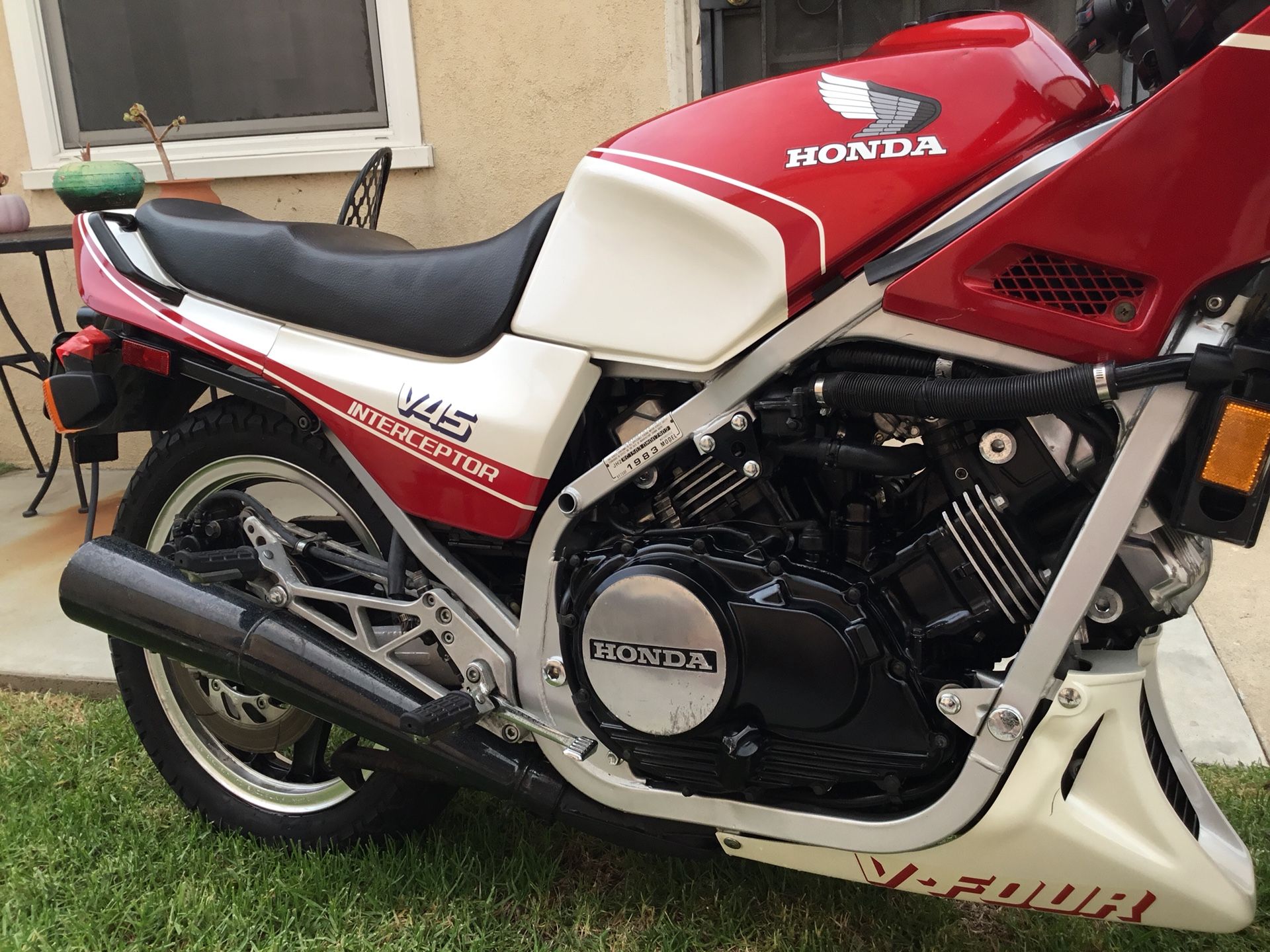
The 1984 Honda VF750F Interceptor stands as a pivotal milestone in motorcycle history, representing the moment the "superbike" transitioned from modified street machines to purpose-built, race-inspired replicas. As of 2026, it remains one of the most significant collector motorcycles for its role in introducing liquid-cooled V4 technology and sophisticated aerodynamics to the mass market.
The 1984 Honda VF750F Interceptor was a high-performance sportbike featuring a 748cc, 90-degree V4 engine, a box-section steel frame, and innovative features like the TRAC anti-dive fork. It solved the industry's plateau in air-cooled performance by offering superior cooling, a narrower profile, and a chassis designed for the track, setting the blueprint for the modern sportbike era.
The Genesis of the Interceptor: A V4 Revolution
To understand the 1984 Interceptor, one must look at the landscape of the early 1980s. The "Universal Japanese Motorcycle" (UJM) era—characterized by air-cooled, inline-four engines in tubular steel frames—had reached its performance ceiling. Honda, seeking to assert its engineering dominance, turned to the V4 configuration, a design heavily influenced by their NR500 and RS1000RW race programs.
The VF750F, first introduced in late 1983 and refined for the 1984 model year, was a radical departure from everything that preceded it. While the engine was based on the earlier VF750S (Sabre) and VF750C (Magna) cruisers, the Interceptor was a different animal entirely. Honda engineers focused on mass centralization and a low center of gravity, qualities inherent to the narrow V4 layout.
By 1984, the Interceptor had become a cultural icon. It wasn't just a motorcycle; it was the machine that Freddie Spencer used to dominate AMA Superbike racing. This "win on Sunday, sell on Monday" philosophy was never more effective than with the VF750F, which wore the iconic red, white, and blue HRC (Honda Racing Corporation) colors that still define Honda’s performance identity in 2026.
Technical Specifications and Architecture
The heart of the 1984 Interceptor is its liquid-cooled, 90-degree V4 engine. This configuration offers a primary balance that an inline-four cannot match without heavy balance shafts, resulting in a smooth power delivery that remains impressive even by modern standards.
Engine and Drivetrain
The engine utilized a double-overhead-cam (DOHC) layout with four valves per cylinder. Unlike later VFR models that used gear-driven cams, the 1984 VF750F relied on a chain-driven system. Power was transmitted through a five-speed gearbox and a hydraulically actuated "slipper" clutch—a rarity for the time—designed to prevent rear-wheel hop during aggressive downshifting.
| Feature | Specification |
|---|---|
| Engine Type | 748cc liquid-cooled 90° V4 |
| Bore x Stroke | 70.0 mm × 48.6 mm |
| Compression Ratio | 10.5:1 |
| Valve Train | DOHC, 4 valves per cylinder |
| Carburetion | Four 32mm Keihin CV |
| Maximum Power | ~86 hp @ 10,000 rpm |
| Maximum Torque | ~46 lb-ft @ 7,500 rpm |
| Transmission | 5-speed with slipper clutch |
| Final Drive | O-ring chain |
| Wet Weight | Approx. 548 lbs (249 kg) |
Chassis and Suspension
The 1984 model featured a perimeter-style box-section steel frame. While aluminum frames would become the standard a few years later with the Suzuki GSX-R750, the Interceptor's steel frame was exceptionally rigid for its day.
The front suspension utilized a 39mm fork equipped with Honda’s TRAC (Torque Reactive Anti-dive Control) system. This mechanical linkage used the torque from the front brake caliper to close a valve in the fork, increasing compression damping and preventing the front end from diving excessively under hard braking. The rear featured the Pro-Link monoshock system, offering a rising-rate suspension that could handle small bumps comfortably while remaining stiff enough for high-speed cornering.
Performance and Handling Characteristics
In 1984, the Interceptor was widely considered the best-handling motorcycle in the 750cc class. The 16-inch front wheel, a trend inspired by Grand Prix racing at the time, allowed for incredibly quick turn-in. While modern riders in 2026 might find a 16-inch front wheel "twitchy," it provided the Interceptor with an agility that made it a weapon on twisty backroads and race tracks alike.
The power delivery is linear, with a distinct V4 "growl" that is markedly different from the "scream" of an inline-four. The 360-degree crankshaft in the 1984 model gives it a unique exhaust note and a tactile sensation often described as "soulful" by collectors. On the highway, the small bikini fairing and belly pan provide surprisingly effective wind protection, making it a capable sport-tourer as well as a pure sportbike.
The Camshaft Controversy: A Historical Technical Analysis
One cannot discuss the 1984 VF750F without addressing the "Chocolate Cam" issue. Early V4 models earned a reputation for premature camshaft wear, which nearly damaged Honda's reputation for reliability.
The Root Cause
Technical post-mortems conducted by enthusiasts and engineers over the decades have identified three primary factors:
- Oiling Volume: The top end of the engine did not receive sufficient oil pressure at low RPMs, particularly during cold starts.
- Manufacturing Tolerances: Inconsistent hardening of the camshaft lobes led to some cams being softer than others.
- Valve Clearance Maintenance: The screw-and-nut adjusters were difficult to access, leading many owners to skip critical maintenance, which exacerbated the wear.
The 2026 Perspective on Reliability
For a rider looking at an Interceptor in 2026, this issue is well-understood and manageable. Most surviving machines have either been retrofitted with "oil kits"—aftermarket lines that tap into the main oil gallery to provide high-pressure lubrication directly to the heads—or have already had their cams replaced with hardened units. When properly maintained, a VF750F engine is capable of exceeding 50,000 miles without significant top-end issues.
Buying and Owning a 1984 Interceptor in 2026
Collecting a first-generation Interceptor requires a blend of passion and mechanical foresight. Because these bikes were often ridden hard or modified, finding an original, "unmolested" example is increasingly difficult and expensive.
What to Look For
- Original Exhaust: The 4-into-2 chrome exhaust is prone to rusting from the inside out. Finding an original set in good condition is a major value-add.
- Plastic Integrity: The ABS plastic fairings become brittle with age. Look for cracks around the mounting points, especially the tabs on the side covers.
- The 16-inch Front Tire: Tire manufacturers have limited production of high-performance 16-inch front tires. In 2026, options like the Bridgestone Battlax series are often the only choice for maintaining original geometry.
- Fuel System: The V4 carburetors are tightly packed. If the bike has been sitting, cleaning the four Keihin carbs is a labor-intensive task that requires patience and precision.
Current Market Value
As of 2026, the market for the VF750F has bifurcated.
- Project bikes: Can be found for $2,000–$3,500, but restoration costs (specifically paint and chrome) can quickly exceed the bike's value.
- Driver-quality examples: Usually command $5,000–$7,500.
- Concours/Museum-quality: pristine, low-mileage 1984 Interceptors are fetching between $10,000 and $14,000 at specialty auctions like Mecum or Bring a Trailer.
Comparisons with Contemporaries
To appreciate the Interceptor, it helps to compare it to its 1984 rivals: the Kawasaki GPz750 and the Suzuki GS750ES.
- Kawasaki GPz750: While the GPz was a formidable machine with a legendary air-cooled engine, it felt like the pinnacle of the old school. It was heavier and lacked the sophisticated liquid cooling and V4 torque of the Honda.
- Suzuki GS750ES: The Suzuki was a balanced and reliable machine, but its styling was more conservative, and its chassis didn't offer the same level of feedback as the Interceptor's race-derived frame.
The Honda felt like a machine from the future. Its narrow waist, aggressive stance, and the complexity of its V4 engine made its competitors look dated overnight.
Legacy: The Mother of the VFR
The 1984 VF750F was the direct ancestor of the VFR750F (Interceptor) and the subsequent VFR800 series. Honda took the lessons learned from the VF750F—especially regarding the camshaft issues—and developed the gear-driven cam V4 engine that became legendary for bulletproof reliability.
In 2026, the 1984 model is celebrated not just for what it was, but for what it started. It moved the motorcycle industry toward the "race replica" era, paving the way for the CBRs, GSX-Rs, and YZFs that would dominate the next four decades. It proved that a street bike could truly be a racing machine with lights and a horn.
Frequently Asked Questions
Is the 1984 VF750F Interceptor a good beginner bike?
No. Despite its age, it remains a heavy and powerful machine with 1980s-era braking and suspension. Parts are scarce, and the maintenance requirements are higher than those of a modern entry-level bike. It is best suited for experienced riders or collectors.
How can I tell if the camshafts are failing?
A "ticking" or "clacking" sound from the top end that does not disappear after a valve adjustment is a primary indicator. Expert inspection involves removing the valve covers to check for "pitting" or "scuffing" on the cam lobes. If the lobes look smooth and polished, the engine is likely healthy.
What is the difference between the 1983 and 1984 models?
The differences are minimal. The 1984 model featured slightly revised graphics and minor internal updates to the oiling system, though the core "cam issue" wasn't fully resolved until the introduction of the VFR750 in 1986. Most parts are interchangeable between 1983 and 1984.
Can I upgrade the brakes on an original Interceptor?
While possible, most collectors advise against it to preserve the bike's value. However, replacing the old rubber brake lines with braided stainless steel lines and using modern sintered brake pads can significantly improve stopping power without altering the vintage look.
Why did Honda use a 16-inch front wheel?
In the early 80s, tire technology was evolving rapidly. A smaller front wheel allowed for a shorter wheelbase and quicker steering response. It was the standard in 500cc Grand Prix racing, and Honda wanted the Interceptor to mirror that "pro" feel.
Final Recommendation
For the enthusiast in 2026 looking to own a piece of history, the 1984 Honda VF750F Interceptor is a rewarding investment. It offers a riding experience that is visceral, mechanical, and distinct from the sanitized feel of modern superbikes. To ensure a successful ownership experience, prioritize bikes with documented service history (specifically valve adjustments and oiling kits) and original bodywork. Owning an Interceptor is not just about owning a motorcycle; it is about preserving the machine that fundamentally changed the definition of a sportbike.