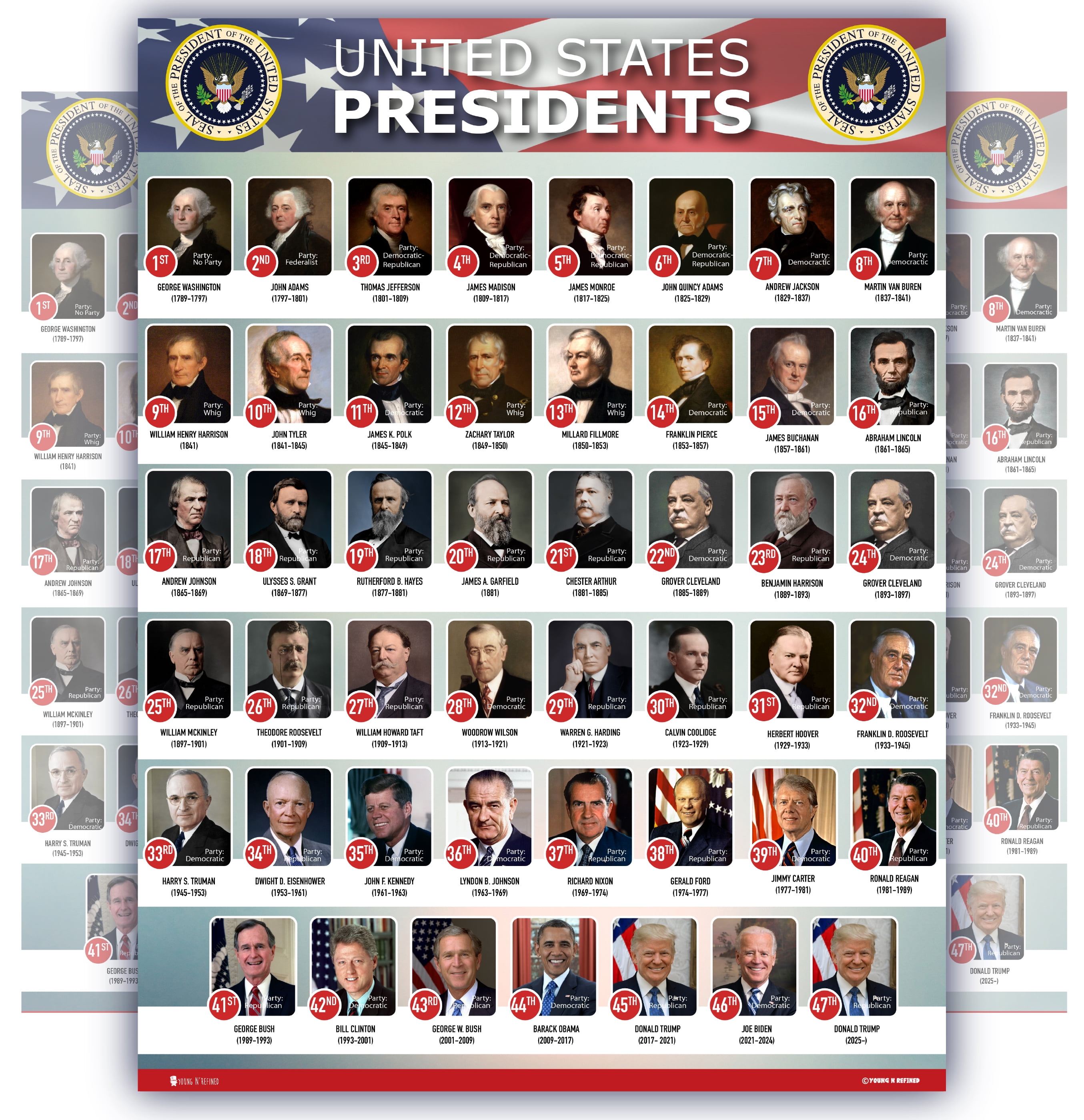
The formation of the United States from a fragile coalition of rebellious colonies into a stable, continental republic was forged through the executive decisions, legislative navigations, and ideological visions of its earliest leaders. Ten foundational executives—from George Washington to John Quincy Adams—defined the scope of federal power, established foreign policy traditions, and navigated existential domestic crises that determined the survival of the American experiment.
1. George Washington (1st President, 1789–1797)
As the indispensable figure of the American Revolution and the unanimous choice for the inaugural presidency, George Washington established the institutional habits and structural precedents of the executive branch. Operating with the understanding that every action would set a constitutional benchmark, he balanced the demands of an energetic national government with republican restraint.
Washington structured the first cabinet, selecting political rivals like Thomas Jefferson and Alexander Hamilton to foster broad-based administration, though their ideological clashes quickly birthed the First Party System. His foreign policy centered on strict neutrality, codified in his 1793 Proclamation of Neutrality, insulating the fragile young republic from the vortex of the French Revolutionary Wars. Domestically, Washington demonstrated the federal government's enforcement capacity by leading a militia force to suppress the Whiskey Rebellion in western Pennsylvania, proving that federal tax laws would be enforced through civil power rather than mob rule. By voluntarily stepping down after two terms, Washington permanently embedded the norm of peaceful transfer of power, immunizing the republic against the temptation of executive permanence.
2. John Adams (2nd President, 1797–1801)
John Adams inherited a fractured nation caught in the crossfire of an undeclared naval war with France (the Quasi-War). A brilliant constitutional theorist and former diplomat, Adams prioritized national sovereignty over partisan popularity, steering the country away from full-scale military conflict despite intense pressure from the militant wing of his own Federalist party.
The defining and most controversial domestic milestone of the Adams administration was the enactment of the Alien and Sedition Acts of 1798. Designed to curb the influence of French sympathizers and suppress partisan criticism from Democratic-Republican newspapers, these statutes represented a profound overreach of federal authority, leading directly to the drafting of the Kentucky and Virginia Resolutions by Jefferson and James Madison. Despite the domestic fallout, Adams's most enduring statesmanlike achievement was the peaceful resolution of the Quasi-War via the Convention of 1800, which freed the United States from its entangling Revolutionary-era alliance with France and set the stage for continental expansion.
3. Thomas Jefferson (3rd President, 1801–1809)
Thomas Jefferson's election marked the "Revolution of 1800," the first peaceful transfer of power between opposing political parties in modern history. An apostle of agrarian democracy, strict constitutional construction, and limited government, Jefferson dramatically reshaped the physical and economic landscape of the nation, despite occasionally stretching his own constitutional principles to do so.
The monumental achievement of Jefferson's tenure was the Louisiana Purchase of 1803. By acquiring 828,000 square miles of territory from Napoleonic France for $15 million, Jefferson doubled the size of the United States and secured control of the Mississippi River basin, eliminating the threat of a hostile European power on the western border. However, the acquisition forced a constitutional paradox: the text of the Constitution contained no explicit provision for acquiring foreign territory, compelling Jefferson to adopt a loose constructionist interpretation he typically opposed. His later second term was dominated by the Embargo Act of 1807, an attempt to use economic coercion to stop British and French impressment of American sailors, which instead crippled domestic commerce and stoked early secessionist sentiment in New England.
4. James Madison (4th President, 1809–1817)
Often hailed as the "Father of the Constitution" and the principal architect of the Bill of Rights, James Madison faced the severe trial of leading the nation through its first major foreign war: the War of 1812. Madison's presidency tested whether a decentralized republic could mobilize for total war against a global superpower.
Faced with ongoing British violations of maritime rights and the incitement of Native American resistance on the western frontier by British agents, Madison asked Congress for a declaration of war in June 1812. The conflict exposed severe structural vulnerabilities: the United States possessed a meager military, a fragmented financial system, and a deeply disaffected New England populace that threatened secession at the Hartford Convention. Although the military campaigns produced mixed results—culminating in the British burning of Washington, D.C., in 1814—the Treaty of Ghent restored the status quo antebellum, and tactical victories like the Battle of New Orleans sparked a wave of intense national pride, ushering in the "Era of Good Feelings."
5. James Monroe (5th President, 1817–1825)
James Monroe presided over the "Era of Good Feelings," a brief window of relative political harmony characterized by the collapse of the Federalist Party and the temporary dominance of the Democratic-Republicans. Yet beneath this surface tranquility, deep sectional fault lines began to fracture the union, most visibly over the expansion of chattel slavery.
Monroe's administration managed the Missouri Compromise of 1820, which admitted Missouri as a slave state and Maine as a free state, while drawing a geographic line across the remaining Louisiana Territory north of which slavery was prohibited. This legislative stopgap temporarily quieted the slavery debate but prompted ominous warnings from aging founders like Thomas Jefferson, who likened the compromise to "a fire bell in the night." Internationally, Monroe cemented his legacy through the Monroe Doctrine of 1823. Formulated largely by Secretary of State John Quincy Adams, this policy declared the Western Hemisphere closed to future European colonization and intervention, establishing a cornerstone of American foreign policy for the next century.
6. John Quincy Adams (6th President, 1825–1829)
As one of the most accomplished diplomats and secretaries of state in American history, John Quincy Adams entered the presidency with a visionary nationalist agenda that proved unsuited to the emerging populist era. His election in 1824, achieved via the House of Representatives following a four-way split in the Electoral College, was immediately denounced by Andrew Jackson’s supporters as a "corrupt bargain."
Adams advocated for an active federal government that would fund an ambitious system of internal improvements, including roads, canals, a national university, and a national astronomical observatory. Grounded in the American System championed by Henry Clay, these proposals were rejected by an increasingly skeptical Congress that feared consolidated federal power and higher tariffs. Adams refused to play the game of political patronage, retaining political opponents in office while firing loyal supporters who disagreed with him on principle. Defeated soundly by Andrew Jackson in the election of 1828, Adams transitioned to a storied post-presidential career in the House of Representatives, where he became a fierce, eloquent opponent of the slave power.
7. Andrew Jackson (7th President, 1829–1837)
Andrew Jackson fundamentally democratized and transformed the American presidency, shifting the center of political gravity from congressional deliberation to populist executive leadership. Nicknamed "Old Hickory," Jackson was the first president born in humble circumstances and the first to draw his primary political mandate directly from the mass participation of white male voters.
Jackson's tenure was defined by three historic confrontations. First, he successfully dismantled the Second Bank of the United States, vetoing its re-charter bill in 1832 and withdrawing federal deposits, an action that triggered severe economic dislocation but permanently shifted monetary authority. Second, he stared down South Carolina during the Nullification Crisis, forcefully asserting federal supremacy against the state's attempt to nullify federal tariff legislation. Third, Jackson championed the Indian Removal Act of 1830, resulting in the forced displacement of tens of thousands of Native Americans along the tragic Trail of Tears, an egregious humanitarian catastrophe that permanently scarred the nation's legal and moral foundation.
8. Martin Van Buren (8th President, 1837–1841)
As Jackson's handpicked successor, Martin Van Buren inherited a booming economy on the brink of collapse. A master political organizer who helped institutionalize the modern two-party system through the Democratic Party, Van Buren's presidential term was consumed by economic ruin rather than party-building.
Just weeks after taking office, the Panic of 1837 struck the nation, triggered by speculative land bubbles, Jackson’s Specie Circular, and the destruction of the national bank. Banks failed by the hundreds, unemployment soared, and soup kitchens opened in major eastern cities. Adhering to strict Jacksonian orthodoxy, Van Buren refused to provide federal relief or emergency intervention, arguing that the market must self-correct. His primary structural legacy was the establishment of the Independent Treasury System in 1840, which divorced government funds from private banks. Punished by voters for the prolonged economic depression, Van Buren was defeated for re-election in 1840.
9. William Henry Harrison (9th President, 1841)
William Henry Harrison holds the somber distinction of serving the shortest presidency in American history—just 31 days—before succumbing to illness. A former general renowned for his victory at the Battle of Tippecanoe and the hero of the Whig Party's first successful presidential campaign, Harrison's administration promised to restore congressional supremacy and reverse executive overreach.
Harrison delivered the longest inaugural address in American history on a freezing, wet March day in Washington, D.C., speaking for nearly two hours without an overcoat or hat. Contrary to popular myth that blamed the rain directly for his demise, modern medical historians analyze that contaminated water sources in the White House likely caused the enteric fever (typhoid) that ended his life. Harrison's death triggered a profound constitutional crisis over presidential succession: the text of the Constitution was ambiguous as to whether Vice President John Tyler would inherit the full executive office or merely assume acting powers. Tyler's decisive assumption of the full presidency established the "Tyler Precedent," ensuring executive stability during times of crisis.
10. John Tyler (10th President, 1841–1845)
John Tyler assumed the presidency under a cloud of constitutional ambiguity and political betrayal. Originally a states' rights Democrat from Virginia placed on the Whig ticket merely to capture southern votes, Tyler fundamentally broke with the Whig leadership upon taking office.
When Henry Clay and congressional Whigs attempted to re-establish a national bank, Tyler exercised his constitutional veto power not once, but twice. Outraged Whig cabinet members resigned en masse, and the party formally expelled Tyler from their ranks, earning him the moniker "His Accidency" and the distinction of being the first president to have a veto overridden by Congress. Despite his domestic isolation, Tyler achieved a major diplomatic and expansionist victory: the annexation of Texas via a joint resolution of Congress in 1845, which added vast territory to the Union but dramatically accelerated the sectional tensions over slavery that would eventually lead to the Civil War.
Comparative Overview of Early American Executives
| President | Term | Political Party | Key Achievement / Defining Event | Primary Domestic / Foreign Challenge |
|---|---|---|---|---|
| George Washington | 1789–1797 | None (Independent) | Establishment of executive precedents; Neutrality Proclamation | Whiskey Rebellion; avoiding European war |
| John Adams | 1797–1801 | Federalist | Peaceful resolution of the Quasi-War with France | Alien and Sedition Acts; partisan division |
| Thomas Jefferson | 1801–1809 | Democratic-Republican | Louisiana Purchase (1803) | Embargo Act of 1807; foreign impressment |
| James Madison | 1809–1817 | Democratic-Republican | Prosecution of the War of 1812 | British naval harassment; Hartford Convention |
| James Monroe | 1817–1825 | Democratic-Republican | Monroe Doctrine; Missouri Compromise | Rising sectionalism over slavery |
| John Quincy Adams | 1825–1829 | Democratic-Republican | American System proposals; defense of diplomacy | Bitter political fallout from the 1824 election |
| Andrew Jackson | 1829–1837 | Democratic | Destruction of the Second Bank; Nullification crisis | Indian Removal Act (Trail of Tears) |
| Martin Van Buren | 1837–1841 | Democratic | Independent Treasury System | The Panic of 1837 and economic depression |
| William Henry Harrison | 1841 | Whig | Established the constitutional precedent of full succession | Shortest tenure in history (31 days) |
| John Tyler | 1841–1845 | Independent (Former Whig) | Annexation of Texas (1845) | Veto conflicts with Congress; cabinet resignation |
Frequently Asked Questions
Which president doubled the size of the United States?
Thomas Jefferson doubled the geographic size of the United States through the Louisiana Purchase of 183. He acquired approximately 828,000 square miles of land from France for $15 million, extending U.S. territory from the Mississippi River to the Rocky Mountains and securing permanent control of the vital port of New Orleans.
How did George Washington shape the executive branch?
George Washington established foundational precedents that defined the modern presidency, including creating the first presidential cabinet, asserting executive authority during domestic uprisings like the Whiskey Rebellion, maintaining strict foreign neutrality, and voluntarily stepping down after two terms to ensure peaceful democratic transitions.
Why was the Monroe Doctrine significant?
Articulated by James Monroe in 1823, the Monroe Doctrine declared that the Western Hemisphere was off-limits to future European colonization and imperial intervention. This policy positioned the United States as the dominant regional power in the Americas and established a core tenet of isolationism and hemispheric defense.
What caused the Nullification Crisis under Andrew Jackson?
The Nullification Crisis was triggered in 1832 when South Carolina declared federal tariff legislation unconstitutional and void within state boundaries. Andrew Jackson responded forcefully by threatening military force and asserting federal supremacy, which resulted in a compromised tariff reduction that defused the immediate threat of secession.
What constitutional precedent did John Tyler establish?
When William Henry Harrison died in 1841, John Tyler assumed the full office and powers of the presidency rather than acting merely as a caretaker. This action, known as the "Tyler Precedent," cemented the constitutional interpretation of presidential succession until it was later codified by the 25th Amendment.
Practical Next Steps for Historians and Researchers
To deepen your understanding of early American executive history, examine primary source archives such as the Founders Online repository hosted by the National Archives. Cross-reference executive state papers with congressional debates from the Annals of Congress to evaluate how legislative tension shaped administrative authority during the formative decades of the republic.