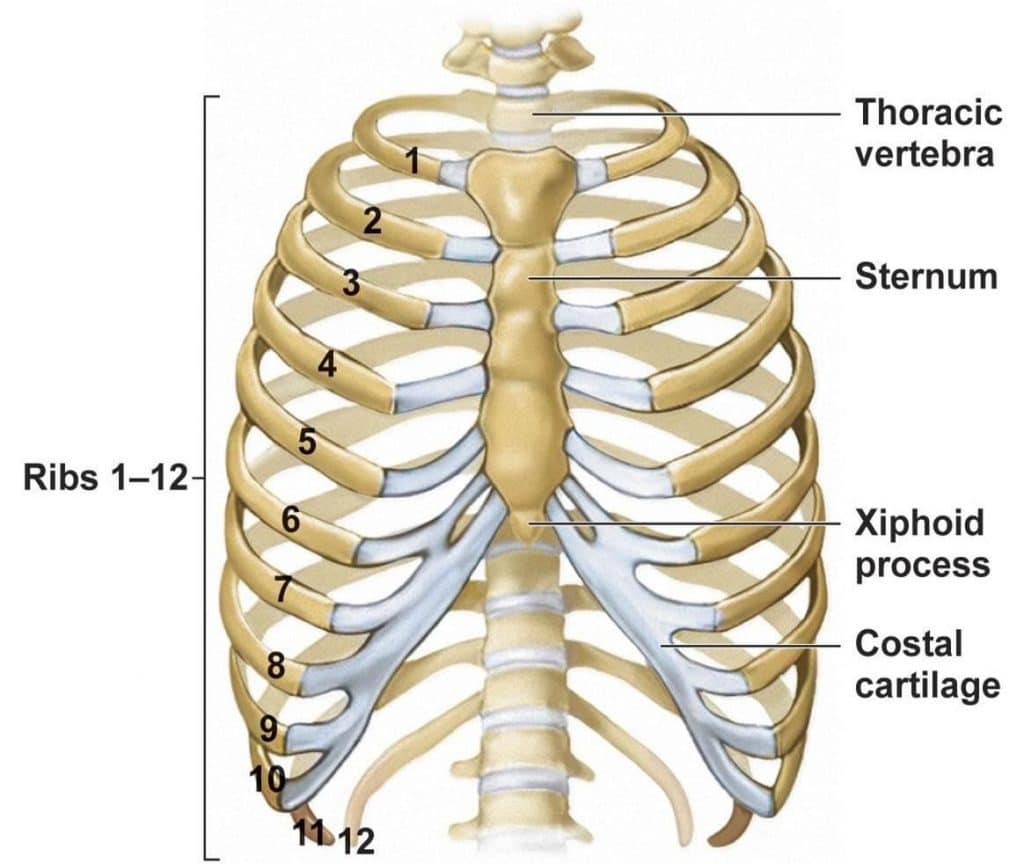
The primary ICD-10-CM code for a left rib contusion is S20.212, which specifically identifies a "Contusion of left front wall of thorax." If the injury is located on the posterior side, the correct code is S20.222, "Contusion of left back wall of thorax." Both codes require a 7th character (A, D, or S) to indicate the encounter type.
A rib contusion, commonly known as a bruised rib, occurs when a blunt force impact damages the soft tissues and blood vessels surrounding the ribs, or the periosteum (the outer layer of the bone itself), without resulting in a cortical break or fracture. In the transition to ICD-10-CM, coding became significantly more granular, requiring healthcare providers and medical coders to specify not only the nature of the injury but also its exact anatomical location and the stage of the patient's care.
As of 2026, these coding standards remain the foundation for accurate medical billing, clinical documentation, and statistical tracking of traumatic injuries. Understanding the nuances of these codes is essential for ensuring reimbursement and maintaining an accurate longitudinal patient record.
Understanding the Structure of ICD-10 Code S20.2
The ICD-10-CM system is hierarchical, meaning each character added to a code provides a deeper level of specificity. To understand the code for a left rib contusion, we must break down the "S20.2" category, which governs superficial injuries of the thorax.
The Category: S20
The "S" prefix in ICD-10 denotes injuries, poisonings, and certain other consequences of external causes. The "20" sub-category specifically refers to "Superficial injury of thorax." Superficial injuries are those that do not penetrate the deep tissues, organs, or cavities. This includes abrasions, blisters, insect bites, and contusions.
The Subcategory: S20.2
The third digit "2" specifies that the injury is a contusion. In clinical terms, a contusion is an injury produced by a blunt stimulus that causes interstitial hemorrhage (bruising) without a break in the skin. This distinguishes it from other S20 codes, such as S20.3 (other superficial injuries of the front wall of the thorax) or S20.4 (other superficial injuries of the back wall of the thorax).
The Site Specificity: S20.21 vs. S20.22
ICD-10-CM requires the coder to differentiate between the "front wall" and the "back wall" of the chest.
- S20.21: Contusion of the front wall of the thorax.
- S20.22: Contusion of the back wall of the thorax.
For a rib injury, the choice between these two often depends on where the impact occurred. If a patient is struck in the sternum or the anterior aspect of the ribs, S20.21 is used. If the impact was from behind, near the scapula or the posterior ribs, S20.22 is the appropriate choice.
Lateralization: Why the "Left" Matters
One of the most significant changes introduced by ICD-10 compared to the older ICD-9 system is the mandatory inclusion of laterality. In 2026, as in previous years, failing to specify whether an injury is on the right or left side will often result in a rejected claim or a generic "unspecified" code that provides poor data for clinical research.
The sixth character in the S20.2 series indicates the side of the body:
- 1: Right side
- 2: Left side
- 3: Bilateral (both sides)
- 9: Unspecified side
Therefore, for a left rib contusion on the front wall, the base code is S20.212. For the back wall, it is S20.222. This level of detail allows insurers and health systems to track injury patterns and ensure that treatments (such as follow-up imaging or physical therapy) are being applied to the correct side of the patient’s body.
The Essential 7th Character: A, D, and S
An ICD-10 code for a rib contusion is not complete—and will not be processed for payment—without a 7th character. This character describes the "encounter" or the stage of treatment. For the S20.212 and S20.222 codes, three options are typically available:
A – Initial Encounter
The 7th character "A" is used while the patient is receiving active treatment for the injury. This is a common point of confusion for new coders. "Initial encounter" does not necessarily mean the "first time" a patient is seen. It refers to the entire period during which the patient is receiving active care, such as emergency department evaluation, initial diagnostic imaging (X-rays to rule out fracture), and the initial surgical or medical management of the injury.
D – Subsequent Encounter
The 7th character "D" is used for encounters after the patient has completed active treatment and is now receiving routine care during the healing or recovery phase. This includes follow-up visits to a primary care physician to check on pain management, physical therapy sessions, or visits to review the results of healing. In 2026, documentation must clearly reflect that the "active" phase (e.g., ruling out more severe injuries) has concluded for "D" to be appropriate.
S – Sequela
The 7th character "S" is used for complications or conditions that arise as a direct result of the injury after the injury itself has healed. For example, if a patient develops chronic intercostal neuralgia (nerve pain) at the site of a previous rib contusion, the "S" character would be used to link the new pain to the old injury. When using "S," it is usually necessary to code both the current condition (the neuralgia) and the injury (the contusion) to show the relationship between the two.
Clinical Documentation Requirements for Rib Contusions
To assign the most accurate ICD-10 code, a healthcare provider’s notes must be specific. In an era where electronic health records (EHR) and AI-assisted coding are prevalent in 2026, the quality of the underlying clinical narrative remains paramount.
A high-quality clinical note for a rib contusion should include:
- Mechanism of Injury: Was it a fall, a motor vehicle accident, or a sports injury? This helps determine if external cause codes (V, W, X, or Y codes) should also be applied.
- Specific Location: Documentation should state "left anterior chest wall" or "left posterior ribs" rather than just "chest pain."
- Presence or Absence of Associated Injuries: The provider must explicitly state if there is no evidence of a fracture, pneumothorax (collapsed lung), or internal organ damage. If these are present, they often take precedence in coding.
- Encounter Status: Is this the first time the patient is being treated for this specific injury, or is this a follow-up visit?
Comparison: Rib Contusion vs. Rib Fracture
A critical distinction in medical coding is between a contusion (bruise) and a fracture (break). While the symptoms—sharp pain, difficulty breathing, and tenderness—can be remarkably similar, the ICD-10 codes belong to entirely different categories.
- Contusion (S20.2-): A superficial injury. Generally treated with rest, ice, and NSAIDs.
- Fracture (S22.3-): A break in the bone. This requires more intensive monitoring due to the risk of lung injury.
When to use S20.212 vs. S22.32
If a patient presents with rib pain and the X-ray is negative for a break, the physician will likely diagnose a rib contusion (S20.212A). However, if the X-ray shows even a hairline crack in a rib on the left side, the code shifts to S22.32XA (Fracture of one rib, left side, initial encounter for closed fracture).
One must never code both a contusion and a fracture for the same anatomical site. According to ICD-10-CM guidelines, a fracture "includes" the contusion. This is an example of the "Excludes1" rule in medical coding.
Coding Logic for Multiple Injuries
| Injury Type | Primary ICD-10 Code (Left Side) | Required 7th Character | Category Type |
|---|---|---|---|
| Rib Contusion (Front) | S20.212 | A, D, or S | Superficial Injury |
| Rib Contusion (Back) | S20.222 | A, D, or S | Superficial Injury |
| Single Rib Fracture | S22.32X | A, D, or G | Fracture (Displaced/Non) |
| Multiple Rib Fractures | S22.42X | A, D, or G | Fracture |
| Chest Wall Abrasion | S20.312 | A, D, or S | Superficial Injury |
Common Coding Errors and Excludes Notes
Navigating the ICD-10-CM manual requires attention to "Excludes" notes, which prevent double-billing or illogical combinations of codes.
Excludes1 Notes
An Excludes1 note means "not coded here." This indicates that the code excluded should never be used at the same time as the code above it. For S20.212, common Excludes1 conditions include:
- Contusion of the heart (S26.0-)
- Contusion of the lung (S27.3-)
- Fracture of the rib (S22.3-)
If a patient has a bruised rib and a bruised lung, only the lung contusion is typically coded if they occur in the exact same trauma zone, as the internal organ injury is more severe.
Excludes2 Notes
An Excludes2 note means "not included here." This indicates that the condition excluded is not part of the condition represented by the code, but a patient may have both conditions at the same time. If a patient has a left rib contusion but also has an open wound (laceration) on the left side of the chest, you may code both S20.212A and the appropriate laceration code (e.g., S21.312A).
The "Unspecified" Trap
Coders should avoid S20.20XA (Contusion of unspecified wall of thorax) whenever possible. In 2026, most payers view unspecified codes as a sign of incomplete documentation. If the chart says "left rib," the wall (front or back) can almost always be determined by the mechanism of injury or physical exam notes.
The Role of External Cause Codes
While S20.212 tells us what the injury is and where it is, it does not tell us how it happened. In 2026, insurance companies and trauma registries heavily rely on "External Cause Codes" (V00-Y99). These are secondary codes used alongside the rib contusion code.
Common external cause pairings include:
- W51.XXXA: Accidental striking against or bumped into by another person.
- V43.52XA: Passenger injured in collision with sport utility vehicle in traffic accident.
- W10.9XXA: Fall on and from unspecified stairs and steps.
Adding these codes provides a complete picture of the encounter, which is often required for workers' compensation claims or auto insurance medical payments.
Clinical Context: Managing a Left Rib Contusion
For patients and non-coding staff, it is helpful to understand the clinical reality behind the code S20.212. A bruised rib can often be more painful than a fracture because the intercostal muscles are constantly in motion during respiration.
Treatment and Documentation
Treatment usually involves "conservative management." Because doctors cannot "cast" a rib, they focus on pain control to ensure the patient can breathe deeply. If a patient "splints" (takes shallow breaths to avoid pain), they are at risk for secondary complications like pneumonia. If a patient develops pneumonia following a rib contusion, that becomes a separate code (e.g., J18.9) that would be sequenced after the injury code or listed as a complication.
Expected Recovery Time
Most rib contusions heal within three to six weeks. In terms of coding, this means the transition from the 7th character "A" to "D" usually happens within the first 7 to 14 days following the initial injury, depending on when the "active" diagnostic phase ends and the "monitoring" phase begins.
FAQs
What is the specific ICD-10 code for a bruised rib on the left side?
The most common code is S20.212A for a contusion of the left front wall of the thorax, initial encounter. If the bruise is on the back, use S20.222A. The "A" must be updated to "D" for follow-up visits.
Does ICD-10-CM distinguish between bruising a single rib versus multiple ribs?
Unlike fractures, where there are different codes for a single rib versus multiple ribs (S22.3 vs. S22.4), the contusion codes in the S20.2 category refer to the "thoracic wall." Therefore, whether one rib or three ribs on the left side are bruised (without fracture), the code S20.212 remains the same.
Can I code a rib contusion if the patient also has a collapsed lung?
No. Under the coding hierarchy, more severe internal injuries take precedence. If a patient has a pneumothorax (S27.0), that would be the primary diagnosis. A superficial contusion of the chest wall is often considered an inherent part of the more significant thoracic trauma.
What if the doctor only writes "bruised rib" without specifying left or right?
In this case, the coder must use S20.219A (unspecified side). However, this is discouraged in 2026. Coders should query the physician or look at the physical exam section of the medical record to identify the side and avoid "unspecified" codes which may delay reimbursement.
Is "chest wall pain" the same as a "rib contusion"?
No. "Chest wall pain" (R07.89) is a symptom code. You should only use R07.89 if a definitive diagnosis has not been made. Once the physician confirms the pain is due to a contusion (bruise), the injury code S20.212 replaces the symptom code.
Summary of Next Actions
For medical professionals and coders dealing with a left rib contusion in 2026, accuracy is key to both patient care and financial health.
- Verify Laterality: Always ensure the "2" (for left) is present in the sixth position.
- Determine the Aspect: Check if the injury is anterior (S20.21-) or posterior (S20.22-).
- Apply the 7th Character: Ensure "A" is used for active treatment and "D" for recovery-phase follow-ups.
- Check for Fractures: Review imaging reports. If a fracture is mentioned, abandon the S20 codes and move to the S22 category.
- Include External Causes: Support the diagnosis with a "V" through "Y" code to describe how the injury occurred, especially for liability-related billing.
By following these steps, you ensure that the patient’s medical record is precise, the facility is compliant with 2026 ICD-10-CM guidelines, and the insurance claims are supported by the highest level of clinical specificity.