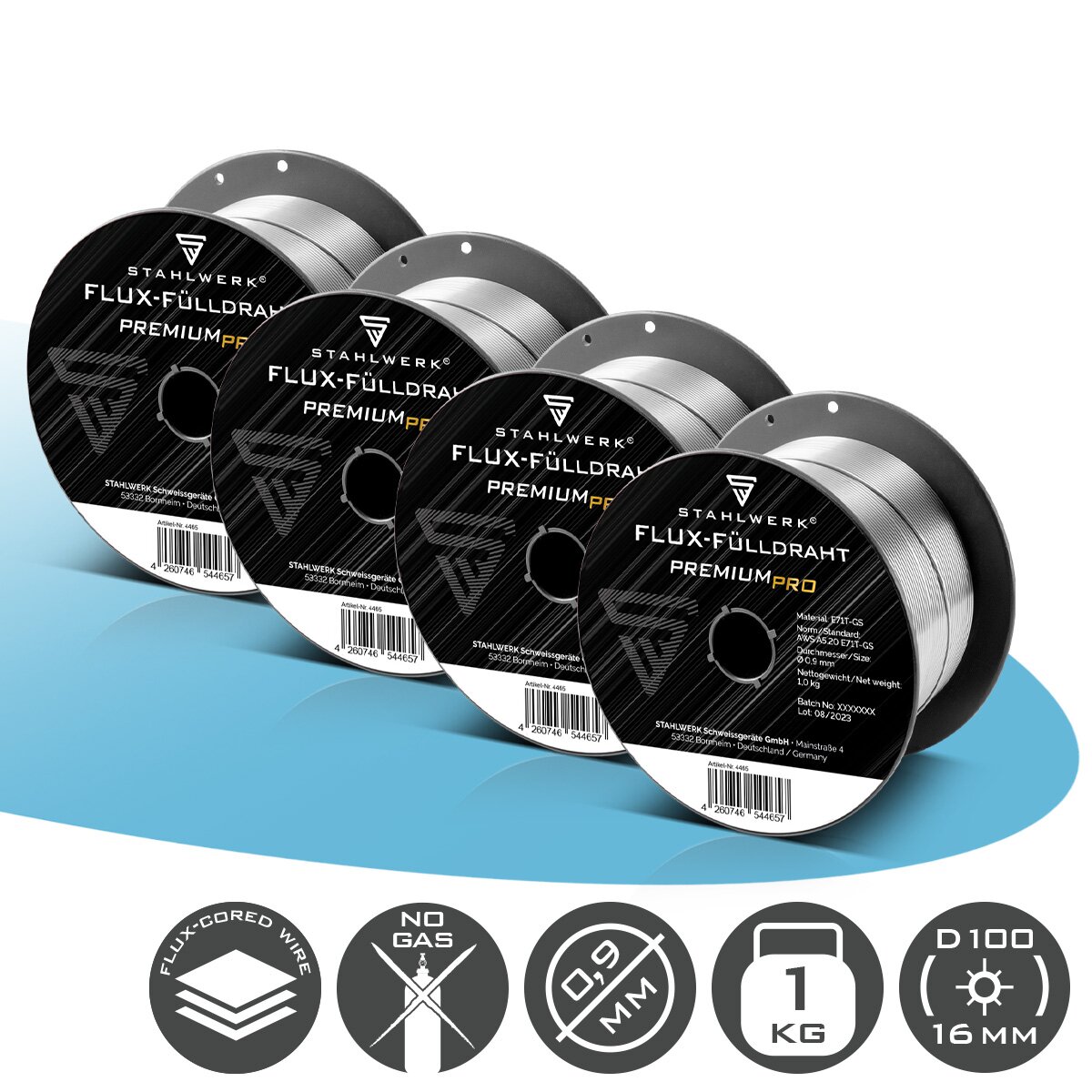
Optimal 1/16 flux core wire settings typically require a voltage range of 24 to 30 volts and a wire feed speed between 180 and 450 inches per minute (IPM). These parameters vary significantly based on whether you are using gas-shielded (FCAW-G) or self-shielded (FCAW-S) wire, the material thickness, and the specific welding position.
Flux-Cored Arc Welding (FCAW) with 1/16 inch (1.6 mm) diameter wire is a staple in heavy industrial fabrication, structural steel erection, and shipyard work. Unlike thinner hobbyist wires, the 1/16 diameter is designed for high deposition rates and deep penetration on thick plates. Navigating the settings for this wire requires an understanding of high-amperage power sources, specific electrode extensions, and the metallurgical properties of the wire classification being used. In 2026, while inverter technology has made these settings more stable, the fundamental physics of the arc remains consistent with established structural welding codes.
Understanding the 1/16 Flux Core Specification
The 1/16 inch wire is a "heavy-duty" consumable. To put its size in perspective, it is significantly larger than the common 0.030 or 0.035 wires found in home workshops. Because of its larger cross-sectional area, it carries much higher current. This makes it unsuitable for thin sheet metal but highly efficient for plates ranging from 1/4 inch to several inches thick.
When discussing settings, we must distinguish between the two primary types of flux core:
- FCAW-G (Gas-Shielded): Uses an external shielding gas (typically 100% CO2 or a 75/25 Argon/CO2 mix). These wires, such as E71T-1, provide high operator appeal, low spatter, and a spray-like transfer.
- FCAW-S (Self-Shielded): Contains all necessary fluxing agents within the core to protect the puddle from the atmosphere. Wires like E71T-8 (commonly used in seismic structural work) are ideal for outdoor use where wind would blow away shielding gas.
The settings for these two categories are not interchangeable. Using gas-shielded settings on self-shielded wire will result in excessive heat, bird-nesting, or weld porosity.
Machine Requirements and Power Source Compatibility
Before adjusting your dials, you must ensure your power source is capable of handling the demands of 1/16 wire. This diameter typically operates in the 200 to 450 ampere range.
Constant Voltage (CV) vs. Constant Current (CC)
Most modern FCAW is performed using a Constant Voltage (CV) power source. In a CV system, you set the voltage on the machine, and the wire feed speed (WFS) determines the amperage. If you attempt to run 1/16 wire on a small, 120V or low-amperage 240V machine, the transformer will likely overheat or the arc will be too "cold" to fuse the metal, leading to a "cold lap" defect.
Polarity Settings
Polarity is the first setting to verify.
- DCEP (Electrode Positive/Reverse Polarity): Standard for most gas-shielded (FCAW-G) wires. This provides deeper penetration and is the configuration used for E71T-1 and E70T-1 wires.
- DCEN (Electrode Negative/Straight Polarity): Standard for most self-shielded (FCAW-S) wires, such as E71T-8 or E71T-11. Using the wrong polarity will result in a violent arc, heavy spatter, and poor bead appearance.
Critical Parameters: Voltage and Wire Feed Speed (WFS)
The relationship between voltage and WFS is the core of your settings. Voltage controls the width and fluidity of the puddle, while WFS controls the amperage and the amount of metal being deposited.
Voltage (V)
For 1/16 wire, the voltage window is generally 22V to 32V.
- Too Low Voltage: The wire will "stub" into the work piece, causing the gun to kick back and creating a ropey, narrow bead with poor fusion.
- Too High Voltage: The arc becomes unstable, spatter increases significantly, and you risk undercutting the base metal.
Wire Feed Speed (WFS)
WFS for 1/16 wire is measured in Inches Per Minute (IPM). Because the wire is thick, the IPM numbers are lower than what you would see for 0.035 wire.
- 150-250 IPM: Low range, used for out-of-position welding (vertical or overhead).
- 300-450 IPM: High range, used for flat and horizontal fillets where high deposition is required.
The Role of Electrode Extension (Stick-out)
One of the most common mistakes when transitioning to 1/16 flux core is using a short MIG-style stick-out. For flux-cored arc welding, the Contact-to-Work Distance (CTWD) or "stick-out" is critical.
For 1/16 wire, a stick-out of 3/4 inch to 1 inch (19mm to 25mm) is standard.
- Why it matters: The flux inside the wire needs time to pre-heat before it reaches the arc. A longer stick-out increases the electrical resistance of the wire, which pre-heats the consumable.
- Consequences of short stick-out: If you hold the gun too close (like MIG welding), the wire will be too cold when it hits the puddle, leading to excessive spatter and potential porosity as the flux doesn't activate correctly.
1/16 Flux Core Settings Reference Table
The following table provides baseline starting points for 1/16 (1.6 mm) E71T-1 (Gas-Shielded) and E71T-8 (Self-Shielded) wires. These are based on 2026 industry standards for structural mild steel.
| Wire Type | Position | Plate Thickness | Voltage (V) | WFS (IPM) | Amperage (Approx) | Shielding Gas |
|---|---|---|---|---|---|---|
| E71T-1 (G) | Flat/Horiz | 1/4" (6mm) | 24 - 25 | 190 - 210 | 230 - 260 | 100% CO2 |
| E71T-1 (G) | Flat/Horiz | 1/2" (13mm) | 26 - 28 | 280 - 320 | 300 - 330 | 100% CO2 |
| E71T-1 (G) | Flat/Horiz | 1" + (25mm+) | 28 - 30 | 380 - 420 | 350 - 400 | 100% CO2 |
| E71T-1 (G) | Vertical Up | 3/8" (10mm) | 23 - 25 | 180 - 200 | 210 - 240 | 75/25 Ar/CO2 |
| E71T-8 (S) | Flat/Horiz | 1/2" (13mm) | 19 - 21 | 140 - 160 | 240 - 270 | None (Self) |
| E71T-8 (S) | Vertical Up | 1/2" (13mm) | 18 - 20 | 120 - 140 | 210 - 230 | None (Self) |
Note: Amperage is a resultant of WFS and stick-out. Use these as estimates. Always refer to the specific manufacturer's data sheet (e.g., Lincoln Innershield or Miller Hobart) for the exact brand of wire you are using.
Shielding Gas Selection for 1/16 FCAW-G
The choice of gas significantly impacts the settings and the resulting weld profile.
100% Carbon Dioxide (CO2)
This is the most common gas for 1/16 flux core. It is inexpensive and provides the deepest penetration. When using 100% CO2, you generally need to increase your voltage by 1 to 2 volts compared to mixed gases to maintain a stable arc. It produces a slightly harsher arc and more spatter, but the slag is usually easy to remove.
75% Argon / 25% CO2 (C25)
This mixed gas is often preferred for out-of-position welding or when a cleaner finish is required. It provides a smoother, "creamier" arc and reduces spatter. Because Argon is more conductive in the arc, you can run slightly lower voltages. However, it does not penetrate as deeply as 100% CO2 on very thick sections.
Technique and Travel Speed
Settings are only half the battle; the 1/16 diameter requires specific physical handling.
The Drag Technique
Unlike MIG welding, where a "push" angle is common, flux core always requires a drag (backhand) technique. Because there is slag involved, you must "drag the slag." If you push the wire, you risk trapping slag under the weld bead, a defect known as slag inclusion. Maintain a travel angle of 5 to 15 degrees.
Travel Speed
With 1/16 wire, the deposition rate is high. If you move too slowly, the puddle will get ahead of the arc, causing the arc to ride on top of the molten slag rather than the base metal. This results in lack of fusion. You must move fast enough to keep the arc at the leading edge of the puddle.
Troubleshooting 1/16 Flux Core Settings
Even with the correct settings on the dial, environmental and mechanical factors can cause issues.
1. Porosity (Small holes in the weld)
- Cause: Often caused by a stick-out that is too short, or gas flow issues in FCAW-G.
- Fix: Ensure a 1-inch stick-out. If using gas, check for drafts or a clogged nozzle. In 2026, many high-end feeders have integrated flow meters—verify you are at 35-45 CFH (Cubic Feet per Hour).
2. Excessive Spatter
- Cause: Voltage is too low for the wire feed speed, or the polarity is reversed.
- Fix: Increase voltage in 0.5V increments or decrease WFS. Double-check that your machine is set to DCEP for gas-shielded or DCEN for self-shielded.
3. "Bird-Nesting" or Feeding Issues
- Cause: 1/16 wire is heavy and requires significant torque to pull from the spool.
- Fix: Use knurled drive rolls. Smooth rolls used for solid MIG wire will slip on flux-cored wire, causing inconsistent WFS. Ensure the drive roll tension is just tight enough to feed without crushing the tubular wire.
4. Worm Tracking (Small grooves on the slag surface)
- Cause: Usually caused by excessive moisture in the flux or too high a voltage when using certain gas mixes.
- Fix: Decrease voltage slightly. Ensure wire is stored in a dry environment or a heated cabinet, especially if using "Low Hydrogen" (H8) rated wires.
Safety and Environmental Considerations
Welding with 1/16 flux core generates significant fumes and ultraviolet (UV) radiation due to the high amperage and the chemical composition of the flux.
- Fume Extraction: Always use a fume extraction system or a respirator (P100 filter) when welding with flux core, especially in confined spaces. The smoke contains manganese and other elements that are hazardous over long-term exposure.
- Heat Protection: At 300+ amps, the radiant heat is intense. Heavy-duty leather jackets and high-quality welding gloves are mandatory.
- Professional Advice Limitation: The settings provided here are for general guidance. For structural applications governed by codes like AWS D1.1, you must follow a qualified Welding Procedure Specification (WPS). Failure to follow a certified WPS in structural work can lead to legal and safety liabilities.
Frequently Asked Questions
What polarity should I use for 1/16 flux core?
For gas-shielded (FCAW-G) wires like E71T-1, use DCEP (Electrode Positive). For self-shielded (FCAW-S) wires like E71T-8, use DCEN (Electrode Negative). Always check the manufacturer's label on the wire spool, as some specialty wires may differ.
Can I run 1/16 wire on a 210-amp welder?
Technically, you can start an arc, but you will be at the absolute limit of the machine. A 210-amp machine will likely hit its duty cycle within a minute or two, and you won't have enough "headroom" to achieve the 24-28 volts required for proper 1/16 penetration. A 300-amp to 450-amp power source is recommended for this wire diameter.
Why is my 1/16 wire stubbing into the metal?
Stubbing usually indicates your voltage is too low for your wire feed speed. Either increase the voltage or slow down the WFS. It can also be caused by a stick-out that is too long, which causes the amperage to drop too low to melt the wire efficiently.
Is 1/16 flux core better than 0.045 for thick plate?
Yes, in terms of efficiency. 1/16 wire has a much higher deposition rate (pounds of metal per hour) than 0.045 wire. For plates over 1/2 inch, 1/16 can significantly reduce the number of passes required, saving time and labor costs.
What gas flow rate is best for 1/16 gas-shielded wire?
A flow rate of 35 to 45 CFH (Cubic Feet per Hour) is generally recommended. Because 1/16 wire creates a large, hot puddle, it requires a robust envelope of shielding gas. If welding outdoors with gas-shielded wire, you may need to increase this or use wind screens.
Final Recommendations for Optimal Results
To master 1/16 flux core settings, start by setting your machine to 26 volts and 250 IPM for a 1/2 inch plate using gas-shielded wire and 100% CO2. Run a test bead on scrap material of the same thickness. Watch the arc carefully: it should be a steady, hissing sound rather than a loud crackle.
Adjust your voltage up if the bead is too narrow and tall, or adjust your WFS down if the machine is struggling to melt the wire. Remember that contact tip wear is faster at these high amperages; always keep several spare 1/16 tips on hand, as a worn tip will cause arc instability regardless of how perfect your settings are on the dial.