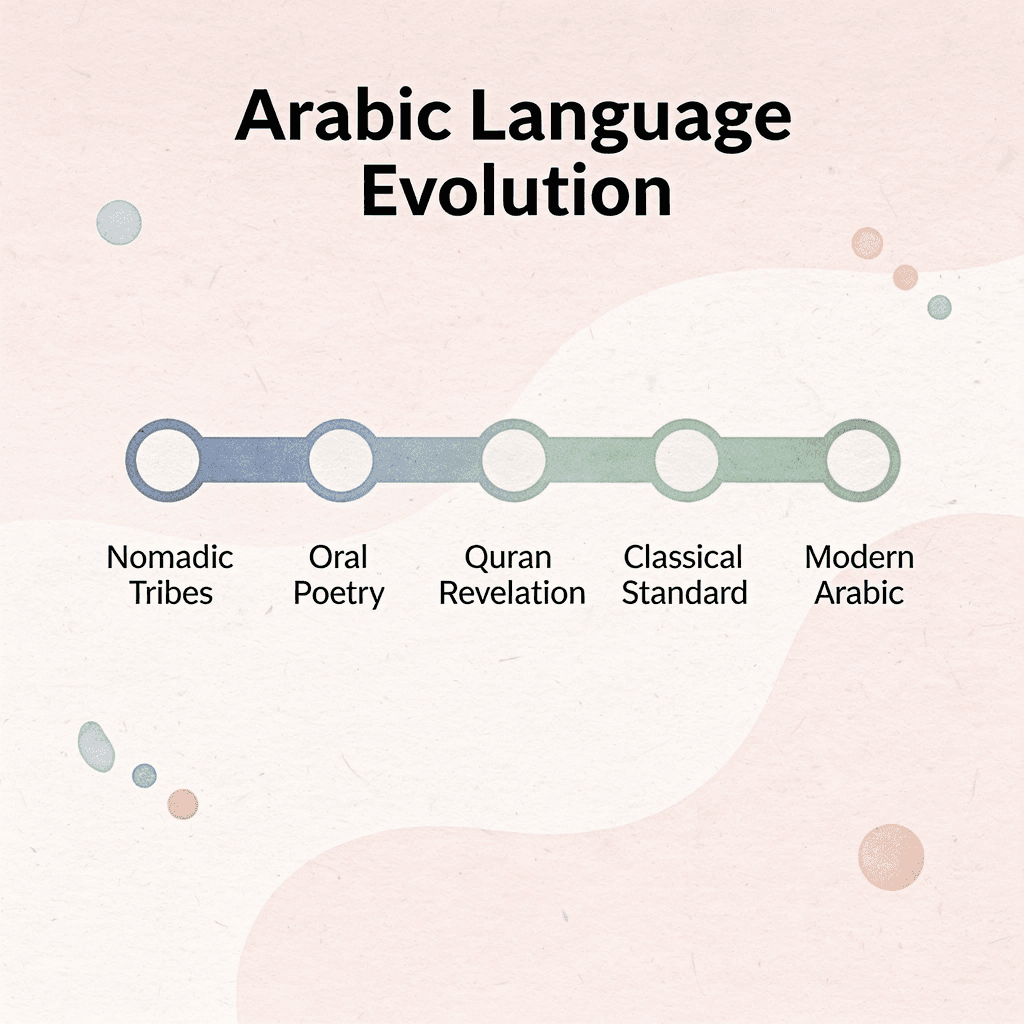
The timeline of the Arabic verb list is a multi-century progression that transitions from the fluid oral traditions of Pre-Islamic poetry to the rigid codification of medieval grammarians, finally evolving into the frequency-based digital databases of 2026. This evolution tracks how the root-and-pattern system was identified, categorized into the ten primary forms, and eventually prioritized for modern learners through computational linguistics.
Arabic is a Semitic language characterized by a highly structured morphological system. Unlike Indo-European languages where verbs often evolve through phonetic drift and irregular conjugation changes over time, the Arabic verb has remained remarkably stable in its core structure for over 1,500 years. However, the list of verbs—how we catalog, define, and prioritize them—has undergone several massive shifts. Understanding this timeline is essential for any scholar, student, or linguist looking to navigate the transition from Classical Arabic (Fus'ha) to Modern Standard Arabic (MSA).
The Pre-Islamic Foundations: The Era of Oral Complexity (Pre-600 CE)
Before the written codification of the Arabic language, the "list" of Arabic verbs existed solely in the collective memory of the Bedouin tribes and the master poets of the Arabian Peninsula. During this period, known as the Jahiliyya, the verb system was already fully formed in its complexity, though no formal grammar books existed.
The verbs of this era were recorded in the Mu'allaqat (The Suspended Odes). Analysis of these poems reveals a massive vocabulary of verbs related to desert life, camel husbandry, warfare, and tribal lineage. Interestingly, many verbs used during this period have since become "archaic," meaning they exist in historical lists but are virtually never used in 2026. The linguistic depth of this era provided the "raw material" for every verb list that would follow.
The primary characteristic of this era was semantic density. A single triliteral root (a three-letter core) could generate dozens of nuanced verbs through internal vowel changes and prefixes, a system that functioned perfectly without a single written rulebook.
The Formative Era: The Birth of Arabic Grammar (7th – 8th Century)
The expansion of the Islamic empire and the revelation of the Quran necessitated a formalization of the Arabic language. As non-Arabs began to enter the fold of the Caliphate, the risk of "linguistic corruption" (lahn) grew. This triggered the first systematic attempts to create a "list" of verbs and their rules.
Abu al-Aswad al-Du'ali and the First Marks
The timeline moves forward with Abu al-Aswad al-Du'ali, who is traditionally credited with inventing the system of diacritical marks (vowels). Since Arabic verbs rely entirely on short vowels to distinguish between active and passive voices (e.g., kataba "he wrote" vs. kutiba "it was written"), this was the first step toward a functional written verb list.
Sibawayh and "Al-Kitab" (Late 8th Century)
The most significant milestone in the history of the Arabic verb is the work of the Persian scholar Sibawayh. His monumental work, Al-Kitab (The Book), was the first to systematically categorize verbs into their different weights or patterns (awzan). Sibawayh didn't just list verbs; he explained the logic of the triliteral root system. He identified how the addition of letters to a three-letter root changes the meaning in predictable ways (the augmented forms). This established the foundational "List of Ten Forms" that students still use in 2026.
The Golden Age: The Great Lexicographers (9th – 14th Century)
During the Abbasid Caliphate and the centuries that followed, scholars moved from defining grammar to cataloging every possible verb in the language. This was the era of the "Great Dictionaries."
- Al-Khalil ibn Ahmad al-Farahidi (8th Century): He authored Kitab al-Ayn, the first dictionary of the Arabic language. He organized verbs not alphabetically, but by the phonetic point of articulation of the letters in the root.
- The Basra vs. Kufa Schools: A massive intellectual rivalry defined this period. The scholars of Basra (like Sibawayh) favored strict logic and regularity in verb categorization, while the Kufa school was more willing to accept "irregular" verb forms used in common speech and poetry.
- Ibn Manzur and "Lisan al-Arab" (1290 CE): This is perhaps the most famous "list" in history. Ibn Manzur compiled over 80,000 entries, creating an exhaustive repository of Arabic verbs and nouns. The Lisan al-Arab remains a primary source for understanding the classical meaning of verbs before they were influenced by modern technological or social concepts.
The Renaissance (Al-Nahda) and the Transition to Modernity (19th – Early 20th Century)
By the 1800s, the Arabic language faced a crisis of modernization. New concepts from the West (telegraphs, steam engines, political ideologies) required new verbs. The Nahda (Arabic Renaissance) saw scholars working to adapt ancient roots to modern needs.
During this time, the "list" of verbs began to bifurcate. Scholars at institutions like Al-Azhar in Cairo worked to preserve the Classical list, while writers and journalists began "activating" dormant roots to create new meanings. For example, the root S-Y-R (to move/travel) was used to create the verb sayyara (to motorize/drive), which eventually led to the noun sayyara (car).
The 19th-century dictionaries, such as Muhit al-Muhit by Butrus al-Bustani, were the first to bridge the gap between the medieval verb lists and the needs of a modernizing society.
The 20th Century: Standardization and Frequency Lists
In the 20th century, the approach to listing Arabic verbs shifted from "total inventory" to "functional utility." This change was driven largely by the needs of non-native learners and the rise of Modern Standard Arabic (MSA).
The Hans Wehr Revolution (1952)
No timeline of Arabic verbs is complete without the Dictionary of Modern Written Arabic by Hans Wehr. Originally published in German and later translated into English, this dictionary reorganized the list of verbs for the modern age. Instead of the "rhyme" order used by medieval lexicographers (sorting by the last letter), Wehr used the root system in a way that was accessible to Western scholars. It became the definitive list of verbs for the 20th century, distinguishing between classical meanings and modern usages.
The Rise of Frequency Lists (1970s – 1990s)
As language pedagogy became more scientific, educators realized that listing 80,000 verbs was counterproductive for students. Researchers like Peter Abboud and others involved in the "Al-Kitaab" series began focusing on "The Top 500 Verbs." These frequency lists prioritized verbs based on how often they appeared in newspapers, broadcasts, and literature.
The Digital Era and 2026: Computational Morphology and Big Data
As of 2026, the "list of Arabic verbs" is no longer a static document in a book; it is a dynamic database. The focus has moved toward computational morphology and the integration of Arabic into Large Language Models (LLMs).
Morphological Analyzers
Modern tools like the Buckwalter Morphological Analyzer and the Qatar Computing Research Institute (QCRI) tools have mapped every possible permutation of Arabic verbs. In 2026, these digital lists can instantly identify the root, form, voice, and mood of any verb in a text.
The 2026 "Active List"
Current linguistic research in 2026 focuses on the Corpus of Contemporary Arabic. This has led to the creation of the most accurate "Active Verb List" in history. We now know that while there are thousands of theoretical verbs, roughly 300 roots account for nearly 80% of all written and spoken Arabic today. This "Power List" is what modern AI-driven language apps use to accelerate fluency.
Evolutionary Milestones of Arabic Verb Classification
| Era | Key Milestone | Primary Organization Method | Significance |
|---|---|---|---|
| Pre-Islamic | Oral Poetry (Mu'allaqat) | Oral transmission | Established the depth of the triliteral root system. |
| 8th Century | Al-Kitab by Sibawayh | Morphological logic (Awzan) | Defined the 10 Forms and grammatical rules. |
| 13th Century | Lisan al-Arab | Rhyme-based (Last letter) | Created the most exhaustive classical inventory. |
| 1950s | Hans Wehr Dictionary | Root-based alphabetical | Standardized MSA verbs for the international community. |
| 2000s | Buckwalter Analyzer | Computational tagging | Enabled digital search and machine translation. |
| 2026 | AI Corpus Analysis | Usage frequency | Focuses on high-utility verbs for real-time communication. |
Understanding the Morphological System: Why the "List" Matters
To understand why the timeline of the Arabic verb list is so unique, one must understand the Root and Pattern mechanism. Most Arabic verbs are derived from a three-letter root (the thulathi).
The "Form" System
The "list" of Arabic verbs is usually categorized into ten patterns (Forms I through X). While there are actually 15 patterns, Forms XI through XV are so rare they are excluded from modern lists.
- Form I (Fa'ala): The ground form (e.g., kataba - to write).
- Form II (Fa' 'ala): Often causative or intensive (e.g., kattaba - to make someone write).
- Form III (Fa'ala): Often involves another person (e.g., kaataba - to correspond with).
- Form IV (Af'ala): Causative (e.g., aktaba - to dictate).
- Form V (Tafa' 'ala): Often reflexive of Form II.
- Form X (Istaf'ala): Often signifies seeking something (e.g., istaktaba - to ask someone to write).
This system allows a speaker to "predict" verbs that they may have never seen before, provided they know the root. This is why, throughout history, the list of verbs has been less about individual words and more about the logic of the patterns.
Challenges in Mapping Arabic Verbs
Despite the structured nature of the language, creating a definitive timeline for the list of Arabic verbs faces several hurdles:
- The Transition from Weak Verbs: Verbs containing "weak" letters (Waw, Ya, or Alif) undergo complex changes. Mapping these "Irregular" verbs has been a primary occupation of grammarians for 1,200 years.
- Diglossia: There is a significant gap between the verbs used in Classical Arabic (Quranic), Modern Standard Arabic (News/Literature), and various dialects (Egyptian, Levantine, etc.). In 2026, many "verb lists" are now dialect-specific to help learners communicate in daily life.
- Semantic Shift: A verb that meant "to urge a camel forward" in 700 CE might mean "to launch a digital marketing campaign" in 2026. The root remains the same, but the list must be updated to reflect modern context.
Frequently Asked Questions
What is the most important verb list for a beginner in 2026?
For a beginner, the "Top 500 Most Frequent Arabic Verbs" is the most effective list. These lists are usually derived from modern news corpora and focus on Form I and Form II verbs, which make up the bulk of daily communication. Relying on ancient dictionaries like Lisan al-Arab is not recommended for those seeking practical fluency.
How many forms are included in a standard modern verb list?
Most modern lists include Forms I through X. While Classical Arabic grammars mention up to 15 forms, forms XI-XV are almost exclusively found in very old poetry or highly specialized religious texts and have no practical use in Modern Standard Arabic.
Why do some Arabic dictionaries list verbs by the last letter?
This is a tradition from medieval "rhyme dictionaries." It was designed to help poets find words that rhymed. For example, if a poet needed a word ending in "Ba," they could look at the "Ba" chapter of the dictionary. Modern dictionaries have moved away from this, favoring the first letter of the root for easier look-up.
Are there any "new" verbs in Arabic?
While the roots are ancient, new verbs are created through a process called ishtiqaq (derivation). In the 21st century, verbs for "Googling," "downloading," and "programming" have been integrated into the language, often by applying traditional patterns to borrowed foreign sounds or by repurposing old roots.
What is a "Triliteral Root"?
The triliteral root is the three-consonant core of an Arabic verb. For example, the root K-T-B relates to the concept of writing. From this root, you get kataba (he wrote), yaktubu (he writes), kitab (book), and maktab (office). The "list of verbs" is essentially a list of what you can do to these roots using set patterns.
Practical Recommendation for 2026
If you are looking to master the Arabic verb list in 2026, avoid the mistake of memorizing exhaustive dictionaries. Instead, follow a tiered approach:
- Master the 10 Patterns (Awzan) first; once you understand the "math" of the verb, you can generate hundreds of words from a single root.
- Use a Frequency-Based Digital App that tracks your progress through the 300 most common roots.
- Utilize Morphological Tools like "Aratools" or modern AI interfaces to deconstruct complex verbs you encounter in the wild.
The timeline of the Arabic verb is a move from the infinite and oral to the structured and digital. By focusing on the patterns rather than the individual entries, you align yourself with the same logic used by the master grammarians of the 8th century, updated for the technology of 2026.